
Best Solar Panel, Best Inverter, Best Battery Backup? For Me, They’re All My Besties.
Discover solar panels, solar energy basics, solar inverter guidance, and clean energy insights from a solar engineer. Learn how solar installation works and choose the right system for your home or business.
Types of solar panels: monocrystalline, polycrystalline, bifacial, half-cut, PERC, portable and more. Learn about efficiency, applications, benefits, cost trends, financing, maintenance and why solar energy is cleaner than grid power.
Engr. Syed Farrukh Anwar celebrating a successful solar panel installation to achieve clean energyEvery time a solar panel unfolds under the sun, I see a friend stretching its arms, ready to work. Poetic? Maybe. But after years in the field, that’s how it feels.
Solar technology and I grew up together. When I graduated as an engineer, solar was still finding its footing, much like a friend figuring out their path. I chose to grow with it, pushing boundaries and proving what we could achieve side-by-side.
This isn’t just a job; it’s a partnership. As a solar engineer and writer, I’ve built a relationship with this technology based on respect, troubleshooting, and celebration.
Solar Energy Matters More Than Ever (4 Key Benefits)
Choosing solar is no longer just about bills. It is about freedom, responsibility, and future security.
Energy Independence: Eliminate reliance on fluctuating utility prices and unpredictable grids.
Climate Action: Every panel helps cut greenhouse gas emissions and pollution.
Smart Investment: Increase property value and deliver long-term savings. Typical payback is 3 to 7 years.
Economic Growth: Support the creation of thousands of solar jobs worldwide.
Hands-On Expertise for Reliable Solar Power
I have navigated the quirks like troubleshooting inverters at 2 AM to ensure your system delivers 24/7 reliability, including proper setup of MC4 Connectors and Solar Charge Controllers.
I have celebrated the wins when the first surge of clean power brings pure joy. I use that experience to maximize your energy yield and return on investment.
I champion the mission because saving the planet needs practical action. I translate that into real cost-saving and climate-action strategies for you.
Why Solar Energy Matters More Than Ever
Choosing a solar power system has evolved. It is no longer just about lower bills. It is about freedom, responsibility, and smart planning for tomorrow.
Energy Independence: Break free from unpredictable utility rates and grid outages.
Tangible Climate Action: Directly reduce your household or business carbon footprint.
A Smart Financial Move: Protect yourself from rising energy costs and increase property value, with a typical payback 3 to 7 years.
Support Economic Growth: You are investing in an industry that creates thousands of sustainable jobs.
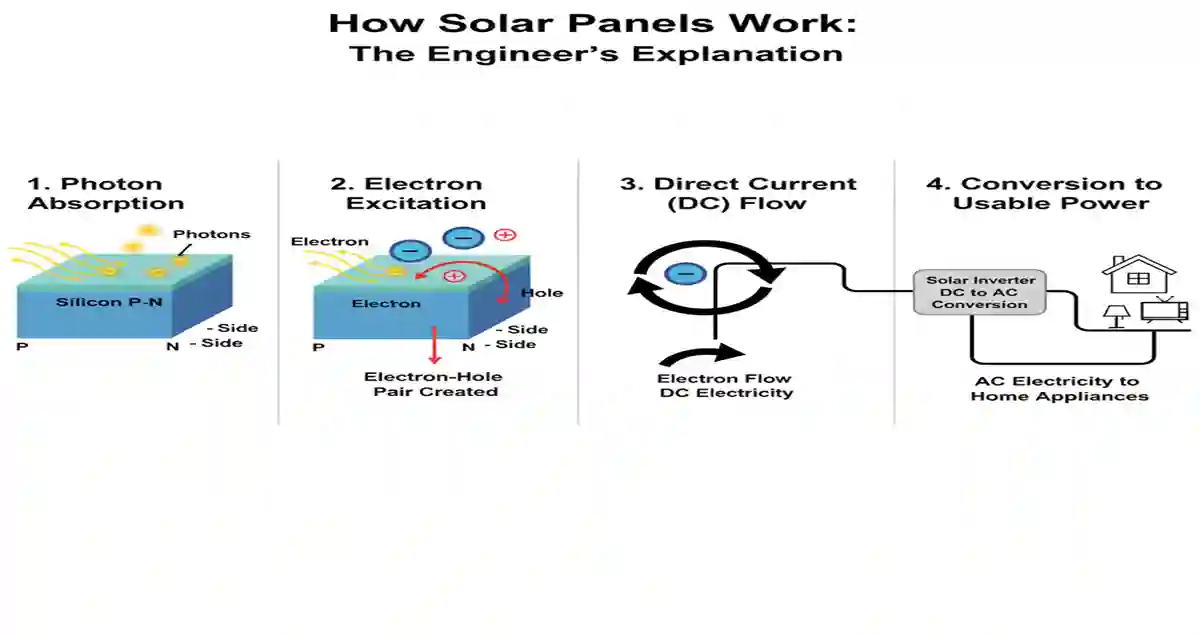
How Solar Panels Work (The Clear, Engineer’s Explanation)
Behind the friendship metaphor lies elegant science. Here is the process that powers your life:
Photon Absorption: Sunlight hits the silicon cells in your solar panel.
Electron Excitation: Photons energize electrons, creating Direct Current electricity.
Conversion to Usable Power: Your solar inverter converts that Direct Current into Alternating Current for your home.
Smart Management: Modern systems intelligently direct power using it instantly, storing it in your home battery backup, BESS (Battery Energy Storage System), or sending excess to the grid.
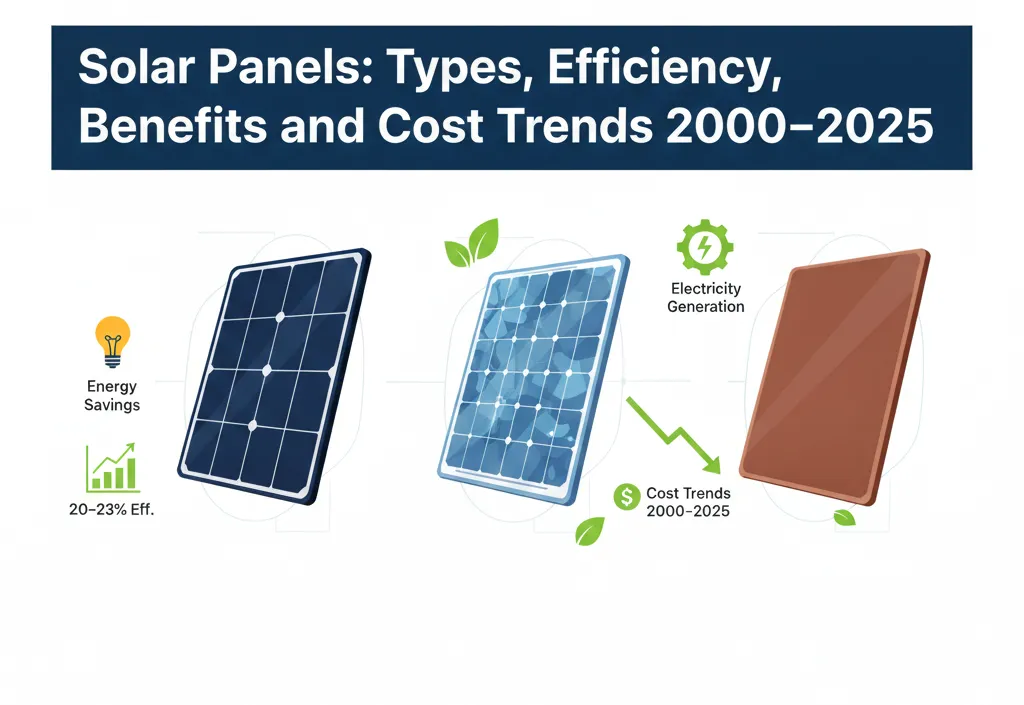
Solar Panels: Types, Benefits, Efficiency, Applications, and Cost Trends
In this guide, you’ll learn everything about solar panels: types, efficiency, benefits, cost trends, applications, maintenance, and why solar energy matters more than ever.
What Are Solar Panels?
Before diving deeper, let’s start with the basics.
A solar panel is a device that converts sunlight into electricity using photovoltaic (PV) cells. Solar panels can:
Generate electricity for immediate use
Store energy in batteries for later consumption
Feed excess energy into the grid for credits
Modern solar panels are durable, highly efficient, and versatile. They can be used for rooftops, ground-mounted solar farms, portable charging setups and even integrated into building materials.
Now that the basics are clear, here’s a breakdown of the most common solar panel types and where they work best.
| Panel Type | Composition/Technology | Average Efficiency Range | Best Use Case |
| Monocrystalline | Single, pure silicon crystal. | 18% – 22% | Limited roof space, high efficiency needs, residential. |
| Polycrystalline | Multiple silicon fragments melted together. | 15% – 18% | Budget-conscious, large ground-mount installations. |
| PERC | (Passivated Emitter and Rear Contact) Enhanced monocrystalline cell with a passivation layer on the back. | 20% – 24% | High-output residential/commercial, better low-light/high-heat performance. |
| Bifacial | Can absorb light from both the front and the back side. | 20% – 24% | Ground-mounted systems, reflective white rooftops, snowy areas. |
| Half-Cut | Standard cells are cut in half, which reduces electrical resistance and heat. | 18% – 23% | Improves shade tolerance, general residential/commercial use. |
| Thin-Film | Deposited onto a substrate (glass, plastic, or metal). | 10% – 12% | Flexible/portable applications, large utility-scale solar farms (where space isn’t limited). |
| CPV | (Concentrated PV) Uses lenses or mirrors to focus sunlight onto small, high-efficiency cells. | 30% – 40% | Utility-scale in high-sunlight, arid areas (requires tracking). |
1. Monocrystalline Solar Panels
Efficiency: 18–22 percent
Durability: 25 plus years
Applications: Residential rooftops, commercial buildings
Benefits: High efficiency, excellent low-light performance, sleek black design
Example: Tesla’s Solar Roof tiles use monocrystalline cells for maximum efficiency and aesthetics.
2. Polycrystalline Solar Panels
Efficiency: 15–18 percent
Durability: 20–25 years
Applications: Homes with ample roof space
Benefits: Lower cost, reliable performance
3. Thin-Film Solar Panels
Efficiency: 10–12 percent
Durability: 10–20 years
Applications: Large-scale solar farms, portable setups
Benefits: Lightweight and flexible
Example: Solar backpacks and emergency power kits use thin-film technology.
4. Bifacial Solar Panels
Efficiency: 20–24 percent
Applications: Ground-mounted systems, reflective rooftops
Benefits: Capture sunlight from both sides for extra energy yield5.
5. Half-Cut Solar Panels
Efficiency: 18–23 percent
Applications: Homes, businesses, industrial roofs
Benefits: Reduced electrical losses, better shade tolerance
6. PERC Solar Panels
Efficiency: 20–24 percent
Applications: Residential and commercial use
Benefits: Enhanced low-light performance
7. Portable Solar Panels
Efficiency: 10–18 percent
Applications: Camping, RVs, boats
Benefits: Lightweight, easy to deploy, great for off-grid life
8. Building-Integrated PV (BIPV)
Efficiency: 15–22 percent
Applications: Solar tiles, facades, windows
Benefits: Looks amazing and saves rooftop space
9. Concentrated PV (CPV)
Efficiency: 30–40 percent
Applications: Utility-scale solar farms
Benefits: Very high efficiency in strong sunlight areas
10. Flexible Thin-Film Portable Panels
Applications: Backpacks, tents, mobile charging
Benefits: Ultra-portable and bendable
Benefits of Solar Panels
No solar guide is complete without understanding the real advantages. Solar panels offer:
Reduced Electricity Bills: While panels generate power, using Solar AI ensures those savings reach their maximum potential.
Renewable and sustainable energy source
Low maintenance
Eco-friendly with a low carbon footprint
High recyclability
Energy independence
Versatility across all environments
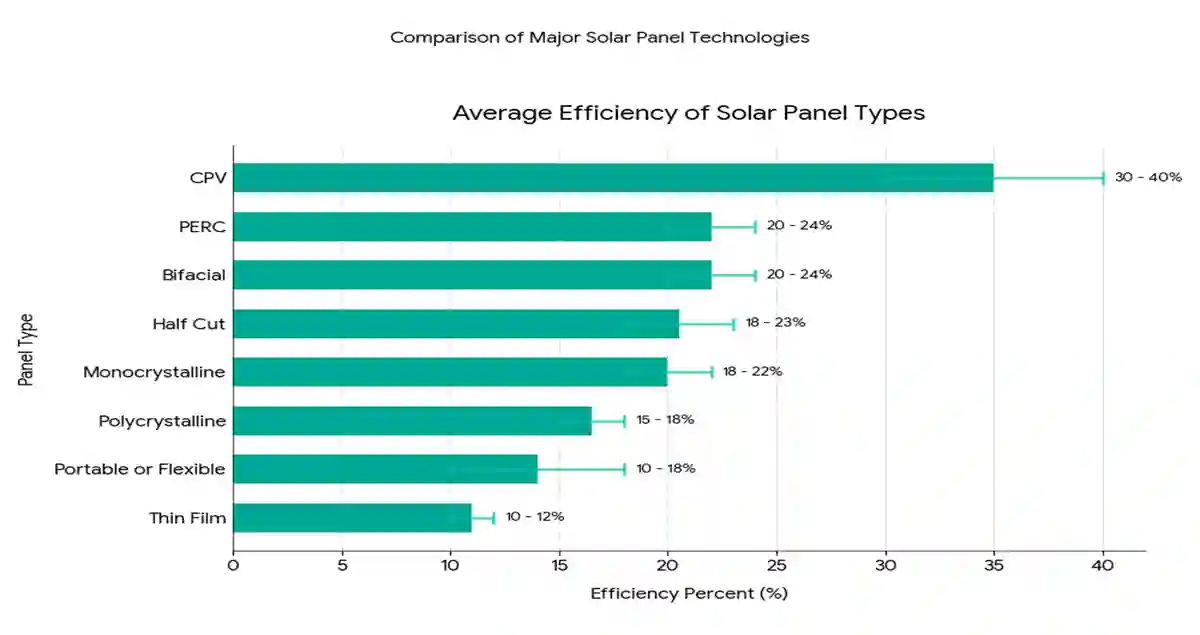
Efficiency of Solar Panels
Efficiency depends on sunlight, shading, temperature, and installation angle.
Type and average efficiency:
New Solar Panel Technologies (What’s Changing Fast in 2026)
Solar panels are no longer just about placing modules on a roof and waiting for savings. In 2026, solar technology is evolving fast, focusing on higher efficiency, better heat performance, and smarter energy management. As a solar engineer, these are the four technologies I see shaping the future right now.
TOPCon Solar Panels (The New Industry Standard)
TOPCon panels have officially replaced PERC as the mainstream solar technology. Built on N-type silicon, TOPCon modules now reach 24.5%–25.5% efficiency in mass production. They handle heat better, resist performance loss over time, and deliver strong returns for both residential and commercial solar projects.
Perovskite-Silicon Tandem Solar Panels
Tandem panels combine perovskite layers with traditional silicon cells to capture more sunlight across a wider spectrum. Early commercial deployments and pilot projects are already approaching 30% efficiency, making this one of the most promising next-generation solar panel technologies.
HJT (Heterojunction) Solar Panels
HJT panels combine crystalline and amorphous silicon to deliver high efficiency and excellent heat performance. With efficiencies of 23.5%–26%, they are ideal for hot climates and premium solar projects where stable, long-term output is critical.
Back Contact (BC) Flexible Modules / Thin-Film Flex (aka Skin-Type Solar Panels)
These ultra-thin, flexible solar modules—often called skin-type panels—are designed to bend and conform to curved surfaces, portable devices, and specialized structures. While their efficiency is lower than rigid panels, they excel in lightweight or unconventional installations, expanding where solar can be used beyond traditional rooftops and utility-scale farms
AI-Integrated Smart Solar Systems
Modern solar systems are no longer “install and forget.” AI-powered solar monitoring tracks performance in real time, predicts maintenance issues, analyzes shading and temperature, and optimizes energy flow to batteries or the grid. This ensures solar systems perform at their best for 25 years or more.
Engineer’s Insight: Traditional solar panels power homes. These advanced solar technologies are building the foundation for long-term energy independence.
Quick Review: New Solar Panel Technologies – 2026
| Panel Type | Key Feature | Efficiency (2026) | Best Use Case |
|---|---|---|---|
| TOPCon | N-type silicon, LID-resistant | 22.5% – 25.5% | Residential & commercial, high ROI |
| HJT | Crystalline + amorphous silicon | 23.5% – 26% | Hot climates, premium projects |
| Perovskite–Silicon Tandem | Stacks perovskite over silicon | ~30% (pilot projects) | Next-gen utility & experimental deployments |
| BC Flexible / Thin-Film Flex (Skin-Type) | Ultra-thin, bendable | 10% – 13% | Curved surfaces, vehicles, portable devices |
| AI-Integrated Solar | Real-time monitoring & optimization | N/A | All panel types, ensures peak long-term performance |
Applications of Solar Panels
Solar panels integrate seamlessly into almost every lifestyle and industry:
- Solar panels integrate seamlessly into almost every lifestyle and industry:
- Residential rooftops for reliable clean energy (See our 2026 Buying Guide)
- Commercial buildings to reduce electricity costs
- Utility solar farms powering communities
- Remote and off-grid living regions with solar independence
- Solar water pumps for agriculture, domestic use, and off-grid systems
- Complete solar panel kits for homes, travel, and portable setups
- Portable applications: balcony solar, camping, RVs, and boats
- Architectural solutions: BIPV systems integrated into building designs
- Solar street lights for urban, residential, industrial, and rural areas
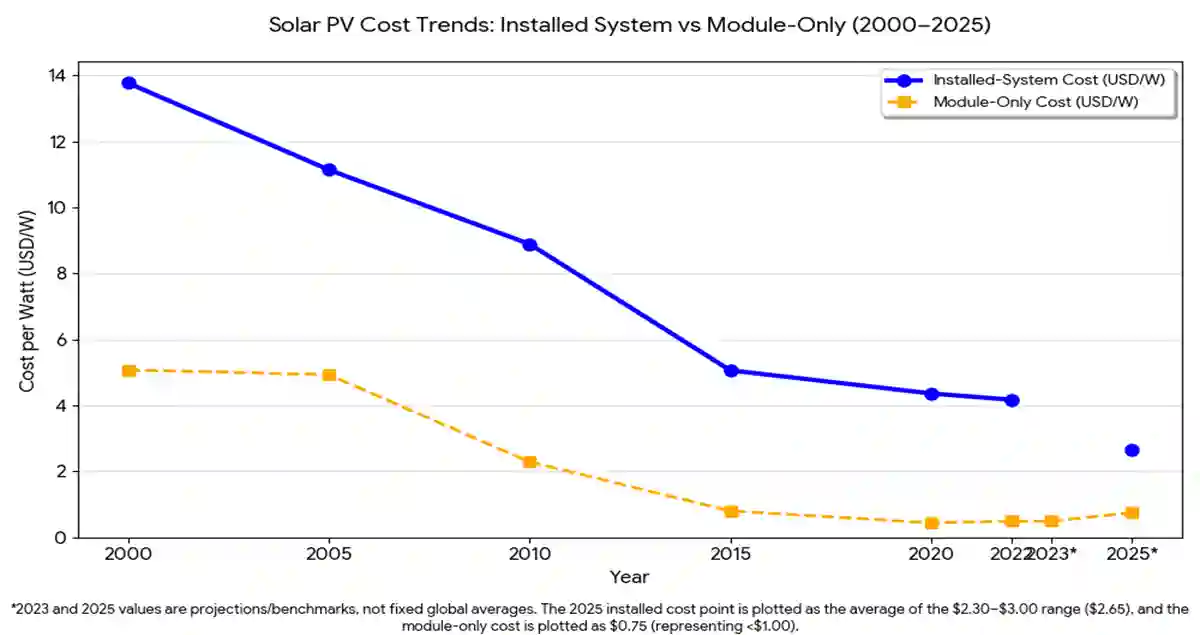
Solar Energy Cost Trends 2000–2025
One of the most exciting parts of solar is how dramatically the prices have dropped.
| Year | Approx. Installed-System Cost (USD/W) | Approx. Module‑Only Cost (USD/W) |
|---|---|---|
| 2000 | 13.77 | 5.07 |
| 2005 | 11.14 | 4.93 |
| 2010 | 8.89 | 2.29 |
| 2015 | 5.06 | 0.80 |
| 2020 | 4.36 | 0.44 |
| 2022 | 4.17 | 0.49 |
| 2023* | — | 0.49 |
| 2025* | 2.30–3.00 (projected) | <1.00 (projected) |
*2023 and 2025 are projections/benchmarks, not fixed global averages.
Solar PV costs have fallen dramatically from 2000 to 2025. Installed-system costs dropped from ~13.77 USD/W to ~4.17 USD/W (projected 2.3–3 USD/W), while module-only costs fell from 5.07 USD/W to ~0.49 USD/W (<1 USD/W projected).
Source: Tracking the Sun, Lawrence Berkeley National Laboratory. View report
Key Takeaways:
More than 90 percent cost reduction since 2000
Solar is now cheaper than grid electricity in many countries
Operational cost is extremely low
Most systems run for 25–30 years
Government Incentives and Financing
Many countries support solar with:
Tax credits
Subsidies
Net metering
Solar loans
Leasing options
These programs reduce the investment burden and shorten payback time to 3–7 years.
Maintenance and Longevity
Solar panels are low-maintenance, but a few simple steps keep them performing at their best:
- Regularly clean dust and dirt ([How to Clean Solar Panels: Safety, Schedule and Complete Maintenance Guide])
- Inspect wiring and the inverter
- Check for any damage after storms
With just a little care, most panels last 25–30 years, delivering reliable energy for decades.
Why Solar Energy is Green and Clean
Zero emissions during operation
Sunlight is unlimited
Panels are over 90 percent recyclable
Energy independence
Low operational cost
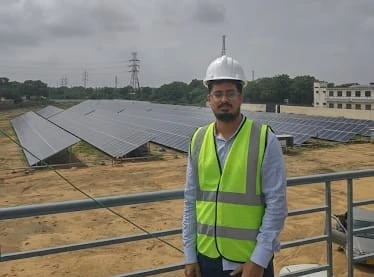
Hi, I’m Your Guide, Engr. Syed Farrukh Anwar
I am a solar engineer, climate advocate, and clean-tech storyteller. My goal is to use hands-on experience to cut through confusion and provide accurate, actionable, and trustworthy solar content.
Home and Business Solar Guides: From choosing the best solar panel brand to navigating commercial projects.
Technical Deep Dives: Essential reads on solar structure design, roof integrity, and installation best practices.
Unbiased Component Reviews: Engineering-focused breakdowns of the best inverters and BESS battery backups for your needs.
Final Thought: More Than Hardware
Solar panels are versatile, efficient, and more affordable than ever. With advanced types like bifacial, half-cut, PERC, portable, and BIPV options, solar fits every home, business, and environmental need.
Every solar panel is a piece of hope, a commitment to a smarter, cleaner future. When we share knowledge about solar, we are not just talking about electricity; we are building a world where energy is clean, affordable, and in everyone’s hands.
Keep exploring SolarVisionAI.com as I continue posting helpful guides for clean energy and modern solar systems.