
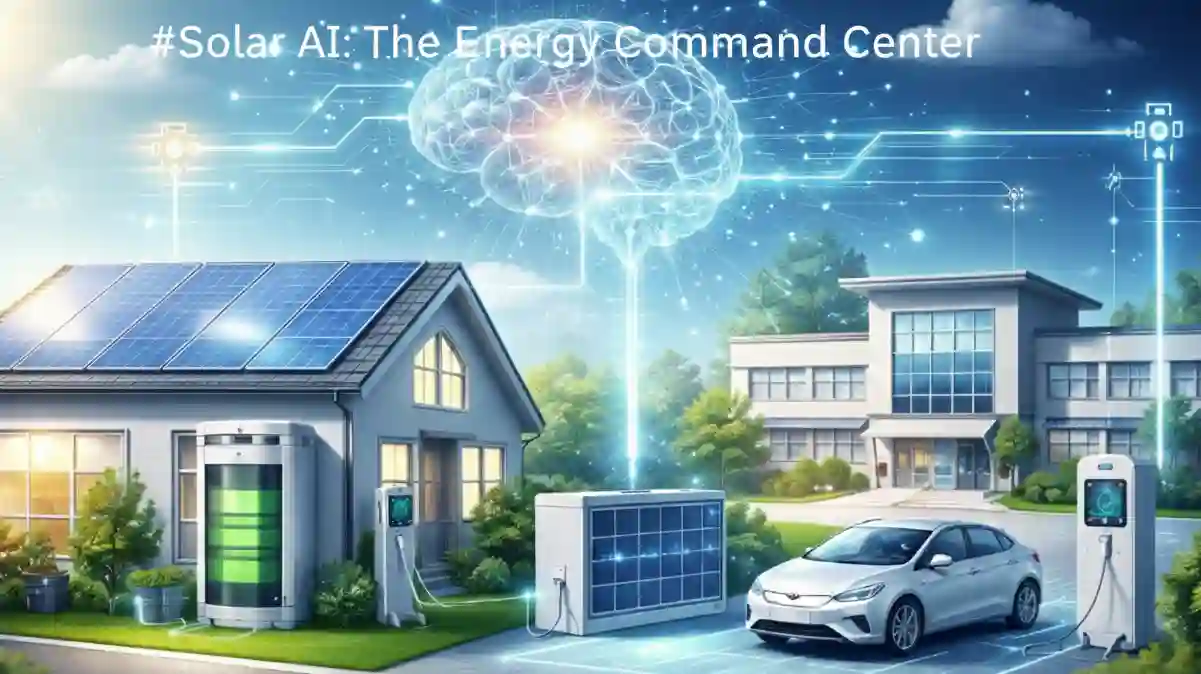
Solar AI is transforming how homeowners manage electricity bills in 2026. You did everything right: invested in a solar installation, navigated permits, coordinated with installers, and waited for that first electricity bill with a zero balance. But many are in for an unexpected twist.
The bill is lower than before, yes. But it is not zero. In some months, it is still uncomfortably high.
This confuses homeowners. Solar panels are supposed to eliminate electricity bills, so why are payments still coming in? The answer is simple. Your solar panels are smart, but your energy system is not.
Without intelligent control, you sell your best solar energy at noon for very little and buy it back at premium prices in the evening. This silent loss is called the Noon-Day Leak, and it is one of the biggest reasons solar alone fails to deliver full savings.
This is where Solar and AI change everything. When solar and AI work together, your home stops leaking energy value. Your system learns, predicts, and optimizes automatically, pushing electricity bills toward zero while supporting a cleaner, more sustainable energy future.
What Is Solar AI? Hardware, Software, or Both?
Solar AI is not a single product or brand. It is an intelligent energy management layer that sits on top of your solar system, coordinating generation, storage, consumption, and grid interaction.
Think of Solar AI as your system’s ‘digital brain.’ For off-grid living or emergency backup, start by building a DIY solar panel kit using AI-ready components to ensure your hardware is optimized for maximum efficiency from day one
Hardware Components Behind Solar AI
Solar AI relies on modern smart hardware to collect data and execute decisions:
• Smart solar inverters capable of variable output
• Battery management systems (BMS)
• Smart meters and bidirectional grid meters
• IoT sensors for voltage, current, temperature, and load
• Smart plugs and appliance controllers
These components continuously stream real-time data about how energy flows through your home or facility.
Software Intelligence That Makes Decisions
The real power of Solar with AI comes from software.
AI algorithms analyze historical data, real-time conditions, weather forecasts, and electricity pricing. Based on this, the system decides:
• When to store energy
• When to use energy locally
• When to export energy to the grid
• When to delay or advance appliance operation
Over time, the system learns your behavior and adapts automatically.
The Result
Your solar system no longer operates passively. It actively manages energy like a professional trader, reducing electricity bills, extending equipment lifespan, and improving sustainability.
Key takeaway: Solar with AI is software-driven intelligence powered by smart hardware that transforms a basic solar installation into a fully automated energy ecosystem.
Why Solar Alone Cannot Eliminate Electricity Bills
Solar panels are a remarkable technology, but they are not enough by themselves.
Most solar installations focus on generation, not management. Electricity, however, is valuable only when used at the right time.
Time-of-Use Pricing and the Noon-Day Leak
By 2026, most utilities worldwide will have adopted Time-of-Use (TOU) pricing models. Electricity prices vary by hour:
• Midday prices are low due to excess solar generation
• Evening prices are high due to peak demand
• Nighttime prices vary by region
Without Solar and AI, your system exports excess midday energy at low rates and imports energy in the evening at high rates. This price mismatch quietly drains your savings.
Seasonal and Regional Challenges
In colder climates or regions with winter heating demand, solar production drops exactly when consumption rises. Without intelligent load shifting and energy storage strategies, homeowners remain dependent on the grid.
Solar alone works blindly. Solar with AI works strategically.
The Environmental and Sustainability Perspective
Solar AI is not just about money. It is also about impact.
Each kilowatt-hour of solar energy consumed directly avoids approximately 0.7 kg of CO₂ emissions compared to fossil-fuel-based electricity. By increasing self-consumption, Solar and AI multiply this benefit.
AI-driven optimization also:
• Reduces peak demand on fossil fuel plants
• Improves grid stability
• Encourages smarter energy behavior
This makes Solar AI a key enabler of global net-zero goals.
The Efficiency Breakdown: Why Standard Solar Falls Short
| System Type | Average Bill Reduction | Strategy Used |
|---|---|---|
| Standard Solar | ~40% | Passive generation |
| Solar + AI | ~70% | Smart load shifting |
| Solar + AI + 25% Extra Panels | 95–100% | Energy arbitrage |
Hardware alone captures only part of the potential. Intelligence unlocks the rest.
The 25% Oversizing Rule: Why It Matters
Many homeowners think that matching solar panel capacity exactly to the inverter’s rating is sufficient. In reality, this approach can limit both energy savings and system flexibility. Installing 25% extra panel capacity creates a powerful advantage, allowing your system to generate more electricity and make the most of every sunny day.
Why Oversizing Works Financially
Adding extra panels is often one of the most cost-effective ways to boost your solar system’s performance:
- Installation costs are largely fixed – Labor, scaffolding, permits, and inverter installation make up most of the upfront expense. Adding panels increases material costs slightly while leveraging the already paid fixed costs.
- Panels are cheaper than ever – The price per watt of solar panels has dropped significantly in recent years, making oversizing an affordable investment.
- More surplus energy – Extra panels generate additional electricity that can be stored in batteries, exported to the grid for peak pricing, or used to power appliances during high-demand periods.
Oversizing ensures that your system produces enough electricity even during cloudy days, mornings, evenings, or winter months, when solar output is naturally lower.
Why Extra Panels Improve Efficiency
Having additional panel capacity gives your energy management system more flexibility to optimize usage:
- Store more energy – Batteries can be fully charged faster, ensuring surplus energy is available when needed.
- Maximize export opportunities – Extra electricity can be sold back to the grid during high-rate periods, increasing credits.
- Shift appliance usage intelligently – High-energy appliances, EV chargers, or water pumps can run without disrupting household comfort or overloading the system.
Without oversizing, the system is limited in its ability to fully cover household demand or take advantage of peak pricing opportunities.
Real-Life Example: The “Shoulder” Gain
A standard 5 kW AC inverter with a 25% oversize (additional 1.25 kW of panels) produces a total of 6.25 kW DC.
- The Result: Even on cloudy winter days, the home generates enough “baseload” to run essential appliances.
- The “Clipping” Benefit: During mid-summer, the inverter will “clip” the peak at 5 kW, but the AI uses that extra DC power to “widen the shoulders” of the day, giving you full 5 kW power earlier in the morning and later in the evening.
Engineering Safety Protocol: The 133% Limit
While Solar AI and oversizing maximize your ROI, hardware has physical boundaries. Most modern string inverters are designed with a Maximum DC/AC Ratio (typically 1.33:1 or 133%).
Before adding extra panels, verify these two “Deal-Breakers”:
- The Inverter Loading Ratio (ILR): Check your inverter’s technical datasheet for the “Max DC Input Power.” If you have a 5 kW inverter, a 1.33 ratio means you can safely install up to 6.65 kW of panels. Exceeding this can lead to excessive Thermal Stress on the internal capacitors and may void your warranty.
- The Voltage Ceiling (Voc): Solar panels produce higher voltage in cold weather. You must calculate your string’s Open Circuit Voltage (Voc) based on your region’s record-low temperature. If this voltage exceeds the inverter’s maximum (typically 600V or 1000V DC), it will result in instant hardware failure.
Pro-Insight: Oversizing is about increasing “Self-Consumption” during low-light hours, not just slamming the inverter at midday. Always cross-reference your panel’s STC (Standard Test Condition) ratings with your inverter’s DC Input window.
Key Takeaways
- Extra panels maximize flexibility – More energy gives the system room to store, export, or consume electricity efficiently.
- Small upfront cost, long-term gain – The added panel cost is minimal compared to savings over the system’s lifetime.
- Reliable performance year-round – Oversizing ensures steady electricity availability even during low-light or seasonal conditions.
By adding 25% extra capacity, your solar installation becomes more efficient, resilient, and capable of reducing electricity bills significantly while taking full advantage of every available sun hour.
Advantages of Solar AI and Smart Net Metering
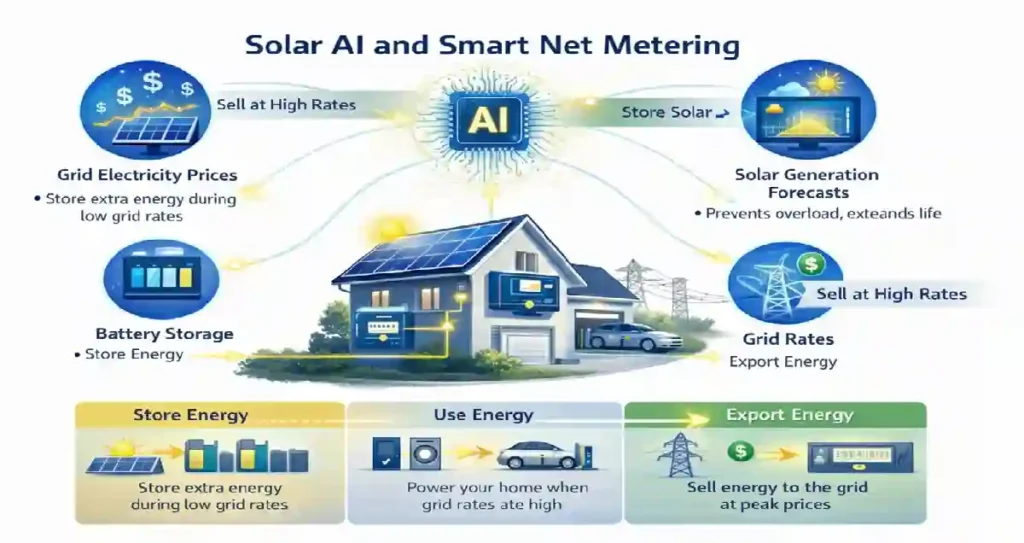
Net metering is often seen as a passive feature—sending excess electricity to the grid and receiving credits. While useful, this approach can leave significant savings on the table. By combining Solar AI with smart net metering, your system becomes an active energy manager, turning every kilowatt into maximum value.
How Energy Arbitrage Works
A smart solar system continuously monitors key factors:
- Grid electricity prices – Determine the best time to buy or sell energy.
- Solar generation forecasts – Uses weather predictions and historical data to anticipate production.
- Battery state of charge – Ensures batteries are charged efficiently without overuse.
- Household demand – Matches energy use to your home’s needs in real time.
Using this information, the system makes intelligent decisions:
- Store energy when generation exceeds demand, preparing for later use or peak pricing.
- Use energy locally when grid electricity is expensive.
- Export energy strategically to the grid to earn maximum credits.
Instead of passively selling excess energy at low midday rates and buying back at peak prices in the evening, this approach flips the equation, capturing the full financial value of your solar production.
Long-Term Impact
Over the course of a year, strategic energy arbitrage delivers tangible benefits:
- Summer credits can offset winter electricity bills for heating, lighting, and appliances.
- Household energy costs can be reduced close to zero, even in regions with high seasonal variations.
- Battery and system health are preserved because energy is managed intelligently rather than inefficiently.
In essence, Solar AI with smart net metering transforms your solar system from a passive generator into a dynamic, money-saving asset, maximizing efficiency, savings, and sustainability.
Effortless Load Shifting and Home Automation
A major advantage of a smart solar system is automating energy use. Instead of manually turning appliances on and off or worrying about peak electricity rates, the system optimizes consumption automatically, ensuring comfort, efficiency, and maximum savings.
Predictive Appliance Scheduling
High-energy appliances like dishwashers, washing machines, and dryers can consume a significant portion of your electricity. With intelligent scheduling:
- Appliances operate during periods of maximum solar generation.
- Household routines remain uninterrupted, but energy costs drop dramatically.
- Even small adjustments—like running a dishwasher an hour earlier—can compound into noticeable savings over a year.
| Appliance | Optimal Operation Time | Benefit |
|---|---|---|
| Dishwasher | 10:00 AM – 2:00 PM | Uses peak solar, reduces grid draw |
| Washing Machine | 11:00 AM – 3:00 PM | Maximizes self-consumption |
| Dryer | 1:00 PM – 4:00 PM | Runs when surplus energy is available |
EV Charging Optimization
Electric vehicles (EVs) can account for huge electricity bills if charged during peak grid hours. Smart energy systems:
- Charge EVs during high solar output hours instead of evening peak rates.
- Prevent battery overuse and reduce dependency on the grid.
- Combine with surplus energy storage to maintain flexibility for household consumption.
Water Pump Scheduling
For homes with solar water pumps or irrigation systems:
- Pumps run during daylight hours when solar production is at its peak.
- Reduces energy draw from the grid and ensures a consistent water supply.
- Avoids wasted energy during low solar production periods.
Thermal Energy Storage
Smart systems can also store thermal energy:
- Pre-cool rooms in the morning or pre-heat water using surplus solar energy.
- Reduces HVAC electricity use during peak hours.
- Provides comfort without increasing electricity bills.
The “Set-and-Forget” Advantage
Once configured, the system requires minimal intervention:
- Appliances, EV chargers, water pumps, and HVAC systems all operate automatically.
- Energy is used efficiently, bills are minimized, and household routines continue seamlessly.
- Maintenance alerts ensure optimal operation without manual monitoring.
By intelligently shifting loads and automating energy use, your solar system maximizes self-consumption, minimizes grid reliance, and improves overall efficiency, all without lifting a finger.
AI-Driven Maintenance and System Health Monitoring
An intelligent solar system goes beyond power generation by continuously monitoring solar panels, inverters, and electrical components to protect your investment. Instead of waiting for visible damage or system failure, AI-driven monitoring operates silently in the background to maintain stable performance throughout the year.
Predictive Maintenance
Solar systems usually degrade gradually due to heat, load stress, or connection issues. AI tracks real-time data such as voltage, current, temperature, and efficiency to detect early warning signs.
This enables early identification of issues like:
• Gradual solar panel degradation and output mismatch
• MC4 connector faults, loose joints, and overheating risks
• Inverter stress, efficiency loss, and abnormal operating cycles
• Cable overheating and insulation-related safety concerns
MC4 connector monitoring is especially important, as loose or overheated connectors are a common cause of energy loss and fire hazards. AI flags abnormal resistance and temperature rise early, preventing serious damage.
Automated Cleaning Alerts
Dust, pollution, and bird droppings can reduce panel efficiency without being visible. Instead of fixed cleaning schedules, the system compares expected and actual generation to identify performance loss caused by panel soiling.
Cleaning alerts are sent only when needed, helping to:
• Maintain optimal energy production
• Reduce unnecessary maintenance costs
• Extend solar panel lifespan
• Improve long-term system returns
Learn more about how clean solar panels improve efficiency and long-term savings
Long-Term Reliability
With continuous monitoring of solar panels, inverters, and electrical safety points, AI-driven maintenance ensures higher reliability, improved safety, and consistent energy output, without constant manual inspections.
Component-by-Component AI Optimization
| System Component | AI Function | Technical and Financial Impact |
|---|---|---|
| Solar Panels | Performance monitoring | Detects shading, soiling, faults |
| Inverter | Dynamic output control | Prevents overload, extends life |
| Battery Storage | Smart charge cycles | Improves lifespan and ROI |
| Smart Loads | Predictive scheduling | Increases self-consumption |
| Grid Meter | Price-based export | Maximizes net-metering credits |
| System Health | Predictive analytics | Avoids downtime and losses |
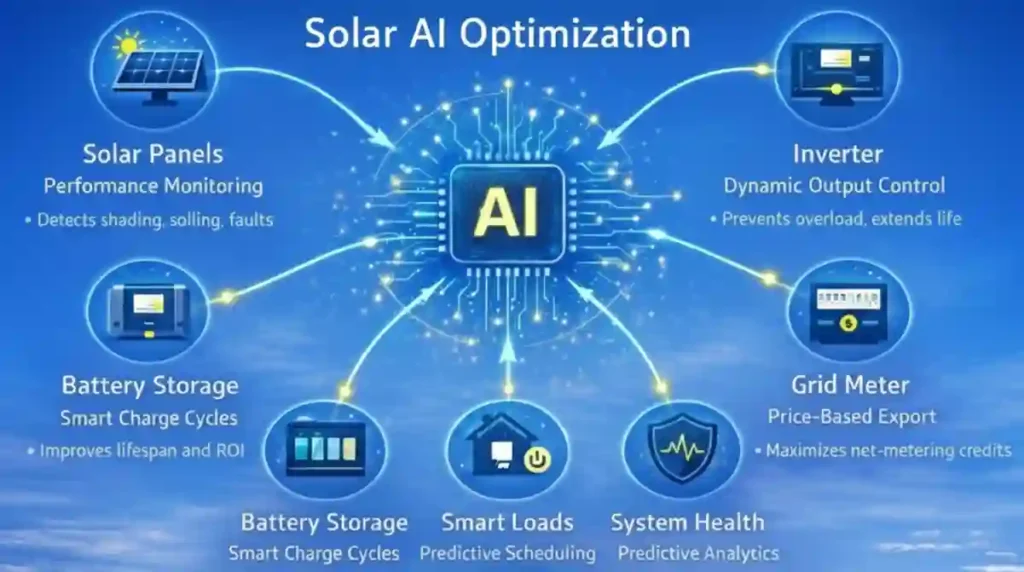
Solar and AI coordinates all components as a single intelligent system.
Applications of Solar and AI for Commercial, Institutional, and Public Infrastructure
Solar integrated with intelligent energy management is no longer limited to residential rooftops. For institutions and commercial facilities, it transforms solar installations into reliable, cost-saving, and mission-critical infrastructure assets.
By aligning energy generation, storage, and consumption with real-time operational needs, organizations gain greater control, resilience, and financial predictability.
Schools and Community Centers
Educational and public facilities have highly predictable daily energy patterns. Intelligent solar systems optimize these patterns without disrupting operations.
Key benefits include:
• Load shifting for cafeterias, classrooms, and gymnasiums during peak solar hours
• Coordinated charging for electric school buses and service vehicles
• Energy dashboards that support sustainability education and student awareness
• Reduced operating costs, freeing budgets for educational programs
Offices and Small Businesses
For offices and SMEs, energy costs directly impact profitability. Smart solar systems continuously balance comfort, productivity, and cost control.
Organizations benefit from:
• Demand charge reduction through controlled peak consumption
• HVAC optimization based on occupancy and weather conditions
• Intelligent backup power prioritization for IT systems and critical operations
• Predictable energy expenses and improved operational efficiency
Clinics and Hospitals
Healthcare facilities require uninterrupted power and high reliability. Intelligent solar systems enhance energy security without compromising patient care.
Key advantages include:
• Guaranteed power for critical medical equipment and emergency systems
• Predictive fault detection to prevent unplanned outages
• Intelligent load prioritization during grid failures
• Enhanced energy resilience during extreme weather or utility disruptions
From Power Generation to Strategic Asset
For institutions and commercial users, solar combined with intelligent control systems converts energy infrastructure into a strategic, resilient, and future-ready asset. It delivers long-term savings, operational stability, and sustainability leadership without increasing management complexity.
Environmental and Sustainability Benefits of AI and Solar
Solar AI strengthens sustainability efforts by:
• Reducing fossil fuel reliance
• Lowering greenhouse gas emissions
• Stabilizing energy grids
• Supporting renewable integration
Even small efficiency gains scale into massive environmental benefits when applied globally.
Real-World Savings Case Study (2026)
System: 5 kW solar + AI + 25% oversizing
Location: Typical suburban household
| Month | Without AI | With Solar AI | Savings |
|---|---|---|---|
| January | $150 | $12 | 92% |
| April | $135 | $10 | 93% |
| July | $160 | $15 | 91% |
| October | $140 | $11 | 92% |
Additional Outcomes
• Self-consumption increased from 30% to over 80%
• Peak-hour grid usage nearly eliminated
• Maintenance costs reduced
• System lifespan extended
Conclusion: Solar and AI – The Smarter Energy Solution
Combining solar power with AI, extra panels, and predictive maintenance lets you:
• Cut electricity bills close to zero
• Use your energy more efficiently
• Extend your system’s life
• Contribute to a cleaner, sustainable future
It’s not just about saving money—it’s about protecting your investment, future-proofing your energy, and powering a smarter, greener world.
FAQs
Does adding 25% more solar panels significantly increase the cost?
No. Panels are now affordable, and adding extra increases generation at a low additional cost.
What are the main advantages of AI-optimized solar systems?
Improves self-consumption, lowers bills, reduces waste, extends lifespan, and automates energy decisions.
How does Solar and AI trade electricity with the grid?
Stores surplus energy during low-price hours and exports during high-price hours to maximize credits.
Can I optimize my existing solar system with AI, or do I need a new installation?
Most systems can be upgraded via software or controllers; full replacement is usually unnecessary.
Is Solar and AI difficult to install or manage?
No. It runs automatically, with simple dashboards for monitoring and alerts.
Does AI-based optimization require special approval from utilities or authorities?
Usually not. It works within existing net-metering and grid regulations.
Do I need special solar panels for AI optimization?
No. Standard panels work; optimization focuses on energy flow, not panel type.
Are special inverters or batteries required for AI-based systems?
Smart or hybrid inverters and compatible batteries give the best results, though many existing inverters support AI upgrades.
Do Solar and AI help with system maintenance and safety?
Yes. It monitors system health, detects issues, and sends alerts for cleaning or maintenance.
Is AI-optimized solar suitable for commercial buildings and institutions?
Yes. Offices, schools, and clinics benefit from load management, backup power, and energy resilience.