
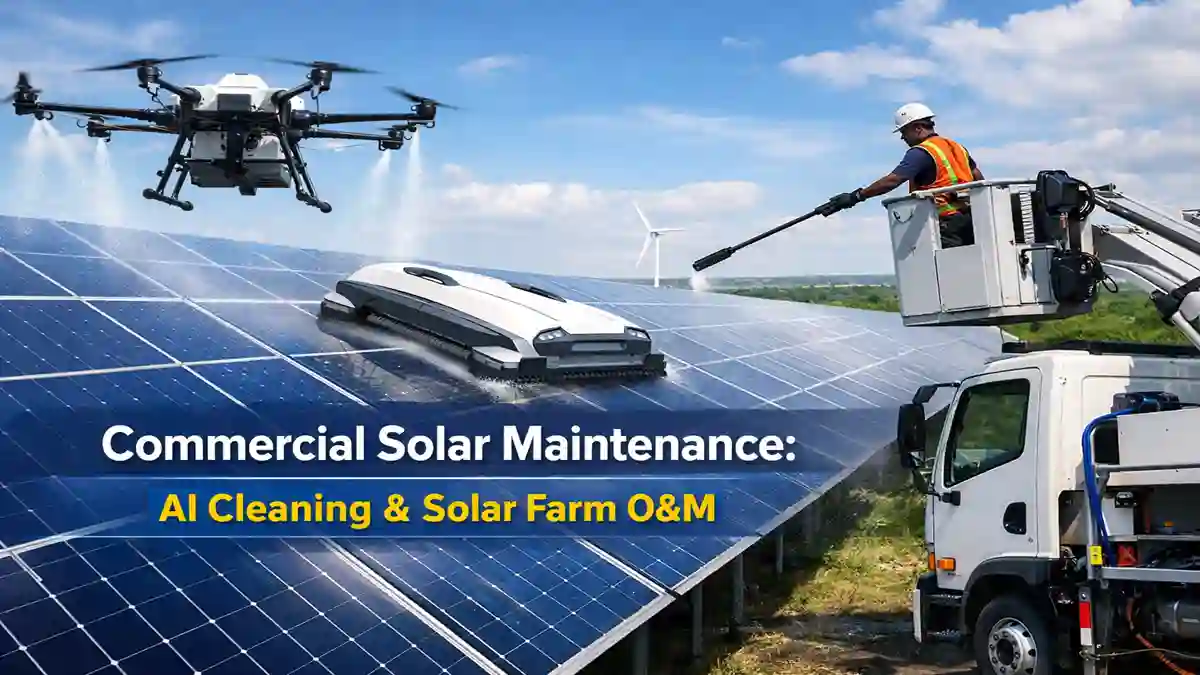
Optimize energy yield with AI-driven commercial solar maintenance. Explore autonomous drone cleaning, robotic operations, and predictive O&M strategies for large-scale solar farms—updated 2026 guide.
At a Glance: Key Takeaways
- Revenue Protection: Soiling and neglect can slash output by 25–30%. Maintenance is a revenue strategy, not just a cost.
- The AI Intelligence Layer: True AI cleaning includes autonomous scheduling and predictive detection, not just the drone hardware.
- Sustainability: Robotic and AI systems reduce freshwater use by up to 40% through advanced recycling and dry-mode technology.
- PPA Compliance: Structured O&M directly protects your Performance Ratio (PR) and Availability Guarantees.
- Asset Recovery: “Solar Orphans” (abandoned systems) can be fully audited and restored to peak performance.
- ROI Benchmark: At $15–$25 per kWp, professional O&M pays for itself by preventing PPA penalties and energy loss.
Commercial Solar Maintenance: AI-Powered Cleaning, Robotic Operations & Solar Farm O&M Guide
Why Regular Maintenance Is Critical for Commercial Solar Panels
I have walked utility-scale solar farms at first light, when the dew is still on the solar panels, and the inverters are just coming online. From 500kW rooftop arrays in industrial estates to multi-megawatt ground-mounted installations across open farmland, the pattern I see repeated on underperforming sites is almost always the same — not faulty equipment, not poor design, but neglected maintenance.
Dust, airborne pollution, bird droppings, and seasonal debris accumulate on panel surfaces, blocking sunlight from reaching photovoltaic cells. In arid, agricultural, or high-pollution environments, this soiling effect alone can reduce energy output by 25–30% — a loss that compounds with each day it goes unaddressed and directly impacts your revenue and PPA performance metrics.
In my experience as a solar renewable engineer, the installations that consistently outperform their modelled yield targets share one thing: a disciplined, data-driven maintenance programme. Not the most expensive panels. Not the largest inverters. Consistent, intelligent maintenance.
A well-structured commercial solar maintenance programme does more than restore lost output. It protects long-term asset value, extends panel lifespan, preserves manufacturer warranty compliance, and ensures your installation meets the contractual thresholds required under Power Purchase Agreements — quarter after quarter, year after year.
From AI-powered panel cleaning to full solar farm O&M — this guide covers everything commercial operators need to maximise performance and protect long-term asset value.
How Soiling and Neglect Cost You More Than You Think
Beyond the immediate energy loss, skipping maintenance creates a compounding problem. Layers of grime left on panel surfaces for extended periods can lead to permanent consequences that cleaning alone cannot reverse.
- Permanent surface staining from mineral deposits in hard water or industrial fallout
- Micro-corrosion on panel frames and mounting hardware
- Hot spots caused by uneven soiling across a panel’s surface, which accelerate cell degradation
- Voided manufacturer warranties that typically require evidence of regular maintenance
- PPA underperformance penalties triggered when output falls below contracted levels
The cost of reactive repairs — replacing degraded panels, paying performance penalties, or negotiating warranty disputes — far exceeds the cost of a structured preventive maintenance programme. Treating maintenance as an operational overhead rather than a strategic investment is one of the most expensive mistakes commercial solar operators make.
Commercial Solar Panel Cleaning Methods: A Full Comparison
Not all cleaning approaches are equal. The right method for your installation depends on the scale of your farm, site accessibility, water availability, and your operational budget. There are three primary cleaning methods used across commercial solar today: AI-powered systems, autonomous robotic cleaners, and manual cleaning vehicles.
AI-Powered Cleaning Systems for Large-Scale Solar Farms
AI-powered cleaning systems represent the most advanced technology currently available for commercial solar. Unlike standalone equipment, AI-powered cleaning is not limited to the physical drone unit — it encompasses the full intelligent layer behind it: autonomous scheduling software, real-time performance monitoring integrations, predictive soiling detection, cloud-based dispatch systems, and multi-unit coordination across large installations.
Solar-powered drones operating within these AI systems are stationed permanently on-site and triggered automatically when performance data identifies underperforming panels. Cleaning happens precisely when and where it is needed — not on an arbitrary fixed calendar.
Key capabilities include:
- Integrated performance monitoring that detects soiling-related output drops and dispatches cleaning units in response
- Eco-friendly cleaning solution dispensing using biodegradable, non-corrosive agents
- Greywater recycling systems that filter and reuse water on-site, dramatically reducing consumption
- Multi-unit coordination for maximum coverage across large installations
- 24/7 operation with infrared and sensor guidance enabling night-time cleaning cycles
Typical Applications:
AI-powered cleaning systems are best suited to large-scale installations where manual intervention is impractical and downtime is costly. Common deployments include:
- Industrial solar panel systems — manufacturing plants, logistics hubs, and heavy industry facilities with large rooftop or ground-mounted arrays, where production continuity demands zero-downtime cleaning
- Agricultural solar farms — agrivoltaic installations and rural ground-mounted farms across wide open terrain where field access is time-consuming and labour costly
- Utility-scale solar farms — multi-megawatt ground-mounted installations operating under strict PPA performance obligations that require continuous output monitoring and triggered cleaning response
- Solar carports and large parking canopies — high-footfall commercial and retail sites where cleaning must happen outside operating hours without disrupting daily activity
For utility-scale farms, the ROI case for AI-powered cleaning is compelling and increasingly straightforward to demonstrate.
The result is precision-targeted cleaning that restores output quickly, reduces water and labour costs, and minimises the safety risk of placing technicians at height or in exposed field conditions. For utility-scale farms, the ROI case for AI-powered cleaning is compelling and increasingly straightforward to demonstrate.
Robotic Solar Panel Cleaners for Ground-Mounted and Rooftop Farms
Autonomous robotic cleaning systems offer a highly effective solution for both ground-mounted solar farms and large commercial rooftop installations. These units move independently across panel rows using soft brushes or microfiber rollers that clean without scratching or damaging panel surfaces.
Robotic systems are either solar-powered or battery-operated, and they are managed remotely via cloud-based platforms that allow operators to set cleaning schedules, monitor progress, and adjust cycles based on real-time performance data. Dry cleaning or low-water cleaning modes make these systems particularly well-suited to water-scarce regions.
Key benefits include:
- Consistent panel-by-panel cleaning without manual supervision
- Programmable daily, weekly, or seasonal cleaning cycles
- Significant reduction in labour costs and operational risk
- Full compliance with eco-efficiency and sustainability targets
- Remote monitoring and scheduling from any connected device
Typical Applications:
Robotic cleaners are well suited to mid-to-large installations with uniform panel layouts where automated, scheduled cleaning delivers the greatest consistency and cost efficiency. Common deployments include:
- Commercial rooftop solar systems — office buildings, warehouses, shopping centres, and mixed-use developments where rooftop access for manual teams is restricted or hazardous
- School solar panels — educational institutions with flat or low-pitch rooftop arrays that require regular, low-disruption cleaning during term time without on-site labour
- Hospital and healthcare facility solar systems — critical infrastructure sites where energy reliability is non-negotiable and unattended automated cleaning minimises operational risk
- Industrial solar panel installations — factory and distribution centre rooftops with large uniform panel grids that are ideal for robotic rail or free-roaming systems
- Agricultural solar farms — ground-mounted agrivoltaic systems where dry robotic cleaning preserves soil moisture and avoids water use restrictions common in farming environments
Robotic cleaners are especially valuable for operators who need reliable, repeatable cleaning without deploying field teams — and for sites where drone operation is constrained by local airspace regulations.
Manual Cleaning Vehicles for Smaller and Urban Installations
For smaller commercial installations, rooftop arrays in dense urban environments, or mixed-use sites where automation is not yet cost-effective, professional manual cleaning vehicles remain a practical and reliable option.
These vehicles are equipped with pressurised water tanks, soft-brush cleaning heads, and extendable lifters that allow technicians to safely reach panels at height. Purified deionised water is used throughout the process to prevent mineral residue from being deposited on panel surfaces, and all cleaning agents meet professional, eco-friendly standards.
Manual cleaning offers the flexibility to handle irregular array configurations, varying roof pitches, and installations that are too fragmented for automated systems. When performed by trained technicians using the right equipment, it delivers excellent results without risk of panel damage.
Typical Applications:
Manual cleaning vehicles are the most flexible option across the widest variety of installation types — particularly where site layouts, scale, or budget make automation impractical. Common deployments include:
- Solar power systems — larger domestic installations and high-end residential properties where panel count justifies professional cleaning over DIY methods
- Small commercial rooftop solar — retail units, small office buildings, and community facilities with compact arrays that do not warrant the capital cost of robotic systems
- Solar street lights — standalone solar-powered street lighting across road networks, car parks, and public spaces where individual unit cleaning requires a mobile, flexible approach
- School solar panels — smaller educational facilities or those with complex rooflines where robotic systems cannot navigate effectively
- Off-grid solar systems — remote cabins, rural telecommunications towers, island installations, and standalone energy systems in locations without grid connectivity, where manual cleaning is the only practical and cost-effective maintenance option
- Places of worship and heritage buildings — installations on listed or architecturally sensitive structures where technician-led cleaning with specialist equipment is required to avoid damage
- Mixed-use and retrofit solar installations — older buildings with non-standard roof configurations, multiple pitches, or fragmented panel layouts that automated systems cannot accommodate
- Community and social housing solar — residential estate rooftop systems managed by housing associations or local authorities, where scheduled manual cleaning is bundled into site maintenance contracts
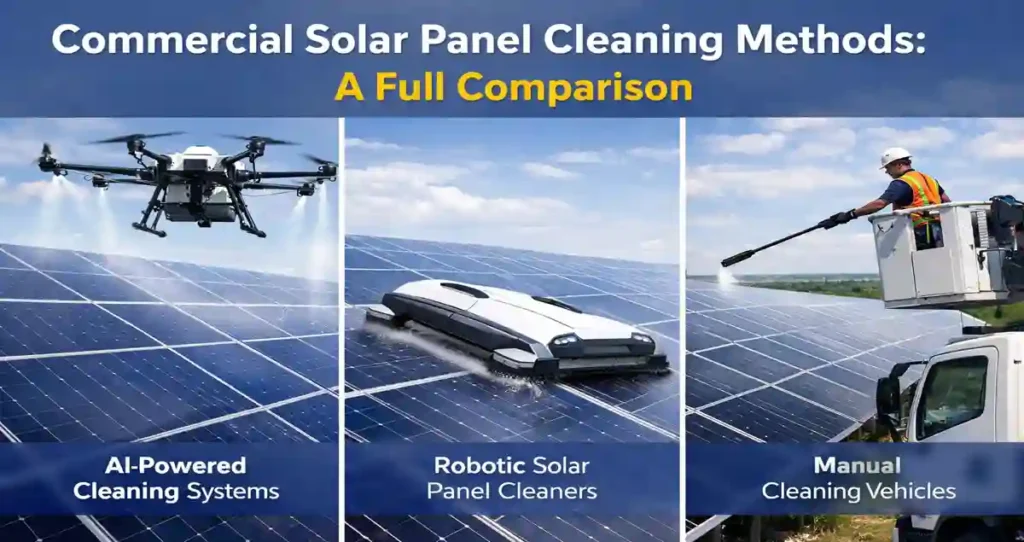
Drone vs. Robot vs. Manual: Side-by-Side Comparison
| AI-Powered Systems | Robotic Cleaners | Manual Vehicles | |
|---|---|---|---|
| Best For | Utility-scale solar farms | Ground-mount & rooftop farms | Smaller / urban installs |
| Automation Level | Fully autonomous | Fully autonomous | Technician-operated |
| Water Consumption | Minimal (recycled) | Minimal to zero | Moderate |
| Operating Hours | Day & night | Scheduled cycles | Business hours |
| Labour Required | Near zero | Near zero | Yes |
| Ideal Farm Size | 1MW+ | 250kW–5MW+ | Up to ~500kW |
| Eco Credentials | Excellent | Excellent | Good |
| Cost Efficiency | High ROI at scale | High ROI at mid-large scale | Cost-effective for small sites |
How Often Should You Clean Commercial Solar Panels?
Cleaning frequency is not a one-size-fits-all answer. The optimal schedule depends on several site-specific variables that directly affect the rate at which soiling accumulates on your panels.
Factors That Determine Your Cleaning Schedule
Geographic location and climate — Sites in arid desert regions, agricultural zones, or areas downwind of industrial activity accumulate soiling faster than coastal or temperate-climate installations. Saharan dust, agricultural sprays, and industrial particulates are among the most aggressive soiling agents.
Panel tilt angle — Steeper tilts above 15° benefit from natural rain-wash and typically require less frequent manual intervention. Flat or low-tilt arrays retain more soiling and need more regular cleaning.
Seasonal weather patterns — Spring pollen season and dry summer months typically require more frequent cleaning. Autumn and winter rain in wetter climates can reduce the need for supplementary cleaning cycles.
Local soiling index — Many O&M providers use a soiling index score for your specific site, calculated from historical weather data and measured energy loss. This provides a data-driven basis for cleaning decisions rather than guesswork.
Recommended Cleaning Frequency by Installation Type
- Utility-scale ground-mounted farms in arid regions: Every 4–6 weeks
- Commercial rooftop in urban or industrial environment: Every 6–8 weeks
- Ground-mounted farms in temperate climates with regular rainfall: Every 8–12 weeks
- Sites with AI-powered or robotic systems: Performance-triggered, real-time, as needed
For sites using AI-powered or robotic cleaning systems, the concept of a fixed schedule becomes largely redundant. These systems clean in direct response to detected performance drops — meaning every cleaning event is justified by data, and no cleaning cycle is wasted.
Eco-Friendly Solar Cleaning: Water Efficiency and Sustainability
Sustainability is not just a corporate value statement for commercial solar operators — it is an operational requirement. The cleaning methods used on your installation should reflect the same environmental principles that motivated the solar investment in the first place.
Modern commercial solar cleaning technology has made significant advances in water efficiency and chemical safety.
Biodegradable cleaning agents replace harsh chemical solvents with non-corrosive, environmentally safe formulations that clean effectively without leaving residue or damaging panel coatings.
Greywater recycling systems built into AI-powered systems and advanced robotic cleaners capture used water, filter it on-site, and recirculate it for subsequent cleaning passes — reducing freshwater consumption by up to 40% compared to conventional pressure-washing.
Dry cleaning modes available on many robotic systems use microfiber brushes without any water, making them entirely suitable for water-scarce environments and drought-restricted areas.
Intelligent scheduling in AI-powered systems ensures cleaning only occurs when it delivers a measurable energy benefit — eliminating the over-cleaning cycles that waste resources without adding value.
These practices reduce your installation’s operational water footprint, lower chemical costs, and support corporate sustainability reporting and ESG compliance — increasingly important for commercial solar assets managed under institutional ownership.
Solar Farm Operations and Maintenance (O&M): What’s Included
Beyond cleaning, a comprehensive solar farm O&M programme covers the full spectrum of activities required to keep a large installation running safely, efficiently, and in compliance with all contractual and regulatory obligations. This is particularly critical in 2025–2026, as the industry is seeing a sharp rise in “solar orphans” — commercial solar installations whose original installers or O&M providers have gone out of business, leaving the asset without technical support, active monitoring, or a maintenance contract. If your installation has been left without an O&M provider, a specialist commercial solar maintenance team can adopt, audit, and fully optimise your system — restoring performance, re-establishing monitoring, and bringing your farm back into PPA compliance regardless of who originally built it.
SCADA and Remote Monitoring
SCADA (Supervisory Control and Data Acquisition) systems provide real-time visibility across every component of your solar farm — from individual panel strings to inverters, transformers, and grid connection points. Continuous remote monitoring means that performance deviations, fault conditions, and equipment anomalies are detected immediately, enabling rapid response before issues escalate into costly failures.
Thermal Imaging Inspections
Thermal imaging (infrared) inspections identify faults that are invisible to the naked eye — including hot spots caused by cell degradation, bypass diode failures, and connection resistance issues. These inspections are conducted periodically as part of a preventive maintenance schedule and are essential for identifying panels that require replacement before they damage adjacent cells or create safety hazards.
Predictive Maintenance Using AI Analytics
AI-driven O&M platforms analyse continuous performance data streams from your monitoring systems to identify patterns that precede equipment failure. Rather than waiting for a fault to appear, predictive maintenance allows your O&M team to schedule interventions proactively — reducing unplanned downtime, extending equipment life, and lowering the overall cost of reactive repairs.
Inverter, Transformer, and HV Electrical Maintenance
Inverters are among the most failure-prone components in any solar farm, and their downtime has a disproportionate impact on energy output. Routine inverter servicing — including firmware updates, cooling system checks, and connection inspections — is a critical component of any O&M programme. Qualified electrical engineers must perform transformer and high-voltage (HV) system maintenance in compliance with local safety and grid connection standards.
Ground and Electrical Maintenance for Solar Farms
Large ground-mounted solar farms require ongoing attention to the physical environment surrounding and beneath the array — not just the panels themselves.
Vegetation management prevents grass, shrubs, and invasive plants from overgrowing panel bases, blocking airflow, creating fire risk, and interfering with mounting hardware. Regular cutting, herbicide application where permitted, and root barrier systems are all standard components of a ground maintenance plan.
Erosion control is particularly important for farms on sloped terrain, where water runoff during heavy rainfall can undermine mounting foundations and damage underground cabling conduits.
Wiring and DC system inspections identify insulation degradation, rodent damage, and loose connections in the DC cabling network — faults that can cause arc flash events, energy losses, and in the worst cases, fires.
HV system checks covering grid connection infrastructure, switchgear, protection relays, and earthing systems ensure the farm remains compliant with DNO (Distribution Network Operator) requirements and avoids forced disconnection events.
PPA Performance Optimisation Through Smart Maintenance
For commercial solar operators selling power under a Power Purchase Agreement, maintenance is not simply a best practice — it is a contractual obligation with direct financial consequences.
PPAs specify minimum performance thresholds that your installation must consistently deliver — most commonly expressed as a Performance Ratio (PR), which measures actual energy output against the theoretical maximum your system should produce under prevailing irradiance conditions. A PR of 75–80% is considered the baseline benchmark for a well-maintained commercial solar farm; sustained soiling, equipment faults, or gaps in O&M can push this figure significantly lower, triggering contractual consequences. Many PPAs also include Availability Guarantees — typically requiring the system to be operational and grid-connected for 97–99% of contracted hours annually. Failure to meet either the PR threshold or the Availability Guarantee — whether due to soiling losses, inverter downtime, or insufficient O&M — can trigger:
- Performance penalty clauses that reduce the price paid per kWh generated
- Curtailment provisions that allow the offtaker to terminate or renegotiate the agreement
- Investor reporting obligations that require documented evidence of maintenance activity and performance remediation
A smart O&M programme addresses PPA compliance proactively. Cleaning schedules and maintenance activities are timed and documented to ensure your farm consistently operates within the performance band specified in your agreement. Data from SCADA and monitoring systems is compiled into structured performance reports for investors, auditors, and offtakers — providing the transparency that institutional stakeholders require.
Linking your maintenance programme directly to your PPA metrics transforms O&M from a cost centre into a revenue protection strategy. Every cleaning cycle that restores 2–3% of lost output is a cleaning cycle that pays for itself.
Commercial Solar Maintenance Checklist: Seasonal Framework
Use this as a starting framework and adapt it to your specific site conditions and O&M contract scope.
Spring
- Full thermal imaging inspection of all panel strings
- Post-winter cleaning cycle (pollen season begins)
- Vegetation clearance and ground inspection after frost
- Inverter servicing and firmware review
- DC wiring and connector inspection
Summer
- Increased cleaning frequency (peak soiling season in arid climates)
- Cooling system checks on inverters and transformers
- Monitoring review for heat-related performance deviations
- HV switchgear visual inspection
Autumn
- Pre-winter structural inspection of mounting and racking
- Drainage and erosion control check before the wet season
- Battery Energy Storage System (BESS) and solar batteries review — inspect battery modules, thermal management systems, state of health (SoH) reporting, charge and discharge cycle performance, and inverter-battery integration ahead of increased winter demand, where applicable
- PPA performance report preparation
Winter
- Snow and ice management protocol activation, where applicable
- Reduced cleaning frequency review based on soiling data
- Annual O&M contract review and planning for next year
- Comprehensive electrical safety audit
Frequently Asked Questions About Commercial Solar Maintenance
What is the best cleaning method for a large-scale solar farm?
For utility-scale solar farms, AI-powered cleaning systems and robotic cleaners deliver the best combination of efficiency, cost savings, and water conservation. AI-powered systems offer the added advantage of performance-triggered cleaning — they respond directly to energy output data rather than operating on a fixed schedule, ensuring every cleaning cycle is justified and effective.
Can AI-powered cleaning systems operate at night?
Yes. AI-powered cleaning systems equipped with drone units use infrared sensors and advanced navigation to operate safely in low-light and night-time conditions. Night-time cleaning is particularly advantageous during peak summer months when daytime temperatures make cleaning less effective and accelerate water evaporation.
How do AI-powered systems know which panels need cleaning?
AI-powered systems are integrated directly with your solar monitoring portal. When performance data identifies panels or string sections generating below expected output — a pattern consistent with soiling — the system automatically dispatches cleaning units to those specific areas. This targeted approach eliminates unnecessary cleaning and maximises the ROI of each cleaning cycle.
Is manual cleaning still relevant for commercial solar?
Absolutely. For smaller commercial rooftop installations, urban arrays, or sites with irregular configurations not suited to automated systems, professional manual cleaning with the right equipment remains highly effective. It is also commonly used for spot-cleaning and post-inspection remediation on larger sites alongside automated systems.
How does maintenance affect PPA compliance?
PPA agreements specify minimum performance thresholds your installation must consistently deliver. Most PPA contracts define these obligations through two specific metrics: the Performance Ratio (PR) — your actual versus theoretical output — and an Availability Guarantee, which typically requires 97–99% system uptime annually. Soiling, equipment faults, and inadequate O&M are the leading causes of underperformance that trigger penalty clauses. A structured, documented maintenance programme is your primary tool for ensuring continuous PPA compliance and protecting revenue — and your evidence of due diligence against both metrics.
Are robotic and AI-powered cleaning systems water-efficient?
Yes. Both technologies are designed with water conservation as a core engineering principle. Robotic systems offer dry-cleaning modes with zero water consumption. AI-powered systems incorporate on-board greywater recycling that filters and recirculates water throughout the cleaning process, reducing freshwater use by up to 40% compared to conventional manual methods.
How much does commercial solar maintenance cost?
Annual O&M costs for commercial solar farms typically range from $15 to $25 per kWp, depending on farm size, location, cleaning method, and contract scope. Larger farms benefit from economies of scale. When evaluated against the revenue protected through maintained PPA compliance and restored energy output, a well-structured O&M programme consistently delivers a strong positive return.
What happens if my original solar installer is no longer operating?
This is an increasingly common situation in 2025–2026, with a growing number of commercial sites becoming solar orphans following installer insolvencies. If your system has been left without active monitoring, maintenance, or technical support, a specialist O&M provider can step in to adopt your installation — conducting a full performance audit, re-establishing SCADA monitoring, and putting a compliant maintenance programme in place. Your asset can be fully optimised regardless of who originally designed or installed it.