
A registered solar engineer breaks down solar batteries, key specs, and AI storage tech. Learn what actually works — and what to avoid — before you buy
I’ve designed and commissioned solar storage systems for homes, commercial buildings, and off-grid installations. The single question I hear most often isn’t about panel types or inverters — it’s this: “What happens when the sun goes down?”
That’s exactly what solar batteries solve. And in 2026, the technology has matured to a point where choosing the wrong battery is an expensive mistake you really don’t need to make.
This guide covers everything you need — from how solar batteries actually work, to the engineering specs that separate a great system from a mediocre one, to how AI is changing battery management. Whether you’re a homeowner planning your first solar panel installation or an engineer designing a commercial BESS, you’ll leave here with the clarity to make the right call.
💡 Engineer’s Note: This guide is written from hands-on engineering experience. All specs, efficiency figures, and system parameters reflect real-world values, not manufacturer marketing claims.
What Is a Solar Battery?
A solar battery is an electrochemical storage device that captures the DC electricity generated by your solar panels and holds it for later use. Instead of pushing unused daytime power back to the grid at low rates, you bank it yourself and draw from it at night or during an outage.
A complete solar battery storage system has four core components working together:
- Solar panels — generate DC electricity from sunlight
- Charge controller — regulates current and voltage flowing into the battery
- Solar battery storage unit — stores the energy electrochemically
- Inverter — converts stored DC into AC power for your home or business
Get these four components sized correctly and working together, and you’ve got a system that can genuinely free you from the grid.
How Solar Batteries Integrate with Your Solar System
Here’s the sequence of events every time your solar system runs — understanding this flow is what helps you size a system properly.
- Sunlight hits the solar panels, producing direct current (DC) electricity.
- The charge controller monitors the battery state and regulates the incoming current to prevent overcharging or voltage spikes — especially important for lithium batteries.
- Excess solar energy that isn’t consumed immediately flows into the battery bank and is stored electrochemically.
- When the sun drops or your load exceeds solar output, the inverter pulls from the battery and converts it to AC for your appliances.
- A smart energy management system — increasingly AI-powered — handles all the switching decisions in real time.
For grid-tied homes, the battery acts as a buffer. For off-grid systems, it’s your primary power source from sunset to sunrise. The design priorities are different in each case, which is why a one-size-fits-all battery recommendation doesn’t exist.
💡 Engineer’s Note: In hot or humid climates, battery thermal management is not optional — it directly affects both cycle life and safety. I always factor this into system design.
Types of Solar Batteries: An Engineer’s Breakdown
There are four main battery technologies used in solar installations today. Each has a specific home, a specific budget range, and a specific set of trade-offs. Here’s how I think about each one.
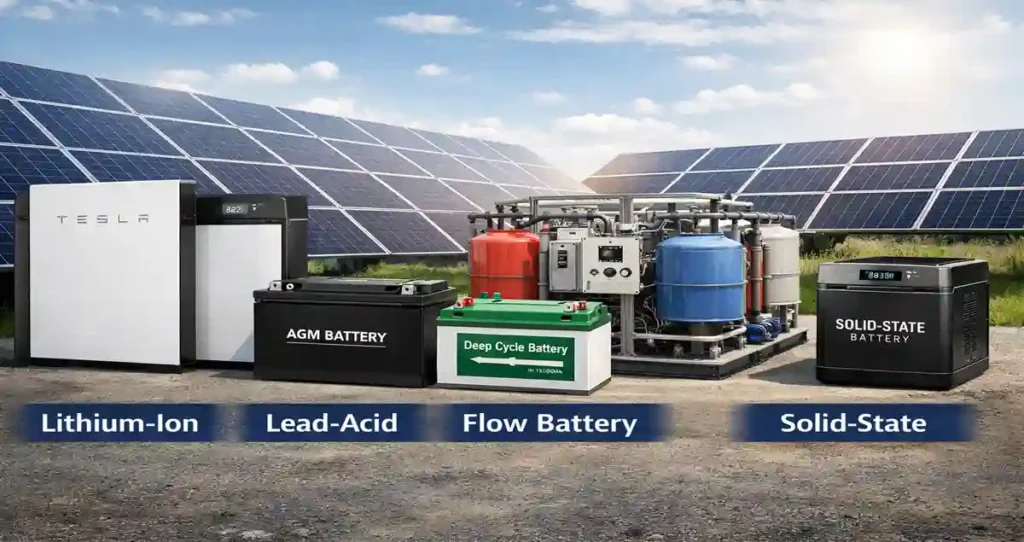
Solar Battery Type Comparison
| Battery Type | Efficiency | Cycle Life | Best For | Main Trade-off |
| Lithium-Ion | 90–95% | 4,000–7,000 | Homes, commercial, backup | Higher upfront cost |
| Lead-Acid | 70–85% | 500–1,500 | Off-grid cabins, small DIY | Short lifespan, low DoD |
| Flow Batteries | 70–80% | 10,000+ | Utility farms, microgrids | Large footprint, complex |
| Solid-State (future) | Est. >95% | Est. 10,000+ | Next-gen EVs, premium homes | Not yet widely available |
1. Lithium-Ion Solar Batteries — The Current Gold Standard
If you’re installing a residential or commercial solar system today, lithium-ion is almost certainly the right call. The energy density is high, the cycle life is long, and the round-trip efficiency of 90–95% means very little of what you store gets wasted.
The most common variants you’ll see are LFP (Lithium Iron Phosphate) and NMC (Nickel Manganese Cobalt). For solar storage specifically, I prefer LFP — it runs cooler, has a longer cycle life, and doesn’t carry the same thermal runaway risk as NMC. The Tesla Powerwall and most modern home batteries use LFP for this reason.
- Cycle life: 4,000–7,000 full cycles
- Usable DoD: 80–95%
- Best for: Residential, solar street lights, Solar Home Appliances, commercial, solar power systems, Balcony Solar
- Requires thermal management in high-temperature environments
2. Lead-Acid Solar Batteries — The Budget Workhorse
Lead-acid has been in solar systems since the 1970s, and it still has a legitimate role — primarily in off-grid applications where budget is tight, and the system isn’t cycled daily.
The three variants are flooded lead-acid (cheapest, needs maintenance), AGM (sealed, maintenance-free, better for vibration), and Gel (best for high temperatures). I typically specify AGM for off-grid rural installations.
- Cycle life: 500–1,500 cycles
- Usable DoD: 40–60% (push deeper and you shorten lifespan fast)
- Best for: Off-grid cabins, RV solar, remote telecoms, small DIY solar kits, and Solar-powered water pumping systems
- Advantage: Works in extreme temperatures without special management
💡 Engineer’s Note: Don’t let the low price fool you. If you cycle a lead-acid battery daily, you’ll replace it every 3–5 years. A lithium battery at twice the price often delivers better 10-year economics.
3. Flow Batteries — Built for Scale
Flow batteries store energy in liquid electrolytes held in external tanks — the larger the tank, the more capacity. This makes them uniquely scalable for large solar farms, industrial solar, and community energy storage projects where you need 8+ hours of storage.
The most commercially mature version is the Vanadium Redox Flow Battery (VRFB). Lifespan exceeds 10,000 cycles with minimal degradation. They’re not practical for homes — the footprint and complexity rule that out — but for utility-scale applications, they’re compelling.
- Cycle life: 10,000+ with minimal degradation
- Scalable: capacity and power are independently adjustable
- Best for: Solar farms, grid stabilization, long-duration storage, Large Agrivoltaics Farms
4. Solid-State Batteries — The Horizon Technology
Solid-state batteries replace the liquid electrolyte with a solid material, which eliminates the main safety risk in conventional lithium batteries and promises higher energy density. The technology is real — Toyota, QuantumScape, and others have working prototypes.
As of 2026, solid-state batteries are not commercially available at scale for solar storage. When they do arrive, they’ll likely enter premium residential areas such as 10kw solar systems and EV applications first. Worth watching, but not a factor in your current system design.
BESS: What It Is and When You Need One
BESS stands for Battery Energy Storage System. It’s not a new type of battery — it’s a complete, integrated storage platform that combines battery cells, a battery management system (BMS), thermal management, power conversion, and grid interface hardware into a single managed system.
The distinction matters because a BESS isn’t just storing energy — it’s actively managing it. Modern BESS installations include AI-powered management software that optimizes charging cycles, monitors degradation, forecasts demand, and integrates with grid signals for peak shaving or demand response.
For residential users: a system like the Tesla Powerwall or Sonnen Eco is essentially a residential BESS. For commercial and utility-scale users, a BESS might be a containerized system from CATL, BYD, or Fluence sized in megawatt-hours.
💡 Engineer’s Note: The most common mistake I see in commercial solar projects is treating battery storage as an afterthought. A BESS should be sized alongside the solar array from day one — not bolted on afterward.
6 Engineering Parameters That Actually Matter
These are the specs I evaluate on every solar storage project. Understanding them will make you a much smarter buyer — and help you cut through manufacturer marketing.
1. Battery Capacity (kWh)
Capacity tells you how much energy the battery can hold — but usable capacity (after accounting for DoD) is what actually matters. A 10 kWh battery with 90% DoD gives you 9 kWh of usable storage. The same capacity in a lead-acid battery at 50% DoD gives you just 5 kWh.
Rule of thumb for sizing: calculate your average daily consumption, subtract what you can self-consume during daylight, and size storage to cover the rest plus a 20% buffer.
2. Depth of Discharge (DoD)
DoD is the percentage of the battery’s total capacity you can actually use without damaging it. Higher is better. Lithium-ion typically allows 80–95% DoD. Lead-acid should be kept above 50% — going deeper dramatically accelerates degradation.
This is why two batteries with the same nominal kWh rating can have very different real-world performance.
3. Cycle Life
One cycle = one full charge and discharge. A battery rated for 4,000 cycles at 80% DoD, cycled once daily, gives you roughly 11 years of useful life. At 7,000 cycles, that’s nearly 20 years.
Flow batteries at 10,000+ cycles are genuinely exceptional on this metric — which is why they make sense for high-cycling utility applications despite higher upfront cost.
4. Round-Trip Efficiency
Round-trip efficiency tells you how much of the energy you put into the battery you actually get back out. A 95% efficient battery returns 9.5 kWh for every 10 kWh stored. A 75% efficient battery returns only 7.5 kWh — the rest becomes heat.
Over thousands of cycles across a 10-year system life, this difference compounds significantly. Higher efficiency means lower effective cost per kWh stored.
5. Charging Speed (C-Rate)
C-rate describes how fast a battery can be charged or discharged relative to its capacity. A 1C rate on a 10 kWh battery means it can charge fully in 1 hour. A 0.5C rate takes 2 hours. For solar, faster charging is valuable during short high-irradiance windows — particularly in regions with frequent cloud cover.
6. Temperature Performance
Most lithium batteries have an optimal operating range of 15–35°C. In very hot climates, performance degrades and thermal management becomes critical. Lead-acid batteries actually handle temperature extremes better, which is one reason they remain relevant in harsh off-grid environments.
If you’re in a hot climate and installing lithium batteries, ensure your system design includes adequate thermal management. I’ve seen lithium battery systems fail prematurely simply because they were installed in unventilated enclosures.
Full Specification Comparison
| Specification | Lithium-Ion | Lead-Acid | Flow Battery | Solid-State (Future) |
| Upfront Cost | Medium–High | Low | High | Very High |
| Cycle Life | 4,000–7,000 | 500–1,500 | 10,000+ | Est. 10,000+ |
| Round-Trip Efficiency | 90–95% | 70–85% | 70–80% | Est. >95% |
| Depth of Discharge | 80–95% | 40–60% | Up to 100% | Est. 100% |
| Thermal Management | Required | Not critical | Not critical | TBD |
| Scalability | Moderate | Moderate | Excellent | TBD |
| Best Use Case | Homes & business | Off-grid, small DIY | Utility, microgrids | Future EVs & homes |
Safety certification to look for: UL 9540 (USA) — the standard for energy storage systems covering electrical, fire, and mechanical safety hazards. Always verify before purchase.
How AI Is Changing Solar Battery Management
Five years ago, battery management systems were reactive — they responded to what was happening. Today’s AI-powered systems are predictive. Here’s what that actually means in practice.
Intelligent Charging Optimization
AI analyzes your solar generation patterns, your historical consumption, and even weather forecasts to decide exactly when and how fast to charge the battery. This prevents overcharging, reduces stress on the cells, and can extend cycle life by 15–25% compared to dumb charge controllers.
Predictive Maintenance
Modern BMS platforms monitor voltage curves, internal resistance, temperature gradients, and coulombic efficiency on every cycle. Anomalies that signal early cell degradation — or potential failure — are flagged weeks before they become a problem. This is what separates a premium BESS from a basic battery bank.
Energy Usage Forecasting
By learning your household or facility’s consumption patterns, AI systems can pre-charge the battery ahead of high-demand periods, or hold back capacity if low solar output is forecast. The result is fewer grid draw events and better self-consumption rates — and over a full billing cycle, that adds up. In fact, AI-driven forecasting is one of the core reasons solar AI can directly reduce your electricity bill, not just offset it.
Temperature and Safety Management
AI continuously monitors thermal signatures across the battery pack and adjusts charging rates or triggers cooling systems when temperatures rise. In my experience, this single feature is the biggest differentiator between a battery that lasts 15 years and one that degrades in 7.
Smart Grid Integration
Advanced installations can connect to grid signals and participate in demand response programs — charging when grid electricity is cheap or renewable-heavy, and discharging or selling back when demand peaks. In markets where this is available, it can significantly improve system ROI.
What’s Coming: The Future of Solar Battery Technology
The trajectory is clear: higher energy density, longer cycle life, lower cost, and smarter management. Here’s where the technology is heading:
- Advanced LFP batteries pushing past 10,000 cycles at scale
- Vanadium flow batteries are becoming cost-competitive for mid-scale commercial use
- Solid-state batteries entering premium residential and EV markets by 2027–2028
- AI battery management is becoming standard even in entry-level residential systems
- Second-life EV batteries are creating a lower-cost tier for less-demanding storage applications
For most installations today, lithium-ion LFP with AI management is the sweet spot. But the economics of flow batteries for commercial applications are improving every year — and are worth evaluating for any project sized above 100 kWh.
Final Thoughts from the Field
Solar batteries aren’t complicated once you understand the core trade-offs: lithium-ion gives you the best all-around performance for homes and businesses; lead-acid is the budget choice for low-cycling off-grid applications; flow batteries earn their complexity at utility scale.
The engineering parameters — DoD, cycle life, round-trip efficiency, and thermal performance — are what separate a system that delivers on its 25-year promise from one that disappoints within a decade. Don’t let a low sticker price blind you to the real lifetime cost.
And if you’re evaluating a BESS for a commercial project: the AI management layer isn’t a luxury add-on anymore. It’s the difference between a system that performs and one that just sits there.
Questions about your specific installation? Contact SolarVisionAI or explore the related guides below.
What is a solar battery?
A solar battery is an energy storage device that captures excess electricity generated by solar panels during the day for use at night, on cloudy days, or during power outages.
What are the main types of solar batteries?
The most common technologies are Lithium-Ion (best for homes), Lead-Acid (budget-friendly off-grid), Flow Batteries (large-scale/industrial), and Solid-State (the high-safety future of storage).
How long do solar batteries last?
Lifespan is measured in “cycles.” Most modern Lithium-Ion batteries last 10–15 years (approx. 6,000 cycles), while Lead-Acid batteries typically last 3–7 years depending on maintenance and depth of discharge.
What is a Battery Energy Storage System (BESS)?
A BESS is an integrated, “smart” storage solution. It combines battery modules with an advanced Battery Management System (BMS) and power electronics to store and distribute energy with high precision and safety.
Are solar batteries worth it in 2026?
Absolutely. With rising grid costs and falling hardware prices, batteries allow for “Peak Shaving” (using stored power when grid rates are highest) and provide critical energy security during grid instability.
Can solar batteries work during a power outage?
Yes, provided the system is designed with “Islanding” capabilities. A solar battery backup system can automatically disconnect from the grid and supply electricity to your essential appliances within milliseconds of a blackout.
How does Artificial Intelligence (AI) improve battery performance?
AI acts as the system’s “brain.” It uses predictive analytics to optimize charging cycles based on weather forecasts and usage patterns, potentially extending your battery’s physical lifespan by up