
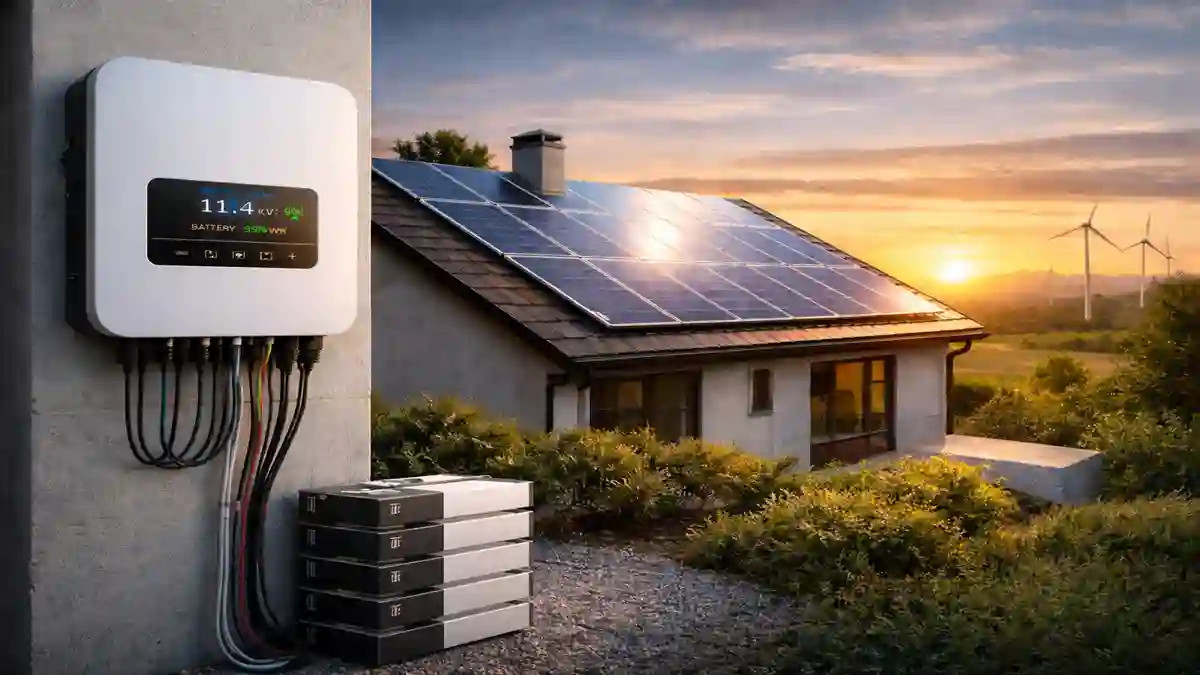
Maximize your energy independence with hybrid inverters. Learn how AI-driven battery storage and net metering can slash your bills. Explore the 2026 guide.
As an engineer, I see that the solar industry has moved beyond simple “passive generation.” Converting DC to AC and sending it to the grid was once the primary focus. In 2026, with grids becoming increasingly volatile and energy prices becoming more dynamic, the hybrid inverter has become the central component of modern solar systems—and the complete solution for efficient energy management.
Hybrid solar inverters manage thermal performance, high-speed switching using Gallium Nitride (GaN) for over 98% efficiency, and intelligent energy flow. They automatically decide when to store energy, when to use it, and when to send it back to the grid, optimizing efficiency, reliability, and savings.
By addressing the intermittency of solar power at the source, hybrid inverters turn variable energy into a stable, dispatchable supply. For modern homes and businesses, they are essential for efficient, resilient, and scalable solar energy systems.
Buying Guide: How to Select a Hybrid Solar Inverter
Choosing the right hybrid inverter is critical to getting the most from a solar system. Not all inverters are equal, and the wrong choice can limit efficiency, reduce savings, or make future expansion difficult. Here are key factors to consider:
1. System Compatibility
Ensure the inverter supports your solar panel configuration and battery type. Popular batteries like Tesla Powerwall, LG Chem RESU, or Enphase Encharge are compatible with most modern hybrid inverters. Check whether the inverter can handle AC or DC-coupled batteries, depending on your system setup.
2. Power Rating and Scalability
Select an inverter with a power output that matches your solar array. For future-proofing, choose a system that can scale easily if you plan to add more panels or batteries. Hybrid inverters designed for both residential and commercial applications often offer modular options.
Engineer’s Pro-Tip: The “AC Startup” Rule
If you are planning to run a 5-ton Central AC during a blackout, prioritize inverters with high LRA (Locked Rotor Amp) support like the EG4 FlexBOSS21 or Solis S6-PRO. Most “standard” 10kW hybrids lack the surge capacity to kickstart large compressors and will trip the system unless you also install a Soft Starter.
3. Efficiency and Technology
Look for high-efficiency inverters—often over 98%—that use Gallium Nitride (GaN) or similar advanced switching technologies. Efficiency directly impacts how much solar energy you can use or store. Some inverters also feature AI-powered energy management, which can optimize when to use, store, or export electricity.
4. Smart Features and Monitoring
Modern hybrid inverters include real-time monitoring apps and AI-driven energy flow control. These features allow you to track energy production, consumption, and battery status, helping maximize savings and reliability.
5. Net Metering and Energy Trading
If you want to sell excess electricity back to the grid, ensure the inverter is compatible with net metering programs. Some hybrid inverters even support automatic energy trading, maximizing financial returns by exporting energy at optimal times.
6. Brand and Warranty
Reputable brands like SolarEdge, SMA, Enphase, Fronius, Huawei, and EG4 offer reliable performance and warranty support. A longer warranty period ensures peace of mind and protection for your investment.
Quick Selection Checklist for Hybrid Inverters
| Factor | What to Look For |
|---|---|
| Battery Compatibility | Tesla, LG Chem, Enphase, AC/DC coupled options |
| Power Rating | Matches solar array, scalable for future growth |
| Efficiency | >98%, GaN-based switching preferred |
| Smart Features | AI energy management, real-time monitoring |
| Net Metering / Energy Trading | Grid-ready, optional automatic trading |
| Brand & Warranty | Trusted manufacturer, long warranty |
By considering these factors, homeowners and businesses can choose a hybrid solar inverter that is efficient, reliable, and future-ready—turning solar energy into a stable, cost-effective, and flexible power system.
This section is specifically curated from an engineering perspective, focusing on the hardware that defines the 2026 U.S. Solar Market. For a modern engineer, selecting an inverter is about balancing peak surge capacity, thermal efficiency, and protocol compatibility.
Look for high efficiency (95–98%+), UL 1741 certification, and compliance with IEEE 1547 and NEC Articles 690 and 706 to ensure grid approval and safety. Also consider monitoring features, warranty length, and the ability to expand in the future for EV charging or additional batteries
2026 Engineering Review: Top Hybrid Inverters for the U.S. Market
As an engineer, I don’t just look at brand names; I look at surge capacity, thermal management, and protocol flexibility. Below is the definitive 2026 ranking of hybrid inverters, categorized by their engineering application.
Master Technical Comparison Table
| Brand / Model | Power Range (AC Output) | Battery Voltage | Max PV Input | Engineering “Edge” |
| EG4 FlexBOSS21 | 12 kW – 16 kW | 48V (Low) | 21 kW | Raw Power: Handles 5-ton AC startups easily; massive 24kW surge. |
| Solis S6-PRO | 3.8 kW – 16 kW | 48V (Low) | 24 kW | UPS Speed: <10ms switching; 190A charge/discharge for heavy loads. |
| SolarEdge Home Hub | 3.8 kW – 11.4 kW | 400V (High) | 22.8 kW | DC-Optimization: Best for complex roofs with high efficiency (99%). |
| Growatt MIN-XH | 2.5 kW – 11.4 kW | 400V (High) | 22.8 kW | Thermal Control: Active cooling for 0% derating in hot climates. |
| Enphase IQ8 Series | 3.8 kW – 10 kW* | 50V (Internal) | Panel-Limited | No Fail-Point: Grid-forming microinverters with 25-year reliability. |
| Sungrow SH-RS | 3 kW – 10 kW | 80V – 600V | 15 kW | Value Architecture: Excellent price-to-performance; very lightweight. |
| Fronius GEN24 Plus | 3.8 kW – 10 kW | Multiple (HV) | 15 kW | Premium Build: High serviceability; Austrian engineering for longevity. |
💡 Engineer’s Note on Enphase Scaling: Unlike “all-in-one” string inverters, Enphase scales by adding microinverters to each panel. While the hardware can technically scale to 100kW+, 10kW is the typical residential threshold for a standard 200A electrical panel. Going beyond this often requires a “Main Service Upgrade” or a “Line-Side Tap” to satisfy NEC safety codes.
Hybrid Solar Power Inverter ROI: Maximize Savings and Payback
A hybrid inverter acts like a smart energy manager. It decides when to use solar, when to store energy in batteries, and when to draw from the grid, maximizing savings automatically.
Typical ROI and Payback (U.S.)
| System Type | Avg. Cost (After Incentives) | Annual Savings | Payback Period |
|---|---|---|---|
| Standard Solar | $12,000 | $1,800 | ~7 Years |
| Hybrid (Solar + Battery) | $18,000 | $2,600 | ~7–8 Years |
*Hybrid systems save more because they store energy during the day and use it at night when electricity rates are highest.
Key Points:
- AI-enabled hybrid inverters maximize ROI automatically.
- Think of a hybrid inverter as a high-yield savings account that also provides backup power.
- Properly sized systems pay for themselves in 7–8 years on average.
Engineering Services: Optimizing Your Hybrid Inverter System
You don’t need to be an expert. Engineers focus on:
- Right-Sizing – Matching inverter capacity to your actual energy usage.
- AI Setup – Program inverters to store when electricity is cheap and export/use when rates are high.
- Future-Proofing – Prepare for EV chargers or additional batteries without replacing your inverter.
With these strategies, a hybrid solar inverter system becomes both a technically smart and financially savvy solution for U.S. homes and businesses.
What Is a Hybrid Inverter?
A hybrid inverter solar system does more than convert DC power from solar panels into AC electricity. It works as a smart energy manager, deciding when to use solar power, when to store energy in batteries, and when to draw power from the grid.
Unlike standard inverters, hybrid inverters maximize self-consumption, reduce electricity costs, support net metering, and provide backup power during outages. In the U.S., most hybrid inverters comply with NEC Articles 690 and 706, are UL 1741 listed, and meet IEEE 1547 grid standards, ensuring safe and utility-approved operation.
Why Hybrid Inverter Solar Systems Are a Smart Choice
Hybrid inverter solar systems help homeowners and businesses use more of their own solar energy, lowering monthly bills and improving energy independence. With battery storage and AI-powered energy management, these systems optimize when to store, use, or export power for better savings and ROI.
They are scalable, code-compliant, and future-ready, allowing easy expansion with more panels, batteries, or EV chargers. With real-time monitoring and strong safety standards, hybrid inverter solar remains a reliable and financially smart investment.
Applications of Hybrid Inverter Solar Systems
Hybrid inverter solar systems are used across residential, commercial, industrial, and mobile energy setups due to their flexibility, smart energy management, and battery integration. They help reduce electricity costs, improve power reliability, and support both grid-connected and off-grid operations.
From homes and businesses to remote locations and portable energy systems, hybrid inverters provide a scalable, efficient, and future-ready power solution.
Residential (Grid-Tied Homes)
In homes and apartments, hybrid inverters reduce electricity bills, store excess solar energy in batteries, and provide backup power during outages. They also support net metering and smart energy monitoring.
Commercial Buildings & Offices
In commercial environments, hybrid systems help manage peak demand, lower operational energy costs, and improve power reliability for offices, retail stores, schools, and healthcare facilities.
Industrial Facilities
For factories and large-scale operations, hybrid inverters support high loads, improve power stability, and enable intelligent load management to optimize energy usage.
Off-Grid living & Remote Locations
Hybrid inverter solar systems are ideal for rural homes, cabins, islands, and remote sites where grid access is limited or unavailable, offering full energy independence with battery storage.
Portable & Mobile Solar Systems
In RVs, boats, and mobile workstations, compact hybrid inverters provide flexible, lightweight, and efficient portable power for travel and temporary energy needs.
Telecom Towers & Remote Infrastructure
Hybrid systems power telecom towers and monitoring stations, ensuring reliable 24/7 operation while reducing dependence on diesel generators.
Agriculture & Farm Operations
On farms, hybrid inverters support irrigation pumps, cold storage, and farm buildings, helping reduce fuel and electricity costs while improving sustainability.
EV Charging & Microgrids
Hybrid inverters are increasingly used in EV charging stations and community microgrids, where they balance loads, store energy, and support scalable energy networks.
Hybrid Solar Inverter Applications by Sector and Power Range
| Application Area | Typical Power Range | Common Use Cases | Key Benefits |
|---|---|---|---|
| Residential (Grid-Tied Homes) | 3–10 kW | Homes, apartments, villas | Lower bills, backup power, net metering, smart monitoring |
| Commercial Buildings & Offices | 10–50 kW | Offices, retail stores, schools, hospitals | Peak shaving, cost savings, improved reliability |
| Industrial Facilities | 20–200+ kW | Factories, warehouses, manufacturing plants | High load handling, power stability, load optimization |
| Off-Grid & Remote Locations | 3–30 kW | Rural homes, cabins, islands, remote sites | Full energy independence, battery-backed power |
| Portable & Mobile Solar Systems | 1–5 kW | RVs, boats, camping, mobile workstations | Lightweight, compact, flexible, easy deployment |
| Telecom Towers & Remote Sites | 3–20 kW | Telecom towers, monitoring stations | 24/7 reliable power, reduced diesel usage |
| Agriculture & Farm Operations | 5–50 kW | Irrigation pumps, cold storage, farm buildings | Lower operating costs, sustainable energy |
| EV Charging & Microgrids | 5–100+ kW | EV chargers, community microgrids, backup hubs | Smart load balancing, scalable, future-ready |
Engineering Case Study: 24-Hour Energy Independence
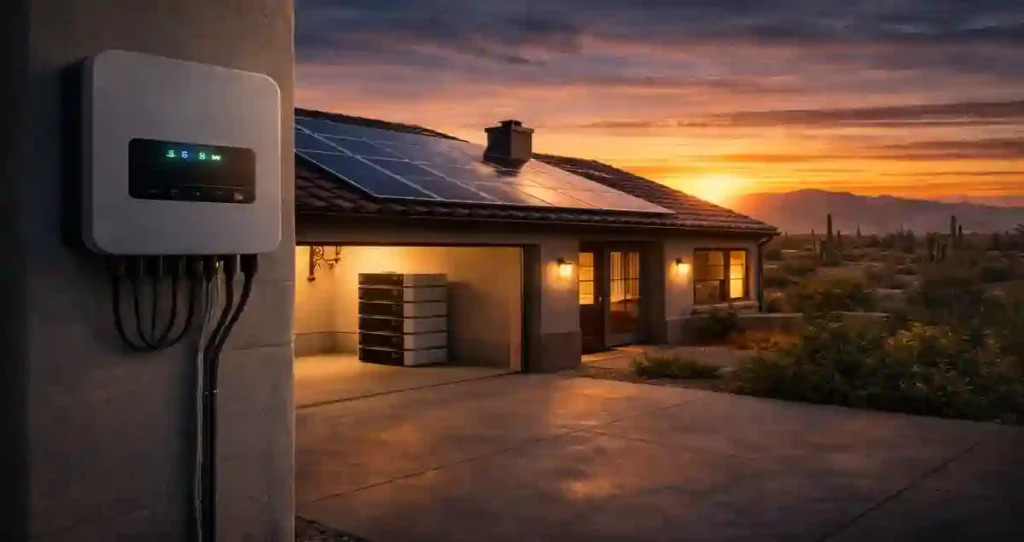
Location: Mesa, Arizona (High Cooling Demand)
System Configuration:
- Inverter: Solis S6-EH1P (11.4 kW)
- Storage: 36 kWh High-Voltage Battery Pack
- Array: 12 kW Bifacial PV Modules
The Challenge
The client was facing monthly utility bills exceeding $450 during Arizona summers, primarily due to Time-of-Use (TOU) rates, where electricity costs tripled between 4:00 PM and 9:00 PM. Frequent monsoon-related grid flickers were also causing home office servers and sensitive electronics to reboot.
The Engineering Solution
We implemented a Peak-Shaving Strategy using the Solis S6’s AI-driven energy manager:
- Solar Self-Consumption: During daylight hours, the 12 kW bifacial array powered the home and charged the 36 kWh battery.
- AI Energy Arbitrage: At 4:00 PM, the system automatically switched the home to battery power, avoiding the most expensive utility rates.
- UPS Integration: Using Solis’s <10ms fast-switching capability, the system handled monsoon-related grid surges seamlessly—desktop PCs and medical equipment didn’t even flicker.
The Results (2026 Data)
| Metric | Result |
|---|---|
| Monthly Bill Reduction | $450 → $45 (90% savings) |
| Grid Independence | 92% autonomous operation |
| Projected Payback | ~6.2 years with local incentives |
Engineer’s Insight:
This project highlights why the hybrid capability of modern inverters is critical. A standard grid-tie system would have left the client in the dark during monsoon outages. By using a hybrid unit with AI management and high-performance batteries, we turned their home into a self-sustaining microgrid that reduces costs and maximizes efficiency every day.
How AI Optimizes Energy Trading and Peak Hour Savings in PV Inverter Hybrid
Modern hybrid inverter solar systems use AI-driven energy management to optimize how solar power, batteries, and grid electricity are used throughout the day. Instead of using energy in a fixed pattern, AI analyzes usage behavior, electricity rates, weather forecasts, and battery status to make smarter real-time decisions.
During the daytime, AI prioritizes using solar energy and charging batteries when production is high and electricity prices are low. During peak hours, when utility rates are higher, the system automatically switches to battery power to reduce grid consumption and lower electricity costs.
AI also enables smart energy trading, deciding when to export excess solar energy to the grid for maximum financial return and when to store it for later use. Over time, the system learns household or business consumption patterns and continuously improves efficiency, maximizing ROI, reducing waste, and improving overall system performance.
Solar AI: Lower Your Monthly Electricity Bills Effortlessly
By automatically shifting energy usage away from expensive peak hours and maximizing self-consumption of solar power, Solar AI helps reduce monthly electricity bills without manual effort. The system continuously fine-tunes charging, discharging, and grid interaction to ensure you get the lowest possible energy cost with maximum savings.
Compatibility with Other Components & Maintenance
A hybrid inverter solar system works best when it is compatible with all essential solar components:
- Solar Panels: Most hybrid inverters support monocrystalline, polycrystalline, bifacial, and Topcon panels, giving flexibility to maximize energy yield, space efficiency, and long-term performance.
- MC4 Connectors: Standard MC4 connectors provide safe, reliable connections between panels and the inverter, reducing energy loss and simplifying installation.
- Batteries: Hybrid inverters integrate with lithium-ion, lead-acid, and branded batteries like Tesla Powerwall, LG Chem RESU, Enphase Encharge, Growatt, and Solis, providing flexible energy storage options.
- Charge Controllers: Compatible with both MPPT and PWM controllers, ensuring efficient charging and long battery life.
- Solar Kits: Pre-packaged residential and commercial solar kits can be used with hybrid inverters, simplifying setup while maintaining optimal performance.
Maintenance for Maximum Performance
Hybrid inverters are designed for low maintenance, but a few simple practices ensure long-term efficiency and reliability:
- Check connections regularly, including MC4 plugs, cables, and inverters.
- Monitor battery health and ensure charge controllers are functioning properly.
- Clean solar panels periodically, including bifacial and Topcon panels, to remove dust, dirt, or bird droppings — even a thin layer of dirt can reduce energy output by up to 20%.
- Use remote monitoring tools, which alert you to system issues before they affect performance.
Proper maintenance ensures your hybrid inverter system continues to deliver reliable, efficient, and cost-saving energy for years.
Conclusion: The Future of Solar with Modern Hybrid Inverters
Modern hybrid inverter solar systems are more than just inverters—they are intelligent energy managers. By integrating AI-powered energy optimization, these systems decide the best way to use solar power, when to charge batteries, and when to draw from or feed into the grid.
Pairing hybrid inverters with high-efficiency solar panels, including Topcon and bifacial technology, allows homes and businesses to capture more energy from the same sunlight, improving overall system performance. When combined with advanced battery solutions like Tesla Powerwall, LG Chem RESU, Enphase Encharge, Growatt, or Solis, users gain reliable backup power and smart energy trading capabilities.
From maximizing self-consumption to reducing electricity bills and enhancing ROI, the modern hybrid inverter is the turning point in solar energy systems. For anyone seeking efficient, scalable, and future-ready solar power, these intelligent systems deliver unmatched efficiency, savings, and energy independence.
Frequently Asked Questions (FAQs) About Hybrid Inverter Solar Systems
Can I use a hybrid inverter without a battery?
Yes, many hybrid inverters can operate without batteries. In this setup, they function like a grid-tied inverter, sending solar power directly to your home or the grid. However, without a battery, you won’t have backup power during outages or the ability to store excess solar energy for peak-hour savings.
What types of solar panels are compatible with hybrid inverters?
Hybrid inverters support a wide range of panels, including monocrystalline, polycrystalline, bifacial, and Topcon solar panels. This flexibility allows you to choose panels based on efficiency, space, and budget requirements.
Can I expand my system in the future?
Yes. Modern hybrid inverters are scalable. You can add more panels, batteries, or even an EV charger later without replacing the inverter, making your system future-proof.
How does AI help reduce my electricity bills?
AI in hybrid inverters analyzes consumption patterns, weather, and electricity rates to decide when to use solar power, store it in batteries, or draw from the grid. This smart energy management maximizes self-consumption and saves money on peak-hour utility rates.
Do hybrid inverters require a lot of maintenance?
Hybrid inverters are designed for low maintenance. Regular checks of connections, MC4 plugs, batteries, and controllers, along with periodic cleaning of solar panels, are usually sufficient. Many systems also include remote monitoring to detect issues early.
Are hybrid inverters safe and code-compliant?
Yes. Most hybrid inverters in the U.S. comply with NEC Articles 690 & 706, are UL 1741 listed, and meet IEEE 1547 grid standards, ensuring safe and approved operation with the utility grid.
Can hybrid inverters be used for off-grid or portable applications?
Absolutely. Hybrid inverters are ideal for off-grid homes, cabins, RVs, boats, farms, and microgrids, providing flexible, reliable power wherever needed.