
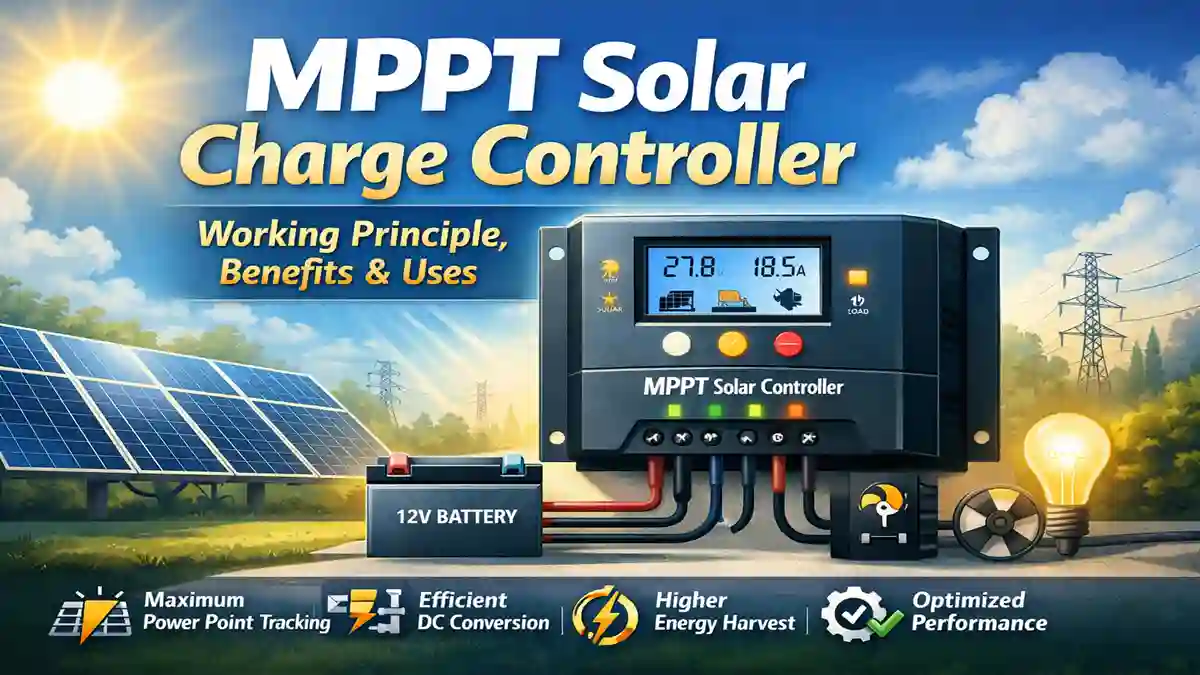
An engineer-led guide to MPPT solar charge controllers covering working principles, benefits, and real projects, based on practical experience in DC and inverter-less solar systems.
Solar energy systems are rapidly shifting toward simpler, more efficient, and inverter-less designs. At the center of this transformation is the MPPT solar charge controller, a technology that allows solar panels to deliver maximum usable power under real-world conditions.
Whether you are designing a DC solar system for a home, an NGO school, a public institution, or a commercial facility, understanding how MPPT charge controllers work is essential, this guide explains the working principle, real benefits, practical use cases, and why MPPT technology is becoming the backbone of modern solar power systems.
⚠️ Electric Shock Warning: MPPT solar charge controllers handle high DC voltages. Always switch off the power before touching wiring or components. Use insulated tools and protective equipment.
What Is an MPPT Solar Charge Controller
An MPPT solar charge controller is an intelligent DC-DC power conversion device that continuously tracks the maximum power point of a solar panel and converts it into the most efficient voltage and current for use by DC loads or batteries.
Unlike basic controllers, MPPT technology adapts to changing sunlight, temperature, and load conditions, ensuring maximum energy extraction throughout the day.
This makes MPPT charge controllers up to 35 percent more efficient than conventional controllers.
How MPPT Solar Charge Controllers Work
Solar panels do not produce a constant voltage. Their output varies depending on sunlight intensity, panel temperature, and electrical load.
An MPPT charge controller works by:
- Measuring solar panels voltage and current in real time
- Calculating instantaneous power output
- Adjusting its internal DC-DC conversion ratio
- Locking the panel at its optimal operating point
- Delivering stable and efficient DC power
This tracking happens multiple times per second, allowing the controller to respond instantly to cloud cover and temperature changes.
MPPT Solar Charge Controller Oscilloscope Display
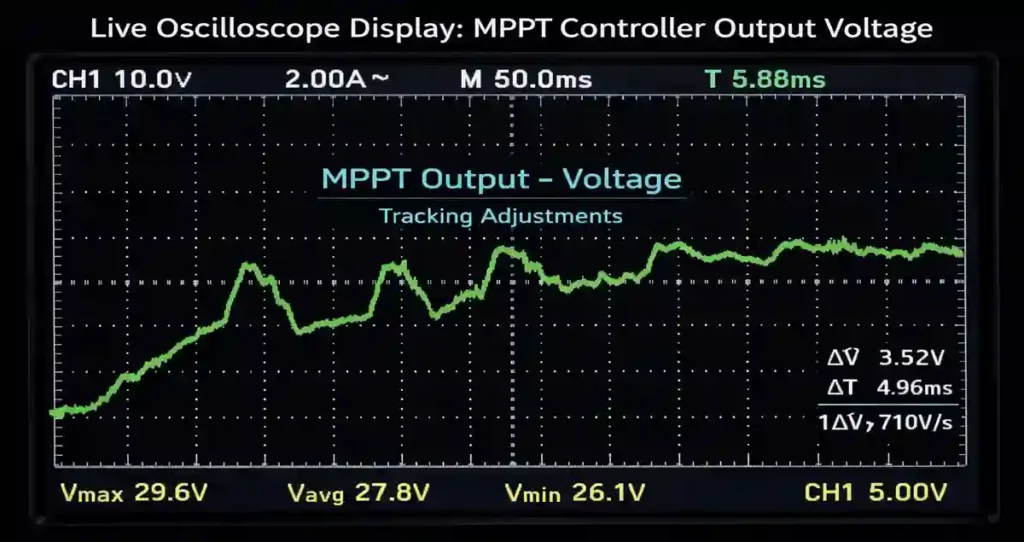
The oscilloscope display illustrates the real-time output of an MPPT solar charge controller, highlighting how it efficiently regulates voltage to DC loads. Key observations include:
- Voltage Tracking: The green waveform shows voltage fluctuations as the controller adjusts to maintain the Maximum Power Point.
- Voltage Range: Output voltage varies between 26.1V (Vmin) and 29.6V (Vmax), with an average of 27.8V, demonstrating stable regulation under changing solar irradiance.
- Tracking Adjustments: The waveform peaks and valleys indicate continuous MPPT adjustments to maximize energy harvest from solar panels.
- High Efficiency: The smooth voltage profile ensures minimal energy loss and reliable DC output for direct-powered loads.
- Technical Insights: The display is useful for monitoring system performance, verifying MPPT operation, and troubleshooting voltage or current anomalies.
Conclusion: This visual confirms the MPPT controller’s ability to maximize solar energy extraction, provide stable DC output, and support direct DC applications such as schools, offices, and off-grid systems.
Why MPPT Charge Controllers Are Better Than PWM
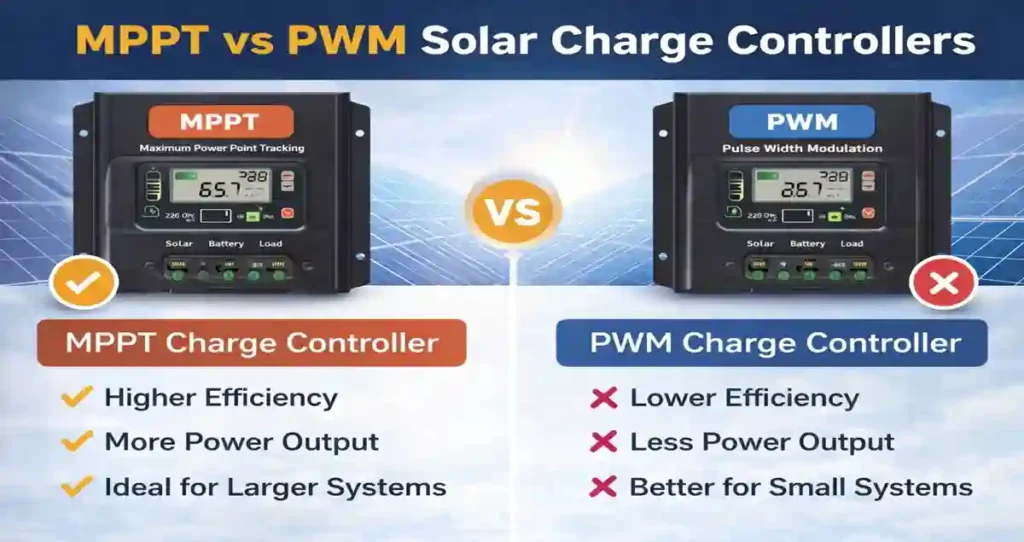
Traditional PWM (Pulse Width Modulation) controllers regulate solar panel voltage by matching it to the battery voltage. While simple, this wastes a large portion of the panel’s potential energy. Excess voltage is lost as heat, and low-light performance is poor. PWM also forces high currents over long cables, increasing losses in larger systems.
MPPT (Maximum Power Point Tracking) controllers solve these issues by electronically converting excess voltage into usable current and continuously tracking the panel’s optimal operating point. This ensures maximum energy extraction under all sunlight conditions.
Key Advantages of MPPT
- Higher energy harvest – up to 20–35% more than PWM controllers.
- Better low-light performance – works efficiently during cloudy or winter conditions.
- Reduced cable losses – higher voltage and lower current reduce energy loss.
- Supports high-voltage panel strings – allows flexible system design.
- Easy scalability and expansion – perfect for growing setups or larger installations.
- Compatible with solar panel kits – integrates seamlessly with off-grid kits, portable solar kits, and pre-packaged solar solutions for homes, schools, or offices.
Real-World Example
A 1 kW solar array with a 24V battery:
- PWM controller delivers ~700–750 W peak
- MPPT controller delivers ~900–950 W peak
This extra energy can power more DC fans, lights, or appliances, saving hundreds annually in electricity costs.
Summary
| Feature | PWM | MPPT |
|---|---|---|
| Energy Harvest | Limited | 20–35% higher |
| Low-Light Performance | Poor | Excellent |
| Voltage Flexibility | Low | High |
| Cable Losses | High | Low |
| System Scalability | Limited | Flexible |
For modern solar installations, MPPT controllers are the standard. They maximize efficiency, reduce losses, and enable reliable, scalable solar systems.
Smart & AI Role in MPPT Solar Charge Controllers
Modern MPPT solar charge controllers are not just electronics—they are becoming smart energy management devices. By integrating AI algorithms and IoT connectivity, solar AI can optimize solar energy harvest more intelligently than ever.
How Smart MPPT Controllers Work
- Predictive Maximum Power Point Tracking
AI algorithms analyze weather forecasts, solar panel performance, and historical data to predict the optimal operating point. This allows the controller to extract more energy even before sunlight changes. - Load Management and Scheduling
Smart controllers can prioritize loads automatically. For example, during low sunlight hours, essential DC appliances like fans or lights get priority, while non-critical loads are reduced. - Remote Monitoring & Diagnostics
Connected controllers provide real-time data on solar generation, battery status, and energy consumption via apps or web dashboards. AI alerts potential system issues before they cause downtime. - Adaptive Efficiency Improvement
AI continuously learns from the system’s performance, adjusting voltage, current, and load allocation to maximize efficiency. Over time, this reduces energy losses and improves ROI.
MPPT Solar Charge Controllers in DC Solar Systems
One of the most significant advantages of MPPT technology is its ability to support DC-only solar systems. These systems operate without inverters and, in many cases, without batteries, which simplifies installation and reduces energy losses. This makes them especially suitable for applications where electricity is mainly needed during daylight hours.
Ideal Applications for DC Solar Systems
DC solar systems powered by MPPT controllers are highly effective for:
• Schools – Classrooms can run fans, lights, and computers directly from solar energy during school hours, ensuring uninterrupted learning without grid dependency.
• Offices – Daytime lighting, air circulation, and networking equipment can operate efficiently without relying on grid electricity, reducing energy costs.
• Training Centres – Equipment such as projectors, lights, and small devices can use direct DC power, allowing workshops and sessions to run smoothly.
• Off-Grid Systems – Remote cabins, off-grid living, rural homes, and field stations can rely entirely on solar energy, providing electricity in areas without grid access.
• Portable Solar Systems – Mobile setups, including vans, RVs, and expedition vehicles, can power fans, LED lights, charging points, and small appliances efficiently while on the move.
• Clinics – Essential DC-powered medical equipment, lights, and fans can run smoothly during peak sunlight hours, ensuring reliable healthcare support in areas with unstable grid power.
• Community Buildings – Halls, meeting rooms, and shared facilities benefit from direct solar energy without complex infrastructure, lowering operational costs and maintenance requirements.
• Agriculture & Solar Water Pumps – DC solar pumps can supply irrigation water, livestock watering systems, and small-scale hydro needs efficiently, reducing reliance on diesel or grid electricity.
How MPPT Enhances DC Systems
MPPT controllers regulate the solar power directly to DC loads, such as DC fans, DC LED lights, routers, and computers. This approach offers multiple advantages:
• Eliminates conversion losses – By bypassing inverters, energy is delivered directly where it is needed.
• Reduces maintenance – Fewer components, no inverter or battery replacement needed.
• Higher reliability – Direct DC systems are simpler and less prone to failures.
• Cost-effective – Lower installation and operational costs make DC solar systems highly affordable for schools, NGOs, and community projects.
For organizations that operate primarily during daylight, such as NGO schools or daytime clinics, DC solar systems with MPPT solar charge controllers are the most efficient and sustainable choice.
Real-World Case Study: NGO School with 14 Classrooms Using MPPT DC Solar
NGO and public schools are perfect candidates for MPPT solar charge controller-based DC solar systems because their energy use aligns with daylight hours. Below is a real-world example of a school where we implemented this system.
Classroom Load Profile
Each classroom uses:
• Two DC BLDC fans
• Two DC LED lights
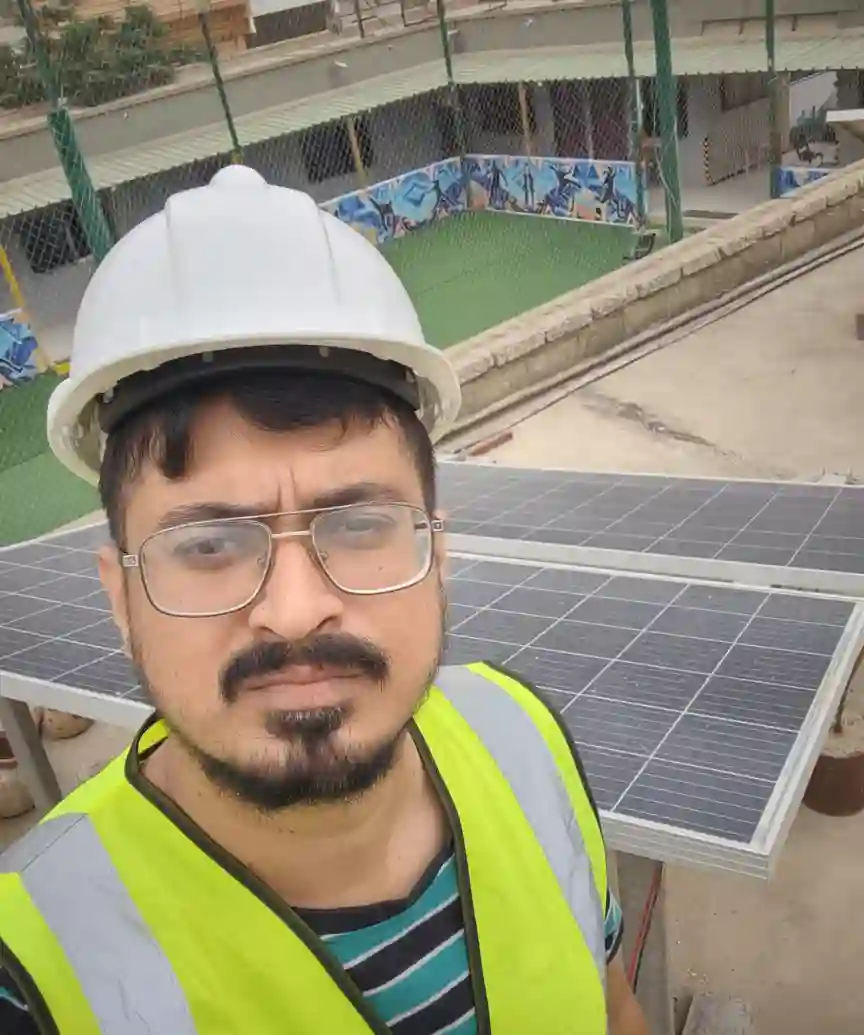
The average load per classroom is approximately 75 watts. Total connected load for 14 classrooms is around 1.1 kW. Daily operation is 6–7 hours, resulting in a daily energy demand of approximately 7–8 kWh.
System Design Approach
- Solar panels sized above peak load to ensure sufficient power
- MPPT solar charge controller for precise voltage regulation
- Direct DC distribution to classrooms for efficient energy use
- No inverter required, simplifying the system
- Battery storage optional; daytime operation allows a battery-less design
- Inrush Current Management: Controllers include Soft Start or slightly higher amperage capacity to handle the startup surge from multiple BLDC fans and prevent system trips
Because the school operates during peak sunlight hours, energy generation exceeds consumption, even during partially cloudy conditions.
Results and Benefits
• Zero reliance on grid electricity during school hours
• No battery replacement or theft risk (if battery-less)
• Silent operation
• Minimal maintenance
• Long system lifespan
• Predictable power availability
This design is scalable and suitable for NGO schools globally, including Africa, South Asia, Latin America, and remote communities worldwide.
Calculation: NGO School with 14 Classrooms Using MPPT DC Solar
1. Classroom Load
Each classroom:
- 2 × DC BLDC Fans → 60W each → 2 × 60 = 120W
- 2 × DC LED Lights → 10W each → 2 × 10 = 20W
Total per classroom = 120 + 20 = 140W
14 classrooms total load = 140 × 14 = 1,960W ≈ 2 kW
(Slightly higher than 1.1 kW earlier, using updated fan specs for global calculation)
2. Daily Energy Consumption
Assuming 6 hours/day operation:
- Total daily energy = 1.96 kW × 6 hours = 11.76 kWh/day
Monthly (30 days): 11.76 × 30 = 352.8 kWh/month
Yearly: 11.76 × 365 ≈ 4,289 kWh/year
3. Solar Generation
- Each 550W panel generates ~4.5 kWh/day under good sunlight (global average, 4–5 peak sun hours/day)
- 10 panels → 10 × 4.5 ≈ 45 kWh/day
But the system only supplies school daytime load (11.76 kWh/day), so solar generation easily covers demand with excess capacity for cloudy days.
4. Grid Electricity Savings
Assuming cost of electricity $0.15/kWh (global average):
- Daily savings = 11.76 × 0.15 ≈ $1.76/day
- Monthly savings = 1.76 × 30 ≈ $52.8/month
- Yearly savings = 1.76 × 365 ≈ $642/year
5. ROI Calculation
Total system cost = $4,104
- ROI = Total Cost / Annual Savings ≈ 4,104 / 642 ≈ 6.4 years
Notes:
- If the electricity cost is higher ($0.20/kWh), the ROI drops to ≈ 5.1 years
- With an optional battery backup, cost rises, but the system can operate at night
6. Benefits Summary
- Zero grid reliance during school hours
- Minimal maintenance, no inverter required
- Silent, reliable operation
- Faster deployment and lower upfront cost
- Scalable for schools and NGOs globally
Quick Overview: NGO School MPPT DC Solar System
| Item | Quantity / Specs | Unit Cost (USD) | Total Cost (USD) | Notes |
|---|---|---|---|---|
| 550W Tier-1 Solar Panel | 10 × 550W, Monocrystalline, 25–30 years lifespan, 20–22% efficiency | 150 | 1,500 | Panels sized above peak load (1.1 kW) for 14 classrooms |
| MPPT Charge Controller | 1 × 40–60A, 24–48V DC input, max efficiency ≥99%, LCD display | 300 | 300 | Regulates voltage, tracks Maximum Power Point, optimizes DC output |
| LiFePO4 Battery (optional) | 0 × 24V, 100Ah, 2000+ cycles, BMS protected | 1,000 | 0 | Optional; not required for daytime operation |
| DC BLDC Fans | 28 × 24V DC, 50–60W, 3-speed, brushless, silent operation | 60 | 1,680 | Two fans per classroom, energy-efficient and long-lasting |
| DC LED Lights | 28 × 10W DC LED bulbs, 24V DC, >80 CRI, 50,000 hrs lifespan | 8 | 224 | Two LED bulbs per classroom, low heat, direct DC powered |
| Wiring & Installation | Copper wiring, fuse/protection, mounting hardware | 400 | 400 | Includes safety protections, panel mounting, and DC distribution |
| Total System Cost | — | — | 4,104 | Cost-effective, battery-less design suitable for daytime school operation |
Why Schools Are Ideal for Battery-Less MPPT Systems
Schools operate when sunlight is strongest.
This simple alignment eliminates the need for batteries and solar inverters.
Key benefits for schools include:
• Lower capital cost
• Faster implementation
• No learning disruption due to power outages
• Reduced technical complexity
• Donor and CSR friendly design
This approach is especially suitable for NGO-funded and government-supported education projects.
MPPT Solar Charge Controller Using LT3652
For low-power solar applications, an MPPT solar charge controller using LT3652 is commonly used.
The LT3652 is a monolithic buck battery charger IC with built-in MPPT functionality. It is designed for small-scale energy harvesting applications such as:
• IoT devices
• Embedded solar systems
• Educational and laboratory projects
• Portable DC charging solutions
While LT3652-based designs are excellent for low-power systems, large installations require a dedicated high-current MPPT solar charge controller.
Quick MPPT Solar System Maintenance
- Solar Panels: Clean every 2–3 months with soft cloth & water; avoid abrasives.
- MC4 Connectors: Check tightness & corrosion; clean or replace if needed.
- MPPT Controller: Verify settings, keep ventilated, check display/LEDs.
- Wiring & Loads: Inspect cables, fuses, and voltage at loads.
- Batteries (if any): Monitor voltage (LiFePO4) or electrolyte (lead-acid).
- Safety: Turn off system before maintenance; wear insulated gloves.
Tip: Regular solar panel cleaning keeps efficiency high and maximizes energy harvest.
⚠️ Danger: Before performing any maintenance, disconnect all solar panels and DC loads. Failure to do so may result in serious electric shock or injury
MPPT Buyer’s Checklist: Finding the “Heart” of Your Kit
When choosing an MPPT solar charge controller, consider these essential factors to ensure maximum efficiency and long-term reliability:
- Efficiency Rating: Ensure the controller specifies at least 98% peak efficiency for optimal energy harvest.
- PV Input Voltage ($V_{oc}$): Verify that the controller can handle at least 20% higher voltage than your solar panel’s Open Circuit Voltage to protect against cold-weather spikes.
- Output Compatibility: For school projects or daytime-only loads, check it supports 24V/48V DC output without a battery (battery-less mode).
- Monitoring Features: Look for a built-in LCD display or Bluetooth/Wi-Fi app support to monitor real-time Maximum Power Point tracking.
- Heat Management: High-quality MPPTs include aluminum heat sinks or internal fans; avoid plastic-only casings in high-current systems to prevent overheating.
Following this checklist ensures your MPPT controller delivers reliable, efficient, and hassle-free performance, making it the true “heart” of your solar kit.
MPPT Solar System FAQs
What is an MPPT solar charge controller?
MPPT solar charge controller device that maximizes the energy harvested from solar panels by adjusting voltage and current to match the battery or DC load.
Why use MPPT instead of PWM?
An MPPT solar charge controller harvests more energy, works better in low light, supports high-voltage panels, and reduces cable losses.
Can I run DC fans and LED lights directly without an inverter?
Yes! MPPT systems can supply power directly to DC loads, such as fans, LED lights, routers, and small appliances.
Do I need batteries for daytime use?
Not always. For schools, offices, or daytime-only loads, MPPT systems can operate battery-less. Batteries are needed for night or backup use.
How often should I clean solar panels?
Every 2–3 months, or more frequently in dusty areas. Use a soft cloth or sponge with water; avoid abrasives.
How do I maintain MC4 connectors?
Check for tightness and corrosion, clean with a dry cloth, and replace if damaged.
What maintenance is required for MPPT systems?
Regular inspection of panels, wiring, connectors, and controller; clean panels; ensure safe connections; monitor battery (if any).
Can MPPT solar systems work globally?
Yes! They are suitable for schools, offices, clinics, off-grid homes, portable setups (RVs, vans), and agricultural pumps worldwide.
What is a smart or app-supported MPPT controller?
Smart MPPT controllers connect to your phone via Wi-Fi or Bluetooth. You can monitor system performance, voltage, current, and energy production in real time, set alerts, and optimize your solar setup remotely using the app.
Are smart MPPT controllers worth it?
Yes! They provide real-time monitoring, remote diagnostics, historical data tracking, and help detect issues early, improving efficiency and system lifespan.