

Discover the truth about off-grid living in 2026. Learn how off-grid solar systems, batteries, and kits can power your home efficiently and sustainably
Most homeowners struggle with “energy anxiety” because their systems are built on guesswork. As a professional engineer, I’ve seen that the key to a stress-free experience lies in selecting a precision-matched off-grid solar system for home use that balances generation and consumption in real-time.
Whether you are starting with a DIY off-grid solar system kit or investing in high-end off-grid solar system packages with batteries, the “secret” is a system designed to work with your lifestyle, not against it.
What is Off-Grid Living? Defining Independence in 2026
In 2026, off-grid living means having full control over your home without relying on public utilities like electricity, water, or gas. Modern off-grid homes integrate solar power, battery storage, and intelligent energy systems with internet and mobile connectivity via 4G and 5 G networks. This allows residents to stay connected, work remotely, and enjoy modern comforts while living sustainably and independently.
As a professional engineer, I categorize this lifestyle into two distinct paths:
The Recreational Retreat: Utilizing modular off-grid solar system kits to power luxury weekend escapes and holiday cabins with zero noise and zero emissions.
The Permanent Homestead: Integrating a full-scale off-grid solar system for home use that supports a family 365 days a year, providing the same comfort as a city apartment but with total energy security.
The Global Trend of Off-Grid Living: 2020 to 2026
The shift toward independence has been a global explosion. In 2026, off-grid solar system packages with batteries are now more reliable than the central grid in many regions.
- 2020–2022 Catalyst: Pandemic caused millions to rethink urban density. Investment hit a record $457 million in 2021.
- 2023–2024 Energy Crisis: Electricity prices spiked over 20%. The industry reached 560 million people globally.
- 2025–2026 Tech Boom: Pakistan added 17 GW of solar in one year. Global clean energy investment reached $2.2 trillion, making Precision Autonomy the standard.
The 2026 Off-Grid “Hotspots”: Where the Trend is Exploding
Residents in these hubs lead the “Great Disconnection.” The table shows how Location (Lifestyle) dictates Solar Strategy (Engineering):
| High-Trend City | Why Residents are Leaving | Target Off-Grid Spot | Solar Potential (PSH) | System Strategy |
|---|---|---|---|---|
| New York, US | High taxes & Energy costs | Catskills / Adirondacks | 3.8 – 4.2 | Storage Focus: Large LiFePO4 banks for winter |
| London, UK | Burnout & Utility hikes | Mid-Wales / Highlands | 2.5 – 2.8 | Efficiency Focus: N-Type panels + Wind kits |
| Sydney, AU | Real estate inflation | Blue Mountains | 4.2 – 5.5 | Total Autonomy: High-output 10kW+ systems |
| Austin, US | Grid instability (Texas) | Texas Hill Country | 4.8 – 5.2 | Resilience Focus: Heat-tolerant battery tech |
| Toronto, CA | Urban density & Pollution | Muskoka Lakes | 3.5 – 4.5 | Snow-Ready: Bifacial panels for albedo gain |
| Madrid, ES | Heatwaves & Cost of living | Alicante Outskirts | 5.0 – 5.3 | Fast ROI: Maximum sun harvesting |
| Mumbai, IN | Space & Air quality | Sahyadri Ranges | 4.8 – 5.4 | Weatherproof: High-tier monsoon protection |
| Karachi, PK | Power tariffs & Unreliability | Thatta / Gharo | 5.2 – 5.8 | Infrastructure: Heavy-load permanent kits |
The 2026 Verdict: Why Engineering the Move Matters
- Global Shift: From NYC to Karachi, autonomy is a high-tech lifestyle choice.
- Lifestyle Meets Logic: True peace of mind requires an off-grid solar system matched to your load profile.
- Financial Freedom: Pre-pay for 25 years of energy with off-grid solar system packages with batteries.
- The Secret: Success isn’t about the land; it’s about the engineered off-grid solar system kit that powers your dream.
What is an Off-Grid Solar System?
- Financial Security: Grid costs rise ~4.5% annually, but a specialized off-grid solar system offers fixed-cost energy with 8-year payback.
- Mental Well-being: Eliminates “energy anxiety” and aligns your home with natural circadian rhythms.
- Environmental Impact: Household carbon footprint reduced by up to 20x compared to coal-based grid power.
An off-grid solar system is a standalone energy setup that operates independently of the public electrical grid. It allows homeowners, apartment dwellers, and small office owners to generate, store, and use electricity on their own, providing energy security, financial savings, and autonomy. It is perfect for off-grid living, giving full control over your power needs without relying on the utility grid.
Unlike grid-tied systems, off-grid solar setups work in both remote and urban locations, ensuring your home, apartment, or office has continuous power 24/7.

For urban homes, these systems provide reliable power for essential appliances, lighting, and air conditioning, while compact designs maximize rooftop or terrace space.
For small offices, off-grid solar ensures uninterrupted operation for computers, servers, and communication equipment, scaling to energy demand for efficiency and cost savings without expensive grid dependence.
The core of an off-grid system lies in its hardware components. Properly selected solar panels, batteries, solar inverters, and controllers ensure seamless performance, making it the ideal solution for off-grid living and delivering a stress-free energy experience.
Components of an Off-Grid Solar System
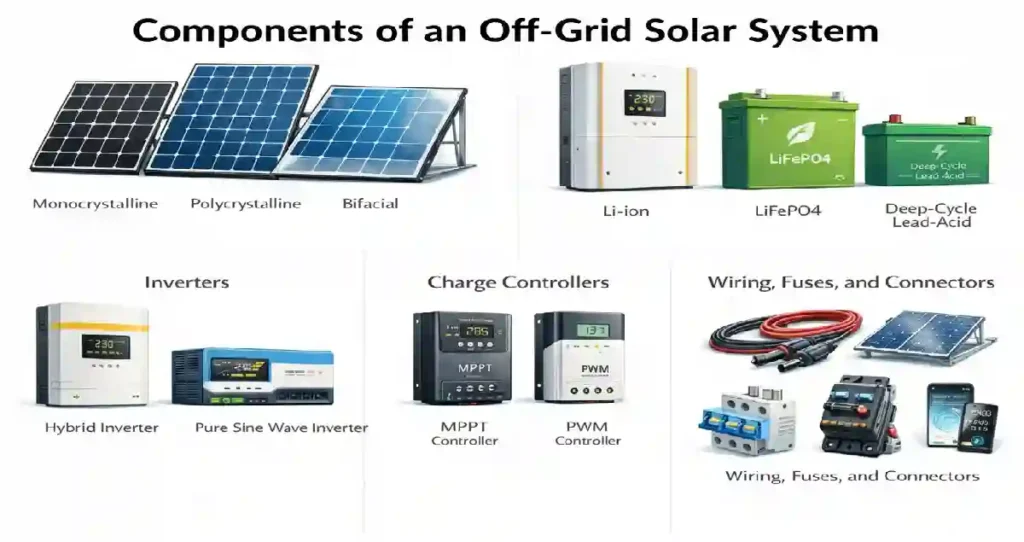
1. Solar Panels (Photovoltaic Modules)
- Capture sunlight and convert it into electricity.
- Types include monocrystalline, polycrystalline, and bifacial panels.
- High-efficiency panels are critical for maximum energy output in limited space.
- Selection by Region & Environment:
- High sun regions (e.g., Middle East, Australia): Monocrystalline panels for maximum efficiency.
- Cloudy or low-sun areas (e.g., Northern Europe): Bifacial panels for reflected light gain.
- Areas with snow or dust: Panels with self-cleaning coating or higher tilt angles.
- For DIY enthusiasts, follow our guide 7 Steps to Build Solar Panel Kits: Reliable Power for Home, Travel, and Emergencies for step-by-step setup.
2. Battery Storage
- Stores excess energy for use at night or during cloudy days.
- Common options: Li-ion, LiFePO4, and deep-cycle lead-acid batteries.
- Selection by Region & Environment:
- Hot climates: Use heat-tolerant LiFePO4 batteries.
- Cold climates: Ensure low-temperature rated batteries for reliable winter performance.
- High usage homes: Install high-capacity modular battery banks for 24/7 energy independence.
3. Inverters
- Convert DC electricity from panels and batteries into AC power for appliances.
- Pure sine wave inverters are best for sensitive electronics.
- Hybrid inverters allow integration of solar, batteries, and optional generator or grid backup.
- Selection by Region & Environment:
- Remote or harsh climates: Choose rugged, outdoor-rated inverters.
- Variable load homes: Hybrid inverters with smart load management.
- For automated energy optimization, consider Solar AI: Lower Your Monthly Electricity Bills Effortlessly to monitor and manage consumption.
4. Charge Controllers
- Protect batteries from overcharging and deep discharging.
- MPPT controllers maximize energy harvest by up to 30% compared to traditional PWM controllers.
- Selection by Region & Environment:
- High sun variability regions: MPPT recommended for efficiency.
- Small DIY setups: PWM controllers may suffice for simplicity and cost.
- Learn more in our detailed guide Solar Charge Controller: The Complete Guide for Safe and Efficient Solar Systems.
5. Wiring, Connectors, and Safety Devices
- Includes fuses, breakers, proper cables, and connectors to ensure safety and efficiency.
- Prevents voltage drops, overheating, and energy loss.
- Optional system monitoring devices help track performance in real-time.
- Selection by Region & Environment:
- Humid or coastal areas: Use corrosion-resistant cabling and connectors.
- High-load systems: Thicker gauge wiring to reduce voltage drop.
- Avoid failures caused by cheap connectors—see MC4 Connectors: The $1 Weak Point in Solar System Failures for best practices.
6. Optional Add-ons for Full Autonomy
- Solar Water Pumps: Ideal for farms and irrigation. Check Solar Water Pump Guide 2026: Best Types & Selection for the right choice.
- Portable Solar Generators: Great for cabins or modular setups.
- Smart Energy Monitors: Optimize consumption and system efficiency.
- Selection by Region & Environment:
- Agricultural zones: Solar pumps sized to water demand and sunlight availability.
- Remote or off-grid retreats: Portable generators for emergency backup.
- Urban fringe areas: Smart monitors to track peak usage and reduce waste.
By understanding these core components and selecting them according to regional sunlight, temperature, and environmental challenges, you can design a precision-matched off-grid solar system that provides reliable power, autonomy, and long-term sustainability.

Off-Grid Solar Mistakes: Why a 5kW System Won’t Always Meet Your Needs
When living off-grid, there is no backup power from the utility grid. Every watt of electricity you generate and store matters. Designing a system without proper calculation can lead to frequent power shortages, frustrated homeowners, and underutilized investment. This is why off-grid solar systems must be engineered carefully, considering daily energy yield, seasonal variations, and worst-case scenarios.
Many people make the mistake of buying a “5kW system”, assuming it will run a 5kW load continuously. In reality, the daily energy production (kWh/day) depends heavily on your location, climate, and season. Designing for your worst-performing month, not the best day, is crucial for reliable off-grid living.
Daily Energy Yield: 5kW Off-Grid Systems by Location
| Location | Typical 5kW System Yield (Daily kWh) | Notes |
|---|---|---|
| London, UK | 8 kWh (winter) | Cloudy winters, low irradiance |
| Toronto, Canada | 10 kWh (winter) | Snow reduces panel efficiency |
| New York, USA | 12–15 kWh | Moderate sun, seasonal variation |
| Sydney, Australia | 22 kWh | Seasonal storms may cause minor dips |
| Mumbai, India | 20 kWh | Monsoon months reduce daily output |
| Karachi, Pakistan | 25 kWh | High sun exposure, reliable daily yield |
Why This Calculation is Crucial
- No Backup Grid: In off-grid living, every kWh counts. If your system underperforms, there’s no alternative power source.
- System Longevity: Oversizing or undersizing batteries and inverters can shorten lifespan and reduce efficiency.
- Financial Efficiency: Accurate calculations ensure you invest only in what’s needed, avoiding unnecessary costs.
- Comfort & Reliability: Properly sized systems provide seamless power for lighting, appliances, and heating/cooling systems, even in cloudy or low-sun periods.
Engineering Insight: Always design your off-grid solar system for the worst month in your location, not the sunny days, to guarantee energy independence and peace of mind.
Sizing Your Off-Grid Solar System: 5kW, 10kW, and 15kW Packages
Choosing the right system size is crucial for off-grid living. Unlike grid-tied setups, there’s no backup power, so every watt must be carefully planned to match your energy needs. The right sizing ensures continuous power, efficiency, and financial value for homes, urban apartments, cabins, or small offices.
Here’s a breakdown of typical packages:
| System Size | Daily Energy Yield (kWh) | Ideal For | Off-Grid Living Use Case | Key Notes |
|---|---|---|---|---|
| 5kW | 8–25 kWh/day | Small urban homes, cabins, or home offices | Essential appliances, lighting, and small AC units | Compact rooftop or terrace systems. Best for limited space. |
| 10kW | 16–50 kWh/day | Medium homes, larger urban apartments, or offices | Powers multiple AC units, refrigerators, and small office equipment | Allows flexibility for future expansion. |
| 15kW | 25–75 kWh/day | Large homes, multiple offices, or high-demand cabins | Full comfort: heating/cooling, water pumps, and critical systems | Maximum autonomy for extended off-grid living. |
Key Considerations for Choosing the Right Size:
- Energy Audit First: List all appliances, lighting, and equipment you want to run off-grid.
- Regional Sunlight: A 5kW system in Karachi may yield 25kWh/day, but in London winter, it may only produce 8–10 kWh/day. Always plan for the worst month, not the best day.
- Future Expansion: Choose a slightly larger inverter and battery bank if you plan to increase energy use.
- Urban vs. Remote: Compact, modular systems work well for city rooftops; larger, multi-panel setups suit cabins or larger offices.
- Load Prioritization: Decide which devices are critical during outages to size your battery correctly.
Engineering Insight: Proper sizing ensures your off-grid system delivers reliability, comfort, and energy independence, making your off-grid living experience stress-free and fully autonomous.
Evaluating Off-Grid Solar System Packages with Batteries: An Engineer’s Checklist
Investing in off-grid solar system packages with batteries is the most critical financial decision of your transition. While panels last 25 years, the battery is the “consumable” part of your infrastructure. To ensure your package provides the best ROI, you must evaluate the storage bank using these four engineering parameters.
1. Useable Capacity vs. Nameplate Capacity
Don’t be fooled by the number on the box.
- Nameplate: The total energy the battery can hold.
- Useable (DoD): How much you can actually use without damaging the cells.
- The 2026 Standard: Only accept packages with LiFePO4 batteries offering 90% – 100% Depth of Discharge. If a package uses Lead-Acid (AGM/Gel), you can only use 50%, effectively doubling your cost per usable kWh.
2. The C-Rating (Discharge Power)
The C-Rating determines how fast you can pull power out of the battery.
- Example: A 10kWh battery with a 0.5C rating can only output 5kW at once. If you turn on two AC units and a pump, the battery might shut down even if it is full.
- Engineering Tip: For high-load homes in Karachi or Austin, look for batteries with a 1C rating to handle heavy start-up surges.
3. Cycle Life & “Cost Per Cycle”
A cheap battery is expensive if it dies in 3 years.
- LiFePO4: Typically rated for 6,000+ cycles (15+ years).
- Lead-Acid: Typically rated for 500–1,000 cycles (2–3 years).
- Calculation: Divide the total package price by the cycle life. You will find that Lithium packages are significantly cheaper over 10 years.
4. Communication (BMS Integration)
In 2026, your battery must “talk” to your inverter.
- Look for packages where the Battery Management System (BMS) integrates via CAN or RS485 communication. This allows the inverter to adjust charging based on the battery’s internal temperature and cell voltage, extending its life by years.
Quick Evaluation Table: Battery Standards for 2026
| Feature | Low-Tier Package | Engineer-Grade Package (Recommended) |
| Battery Chemistry | Lead-Acid / Gel | LiFePO4 (Lithium Iron Phosphate) |
| Depth of Discharge | 50% | 90% – 100% |
| Cycle Life | 1,000 Cycles | 6,000 – 8,000 Cycles |
| Safety | Risk of off-gassing | Thermal Stability (Non-combustible) |
| Weight | Heavy / Stationary | Compact / Modular (Wall-mounted) |
| Best Location | Temporary Cabins | Permanent Homes (Sydney, Toronto, etc.) |
The “Autonomy Rule”
When selecting off-grid solar system packages with batteries, I always recommend the 2.5× Rule:
Your usable battery capacity should be at least 2.5× your daily nighttime consumption.
This provides a reliable safety buffer for different regions:
| Location | Typical Environmental Challenge | Purpose of Safety Buffer |
|---|---|---|
| London, UK | Rainy and cloudy days | Ensures enough stored energy during extended low-sun periods |
| Karachi, PK | Dust storms and high temperatures | Maintains power when solar generation is temporarily reduced |
| New York, US | Snowy winters & short daylight | Covers energy needs during overcast or snow-covered days |
| Canada | Cold, overcast winters | Keeps essential appliances running despite low solar yield |
Off-Grid Solar System vs. Off-Grid Solar Panel Kit: Choosing the Right Path to Independence
When planning for off-grid living, understanding the difference between a complete off-grid solar system and an off-grid solar panel kit is crucial. Both provide energy independence, but the choice depends on your location, energy needs, and lifestyle.
1. Full Off-Grid Solar System
A full off-grid solar system is a professionally engineered setup designed for long-term, large-scale energy autonomy. It typically includes:
- Solar panels (high-capacity modules)
- Battery bank (LiFePO4 for maximum lifespan and DoD)
- Hybrid or high-capacity inverter
- MPPT charge controllers
- Proper wiring, mounting, and monitoring systems
Ideal For: Urban homes, small offices, or permanent off-grid cabins that require reliable 24/7 power for multiple appliances, solar air conditioning, and high-demand equipment.
Advantages:
- Tailored design for your specific load profile
- Optimized efficiency across all components
- Scalable for future energy expansion
2. Off-Grid Solar Panel Kit with Battery and Inverter
An off-grid solar panel kit is a pre-packaged, plug-and-play solution that makes transitioning to off-grid living simple. It includes solar panels, a battery, an inverter, and all necessary accessories, often designed for faster installation and moderate energy needs.
Ideal For
Apartments, small urban homes, cabins, or home offices that need a quick, reliable energy solution without custom engineering. It’s perfect for those starting their off-grid living journey in both urban and semi-urban settings.
Advantages
- Easier and Faster Installation: Pre-matched components minimize setup errors and reduce installation time.
- Compatibility Guaranteed: Panels, batteries, inverters, and controllers are designed to work together efficiently.
- Cost-Effective: Suitable for smaller energy requirements without the high investment of a full system.
How to Select the Right Kit for Off-Grid Living
When choosing a kit for your home or office, consider the following engineering and lifestyle factors:
- Energy Needs: Calculate your average daily consumption (kWh/day), including lighting, appliances, and AC units.
- Battery Capacity: Look for LiFePO4 batteries with high Depth of Discharge (DoD) and enough capacity to cover your night-time usage and cloudy days.
- Inverter Size: Ensure the inverter can handle your peak loads and startup surges for appliances like refrigerators or pumps.
- Panel Output: Match panel capacity to your daily energy needs and regional sunlight availability.
- Expansion Options: Choose a kit that allows you to add panels or batteries later if your energy demand grows.
- Accessories and Quality: Check for reliable MC4 connectors, mounting hardware, and included monitoring tools.
- Environmental Factors: Consider local weather, dust, snow, or heat. Some kits include weatherproofing for extreme conditions.
By evaluating these factors, you can select a kit that provides safe, efficient, and scalable energy independence, making your off-grid lifestyle stress-free from day one.
Choosing Between the Two
- Use a full system if you plan for high energy demands, long-term off-grid living, or want a system engineered for maximum reliability.
- Choose a kit if you’re starting small, want a simpler setup, or need moderate energy independence in urban or semi-urban locations.
Both options are perfect for off-grid living, but understanding the scale and requirements of your home or office ensures you select the right path to energy autonomy, reliability, and financial efficiency.
Maintenance & Safety: Keeping Your Off-Grid System Reliable
Living off-grid gives you energy independence, but it also comes with responsibilities. Proper maintenance and safety checks ensure your system runs efficiently and prevents costly downtime. For urban homes, cabins, or small offices, some care steps are simple, but others require careful planning.
1. Battery Maintenance
- Check Connections: Ensure cables are tight and corrosion-free.
- Monitor Health: Use your BMS to track voltage, temperature, and charge cycles.
- Avoid Deep Discharge: Even LiFePO4 batteries benefit from avoiding repeated full discharges beyond their rated DoD.
- Temperature Control: Keep batteries in ventilated, cool areas to maximize lifespan.
2. Inverter & Controller Safety
- Inspect Wiring: Loose or damaged wires can lead to sparks or downtime.
- Surge Protection: Use inverters with built-in surge capacity to handle heavy appliances like AC units or pumps.
- Firmware Updates: Some modern inverters (Growatt, Victron) can be updated to improve efficiency and add features.
- MPPT Optimization: Ensure the MPPT charge controller is properly configured for your panel type to extract maximum energy.
3. Solar Panel Cleaning
Living off-grid sometimes means you’re responsible for every drop of energy your system produces. Dust, pollution, and bird droppings can reduce output significantly.
- Scheduled Cleaning: Inspect panels every 2–3 months, or more frequently in dusty regions.
- Use Proper Tools: Select brushes and accessories designed for solar panels to avoid scratches.
- Link for Guidance: Check out Solar Panel Cleaning Tips and Solar Panel Cleaning Brush Options to pick the right tools for your off-grid setup.
- Safety First: Always clean panels from the ground when possible and avoid wetting electrical connections.
4. Preparing for Off-Grid Challenges
- Off-grid living is rewarding, but it can sometimes be harder than living with a grid connection. Plan for emergency backups for critical loads.
- Keep spare fuses, connectors, and accessories ready.
- Document your system: note panel layout, inverter settings, and battery specs for quick troubleshooting.
Conclusion
Living off-grid is no longer a niche lifestyle; it’s a choice for autonomy, reliability, and sustainability. Whether you select a full off-grid solar system or a pre-packaged solar panel kit, the key to success lies in engineering your system to match your energy needs, environment, and lifestyle.
From panels and batteries to inverters and charge controllers, every component plays a vital role in delivering continuous, stress-free power. With careful planning, proper maintenance, and smart selection of components, off-grid living can be a seamless, independent, and empowering experience for urban homes, small offices, cabins, or remote retreats.
Off-grid solar systems are more than equipment—they are your “Hardware of Independence,” giving you control, savings, and peace of mind.
FAQs:
How do I know what size off-grid system I need?
Start with a daily energy audit of all appliances, lighting, and heating/cooling needs. For off-grid living, always design for your worst month’s consumption, not the best day, to ensure uninterrupted power without relying on the grid.
Are off-grid battery-powered kits safe?
Yes. LiFePO4 batteries with proper BMS integration are safe and reliable. Following manufacturer installation and maintenance guidelines is crucial to maintain long-term off-grid independence.
How often should I clean solar panels in an off-grid setup?
Living off-grid means every kWh counts. Panels should be checked every 2–3 months, or more often in dusty or high-pollution areas. Use solar-specific brushes and accessories to avoid damage and maximize energy output.
Can off-grid systems be expanded later?
Yes. Many off-grid kits and full systems are modular, allowing you to add panels or batteries as your energy needs grow, maintaining full independence from the utility grid.
What is the difference between a full off-grid system and a kit?
A full off-grid system is engineered for high energy demands and long-term autonomy, ideal for permanent homes or offices. A kit is plug-and-play, cost-effective, and perfect for smaller homes, urban apartments, or beginner off-grid setups.
How long do off-grid solar systems last?
Typical solar panels last 25+ years, while batteries vary by type—LiFePO4 can last 15+ years with proper care. Inverters and controllers usually last 10–15 years, depending on usage.
Can I power air conditioning or heating off-grid?
Yes, but it requires careful sizing of panels, batteries, and inverters. Energy-efficient appliances and smart load management are recommended.
Do I need maintenance for an off-grid system?
Yes. Batteries, inverters, and panels require regular inspections and cleaning to ensure optimal performance and safety.
Can off-grid systems support internet and mobile connectivity?
Absolutely. With proper solar sizing and backup batteries, you can power routers, 4G/5G hotspots, and other communication devices.
What happens during prolonged cloudy or low-sun periods?
Battery banks sized for your worst month, along with optional generators, ensure uninterrupted power during extended cloudy or low-sun periods.
Does an off-grid system require a backup generator?
While not strictly required if your solar and battery bank are sized correctly, a small backup inverter-generator is a smart “insurance policy.” In 2026, many hybrid inverters can automatically start a generator if the battery falls below a 20% state of charge.
Is LiFePO4 really worth the higher price compared to Gel batteries?
Absolutely. While the upfront cost is higher, the Cost Per Cycle is significantly lower. A Gel battery may last 1,000 cycles, while a LiFePO4 lasts 6,000 plus. You would have to buy and install six Gel batteries over the lifespan of a single Lithium unit, making Lithium the cheaper and more reliable engineering choice.