
Maximize farm profits with Agrivoltaics. Our 2026 guide shows how Solar + AI slashes energy costs, saves water, and qualifies for US USDA REAP grants. Build a smarter, higher-yield farm today
For thousands of years, agriculture has been the heartbeat of human survival. From the first plowed fields to today’s high-tech farms, farming has always evolved alongside innovation. Now, with populations rising and climate change threatening crop yields, traditional methods alone may no longer meet global demand.
From my experience as an engineer working with solar-powered systems, I see immense potential in combining agrivoltaics, agricultural solar panels, and AI-driven farm management. These technologies are transforming underutilized lands into productive fields, optimizing water use, improving crop quality, and managing planting and harvesting with precision that was unimaginable just a few years ago.
Smart farming is more than just technology—it’s a movement toward sustainable, efficient, and intelligent farming. Farms are no longer merely plots of land; they are becoming self-sufficient ecosystems where food production and energy generation coexist, guided by data and powered by the sun. Understanding how to design and implement these systems is key to building a resilient and productive future for global agriculture.
Why Agriculture Needs Transformation
Global agriculture faces unprecedented challenges that threaten food security and sustainability:
Water Scarcity: Farming accounts for over 70% of the world’s freshwater usage, yet billions of people live in water-stressed regions. Droughts and erratic rainfall patterns make traditional irrigation insufficient for consistent crop growth.
Rising Energy Costs: Diesel-powered pumps, grid electricity, and fuel shortages drive up operational costs while increasing carbon emissions. Farmers often spend a significant portion of their revenue just powering their irrigation and farm machinery.
Unfertilized and Uncultivated Lands: Millions of acres remain idle—not because the soil is infertile, but because resources such as water, electricity, and affordable equipment are unavailable. These lands could feed communities if access to energy and irrigation were optimized.
Climate Change: Erratic weather patterns, floods, and heatwaves threaten crop yields, making traditional farming less reliable. Crops fail unpredictably, and farmers face financial instability.
Traditional methods alone cannot meet the demands of a growing population. Smarter, technology-driven solutions are no longer optional—they are essential for a sustainable future in agriculture.
What Is Agrivoltaics?
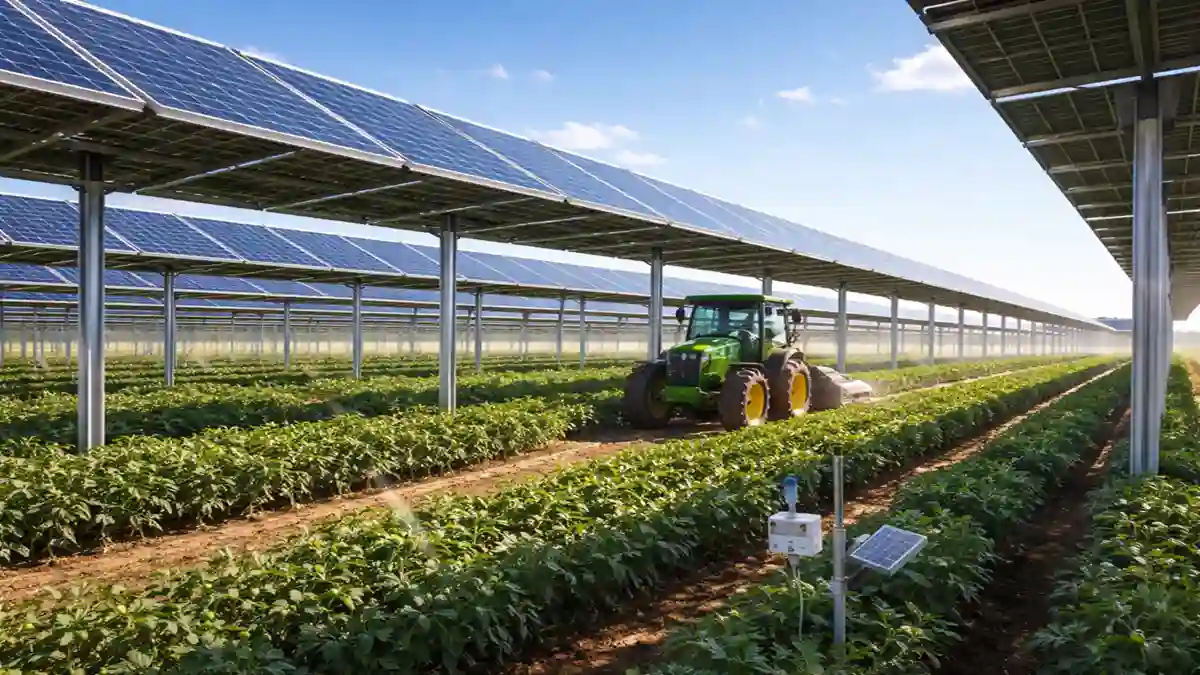
Agrivoltaics is the simultaneous use of land for agriculture and solar power generation. By elevating solar panels above crops, sunlight is shared between energy production and plant growth, creating a dual-use system that increases productivity and efficiency.
This system offers multiple advantages:
- Maximized Land Use: Farmers can harvest electricity and crops from the same plot.
- Reduced Crop Stress: Panels provide partial shading, protecting crops from excessive heat, reducing water stress, and improving growth conditions.
- Additional Revenue: Farmers earn income from electricity production in addition to crop sales.
- Environmental Benefits: Solar energy reduces dependence on fossil fuels, lowers greenhouse gas emissions, and contributes to sustainable agriculture.
In practice, agrivoltaic systems are carefully engineered to balance light for crops while maximizing solar energy output. This dual benefit makes agrivoltaics an attractive solution for both small and large-scale farms.
Types of Agrivoltaics
Agrivoltaics isn’t one-size-fits-all. Depending on the crops, climate, and farm objectives, various system types are employed to balance solar energy production with agricultural requirements. Understanding these types helps farmers choose what works best for their land.
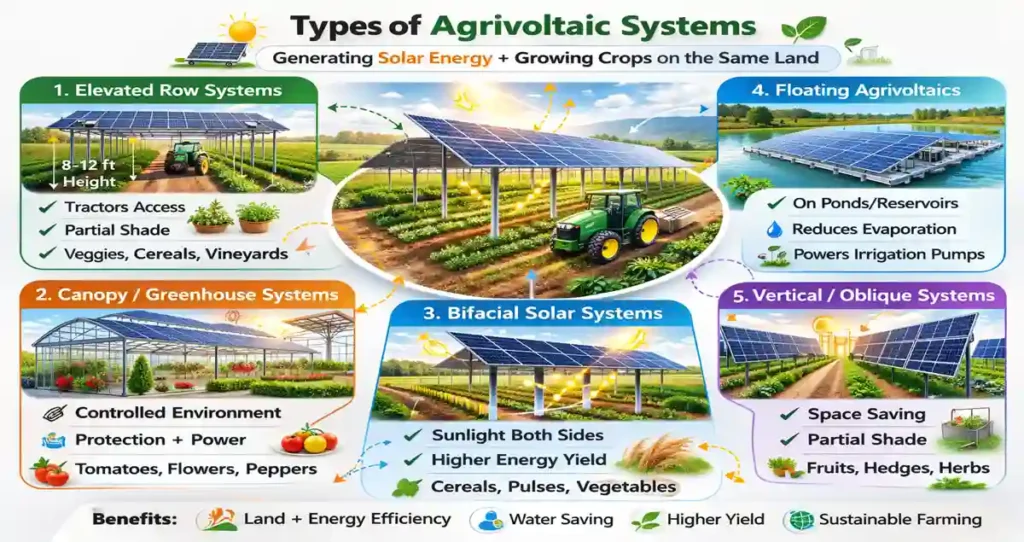
1. Elevated Row Systems:
The most common type of agrivoltaic setup, elevated row systems involve mounting solar panels on raised structures above the crops. This allows machinery like tractors and harvesters to pass underneath while letting crops receive partial sunlight. The height and spacing can be customized depending on crop type and equipment size. This system is particularly popular for vegetables, cereals, and vineyards, where partial shade actually benefits the plants by reducing heat stress and water evaporation.
2. Canopy or Greenhouse Systems:
Some farms integrate solar panels directly into greenhouse roofs. This type of agrivoltaics provides a controlled environment for plants while generating electricity. Crops benefit from protection against rain, pests, and extreme sunlight. Modern systems often utilize semi-transparent panels that allow sufficient sunlight for photosynthesis while efficiently generating energy. Greenhouse agrivoltaics works especially well for high-value crops like tomatoes, peppers, and flowers.
3. Bifacial Solar Systems:
Bifacial panels are designed to capture sunlight from both sides—direct sun on top and reflected light from the ground below. When installed above crops, they not only generate more energy but also create dappled light that improves plant health. This type works best in areas with highly reflective soil or mulch, as the ground reflection enhances energy output without harming crop growth.
4. Floating Agrivoltaics:
Though less common in traditional farming, floating agrivoltaics is gaining attention. Panels are installed on water bodies like ponds or irrigation reservoirs. These systems reduce water evaporation, provide energy for nearby irrigation pumps, and can even improve water quality by reducing algae growth. Floating systems are ideal for farms with limited land area but with available water surfaces.
5. Vertical or Oblique Systems:
In some cases, panels are installed vertically or at an angle to save space while generating electricity. These are often used for hedgerows, narrow fields, or areas with high land value. While they produce less energy than fully horizontal systems, they can coexist with crops that tolerate partial shade, making them a flexible solution for specific farm layouts.
Each type of agrivoltaic system has its own advantages and trade-offs. The choice depends on the farm’s crop type, machinery, climate, and energy needs. By selecting the right system, farmers can maximize both agricultural productivity and solar energy generation, turning every acre into a dual-purpose powerhouse.
How an Agrivoltaic System Works
An agrivoltaic system is designed to optimize both crop production and solar energy generation.
Key Components Include:
- Elevated Solar Panels: Mounted above crops to ensure sunlight reaches plants below. Height and spacing vary depending on crop type.
- Row Spacing and Panel Tilt: Proper spacing prevents shading while maximizing electricity output. Adjustable tilt angles capture sunlight throughout the day.
- Tracking Systems: Some panels follow the sun’s path, increasing energy yield without impacting crop growth.
- Integrated Irrigation: Solar-powered pumps supply water efficiently to crops underneath.
Operational Benefits:
- Produces renewable electricity for farm operations.
- Reduces dependency on external energy sources.
- Maintains or even improves crop yield due to partial shading and controlled microclimates.
Real-World Example: In France, agrivoltaic vineyards use panels above grapevines to reduce sun stress, improve grape quality, and sell surplus energy to the grid. Similar projects in the U.S. and Japan demonstrate higher efficiency per hectare compared to traditional separate farming and solar farms.
Agrivoltaic Systems: Technical Compatibility & Maintenance
Installing an agrivoltaic system is only the beginning. Long-term success depends on how well the solar infrastructure integrates with daily farm operations — from tractors and irrigation pumps to monitoring systems. When compatibility is engineered correctly, solar supports farming instead of interfering with it.
1. Structural & Machinery Compatibility
Agrivoltaic arrays must be designed around active farming. Panels are typically installed 8–12 feet high so tractors and harvesters can move freely underneath. Row spacing should match crop patterns and machinery width to avoid operational slowdowns. Because elevated systems face stronger wind exposure, racking structures must meet local structural and agricultural load standards.
2. Solar Panel Compatibility with Crops
Crop type determines panel selection.
- Monocrystalline panels maximize efficiency where space is limited.
- Bifacial panels perform well with reflective soil or mulch.
- Semi-transparent panels suit greenhouse or canopy systems.
Before installation, evaluate crop shade tolerance and seasonal sunlight shifts to protect yield.
3. Inverter & Power Integration
Farm energy demand fluctuates.
- String inverters work best with uniform sunlight exposure.
- Microinverters or optimizers reduce losses from partial shading.
- Hybrid inverters are essential if battery storage powers irrigation or monitoring systems.
Ensure MPPT voltage ranges align with your panel configuration and climate conditions.
4. Irrigation & System Synchronization
Solar water pumps must match array capacity and water depth requirements. Integrating moisture sensors and automated controls improves efficiency. If batteries are installed, prioritize critical loads like irrigation and monitoring equipment to maintain crop stability.
Maintenance for Long-Term Performance
Agrivoltaic systems operate in dusty, high-activity environments. Routine care protects both energy output and crop productivity.
Panel Cleaning:
Use soft brushes and deionized water. Clean weekly in dusty areas, less frequently in moderate climates. Avoid harsh chemicals; recommended solar cleaner.
Structural & Electrical Checks:
Inspect bolts, racking, wiring, and MC4connectors quarterly. Farm vibration and moisture can loosen hardware over time.
Vegetation Management:
Monitor crop height, tree growth, and weeds to prevent unintended shading.
Why Integration Matters
Agrivoltaics works best when solar, irrigation, machinery, and monitoring systems operate as one coordinated ecosystem. With proper compatibility planning and routine maintenance, systems can deliver reliable energy and stable crop yields for 25+ years — turning farmland into a true dual-purpose asset.
Agricultural Solar Panels: Powering Farms Beyond Dual-Use
While agrivoltaics focuses on sharing land for crops and energy, agricultural solar panels provide versatile ways to bring clean, reliable power to farms—even without affecting crop growth. These systems help reduce costs, increase efficiency, and support sustainable farming.
Applications in Agriculture
1. Solar Panels for Irrigation and Equipment
- Power irrigation systems, crop dryers, greenhouses, and farm lighting.
- Replace diesel or grid electricity, saving costs and emissions.
- Ensure consistent watering, post-harvest drying, and safe lighting.
2. Rooftop Installations
- Install on barns, sheds, and storage buildings to generate electricity without taking up farmland.
- Protect structures from sun, rain, and hail while producing power.
3. Solar Pumps for Water Delivery
- Enable irrigation in remote or previously uncultivated fields.
- Revive barren lands and increase productivity.
- Operate independently from the grid with zero fuel costs.
Options for Agricultural Solar Panels
Farmers can choose panel types based on farm size, crop needs, and budget:
| Panel Type | Efficiency | Best Use | Benefits |
|---|---|---|---|
| Monocrystalline | 18–22% | Roofs, limited space | High efficiency, long lifespan, performs in low light |
| Polycrystalline | 15–18% | Large open fields | Lower cost, durable, reliable |
| Bifacial | High, +10–15% | Agrivoltaic fields | Generates energy from top & reflected light, cooler operation |
| Semi-Transparent | Moderate | Greenhouses | Allows 30–50% sunlight through for crops, and produces electricity |
| Thin-Film / Flexible | 10–14% | Small pumps, irregular surfaces | Lightweight, affordable, flexible installation |
Recommended Solar Panel Setup for 2026
For most farms and agrivoltaic systems, the practical recommendation is:
- Bifacial panels for fields and agrivoltaic arrays – maximize energy without harming crops.
- Semi-transparent modules for greenhouses or light-sensitive crops – maintain crop growth while generating electricity.
- High-efficiency monocrystalline panels for rooftops and high-energy demand areas – reliable and space-efficient.
Trending Technologies to Consider:
- N-TOPCon and HJT cell modules – high efficiency (>28%), low degradation.
- IoT and AI integration – smart water and energy management, reducing waste.
- Energy storage solutions – batteries or hybrid systems for reliable operation during cloudy days or at night.
Farmer Tip: Pair high-efficiency panels with energy storage to ensure round-the-clock irrigation, lighting, and greenhouse operation. This combination boosts yield, reduces costs, and ensures sustainability.
Solar Panels on Agricultural Buildings
Solar panels on agricultural buildings provide a practical solution for maximizing unused roof space:
- Power Storage and Cold Chain: Roof-mounted panels can power refrigeration for fruits, vegetables, and dairy products.
- Lighting and Fencing: Solar energy powers LED lighting, electric fences, and cameras for farm security.
- Remote Farming Applications: Provides electricity to areas far from the main grid, supporting irrigation and crop monitoring.
Proper installation includes avoiding shading, cleaning panels regularly, and integrating battery backups to maintain consistent performance.
U.S. Focus: USDA REAP Grants for Solar-Powered Agriculture
For U.S. farmers and rural small businesses, the USDA’s Rural Energy for America Program (REAP) offers grants and loan guarantees to help reduce the upfront cost of renewable energy and energy efficiency projects. This program is real, active, and designed to make farms more energy-independent, resilient, and sustainable.
What REAP Actually Covers
REAP primarily supports hardware and infrastructure that generate or save energy. Key eligible projects include:
- Solar Photovoltaic (PV) Systems – Install solar panels to power irrigation pumps, lighting, greenhouses, barns, or other farm operations.
- Solar Water Pumps – Use a solar power system to deliver water to fields, including previously uncultivated or remote lands.
- Energy-Efficient Irrigation Systems – Upgrade pumps, controllers, and sensors to reduce electricity or diesel consumption.
- Energy-Efficient Farm Equipment – Includes energy-saving motors, lighting, and climate-control systems in greenhouses or storage areas.
Note: REAP covers the cost of installing, connecting, and commissioning these systems. The focus is on reducing energy costs and emissions, not software or AI analytics alone.
Funding Limits and Cost Share
- Renewable energy systems: Grants can cover up to 50% of eligible costs, capped at $1 million per project.
- Energy efficiency improvements: Grants cover up to 25–50% of costs, capped at $500,000 per project.
- Applicants may also combine renewable and efficiency projects up to $1.5 million per year.
Who Can Apply
- Agricultural producers: Must earn at least 50% of income from farming.
- Rural small businesses: Must meet SBA size standards and be located in rural areas (generally under 50,000 residents).
- Applicants must control the property where the system is installed and use commercially available equipment.
Key Benefits
- Lower energy costs: Solar pumps and PV systems replace diesel or grid electricity.
- Productivity gains: Enables irrigation for remote or previously uncultivated land.
- Sustainability: Reduces greenhouse gas emissions and dependence on fossil fuels.
- Financially smart: Grants significantly reduce upfront capital investment.
Reviving Unfertilized Lands with Solar and AI
Millions of acres around the world remain uncultivated—not because the soil is poor, but because access to water and energy for irrigation is limited. Solar energy combined with AI-driven systems is changing that equation. Solar pumps provide reliable water without diesel, while AI ensures precise irrigation and nutrient delivery. Together, they turn barren lands into productive farmland, supporting food security, local employment, and sustainable agriculture.
In regions like India and Africa, solar irrigation has already transformed desert-edge villages into thriving farms. What was once dry, unproductive land now grows wheat, vegetables, and fruits, demonstrating the real-world impact of this technology.
How Solar Empowers Farms
Solar energy is the backbone of modern, resilient farming. Solar pumps allow water access in remote or off-grid areas, eliminating recurring fuel costs. Farmers can power irrigation systems, greenhouses, dryers, lighting, and even fencing with clean energy, making farms energy-independent and cost-effective.
By combining solar with energy storage, farms can operate around the clock—even during cloudy days or at night—ensuring a continuous water supply and protection for crops and livestock.
AI-Driven Precision Farming
While solar provides energy, AI provides intelligence. AI collects real-time data from soil sensors, weather stations, and plant health monitors to make automated, precise decisions across the farming cycle.
Applications of AI include:
- Irrigation: Moisture sensors feed AI algorithms that determine exactly when and how much water each plant needs, conserving water while ensuring healthy growth.
- Fertigation: AI identifies nutrient deficiencies and delivers fertilizers precisely through drip systems, preventing over- or under-fertilization.
- Seeding and Planting: Autonomous tractors and robots assess soil conditions and plant seeds at optimal depth and spacing for maximum yield.
- Growth Monitoring: AI tracks plant health, detects pests early, and recommends interventions.
- Harvesting: Smart machines determine peak ripeness, harvesting crops efficiently and reducing losses.
Solar AI: Lower Your Monthly Electricity Bills Effortlessly
By using AI to optimize solar energy for irrigation, lighting, and machinery, farms reduce grid and diesel use, cutting monthly electricity bills while maintaining high productivity.
Integrating Solar and AI: Creating the Future-Ready Farm
When solar energy powers AI systems, farms become autonomous and efficient. Solar panels energize pumps, sensors, and machinery, while AI manages water, nutrients, and crop monitoring. Farmers can track and control operations remotely through mobile dashboards and IoT platforms.
This integration allows previously uncultivated lands to thrive, making farms sustainable, productive, and scalable. It’s a blueprint for the future of agriculture—where technology and nature work together to feed growing populations.
Global Success Stories
- India: Solar-powered irrigation reduces diesel use and ensures reliable crop cycles.
- Africa: Mini-grid solar systems bring irrigation to off-grid villages, improving food security.
- Europe: Vineyards use AI-based irrigation to save water and improve grape quality.
- Middle East & Israel: Desert farming thrives with solar-powered AI drip systems, producing crops even in arid environments.
These examples prove that solar + AI farming is practical, scalable, and globally viable. Farmers adopting these technologies today are shaping the next generation of sustainable agriculture.
Best Practices Solar + AI Farming: Best Practices for Modern Agriculture
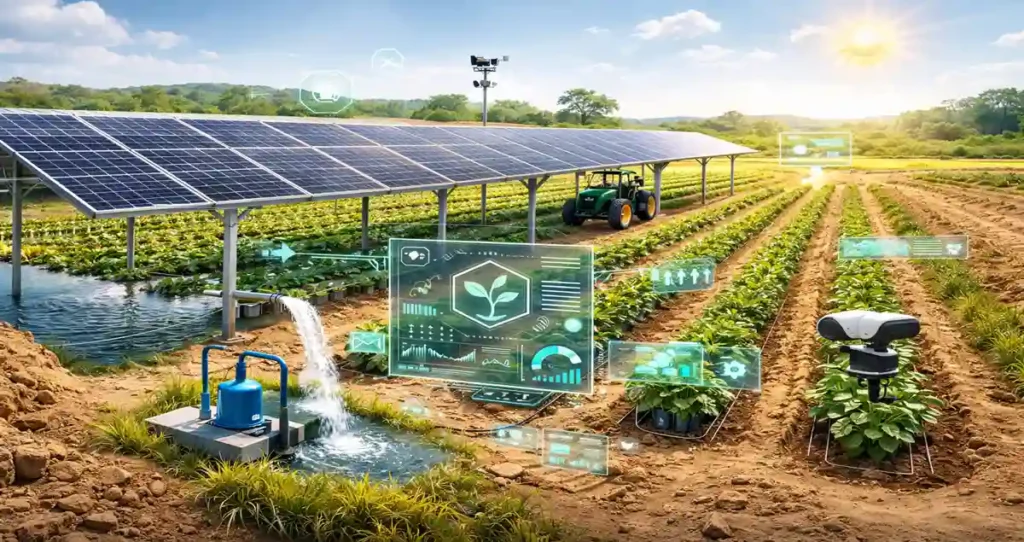
Combining solar energy and artificial intelligence is reshaping farming as we know it. This isn’t just about installing panels or sensors—it’s about building a smart, efficient, and sustainable farming ecosystem that improves yields, reduces costs, and revives underutilized lands.
Installing Solar Systems Effectively
A proper solar setup is the backbone of any productive farm. Solar pumps should be installed around 10 meters from crop rows, ensuring even water pressure throughout irrigation lines. Panels must remain free from shading caused by trees, poles, or nearby structures, while weekly cleaning helps maintain peak performance. Including battery storage (BESS) ensures operations continue during cloudy days or at night, keeping irrigation, greenhouses, and farm lighting consistent and reliable.
Integrating AI for Precision Farming
AI transforms a solar-powered farm into a data-driven, autonomous system. By deploying multiple soil moisture sensors across crop sections, AI algorithms can monitor soil conditions in real time. Systems should be calibrated to the specific needs of each crop, delivering precise water and nutrient levels through smart drip lines. When linked to mobile or IoT dashboards, farmers gain the ability to monitor fields remotely, receive instant alerts, and make informed decisions without walking every row.
Key AI applications include:
- Precision irrigation to save water and optimize crop hydration
- Fertigation for exact nutrient delivery
- Seeding and planting with autonomous vehicles or robots
- Growth monitoring for plant health and pest detection
- Smart harvesting to pick crops at peak ripeness
This integration ensures higher yields, healthier crops, and lower labor costs, while protecting soil and resources.
Benefits for Farmers and Sustainability
Solar + AI farms deliver more than efficiency—they create profitable, eco-friendly, and resilient systems. Uncultivated lands become productive, supporting local food security and boosting rural economies. Diesel reliance is eliminated, lowering carbon emissions and operational costs. Optimized water and nutrient use conserves scarce resources while improving crop quality, giving farmers better income and reduced labor strain.
This approach aligns with global sustainability initiatives, including clean energy, zero hunger, and climate action, proving that technology can benefit both people and the planet.
Future Trends in Solar + AI Agriculture
The coming years will bring smarter AI, advanced solar panels, and autonomous farms. Predictive AI will identify pest threats before they occur. Solar-powered robots will manage seeding, weeding, and harvesting independently. Farmers will monitor multiple fields remotely, optimizing irrigation, crop rotation, and energy use in real time.
The future is intelligent, sustainable, and highly productive farming—an agricultural revolution powered by sunlight and data.
Agrivoltaic Systems: Technical Compatibility & Maintenance
Final Thoughts
Agrivoltaics, agricultural solar panels, and AI-driven smart farming are not just incremental improvements—they are transforming the way the world grows food.
By harnessing solar energy and intelligence, uncultivated lands become productive, water is conserved, crops are healthier, and farmers are empowered.
The future of farming is here: autonomous, sustainable, and profitable. Farmers embracing solar + AI agriculture today are shaping a global revolution for generations to come.
Frequently Asked Questions
Does agrivoltaics reduce crop yield?
Not necessarily. While some sun-loving crops may see a slight decrease, many high-value crops like berries, leafy greens, and potatoes actually see a yield increase of up to 20%. The solar panels create a microclimate that reduces heat stress and water evaporation, protecting plants during extreme 2026 weather patterns.
How much does it cost to install an agrivoltaic system?
Agrivoltaic systems generally cost 10-15% more than traditional ground-mount solar due to the specialized mounting structures required for machinery clearance. However, when you factor in USDA REAP grants (covering up to 50% of costs), reduced water bills, and dual-income streams (crops + energy), the ROI is typically achieved within 5 to 7 years.
What are the best crops for agricultural solar panels?
Shade-tolerant and partial-shade crops perform best. This includes leafy greens (lettuce, spinach), root vegetables (potatoes, carrots), and various fruits (berries, grapes). Additionally, agrivoltaic sites are excellent for beekeeping and livestock grazing (sheep and poultry), as the panels provide essential shelter for animals and pollinators.
What is solar-powered AI farming?
Solar-powered AI farming combines renewable solar energy with artificial intelligence systems to automate irrigation, fertilization, monitoring, and harvesting. Solar panels power pumps, sensors, and machinery, while AI analyzes real-time data to optimize crop growth, reduce water usage, and increase yields.
How does AI improve irrigation efficiency?
AI uses soil moisture sensors, weather forecasts, and crop data to determine exactly when and how much water plants need. This prevents overwatering and underwatering, conserves water resources, and improves plant health and productivity.
Can solar energy really revive uncultivated or barren land?
Yes. Solar-powered pumps provide reliable irrigation in off-grid or water-scarce areas, while AI ensures precise water and nutrient management. Together, they turn previously unproductive land into fertile farmland capable of growing crops sustainably.