
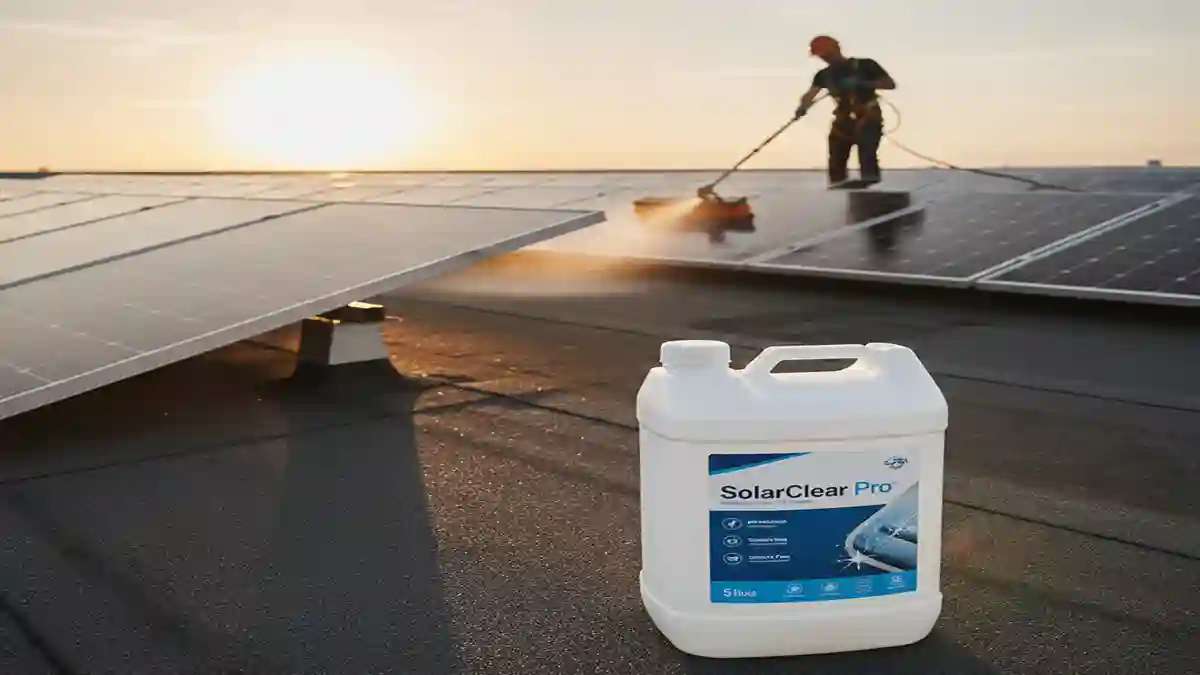
Discover the best solar panel cleaner in 2026. Engr. Syed Farrukh Anwar shares professional tips on liquids, shampoos, and chemicals to boost efficiency by 30% for home and commercial systems.
Keeping your solar panels clean is crucial for maximizing efficiency, extending their lifespan, and ensuring consistent energy production. Dust, pollution, bird droppings, and hard water deposits can reduce sunlight reaching photovoltaic cells by up to 30%.
As an engineer, I often get asked: “Why isn’t my solar panel producing as much power as it should?” In most cases, the panels are fine—the real issue is dirt and grime. Even a thin layer of dust can significantly reduce output.
Using the right solar panel cleaner, including solutions, liquids, shampoos, soaps, chemicals, and agents, protects your investment while ensuring safe cleaning for home, commercial, and industrial systems. Even a small investment in proper cleaning products can improve energy output, reduce maintenance costs, and increase ROI.
Why Cleaning Solar Panels is Critical
Dirty panels can cause:
- Reduced efficiency: Dust, grime, or bird droppings block sunlight.
- Premature wear: Harsh residues can damage coatings over time.
- Lower ROI: Less energy production increases electricity costs or reduces savings.
Using high-quality solar panel cleaners ensures panels operate at peak capacity. For commercial solar farms, even a 5–10% increase in efficiency can translate into substantial revenue gains.
Quick ROI Calculation (Commercial Example):
If cleaning restores 10% efficiency in a 100 kW commercial solar system, you recover approximately:
- 15,000 kWh per year (assuming 1,500 sun-hours)
- This typically pays for the solar panel cleaner and labor within 1–2 cleaning cycles, making cleaning one of the highest ROI maintenance actions in solar O&M.
Types of Solar Panel Cleaner Products
| Product Type | Best For | Why It Works | Application | Formula / Composition |
|---|---|---|---|---|
| Plain Water (Distilled or Deionized) | Light dust, pollen, mild dirt | Safe for regular maintenance; prevents streaks and mineral spots. | Home, Small Commercial | Pure water free of minerals |
| Mild Detergent or pH-Neutral Soap (“Solar Shampoo”) | Sticky grime, bird droppings, smog residue, hard water stains | Gentle, non-abrasive formulas lift dirt without affecting coatings. | Home, Small Commercial | Mild surfactants, pH-neutral, biodegradable |
| Solar Panel Cleaning Liquids & Ready-Made Solutions | Convenience and consistent results | Eco-friendly liquids rinse clean without streaks; suitable for home and commercial panels. | Home, Commercial | Water-based, mild acids for hard water stains, surfactants |
| Specialized Commercial Cleaning Chemicals & Agents | Heavily soiled or industrial panels | Professional-grade chemicals remove tough grime while protecting coatings; ideal for large rooftops or solar farms. | Commercial, Industrial | Strong biodegradable surfactants, mild acids/alkalis, corrosion inhibitors, anti-spot agents |
Safe and Efficient Solar Panel Cleaning Methods
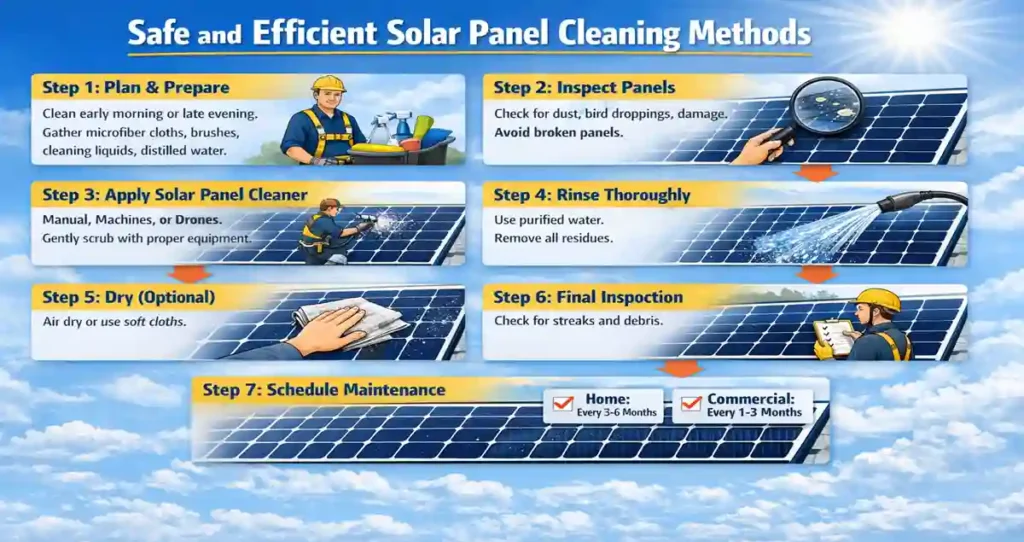
Step 1: Plan and Prepare
- Clean during cool hours (early morning or late evening).
- Gather soft microfiber cloths, sponges, brushes, solar panel cleaning liquids, shampoos, or chemicals, buckets, and distilled/purified water.
- Wear safety gear—gloves, harnesses, scaffolding, or ladders for large installations.
Step 2: Inspect Panels
- Look for dust, grime, bird droppings, or hard water stains.
- Avoid cleaning damaged or cracked panels manually; consult professionals.
Step 3: Apply Solar Panel Cleaner
- Manual Cleaning: Spray or pour solar panel cleaning liquid, shampoo, or soap onto panels. Gently scrub with soft cloths, sponges, or a solar panel cleaning brush.
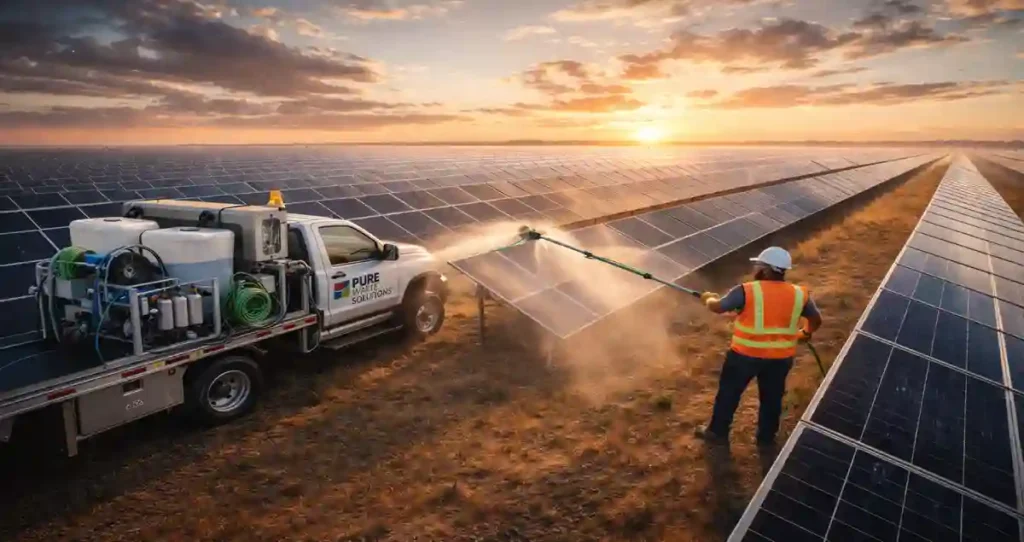
- Machines / Water-Fed Poles: Distribute cleaner evenly for large commercial rooftops without stepping on panels.
- Robots / Drones: Automated systems apply liquids and scrub panels efficiently—ideal for commercial or industrial solar farms.
Step 4: Rinse Thoroughly
- Use distilled or purified water to remove all residues.
- Prevent streaks, mineral deposits, and ensure maximum sunlight absorption.
Step 5: Dry (Optional)
- Air dry or use soft, lint-free cloths. Avoid abrasive towels.
Step 6: Final Inspection
- Check for streaks, missed spots, or debris. Ensure panels are clean and safe.
Step 7: Schedule Regular Maintenance
- Home panels: every 3–6 months.
- Commercial panels: every 1–3 months, depending on dust, pollution, and climate.
⚠️ High Voltage Safety Note
Solar panels produce electricity whenever exposed to sunlight. Before using any solar panel cleaner:
- Never apply cleaners or water to MC4 connectors, junction boxes, DC cables, or inverters
- Do not disconnect connectors under load
- Avoid cleaning during rain or wet conditions
- For commercial systems operating at high DC voltage, use trained personnel only
Engineer’s Note:
As per international electrical safety standards such as NFPA 70E (Standard for Electrical Safety in the Workplace), commercial solar panel cleaning should always involve a Job Hazard Analysis (JHA) to identify live DC risks before applying any liquids or cleaning agents.
DIY Solar Panel Cleaner Solutions for Home Use
| Remedy | Best For | How to Use | Notes |
|---|---|---|---|
| Vinegar & Water | Light dust, hard water stains | Mix 1 part vinegar with 8 parts distilled water; apply with a soft cloth or sponge | Safe for residential panels; rinse thoroughly |
| Mild pH-Neutral Soap / Solar Shampoo | Sticky grime, bird droppings | Dilute in water and apply gently | Eco-friendly; avoid household detergents |
Tip: Home remedies are ideal for residential panels, but commercial or heavily soiled panels require specialized cleaning chemicals or automated systems.
Engineer’s Tip
Engineer’s Tip: Always check the Short Circuit Current before and after using a solar panel cleaner. If output doesn’t increase by 5–10%, the issue may not be dirt—it could indicate micro-cracks or PID (Potential Induced Degradation). Early detection prevents efficiency loss and costly repairs.
Prohibited Items – What NOT to Use
| Item | Danger Level | Why |
|---|---|---|
| Pressure Washers | 🔴 High | Can crack glass and damage seals |
| Generic Dish Soap | 🟡 Medium | Leaves a greasy film that attracts dust |
| Abrasive Pads | 🔴 High | Scratches the anti-reflective coating |
| Cold Water on Hot Panels | 🔴 High | Thermal shock can shatter glass |
| Tap Water (Hard Water Areas) | 🟡 Medium | Calcium and magnesium cause limescale, acting like permanent shading on cells |
Engineer’s Tip:
Use a TDS meter. If water quality is > 50 ppm, switch to deionized or distilled water for solar panel cleaning.
Can You Use Solar Panel Cleaner on Other Solar Components?
A solar panel cleaner is formulated specifically for panel surfaces. Using it on the wrong components can cause damage or safety issues. Here’s a clear guide:
- Solar Panel Glass (Front Surface)
Yes – Solar panel cleaner is designed for this surface. Safe for tempered glass and anti-reflective coatings. - Anti-Reflective Coating (ARC)
Yes – Use only pH-neutral solar panel cleaning liquids or shampoos. Avoid abrasive chemicals. - Aluminum Frame of Solar Panels
Yes – Safe when applied with mild cleaners and rinsed properly. - Solar Inverter (Casing Only)
No – Do not use solar panel cleaner. Clean inverter exteriors with a dry or slightly damp cloth only. - Solar Batteries (Lead-Acid, Lithium, Gel – Outer Casing)
No – Solar panel cleaner is not recommended. Use a dry cloth. Avoid moisture near terminals. - Solar Wires and DC Cables
No – Clean manually with a dry cloth. Liquids may degrade insulation over time. - Solar Charge Controller (PWM or MPPT – Casing Only)
No – Solar panel cleaner should not be used. Clean only with a dry cloth. Avoid moisture near ventilation slots and terminals - MC4 Connectors
No – Never spray solar panel cleaner or water directly. Moisture can cause corrosion and electrical faults. - Junction Box (Rear of Panel)
No – Do not apply any cleaning liquid. Keep dry to prevent short circuits. - Solar Panel Mounting Structures
Yes (Limited) – Mild solar panel cleaning solution can be used to remove dust or bird droppings. Avoid runoff into electrical parts. - Complete Solar Panel Kits
Partial Yes – Solar panel cleaner is safe only for the panel surface and frame, not for inverters, batteries, cables, or connectors included in the kit.
Solar Panel Cleaner Application Compatibility – Technical Review Table
| Solar System Component | Can You Use Solar Panel Cleaner? | Notes / Safety Guidance |
|---|---|---|
| Solar Panel Glass (Front Surface) | ✅ Yes | Designed for this surface. Safe for tempered glass and anti-reflective coatings. |
| Anti-Reflective Coating (ARC) | ✅ Yes | Use only pH-neutral solar panel cleaning liquids or shampoos. Avoid abrasives. |
| Aluminum Frame of Solar Panels | ✅ Yes | Safe with mild cleaners. Rinse properly to avoid residue buildup. |
| Solar Inverter (Outer Casing Only) | ❌ No | Clean only with a dry or slightly damp cloth. Keep liquids away from vents. |
| Solar Charge Controller (PWM) | ❌ No | Do not apply any liquid cleaner. Moisture can damage internal electronics. |
| MPPT Charge Controller | ❌ No | Highly sensitive electronics. Clean casing only with a dry cloth. |
| Solar Batteries (Lead-Acid, Lithium, Gel – Casing Only) | ❌ No | Avoid liquids near terminals. Use a dry cloth only. |
| Solar Wires and DC Cables | ❌ No | Liquids may degrade insulation and increase electrical risk. |
| MC4 Connectors | ❌ No | Never spray cleaner or water. Moisture can cause corrosion and arcing. |
| Junction Box (Rear of Panel) | ❌ No | Keep completely dry to prevent short circuits or DC leakage. |
| Solar Panel Mounting Structures | ⚠️ Limited Use | Mild cleaner can remove dust or bird droppings. Avoid runoff into wiring. |
| Complete Solar Panel Kits | ⚠️ Partial Use | Cleaner is safe only for panel glass and frame—not electrical components. |
Engineer’s Safety Note
Solar panel cleaners are surface-specific products. They improve efficiency only when used on the panel glass and frame. Using them on electrical components does not increase performance and may reduce system reliability.

Conclusion
Maintaining clean panels with the right solar panel cleaner—including solutions, liquids, shampoos, soaps, chemicals, and agents—ensures maximum efficiency, extended lifespan, and higher ROI. Even a small, consistent investment in proper cleaning solutions significantly boosts energy output, reduces maintenance costs, and prevents costly repairs for home, commercial, and industrial solar systems.
FAQs – Solar Panel Cleaner
Can I use vinegar to clean solar panels?
Yes, a mixture of 1 part vinegar to 8 parts water is a safe, eco-friendly solution for light stains.
Will rain clean my solar panels?
Rain washes away loose dust but leaves mineral spots, which can reduce efficiency over time.
How often should I clean commercial panels?
Depending on dust, pollution, and climate, a frequency of every 1–3 months is ideal for peak efficiency.
Can I use generic dish soap or bleach?
No. Harsh chemicals or detergents can damage coatings and reduce the lifespan of panels.
Can I use a solar panel cleaner on my inverter or batteries?
No. Solar panel cleaners are designed for panel surfaces only. Inverters and batteries should be wiped with a dry or slightly damp cloth to avoid electrical hazards.
Can solar panels be cleaned in direct sunlight?
No. Cleaning in hot sun can cause streaks, thermal stress, or micro-cracks. Always clean early morning or late evening.
Are eco-friendly solar panel cleaners effective for bird droppings or smog?
Yes. pH-neutral, biodegradable solutions safely remove grime, hard water stains, and smog residue without damaging coatings.
Can I use automated robots or drones with a solar panel cleaner?
Yes. Commercial robots and drones can safely apply cleaning liquids and scrub panels efficiently, reducing labor and improving safety.