
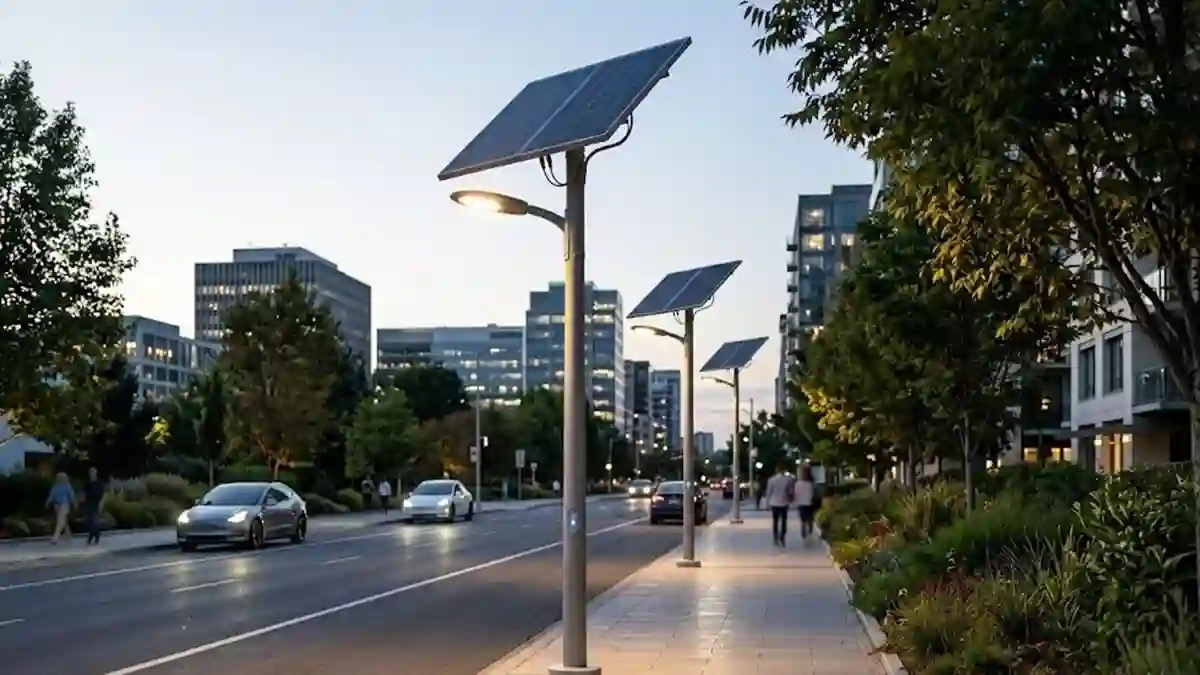
Discover everything about solar street lights—from their history, types, applications, and poles to the latest AI, IoT, and sensor technologies. Learn how modern systems save energy, reduce carbon, and create smarter, safer cities.
Solar Street Lights: Buying Guide & Selection Tips
Discover everything you need to know about solar street lights—from high-efficiency TopCon and monocrystalline panels, long-lasting LED luminaires, and smart battery & controller systems, to durable poles engineered for safety and optimal light distribution. Modern systems integrate AI, IoT, motion sensors, and automated panel cleaning to maximize energy efficiency, reduce maintenance, and support sustainable urban, industrial, school, and agricultural applications. With payback periods of 3–5 years, solar street lights are a reliable, eco-friendly investment for cities, businesses, and off-grid locations.
Introduction: Why Solar Street Lights Are Revolutionizing Urban Infrastructure
The world of street lighting is changing rapidly. Traditional electric street lights, while effective, have long posed challenges—high energy bills, costly maintenance, and environmental impact. Today, solar street lights offer a sustainable alternative that addresses these issues while improving city safety, visibility, and operational efficiency.
Solar powered street lights
They are not just a technological upgrade; they are a strategic investment in a city’s infrastructure. They reduce reliance on the power grid, lower carbon emissions, and integrate seamlessly with smart city management systems. Municipalities and businesses are increasingly adopting solar lighting because of these tangible and long-term benefits.
The Evolution of Street Lighting
Street lighting has been central to human civilization for centuries, evolving alongside societal progress.
Ancient and Medieval Lighting
Long before electricity, communities relied on torches, oil lamps, and candles. These early solutions were fragile and dim, but they enhanced safety, enabled commerce after dark, and fostered social interaction.
Gas Lighting in the 18th–19th Century
The introduction of gas lamps in cities like London and Paris transformed urban life. Streets became brighter and safer, encouraging evening activities and commerce. However, the need for nightly lamplighters and the risk of leaks made gas lighting labor-intensive and potentially hazardous.
Electric Lighting Revolution
The late 19th and early 20th centuries brought electric street lights—arc lamps, incandescent bulbs, and later fluorescents. While these lights were brighter and more reliable, they required extensive wiring, costly grid infrastructure, and continuous energy from fossil-fuel plants. Over time, rising electricity costs and environmental concerns prompted cities to search for greener alternatives.
Solar Street Lights: The Modern Era
Today, solar street lights combine solar panels, LED luminaires, batteries, and smart controllers into intelligent systems. They provide energy independence, reduce environmental impact, and incorporate advanced technologies like AI, IoT, and adaptive sensors. Modern solar street lights are more than illumination—they are a key part of sustainable city planning.
Components of a Solar Street Light
A fully functional solar street light integrates several critical components:
Solar panels
Solar panels capture sunlight and convert it into electricity for solar street lights using MC4 connectors, ensuring consistent nighttime operation and extended battery life.
| Type | Technology / Feature | Description / Benefit | Top Consideration |
|---|---|---|---|
| Monocrystalline | High-efficiency silicon cells | Compact, high energy output, works well in limited space | Higher cost, but best efficiency |
| Polycrystalline | Multi-crystalline silicon | Cost-effective, slightly lower efficiency | Slightly lower energy yield |
| Thin-Film | Amorphous / CIGS | Lightweight, flexible, and performs better in diffuse light | Larger area needed for the same output |
| Bifacial | Dual-sided cells | Captures sunlight from both sides, higher energy yield | Requires a reflective surface for max gain |
| TopCon | Tunnel Oxide Passivated Contact | High efficiency, better temperature performance, improved durability | Slightly higher cost, advanced tech |
LED Luminaire
The LED luminaire is the primary light source for solar street lights, providing bright, long-lasting illumination while consuming minimal energy. LEDs last much longer than traditional bulbs, reducing maintenance and replacement costs.
| Type | Technology / Feature | Use / Benefit |
|---|---|---|
| Street LED | SMD / COB | Even illumination for roads |
| Smart LED | Motion / Ambient Light Sensors | Saves energy by adjusting brightness |
| Decorative LED | RGB / Color LEDs | Aesthetic lighting for parks & pathways |
| Flood LED | High-lumen SMD | Wide coverage for parking lots or open areas |
Batteries & Storage Backup
Batteries store the energy generated during the day for nighttime use. Advanced battery technologies allow multiple nights of autonomy without sunlight, and smart battery management extends battery life while ensuring uninterrupted lighting even during cloudy weather.
Controllers
Controllers manage charging, discharging, and load distribution for solar street lights. With AI and IoT integration, they can monitor system health in real time, detect potential faults, and optimize battery performance.
Why it matters: Intelligent control systems reduce downtime and maintenance needs while enabling features like adaptive dimming.
| Type | Technology / Feature | Description / Benefit |
|---|---|---|
| PWM Controller | Pulse Width Modulation | Simple, cost-effective, protects battery from overcharge |
| MPPT Controller | Maximum Power Point Tracking | Higher efficiency, optimizes energy from solar panels |
| AI / IoT Smart Controller | Real-time monitoring, adaptive dimming | Optimizes battery performance, detects faults early, enables smart features |
Solar Street Light Pole: The Backbone of Performance
While solar panels and batteries often receive the spotlight, the solar street light pole is a critical engineering component that directly affects performance, stability, and longevity. A well-designed pole must withstand decades of environmental stress—including high winds, seismic activity, rain, and corrosion—while precisely positioning the luminaire for optimal light distribution. Materials and Durability
The choice of pole material depends on application and environment:
Galvanized Steel: The most common option, prized for its strength and corrosion resistance. Hot-dip galvanization creates a protective zinc layer that can last 20–25 years, making it ideal for highways and industrial zones.
Powder-Coated Steel: Offers the same structural strength with an added colored finish for aesthetics. Perfect for residential streets, parks, and urban areas where visual integration matters.
Aluminum Alloys: Lightweight and naturally corrosion-resistant, aluminum poles are easy to transport and install. They are ideal for coastal regions and applications requiring lighter structural loads.
Height and Light Distribution
Pole height is determined by photometric calculations to achieve optimal illumination:
- 5–7 meters (16–23 feet): Residential streets, pathways, bicycle lanes, and parks. Focused lighting without spilling into nearby homes.
- 8–10 meters (26–33 feet): Collector roads, parking lots, and commercial complexes needing wider light coverage.
- 10–14 meters (33–46 feet): Highways, airports, and industrial zones. Supports high-wattage luminaires and wider spacing while maintaining uniform illumination.
Engineering for Structural Integrity
Poles must resist high wind loads, sometimes exceeding 160 km/h (100 mph). Manufacturers calculate wind resistance based on height, material, taper, and mounted equipment. Base plates and anchor bolts transfer loads safely to concrete foundations, ensuring stability and longevity.
Poles as Smart Infrastructure
Modern solar street light poles are more than supports—they are smart city platforms:
- IoT communication modules for real-time data
- Security cameras and public address systems
- Environmental sensors for air quality and weather
- EV charging points
- 5G small-cell nodes
This makes each pole a connected urban asset, supporting city services beyond illumination.
Why the Right Pole Matters
Choosing the right pole is not just an aesthetic choice—it’s a long-term structural and financial decision. Poles that are too short or made from substandard materials can create safety hazards, require costly replacements, or fail under environmental stress. Specifying poles engineered to exact project requirements—material, height, wind rating, and smart-ready features—ensures your solar street lighting investment delivers safe, reliable, and maintenance-free performance for decades.
Solar Street Lamp
A solar street lamp is a standalone outdoor lighting system powered by solar energy. It typically includes a solar panel, LED luminaire, battery, charge controller, and mounting pole. These systems are widely used for:
- Roads and highways
- Parking areas
- Residential streets
- Industrial zones
- Parks and public spaces
Solar street lamps reduce grid dependency, lower electricity costs, and provide reliable lighting in off-grid or rural areas. They are especially valuable for municipalities aiming for sustainable infrastructure and reduced carbon emissions.
Solar Street Light vs Solar Street Lamp
Although the terms are often used interchangeably, there are slight differences in usage:
| Term | Meaning | Common Usage |
|---|---|---|
| Solar Street Light | Refers to the complete lighting system powered by solar energy | More common in technical and commercial discussions |
| Solar Street Lamp | Often refers specifically to the lighting fixture (lamp unit) itself | More common in product listings and retail contexts |
In practical terms:
Both usually describe the same solar-powered street lighting system. However, “solar street light” is more widely searched and used in industry documentation, while “solar street lamp” is commonly seen in supplier catalogs and e-commerce platforms.
Types of Solar Street Lights
Solar street lights come in various configurations to suit different applications.
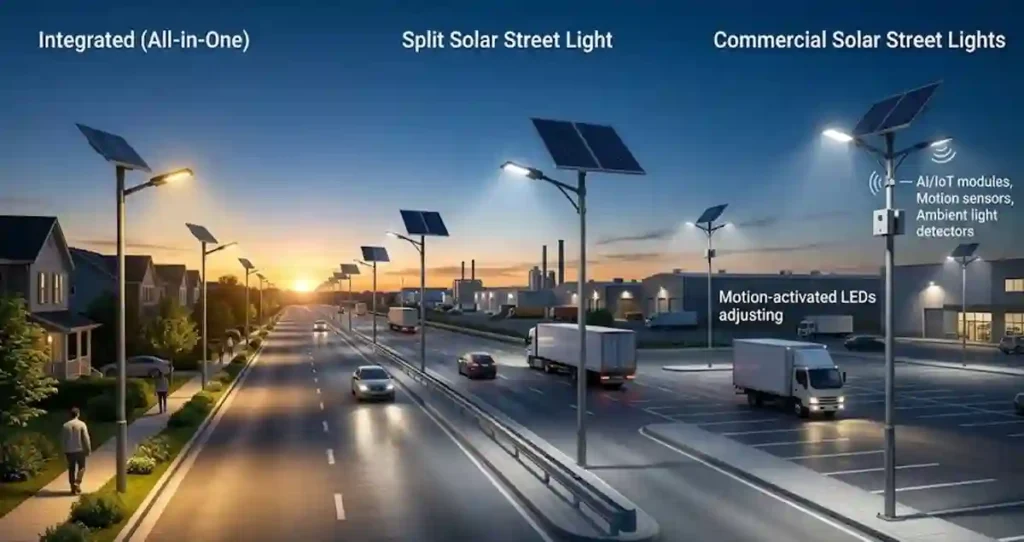
Integrated (All-in-One) Systems
Integrated lights combine the solar panel, LED, battery, and controller into a single unit. These systems are ideal for residential streets, parks, and small commercial zones. Their compact design reduces installation time and wiring requirements, allowing rapid deployment. Why it matters: integrated systems simplify maintenance while providing reliable illumination.
Split Solar Street Light Systems
Split systems separate the solar panel from the luminaire, allowing larger batteries and higher-wattage LEDs. They are suitable for highways, industrial zones, and large commercial areas. Key advantage: split systems maximize energy capture and provide more autonomy for areas with inconsistent sunlight.
Commercial Solar Street Lights
Engineered for industrial and large-scale applications, commercial lights offer high-lumen LEDs, reinforced poles, and advanced AI-based control. Motion sensors, ambient light detection, and IoT monitoring ensure energy optimization and predictive maintenance. Impact: These systems provide safe, efficient, and cost-effective lighting for expansive infrastructure projects.
Applications of Solar Street Lights
Urban & Residential Areas: Solar lights enhance safety on streets, parks, and neighborhoods. Motion-activated LEDs reduce energy consumption, while AI-driven systems allow city planners to track usage and optimize performance.
Rural & Off-Grid Locations: Remote villages and farm roads benefit from solar lighting because it eliminates the need for grid connections. Fast deployment ensures reliable illumination, promoting safety and accessibility.
Industrial & Commercial Zones:Industrial and commercial zones such as warehouses, airports, and parking lots rely on solar street lights for security and energy efficiency. Schools benefit from safer, well-lit campuses, industries use solar lighting to secure perimeters and support night operations, and agricultural areas use solar lights for farm security and extended working hours, reducing costs and grid dependence.
Government Infrastructure: Highways, expressways, and border areas gain both safety and sustainability benefits from solar street lighting. Energy savings can be redirected toward public services, creating a positive social impact.
The Role of AI and Smart Technology in Solar Street Lights
Modern solar street lights are no longer just standalone lights powered by the sun. Artificial Intelligence (AI), Internet of Things (IoT), and smart sensors have transformed them into intelligent systems that maximize efficiency, safety, and sustainability.
AI-Powered Adaptive Lighting
AI algorithms continuously analyze traffic, pedestrian activity, and ambient light conditions. This allows street lights to:
- Adjust brightness dynamically: Lights brighten when movement is detected and dim during low activity hours, reducing unnecessary energy consumption.
- Predict maintenance needs: AI monitors battery health, LED efficiency, and panel performance to schedule maintenance before failures occur.
- Optimize energy usage: AI balances energy storage and consumption, ensuring lights remain operational even during cloudy days or extended low sunlight periods.
Benefit: Cities save on electricity costs while ensuring streets are always safely illuminated.
Motion and Environmental Sensors
Solar street lights equipped with motion sensors and environmental detectors add an extra layer of intelligence:
- Motion Sensors: Detect pedestrians, vehicles, or cyclists to increase illumination only where and when needed.
- Ambient Light Sensors: Adjust brightness according to natural light levels, preventing over-illumination and reducing light pollution.
- Weather Sensors: Monitor temperature, rainfall, and humidity, helping AI adjust energy management and alert maintenance teams to potential issues like ice or heavy dust accumulation.
Benefit: Energy efficiency improves drastically, and safety is enhanced by targeting illumination to areas of activity.
Robotic Cleaning and Maintenance Bots
Maintenance has always been a concern for solar street lights, as dirt and dust reduce panel efficiency. Robotic cleaning systems and automated maintenance bots now overcome this challenge:
- Automated Cleaning Robots: Regularly clean panels without human labor, maintaining peak energy generation.
- Self-Diagnosing Units: Some advanced poles can detect faults in LEDs or batteries and send alerts to city management dashboards.
- Predictive Maintenance Bots: AI predicts potential component failures, scheduling preventive maintenance to avoid downtime.
Benefit: Reduced labor costs, higher efficiency, and faster adoption of solar street lights city-wide.
IoT and Cloud Integration
IoT sensors combined with cloud-based platforms allow real-time monitoring of solar street lights:
- Energy Production Tracking: Monitor solar energy collected, stored, and consumed.
- Operational Analytics: Track which lights are operating at optimal performance and which require attention.
- Centralized Control: Municipal authorities can control thousands of lights remotely, adjusting schedules, brightness, and maintenance routines from a single dashboard.
Benefit: Cities gain complete visibility into infrastructure performance, improving decision-making, planning, and budget allocation.
Real-World Application
In cities like Amsterdam and Bhubaneswar, integrating AI, motion sensors, and robotic cleaning has:
- Reduced electricity and maintenance costs by up to 80%
- Ensured consistent lighting even during prolonged cloudy periods or blackouts
- Increased public satisfaction and safety due to adaptive illumination and faster issue resolution
AI and smart technologies are no longer optional—they are key enablers for making solar street lighting practical, scalable, and sustainable.
Real-World Impact: Solar Street Lights in Action
Cities around the world are embracing solar street lights not just as a sustainable solution, but as a strategic urban investment. Two examples—Amsterdam, Netherlands, and Bhubaneswar, India—illustrate how modern solar lighting improves efficiency, safety, and environmental sustainability.
Amsterdam, Netherlands: A Smart City Approach
Amsterdam has integrated solar street lights into its smart city infrastructure, combining LEDs, AI, IoT, and robotic cleaning systems.
The city faced challenges such as rising electricity costs, high maintenance demands, and ambitious carbon reduction targets. To overcome these, Amsterdam installed solar street lights across neighborhoods, parks, and busy traffic zones.
Why it matters:
- High-efficiency solar panels capture energy even on cloudy days, powering long-lasting LEDs.
- AI-controlled brightness and motion sensors optimize energy use while maintaining safety.
- Robotic cleaning ensures panels remain dust-free, maximizing energy generation and reducing maintenance costs.
Impact:
- Reduced electricity bills by nearly 70%
- Lowered CO₂ emissions, contributing to EU climate goals
- Enhanced street visibility and public safety
Bhubaneswar, India: Rapid Deployment and ROI
Bhubaneswar implemented over 10,000 solar street lights to reduce grid dependency, improve safety, and integrate smart technology.
The deployment included integrated systems, split solar street lights, and commercial-grade installations, all monitored via IoT dashboards and supported by robotic cleaning.
Key Advantages:
- Fast deployment with reduced wiring and installation costs
- AI-driven predictive maintenance minimizes downtime
- Adaptive lighting adjusts brightness based on pedestrian and vehicle activity
Outcome:
- Electricity costs reduced by 80%
- Reliable lighting even in remote areas
- Residents reported higher satisfaction and improved perception of public safety
Key Takeaways for Cities
- Pilot Testing Works: Starting small ensures smooth scaling.
- Automated Maintenance is a Game-Changer: Robotic cleaning reduces labor, maintains efficiency, and supports rapid expansion.
- Smart Integration Maximizes Value: AI, IoT, and adaptive sensors enhance energy optimization, predictive maintenance, and urban planning capabilities.
Cities can replicate these models to achieve cost savings, sustainability, and safer, smarter streets, making solar street lighting an essential part of modern urban infrastructure.
Engineering Compliance & International Standards
In professional solar lighting, safety and performance go hand in hand. Modern systems are designed not just for illumination but to meet global engineering and safety standards:
| Category | Standard / Code | Key Requirement / Purpose | Application in Solar Street Lights |
|---|---|---|---|
| Structural & Mechanical | AASHTO LRFD | Wind-load calculation for pole thickness and taper | Ensures poles remain stable in gusts up to 160 km/h |
| ASTM A123 | Hot-dip galvanizing of steel | Provides 25+ years of corrosion protection for steel poles | |
| Electrical & Fire Safety | NFPA 70 Article 690 | PV module grounding & wiring | Supports all system sizes with Sam calculations for proper installation |
| NFPA 70 Article 411 | Low-voltage (12V/24V DC) installation rules | Ensures correct cable management and listed ties | |
| NFPA 70 Article 270 (2026) | Grounding & bonding for >1500V DC systems | Standard for high-mast or stadium solar lighting | |
| NFPA 855 | Battery enclosure safety for LiFePO4 | Ensures thermal isolation and impact protection | |
| Smart City & Optical | IEEE C136.41 | 7-pin NEMA receptacle | Integrates AI, IoT sensors, and smart modules on poles |
| IES RP-8-21 | Roadway & area lighting standards | Ensures proper Lux levels, uniformity, and public safety compliance |
Cost and Return on Investment
The cost of solar street lights varies depending on LED wattage, battery capacity, pole height, and smart features like AI and IoT.
Energy savings are substantial. With zero electricity bills and minimal maintenance, the typical payback period is 3–5 years for commercial projects. Advanced monitoring and robotic cleaning further reduce operational expenses, making solar lighting a sound long-term investment.
Benefit: Cities can redirect savings to schools, hospitals, parks, or other critical infrastructure, maximizing the social impact of their investment.
The Future of Solar Street Lights
The future is bright. Solar street lights will increasingly integrate AI, IoT, and adaptive sensors to create fully autonomous, energy-efficient, and safe urban environments. Motion-sensitive, dimmable LEDs, predictive maintenance, and automated solar panel cleaning will make solar lighting an essential component of smart city planning.
Why it matters: Solar street lights are no longer just about illumination—they are a critical part of sustainable urban development, cost reduction, and enhanced public safety.
FAQs About Solar Street Lights
How long do solar street lights last?
High-quality systems can operate 5–7 nights without sunlight and have a lifespan of 10–15 years, depending on battery type, panel efficiency, and maintenance.
Are solar street lights reliable in cloudy or rainy climates?
Yes. Modern solar panels charge efficiently even under low-light conditions, and batteries ensure consistent operation through cloudy or rainy periods.
What is the typical ROI for solar street lights?
The typical ROI for solar street lights is 3–5 years, thanks to energy savings and low maintenance costs.
How is maintenance handled for solar street lights?
Traditional maintenance challenges are addressed with AI monitoring, robotic cleaning bots, and predictive maintenance alerts, ensuring optimal performance with minimal human intervention.
Can solar street lights be integrated with smart city technology?
Absolutely. Many modern poles support IoT modules, motion sensors, environmental sensors, security cameras, EV charging points, and even 5G small-cell nodes, making them multipurpose urban assets.
How high should solar street light poles be installed?
Pole height depends on application: 5–7 meters for residential streets, 8–10 meters for parking lots and collector roads, and 10–14 meters for highways or industrial zones, optimizing light distribution.
What types of solar street lights are available?
Options include integrated solar street lights (panel, battery, LED in one unit), split systems (separate panel and battery), commercial high-capacity lights, and smart hybrid systems with AI and IoT integration.
How do solar street lights contribute to sustainability?
They reduce electricity consumption and CO₂ emissions, minimize light pollution with focused LEDs, and use recyclable materials, making them a cost-effective and environmentally friendly urban lighting solution.