
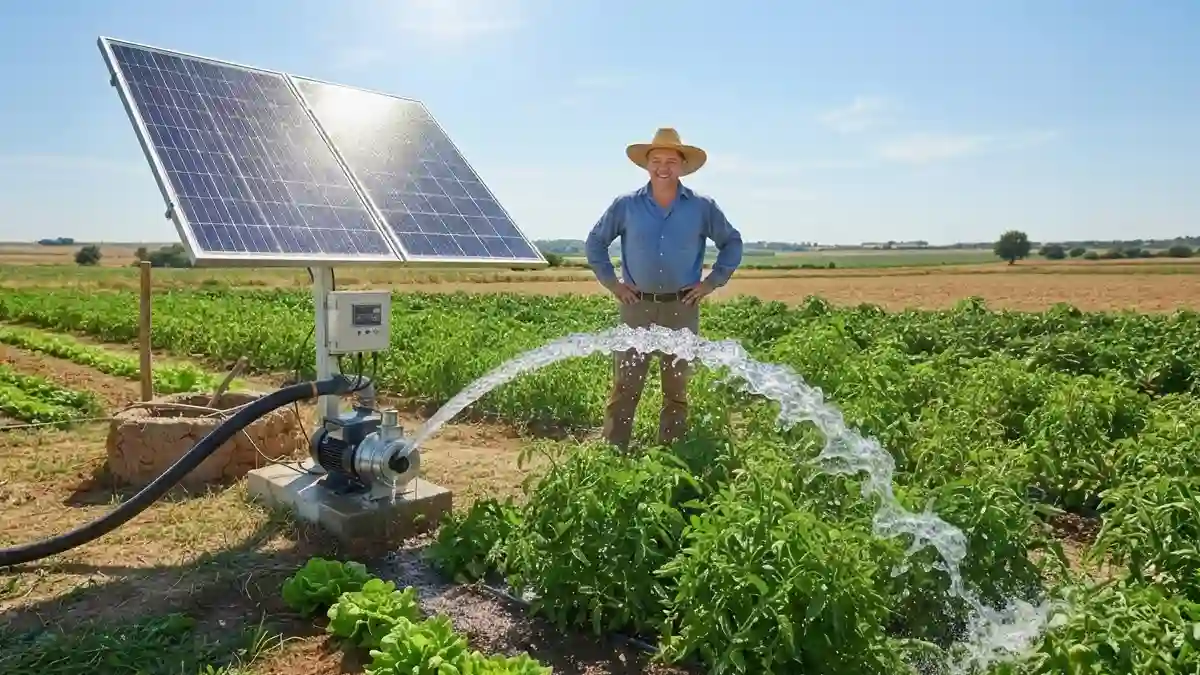
learn how solar water pumps work and choose the best pump for agriculture, domestic, and home use, including wells, pools, and fountains in 2026.
Master solar water pumping in 2026. Learn about submersible vs. surface pumps, key technical specifications, working principles, and how solar water pump systems operate efficiently using panels, controllers, and optional battery backup.
What Is a Pump?
A pump is a mechanical device designed to move water from one location to another by converting mechanical energy into hydraulic energy. In simple terms, a pump creates pressure or suction that allows water to be lifted vertically, transferred over distance, or circulated within a closed system.
In a solar water pump system, the pump operates using energy generated from solar panels. This energy powers either a DC or AC motor, depending on the system design, enabling reliable water movement without reliance on grid electricity or fuel.
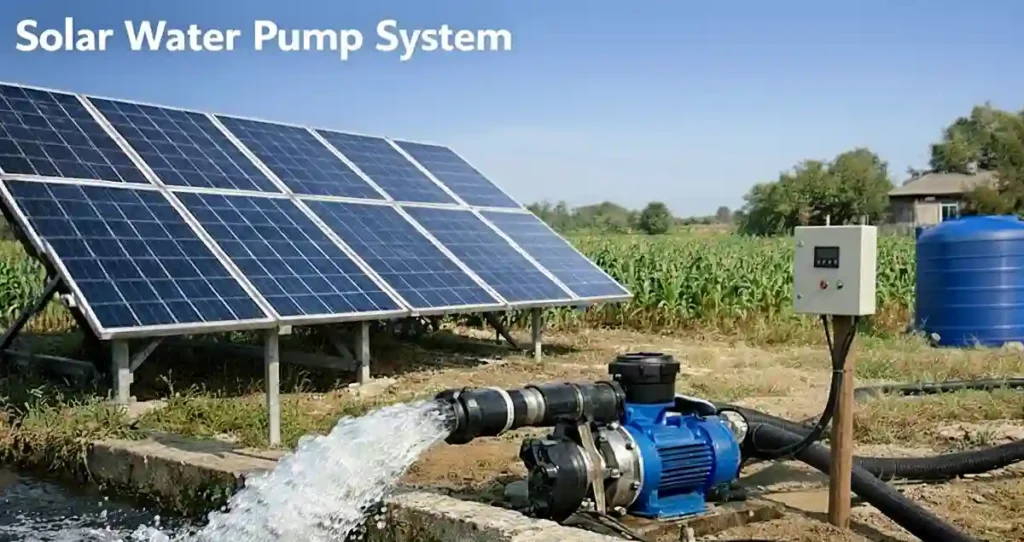
Solar-powered pumping technology has made water access easier for agriculture, domestic, and home applications, especially in off-grid and remote areas.
Basic Functions of a Pump
Regardless of application, every pump performs one or more of the following essential functions:
• Lifting water from underground sources such as wells and boreholes
• Transferring water horizontally across fields or pipelines
• Maintaining required pressure and flow for irrigation or household use
• Circulating water in closed systems like pools and fountains
These functions remain the same whether the pump is powered by electricity, diesel, or a solar powered water pump system.
Pump and Motor: Two Core Elements
A solar water pump system consists of two fundamental components that work together to deliver water efficiently.
Pump Unit
The pump unit is responsible for the physical movement of water. Its internal design determines flow rate, pressure, and suitability for different applications.
Common pump designs include:
• Centrifugal pumps – Best for high flow with low to medium pressure, commonly used in surface and pool pumps
• Submersible pumps – Installed underwater for deep wells and boreholes
• Positive displacement pumps – Designed for high pressure with low flow, suitable for precise water delivery
Selecting the correct pump type is critical for system efficiency and long-term reliability.
Motor
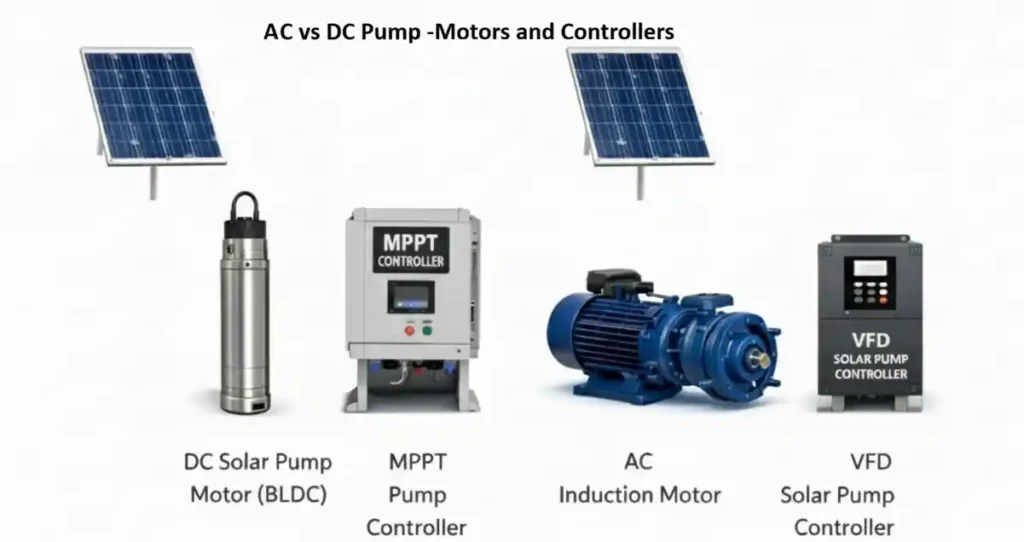
The motor supplies rotational energy to the pump shaft, enabling water movement. In solar systems, motors are carefully matched with solar panel output.
DC Motor
• Runs directly on solar panel DC output
• High efficiency with minimal energy loss
• Low maintenance and long service life
• Ideal for off-grid and daytime solar pump operation
DC motors are widely used in solar water well pumps, fountain pumps, and standalone agricultural systems.
AC Motor
• Requires an inverter to convert DC solar power into AC
• Suitable for higher-capacity systems
• Compatible with existing AC pump infrastructure
• Slightly higher energy losses due to power conversion
AC motors are commonly used where grid or hybrid systems are available.
AC vs DC Solar Water Pumps
| Feature | DC Solar Pump | AC Solar Pump |
|---|---|---|
| Power Source | Direct solar DC | Solar + inverter |
| Efficiency | High | Moderate |
| Maintenance | Low | Higher |
| Cost | Lower system cost | Higher system cost |
| Best Use | Off-grid systems | Large or hybrid systems |
Main Components of a Solar Water Pump System
A complete solar water pump system consists of integrated components that ensure efficient, reliable, and safe operation.
1. Solar Panels
Solar panels convert sunlight into DC electricity. Monocrystalline panels are preferred for higher efficiency and compact size.
Best Practices:
- Panels should face south (Northern Hemisphere).
- Tilt angle should match local latitude.
- Avoid shading throughout the day.
2. MPPT Controller
The controller is responsible for matching the power from the PV array to the mechanical load of the pump.
MPPT (Maximum Power Point Tracking): In solar pumping, sunlight intensity changes every minute. The MPPT controller continuously adjusts the electrical operating point of the panels to ensure the motor receives the maximum available wattage, even during low-light conditions (99% tracking efficiency).
Benefits:
- Stable power supply to the pump
- Protection against overload, dry running, and voltage fluctuations
- Optimal energy utilization from solar panels
3. Pump Controller / VFD (Variable Frequency Drive) for AC Pumps
The pump controller regulates motor speed, torque, and power delivery in accordance with the available solar energy. AC systems often use a Variable Frequency Drive (VFD) for smooth, efficient operation. For large-scale irrigation using AC motors, a VFD is essential. It prevents “Motor Stalling” by allowing the pump to start at a lower frequency (e.g., 30Hz) in the early morning and ramp up to full speed (50/60Hz) at noon.
Functions:
- Adjust motor speed to match sunlight intensity
- Soft start to reduce mechanical stress
- Regulate voltage and frequency
- Protect against low water, dry-run, or unsafe conditions
VFD Benefits:
- Improved energy efficiency
- Reduced wear on the pump and motor
- Better flow control
- Compatibility with AC motors
Engineering Tip:
Using a VFD reduces mechanical stress (Soft Start) and can extend your pump’s lifespan by up to 30% by avoiding abrupt torque spikes.
For DC pumps, speed control is handled electronically in the controller.
4. Wiring, Electrical Safety, and Protection
High-quality copper cables with proper gauge sizing are essential for minimizing voltage drop and ensuring stable power.
Key Considerations:
- DC systems carry higher currents; undersized wires risk overheating
- Long wire runs can cause voltage loss, reducing efficiency
- Use waterproof MC4 connectors, secure routing, and proper earthing
- Install fuses or circuit breakers for overcurrent protection
Maintenance Tips:
- Keep connections tight and weatherproof
- Inspect wiring, controllers, and pumps regularly
- Always disconnect power and wear protective equipment during maintenance
5. Battery Backup (Optional)
Battery storage allows excess energy to be stored for use during non-sunlight hours or cloudy periods.
Benefits:
- Night-time or cloudy-day operation
- Emergency water supply
- Supports off-grid or critical water needs
Considerations:
- Lithium-ion or lead-acid batteries can be used; lithium offers higher efficiency and lifespan
- Proper battery sizing and a charge controller are essential
6. Optimal Operation Timing
Solar water pumps perform best during peak sunlight hours for maximum efficiency.
Recommendations:
- Operate irrigation or domestic pumps between 9 a.m. and 3 p.m.
- Use battery backup for evening, cloudy, or emergency pumping
7. Safety and Maintenance
Panel Maintenance:
Keep solar modules free from dust and bird droppings to ensure maximum voltage; see our complete guide on how to clean solar panels for safe cleaning techniques.
Pump Operation:
- Avoid running pumps dry; ensure suction pipes and filters are clean
- Do not exceed the recommended flow rate or head
Battery Safety:
- Follow manufacturer guidelines, avoid overcharging or deep discharge
- Ensure proper ventilation and careful handling
Structural Safety:
- Install panels on stable structures and protect equipment from extreme weather
- Keep the pump area dry and debris-free
Routine Maintenance:
- Inspect all components periodically
- Follow manufacturer instructions for long-term reliability
Summary:
A solar water pump system is safe and efficient when installed with proper wiring, controllers, and optional battery backup. Daytime operation maximizes performance, while maintenance and safety precautions ensure long-term reliability.
Types of Solar Water Pumps and How They Work
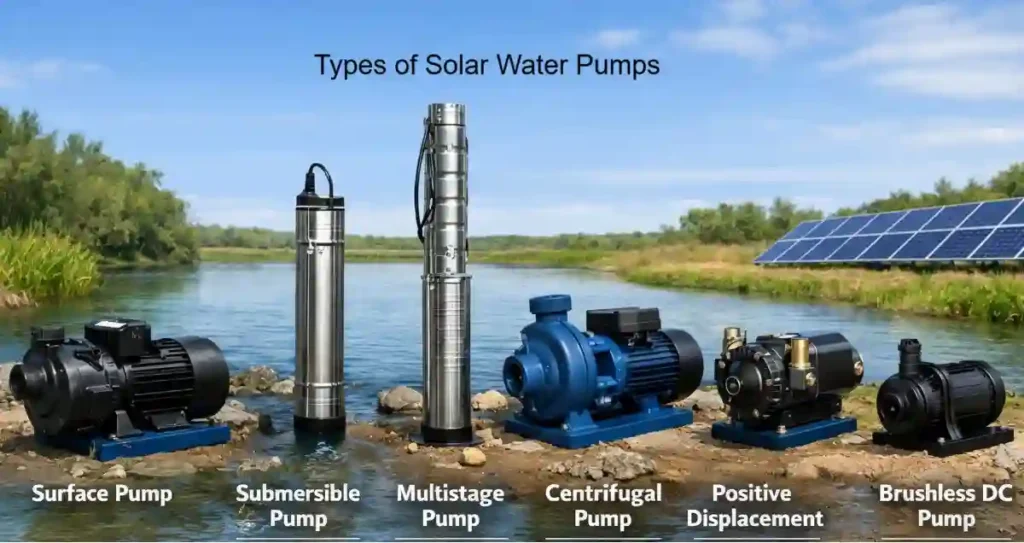
A solar water pump system can be built using different pump designs, depending on factors such as water depth, pressure requirement, flow rate, and end application. While the energy source remains solar power, the internal working principle of the pump determines how efficiently water is lifted, transferred, or circulated.
Understanding these pump types is essential for selecting the right solar water pump, avoiding performance losses, and ensuring long-term system reliability for domestic, agricultural, and commercial use.
Comparison Table: Which Solar Pump Do You Need?
| Pump Type | Installation | Max Suction / Lift | Best For | Main Advantage |
| Surface Pump | Above Ground | 6 – 8 Meters | Ponds, Rivers, Canals | Lowest cost, easy maintenance. |
| Submersible Pump | Underwater | 10 – 60 Meters | Borewells, Open Wells | High efficiency, quiet operation. |
| Multistage Pump | Underwater | 60 – 200+ Meters | Deep Borewells | Extreme lift for deep water tables. |
| Centrifugal Pump | Surface/Submerged | Low to Medium | Pools, Large Irrigation | High flow rate, very durable. |
| Positive Displacement | Surface/Submerged | High Pressure | Drip Irrigation | Consistent pressure for crops. |
| Brushless DC (BLDC) | Surface/Submerged | Small to Medium | Fountains, RVs, Ponds | 30% more efficient, no maintenance. |
Surface Solar Water Pumps
A surface solar water pump is installed above the water source and draws water using suction. These pumps are commonly used where water is available at shallow depths, such as ponds, canals, open wells, rivers, storage tanks, and shallow bore sources.
How It Works
The motor rotates an impeller that creates low pressure at the pump inlet. Atmospheric pressure then pushes water upward through the suction pipe, and the pump discharges it toward an irrigation system or storage tank.
Key Characteristics
• Maximum suction depth of approximately 6–8 meters
• High flow with low to medium pressure
• Easy installation and simple maintenance
Why It Fits Solar Systems
Surface pumps require lower starting torque and operate efficiently with DC solar motors, making them ideal for daytime solar operation and shallow water applications.
Multistage Submersible Solar Pumps
When water must be lifted from very deep sources, a standard submersible pump may not generate enough pressure. In such cases, multistage submersible solar pumps are used.
How It Works
Multiple impellers are arranged in series inside the pump. Each stage increases water pressure incrementally, and the combined effect allows water to be lifted from depths of 20 to 200 meters or more.
Key Characteristics
• High-pressure capability
• Slightly lower flow compared to single-stage pumps
• Requires precise motor and controller matching
Why It Fits Solar Systems
Multistage pumps are essential for deep borewell solar irrigation and rural water supply systems, where consistent pressure is more important than high flow.
Centrifugal Solar Water Pumps
A centrifugal solar water pump moves water using rotational kinetic energy and is one of the most widely used pump designs in solar pumping systems.
How It Works
Water enters the center of a rotating impeller. Centrifugal force pushes the water outward, converting kinetic energy into pressure energy before discharge.
Key Characteristics
• High flow rate
• Low to medium pressure
• Simple, durable, and cost-effective design
Why It Fits Solar Systems
Centrifugal pumps perform efficiently during peak sunlight hours and are commonly used in irrigation systems, surface pumping, and solar pool pump applications.
Positive Displacement Solar Pumps
A positive displacement solar pump moves water by trapping a fixed volume and forcing it through the outlet. Unlike centrifugal pumps, the flow remains consistent even as pressure increases.
How It Works
Water is captured in a chamber and mechanically displaced with each rotation or stroke, delivering a steady and controlled output.
Key Characteristics
• High pressure with low flow
• Accurate and controlled water delivery
• Efficient operation at low speeds
Why It Fits Solar Systems
These pumps are well-suited for drip irrigation and precision watering, where pressure stability is more critical than high water volume.
Brushless DC Solar Pumps
A brushless DC (BLDC) solar pump uses electronic commutation instead of mechanical brushes, resulting in higher efficiency and extended service life.
How It Works
An electronic controller switches motor phases electronically, eliminating friction, sparking, and wear associated with brushes.
Key Characteristics
• Very high efficiency
• Minimal maintenance
• Compact, silent operation
Why It Fits Solar Systems
Brushless DC pumps operate directly on solar panels without the need for solar inverters, making them ideal for solar fountain pumps, ponds, decorative water features, and small domestic applications.
Selecting the Right Solar Water Pump: Key Parameters
Choosing the right solar water pump involves several critical factors to ensure efficient and reliable operation. Key parameters include pump horsepower (HP), daily water demand, and the size of the solar array needed to power the system. Additional considerations include total dynamic head (vertical lift plus pipe friction losses), pump type (submersible or surface), and overall system efficiency.
A practical approach is first to determine your daily water requirement, then select a pump with the appropriate HP to meet that demand at the required head. Based on the pump rating and local solar conditions, you can estimate the recommended solar array size to provide sufficient energy during peak sunlight hours. This ensures reliable water flow while operating efficiently under varying solar conditions.
Rule-of-Thumb Sizing Table
| Pump Power (HP) | Rated Power (Watts) | Recommended Solar Array (Watts) | Typical Daily Discharge (Liters) |
| 0.5 HP | ~375W | 600W – 800W | 12,000 – 18,000 |
| 1.0 HP | ~750W | 1,200W – 1,500W | 25,000 – 35,000 |
| 1.5 HP | ~1120W | 1,800W – 2,200W | 40,000 – 55,000 |
| 2.0 HP | ~1500W | 2,500W – 3,000W | 60,000 – 80,000 |
| 3.0 HP | ~2250W | 4,000W – 4,500W | 90,000 – 120,000 |
This table provides a quick visual guide for the solar-to-pump ratio, helping users make faster and more informed decisions.
Solar Water Pump for Irrigation
When it comes to agricultural irrigation, solar water pumps offer a sustainable, cost-effective solution for supplying water to crops, orchards, and greenhouses. Selecting the right type of solar pump ensures maximum efficiency, reliability, and alignment with water demand.
Recommended Pump Types for Irrigation:
- Submersible Solar Water Pumps
- Best for borewells and tube wells with depths greater than 8 meters
- Pushes water efficiently from underground sources
- Maintains a stable flow even during variable sunlight
- Surface Solar Pumps
- Ideal for shallow wells, ponds, and canals (up to 6–8 meters depth)
- Easy to install and maintain
- Works efficiently with DC motors and daytime operation
- Positive Displacement Pumps
- Suitable for drip irrigation or precise water delivery
- Maintains consistent pressure for sensitive crops
Tip: For large agricultural setups, pairing submersible pumps with multistage systems can handle deep water sources, while surface pumps work well for shallow reservoirs.
Solar Water Well Pump
Used primarily to extract water from wells, solar water well pumps are essential for domestic, agricultural, and community water supply systems.
Recommended Pump Types:
- Submersible Pumps: Optimal for deep well applications (up to 200 meters with multistage design)
- Multistage Submersible Pumps: For very deep wells requiring higher pressure
- Brushless DC Pumps: For small domestic wells and water features
These pumps are ideal for off-grid setups, allowing daytime operation with solar panels while optionally using battery backup for cloudy days.
Solar Pool Pump
Solar pool pumps are designed for circulating and filtering water in residential or commercial swimming pools efficiently using solar energy.
Recommended Pump Types:
- Centrifugal Solar Pumps: High flow, low to medium pressure, perfect for pool circulation
- Brushless DC Pumps: Silent operation, low maintenance, ideal for smaller domestic pools
Tip: Operating the pool pump during peak sunlight hours maximizes efficiency and reduces electricity costs.
Solar Water Fountain Pump
Solar water fountain pumps are mainly used for decorative fountains, ponds, and garden water features.
Recommended Pump Types:
- Brushless DC Solar Pumps: Compact, high efficiency, low maintenance, and directly powered by solar panels
- Surface Pumps: For shallow decorative ponds or small garden water features
Tip: Ensure the fountain pump is matched to the height and flow requirements of the water feature for optimal performance.
Conclusion
A solar water pump system provides an efficient and sustainable solution for agricultural, domestic, and decorative water applications. Choosing the right pump type, such as surface, submersible, multistage, centrifugal, positive displacement, or brushless DC, ensures the system delivers optimal water flow, pressure, and long-term reliability. Proper installation, including correctly sized wiring, secure electrical connections, and optional battery backup, enhances performance and extends the lifespan of the system.
By adhering to safety measures and operating the pump during peak sunlight hours, users can maintain a consistent water supply while minimizing energy costs and environmental impact. Solar water pumps are not only practical for off-grid or remote locations but also represent a smart investment in sustainable water management and efficient resource utilization.
Frequently Asked Questions (FAQs)
What is the best solar water pump for irrigation?
Submersible solar pumps are ideal for borewells and tube wells with depths greater than 8 meters, while surface pumps work well for shallow wells, ponds, or canals. Positive displacement pumps are recommended for drip irrigation requiring consistent pressure.
Can I use a solar pump at night?
Yes, but only if your system has a battery backup to store excess solar energy. Without batteries, solar pumps operate efficiently only during daylight hours.
What is the difference between AC and DC solar pumps?
DC solar pumps run directly from solar panels, offering high efficiency and low maintenance for off-grid systems. AC solar pumps require an inverter to convert DC to AC, suitable for larger or hybrid setups.
How do I ensure the wiring is safe?
Use high-quality copper wires, select the correct gauge for current and distance, install fuses or breakers, ensure proper earthing, and use waterproof connectors. Never touch live wires or terminals while the system is powered.
Are solar water pumps suitable for domestic use?
Absolutely. They are ideal for supplying water to homes, overhead tanks, fountains, pools, and gardens, especially in off-grid or remote areas.
How often should I maintain my solar water pump system?
Inspect panels, controllers, wiring, and pumps at least once every few months. Clean filters and suction pipes regularly, and follow manufacturer guidelines for all components.
Can solar pumps handle deep wells?
Yes. Multistage submersible pumps can lift water from depths of 20–200 meters or more, providing stable pressure and flow for agricultural and community water supply systems.
Can a standard solar panel kit be used for a solar water pump?
Yes, but with caution. A standard 12V or 24V solar kit (panels + battery + charge controller) can power small DC surface or fountain pumps. However, for deep well submersible pumps or high-pressure irrigation, a standard kit is usually insufficient. You will need a Solar Pump Inverter or a dedicated MPPT Pump Controller that can handle the high “starting torque” (inrush current) required by the pump motor. Always ensure the solar array wattage is 1.5x to 2x the pump’s rated power for reliable operation.
What type of solar pump is best for off-grid living or RVs?
For off-grid cabins or RV use, a 12V or 24V Brushless DC (BLDC) Surface Pump is the most efficient choice. Because these pumps run directly on DC power, they integrate seamlessly with standard off-grid battery banks without needing a power-hungry inverter.
For RVs: Compact diaphragm pumps are best for pressurized water on demand.
For Off-Grid Cabins: A DC Surface Centrifugal pump is ideal for transferring water from a tank to the home.
Pro Tip: Look for “Brushless” models to ensure 30,000+ hours of maintenance-free operation, which is critical when you are living away from the grid.