
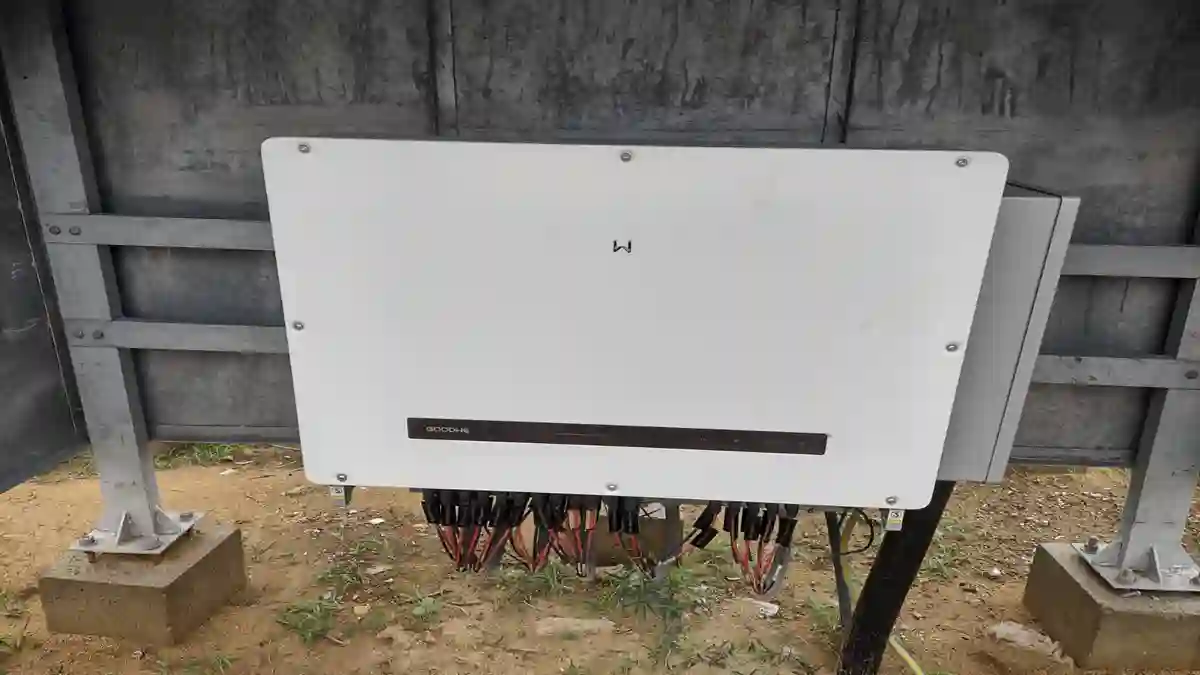
Explore our 2026 guide to string inverters for solar systems. Learn about costs, HS codes, system comparisons, and key features to make informed decisions for USA, UK, and global projects.
As an engineer with over a decade of experience in solar power systems, I’ve seen the vast number of string inverter brands, models, and types available in the market. For anyone new to solar power systems —or even experienced buyers—this sheer variety can be overwhelming. Generic information often fails to explain how these inverters actually perform in real-world applications.
Understanding string inverters requires more than just reading technical specs. It involves knowing their uses, installation requirements, key performance parameters, and suitability for different system sizes. With so many options, making the right choice can be confusing without a structured, practical guide.
In this article, I’ll break down string inverters from an engineer’s perspective, sharing insights from years of hands-on experience. You’ll learn about their applications, technical specifications, advantages, and limitations—so you can confidently select the best inverter for your solar system, whether residential, commercial, or utility-scale.
Executive Summary: String Inverter Guide 2026
- The Verdict: String inverters remain the most cost-effective solution for unshaded residential and commercial solar projects in 2026, offering superior ROI and simplified maintenance compared to microinverters.
- Key Advantage: Lowest upfront cost (typically $0.10–$0.20 per watt) and a centralized design that allows for easier repairs and AI-driven system-wide monitoring.
- Best Use Case: Ideal for south-facing, unshaded roofs in the USA, UK, and EU, where maximizing energy harvest per dollar invested is the primary goal.
Buying Guide: Selecting the Right String Inverter
When choosing a string inverter, several factors ensure system efficiency, reliability, and long-term performance, especially for residential, commercial, and utility projects in high-tier markets like the USA and UK.
Key Factors Table: Selecting a String Inverter
| Brand | Primary Strength | Technical Limitation / Trade-off | Best Application |
| SMA | German engineering; industry-leading MTBF (Mean Time Between Failures). | Higher upfront CAPEX; the interface can be less “user-friendly” for homeowners. | Industrial & Utility-scale. |
| Fronius | Unique SnapINverter design for 15-minute field servicing. | Fan-based cooling can be noisy; requires strategic placement away from living areas. | Residential (UK/EU). |
| SolarEdge | Excellent shading mitigation via DC Optimizers. | System Complexity: A higher number of components increases potential “failure points” on the roof. | Complex, shaded rooftops. |
| Sungrow | Best Price-to-Performance ratio; massive global support network. | Firmware updates can occasionally be complex for non-technical installers. | Commercial & Budget Residential. |
| Huawei | Integrated AI for Arc Fault Detection (AFCI) and PID recovery. | Limited availability in the US market due to ongoing regulatory restrictions. | Commercial (UK/EU/Asia). |
Recommended String Inverter Brands for Residential, Commercial, and Utility Applications
Choosing the right string inverter brand is critical for system performance, reliability, and compliance with local regulations. Different brands dominate in different regions, and selecting a reputable manufacturer ensures high efficiency, AI optimization, and long-term support. The table below highlights the top string inverter brands for residential, commercial, and utility applications in the USA, UK, and EU markets.
String Inverter Brand Recommendations by Application and Region
| Application | Region | Recommended Brands | Notes / Engineer Insight |
|---|---|---|---|
| Residential/Home | USA | SMA, SolarEdge, Enphase | Compact units suitable for 3–10 kW systems, high efficiency, optional panel-level monitoring with hybrid setups |
| Residential/Home | UK | Fronius, SolarEdge, Huawei | Compliant with G99/G100 standards, reliable performance, AI-enabled monitoring |
| Commercial | USA | SMA, ABB, Sungrow | Scalable modular units for 10–500 kW installations, strong grid support, predictive maintenance features |
| Commercial | UK/EU | Huawei, Fronius, SolarEdge | Industrial-grade performance, AI optimization, smart grid compliance, long warranties |
| Utility | Global | Sungrow, SMA, Schneider Electric | High-capacity central string inverters for multi-megawatt projects, integrated monitoring, and energy ecosystem compatibility |
Cost Analysis and Return on Investment in High-Tier Markets
Understanding the cost and ROI of string inverters is essential for engineers, system designers, and buyers planning residential, commercial, or utility-scale installations. String inverters offer lower upfront costs, scalability, and long-term value, making them a cost-effective choice compared to microinverters.
String Inverter Cost and ROI Table
| Application | System Size | Typical Cost Range (USD) | ROI Considerations | Notes / Engineer Insight |
|---|---|---|---|---|
| Residential | 3–8 kW | $800–$2,500 | Faster payback due to lower initial cost | Ideal for rooftop homes with minimal shading |
| Commercial | 10–100 kW | $2,000–$15,000 | Phased expansion improves ROI | Scalable modular design reduces future replacement costs |
| Utility | 500 kW+ | $50,000+ | High CAPEX but optimized for multi-megawatt energy yield | Centralized inverters reduce infrastructure complexity, and predictive maintenance maximizes uptime |
Key ROI Insights:
- Lower upfront costs compared to microinverters improve the payback period.
- Scalability allows phased system expansion without replacing existing inverters.
- Extended warranties and manufacturer support enhance long-term value and reliability.
- AI-enabled monitoring and predictive maintenance can further optimize system efficiency, reducing operational costs over the inverter lifespan.
What is a String Inverter?
A string inverter is the central component in most traditional solar panel systems. Its main function is to convert the direct current (DC) electricity generated by solar panels into alternating current (AC) electricity, which powers homes, commercial buildings, and can also be exported to the electrical grid.
Why Is It Called a String Inverter?
The term “string” comes from how solar panels are connected—wired together in series, like beads on a string. This configuration forms a continuous electrical circuit, sending the combined DC power from all panels in the string to a single centralized inverter. This design allows the inverter to manage multiple panels efficiently while keeping installation and maintenance simpler.
This technology has been the industry standard in the USA, UK, and other high-tier solar markets because of its reliability, regulatory compliance, and cost-effectiveness, making it the preferred choice for residential, commercial, and utility-scale solar systems.
String Solar Inverters: How They Work in Modern Solar Systems
The process begins with multiple solar panels—typically between 8 and 20—connected in series to form a string. This configuration combines voltage while maintaining consistent current flow. The combined DC electricity travels to the string inverter, where advanced electronics and Maximum Power Point Tracking (MPPT) optimize energy extraction under varying weather conditions. The converted AC electricity is then used onsite or exported to the utility grid under grid-compliant standards such as IEEE 1547 (USA) and G99/G100 (UK).
String Inverter Solar Applications in Residential, Commercial, and Utility Projects
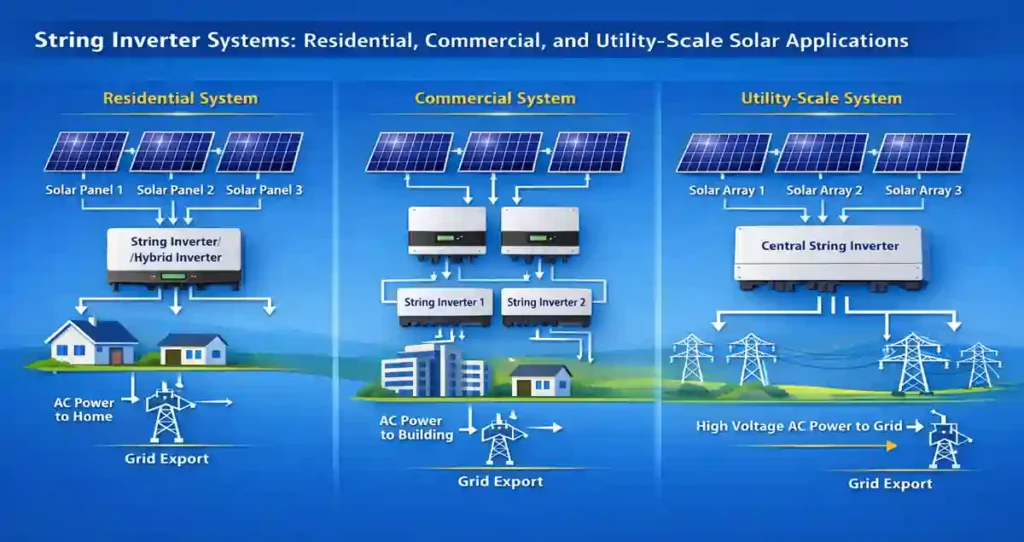
String inverter solar systems are widely used across residential rooftops, commercial buildings, and utility-scale solar farms due to their reliability and cost-effectiveness. In the USA, UK, and other high-tier countries, residential systems typically range from 3–10 kW, complying with grid standards like IEEE 1547 (USA) and G99/G100 (UK).
For commercial projects, such as warehouses and offices, multiple string inverters scale system capacity from 10–500 kW, following industrial electrical standards. These inverters fall under HS Code 8504.40, covering static converters, including solar inverters, for import/export purposes.
| Application | System Size / Capacity | Performance & Efficiency | Engineer’s Insight / Suitability |
| Home / Residential | 3–10 kW | High | Best for unshaded roofs; lowest upfront cost for grid-tie. |
| Commercial Offices | 10–500 kW | High | Scalable modular design; multiple MPPTs handle large arrays. |
| Utility Solar Farms | 500 kW – Multi-MW | Very High | Centralized control with max ROI for multi-megawatt projects. |
| Off-Grid / Cabins | 3–20 kW | Low | Not Recommended: Requires separate AC-coupled battery inverters. |
| RVs / Vans / Mobile | 1–5 kW | Low | Avoid: Series wiring is poor for mobile shading; use Hybrid or DC systems. |
Utility-scale solar farms utilize high-capacity string inverters for megawatt-level systems, which feature advanced grid support, remote monitoring, and compliance with international standards. Selecting the right inverter ensures efficiency, safety, and a strong ROI across all project types.
String Inverters: Key Technical Parameters Explained
Key specifications determine system performance and compliance in high-tier markets:
AC Output Power defines maximum usable energy
Max DC Input Power supports DC oversizing
MPPT Voltage Range ensures optimal efficiency
Number of MPPTs supports multi-orientation arrays
Efficiency Ratings reach 97–99%
Ingress Protection (IP65/IP66) ensures durability
Grid compliance aligns with UL 1741 (USA) and IEC standards
The Critical DC/AC Ratio Concept for High-Performance Solar Systems
The DC/AC ratio, also known as the inverter loading ratio, optimizes energy harvest. Ratios typically range from 1.1 to 1.6, depending on project scale. In high-tier markets, residential systems commonly use ratios of 1.1–1.3, while commercial and utility installations use 1.2–1.6 to maximize ROI under real-world operating conditions.
Advantages and Limitations of String Inverters
String inverters offer several advantages that make them popular in residential, commercial, and utility-scale solar systems. They provide a lower cost per watt compared to microinverters, proven reliability from decades of field deployment, and simplified maintenance with centralized servicing. High conversion efficiency, scalable design for system expansion, and strong manufacturer support with extended warranty options further enhance their appeal.
Shading Issues and Other Limitations
Despite their high efficiency, string inverters have a specific technical behavior that every buyer should understand. From an engineering perspective, panels are wired in a series circuit.
The “Christmas Lights” Analogy: Think of a string inverter like a traditional string of Christmas lights. If you cover one bulb (or if one bulb fails), the entire string goes out or dims. Similarly, if even one solar panel in a string is covered by shade from a chimney, tree, or passing cloud, the output of every other panel in that string drops to match the “weakest link.”
This “bottleneck” effect is the primary limitation of string technology. Other considerations include:
Limited Monitoring: You can usually see how the total system is performing, but you won’t see if one specific panel is underperforming unless you add DC Power Optimizers.
Single-Point Failure: Because all panels rely on one central inverter, if that unit fails, your entire system stops producing power until it is repaired.
Fixed Lifespan: While solar panels can last 25 years, a string inverter typically needs replacement or a major overhaul after 12 to 15 years.
Battery Integration Possibilities with String Inverters
While standard string inverters are not designed for direct battery integration, they can support energy storage through AC-coupled battery inverters, allowing the solar system and battery to operate independently. Hybrid inverters provide a more integrated solution with built-in battery charging and management, while battery-ready string inverters offer the flexibility to add storage in the future. For projects prioritizing efficiency, DC-coupled systems typically deliver higher energy conversion rates, making them ideal for large-scale or advanced residential installations. Understanding these options helps engineers and system designers plan solar-plus-storage solutions effectively while ensuring compliance with grid standards.
String Inverter vs Microinverter: Key Differences
Choosing between a string inverter and a microinverter is a critical decision for solar system design. String inverters use a single centralized unit to convert DC to AC power from multiple panels, making them cost-effective and easier to maintain for larger, unshaded systems. They are generally classified under HS Code 8504.40 (static converters including solar inverters) and comply with grid standards such as IEEE 1547 in the USA and G99/G100 in the UK.
In contrast, microinverters operate independently at each panel, providing panel-level monitoring and superior performance under partial shading conditions. Microinverters often carry the same HS code and meet similar grid compliance standards, but are preferred for smaller or complex installations where shading and individual panel performance matter. While microinverters excel for shaded or intricate rooftops, string inverters remain the preferred choice for cost-efficient, standard installations due to their simpler design and lower replacement costs.
Comparison Table: Micro Inverter vs String Inverter
| Feature | String Inverter | Microinverter |
|---|---|---|
| Configuration | Single centralized inverter for multiple panels | Individual inverter at each panel |
| Performance under shading | Lower, affected by the weakest panel | High, panel-level optimization |
| Cost | Lower upfront cost, more economical for large systems | Higher upfront cost |
| Monitoring | System-level monitoring | Panel-level monitoring |
| Maintenance | Easier, single unit to service | More complex, multiple units to service |
| HS Code | 8504.40 | 8504.40 |
| Compliance | IEEE 1547 (USA), G99/G100 (UK) | IEEE 1547 (USA), G99/G100 (UK) |
| Best Use | Unshaded, large residential/commercial systems | Shaded roofs, complex layouts, detailed monitoring |
When comparing string inverters vs microinverter solutions, string inverters remain preferred in commercial and utility sectors due to lower capital cost, simpler infrastructure, and scalable expansion. Microinverters excel in residential installations requiring detailed monitoring and shading resilience.
String Inverter vs Hybrid Inverter: Key Differences
Hybrid inverters combine the functions of a string inverter with integrated battery management, offering both AC/DC conversion and energy storage capabilities. Standard string inverters cannot directly support DC-coupled battery systems and require an AC-coupled battery inverter, whereas hybrid inverters provide a single solution for solar-plus-storage installations. Hybrid inverters also comply with grid standards like IEEE 1547 and G99/G100, and are generally classified under HS Code 8504.40.
While hybrid inverters provide flexibility for future battery integration and enhanced backup options, they are typically more expensive upfront than standard string inverters. Standard string inverters remain ideal for cost-efficient, unshaded solar systems, while hybrid inverters are preferred for projects requiring energy storage or advanced load management.
Comparison Table: String Inverter vs Hybrid Inverter
| Feature | String Inverter | Hybrid Inverter |
|---|---|---|
| Battery Integration | Not directly supported; requires an AC-coupled system | Integrated battery control, DC/AC-coupled options |
| System Complexity | Simple, single unit | More complex due to storage management |
| Cost | Lower upfront cost | Higher upfront cost |
| Monitoring | System-level monitoring | System + battery monitoring |
| Maintenance | Easier, single unit | Slightly more complex due to battery integration |
| HS Code | 8504.40 | 8504.40 |
| Compliance | IEEE 1547 (USA), G99/G100 (UK) | IEEE 1547 (USA), G99/G100 (UK) |
| Best Use | Cost-efficient, unshaded systems | Solar-plus-storage projects, backup systems |
Comparison with Alternative Technologies (Hybrid and Optimizer Systems)
Beyond microinverters, other technologies complement string inverter systems:
- Hybrid Inverters integrate battery charging circuits directly, enabling DC-coupled energy storage and providing a complete solar-plus-storage solution. They are ideal for applications requiring backup power or load management.
- Power Optimizers serve as a middle-ground solution, enhancing string inverter performance under shading conditions while keeping costs lower than full microinverter systems.
- Central Inverters extend the string inverter concept to utility-scale solar farms, managing megawatt-level arrays efficiently while maintaining compliance with international grid standards (IEEE 1547, G99/G100) and HS Code 8504.40.
These alternative technologies allow engineers to customize system design for performance, efficiency, and project-specific requirements, whether for residential, commercial, or utility-scale installations.
Installation and Maintenance Requirements
Install string inverters in cool, well-ventilated locations protected from extreme weather. Ensure proper grounding, accurate DC/AC wiring, and compliance with grid codes. Routine monitoring and performance checks help optimize energy output and detect potential issues early.
String Inverter HS Code (USA, UK, and Global Trade)
For international trade, procurement, and customs classification, string inverters typically fall under the following HS codes:
| Region | HTS / Commodity Code | Description / Engineer Insight |
| Global | 8504.40 | Static converters (General heading for all solar inverters) |
| USA (Primary) | 8504.40.9570 | Primary Inverter Code: Used for the actual string/hybrid inverter unit. |
| USA (Secondary) | 8504.40.9580 | Component Code: Used for MPPT charge controllers or power modules if shipped separately. |
| UK / EU | 8504.40.84 | Inverters with MPPT functionality (Highly specific for 2026). |
These codes are essential for importing solar inverters in high-tier markets like the USA, UK, and Europe.
Engineer’s Trade Tip: While the 6-digit HS code (8504.40) is universal, the US-specific 10-digit HTS codes distinguish between the core inverter unit (.9570) and auxiliary power electronics or controllers (.9580). Using the precise 10-digit code prevents “Entry Summary” delays at US ports.
String Inverters and AI Optimization: Latest Technological Advancements & Future Trends
Modern string inverters are evolving rapidly, integrating artificial intelligence (AI) and smart technologies to enhance performance, reliability, and adaptability in high-tier solar markets like the USA, UK, and Europe. These inverters now feature AI-based performance optimization, enabling predictive adjustments to maximize energy extraction under varying sunlight and shading conditions.
Advanced smart grid support allows inverters to regulate voltage and frequency, contributing to grid stability, especially in renewable-heavy networks. Safety enhancements such as rapid shutdown compliance and arc-fault detection ensure protection for both installations and maintenance personnel. Remote monitoring via mobile apps, Wi-Fi, or Ethernet, combined with predictive maintenance analytics, allows engineers and system operators to detect potential issues early and optimize overall system performance.
Residential and Home Applications
In-home and residential solar systems, string inverters typically power 3KW to 10kW solar system rooftop installations. AI-enabled monitoring ensures maximum energy extraction even under partial shading or changing weather conditions. Homeowners benefit from system-level performance insights, predictive maintenance alerts, and integration readiness for future battery storage or hybrid systems. The compact design of modern string inverters also allows installation in limited rooftop or garage spaces while maintaining high efficiency (97%+).
Commercial and Utility-Scale Applications
For commercial and utility-scale projects, string inverters scale from 10 kW to multi-megawatt installations, providing centralized control, modular expansion, and compatibility with industrial energy management systems. AI-driven optimization improves energy yield across large arrays, while grid-forming capabilities and cybersecurity protections ensure compliance with high-tier regulations and smart grid standards. These inverters remain a dominant choice due to cost-effectiveness, reliability, and future-ready technology.
Looking forward, string inverters continue to evolve with:
- AI integration for predictive operations and energy management
- Cybersecurity protection for connected and IoT-enabled systems
- Grid-forming capabilities, enabling inverters to actively establish grid parameters
- Improved power density and smaller footprints, making installations more compact without compromising capacity
- Full compatibility with energy ecosystems, enabling seamless integration with storage systems, hybrid inverters, and smart energy management platforms
These technological advancements make modern string inverters a cornerstone for residential, commercial, and utility-scale solar projects, offering high efficiency, safety, and adaptability while supporting the transition to smarter, AI-driven renewable energy systems. By understanding these parameters, engineers and system designers can maximize energy yield, reliability, and ROI over the inverter’s lifespan.
Compatibility with Other Solar Components
String inverters are designed to work seamlessly with a variety of solar system components. Ensuring proper compatibility is essential for maximizing performance, efficiency, and long-term reliability:
- Solar Panels: Compatible with monocrystalline, polycrystalline, and bifacial panels. For high efficiency, consider TOPCon panels. Check the panel voltage, current ratings, and DC capacity to match the inverter’s input specifications.
- Connectors & Cabling: Supports standard MC4 connectors for PV module connections, ensuring safe and low-loss DC wiring. Correct cable sizing and polarity are critical.
- Net Metering & Grid Integration: Works with standard grid-tied net metering systems in the USA, UK, and EU. Ensures compliance with local standards like IEEE 1547, G99/G100, and IEC 62109.
- Power Optimizers & MPPT Modules: Compatible with module-level power optimizers to improve performance in shaded or multi-orientation arrays.
- Other Electrical Components: Works with junction boxes, AC breakers, fuses, and surge protection devices to maintain safety and regulatory compliance.
Engineer Tip: Always verify that the DC input voltage and current limits of the string inverter match the panel array configuration to avoid overload and maintain optimal efficiency.
Maintenance and Longevity of String Inverters
Proper maintenance is key to ensuring your string inverter performs efficiently and lasts its full expected lifespan of 12–15 years. Routine checks include inspecting connections, ensuring proper ventilation, and monitoring system performance through smart apps or monitoring software.
Regular solar panel cleaning also directly impacts inverter efficiency. Dust, dirt, and debris on panels can reduce DC input, lowering overall AC output from the inverter. clean solar panels effectively using brushes and specialized solar panels cleaners
Monitoring inverter performance and ensuring cables, MC4 connectors, and junction boxes remain secure reduces the risk of faults. Simple preventive care not only prolongs inverter life but also maximizes energy yield, improving ROI over the system’s lifespan.
Common String Inverter Error Codes by Brand
| Brand | Error Code | Meaning / Fault | Action / What It Indicates |
|---|---|---|---|
| Fronius | STATE 101 | Grid voltage is too high | Check grid voltage and breakers; adjust service menu if needed |
| STATE 104 | Mains frequency out of range | Verify grid frequency and settings | |
| STATE 107 | Grid synchronization loss | Check the mains connection and circuit breakers | |
| STATE 108 | Islanding detected | Automatic islanding may self‑clear | |
| Sungrow | 002 | Grid overvoltage | Voltage exceeds limit; grid problem, not inverter defect |
| 004 | Grid undervoltage | Low grid voltage; may self‑clear when normal | |
| 005 | Undervoltage continued | Significant undervoltage condition | |
| 010 | Islanding / no grid | No grid power present; trip output | |
| 006 / 022 | Overcurrent faults | Too much current from panels or the AC side | |
| 028 | Reverse PV connection | Check PV string wiring & polarity | |
| 036 / 037 | Temperature issues | Ventilation problem or overheated unit | |
| Growatt | 102 | CPU data mismatch | Restart the inverter; check the grid quality |
| 111 | IGBT drive fault | Internal hardware fault; contact installer | |
| 117 | Relay circuit error | Restart; if persistent, call support | |
| 120 | Current sensor fault (HCT) | Restart and test the system; contact the installer if needed |
Understanding String Inverter Error Codes (Engineer Tips)
Error codes vary by brand (Fronius, Sungrow, Huawei, etc.), so always check your inverter manual.
Grid Faults: Protective trips, not hardware failures. Check local voltage, frequency, and breakers.
DC Side Issues: Overcurrent, reverse connection, or string voltage errors usually indicate wiring or panel issues. Verify polarity, connectors, and string configuration.
Internal Errors: IGBT or relay faults may need professional inspection and could be under warranty.
Temperature & Ventilation: Overheating occurs in poorly ventilated setups. Ensure airflow and shade from direct sunlight.
High-Voltage Warning
String inverters operate at dangerous DC voltages—always follow safety protocols during maintenance.
Conclusion: The Engineer’s Verdict for 2026
After a decade of designing and auditing solar installations, my verdict on string inverters remains clear: they are the reliable workhorses of the solar world. While newer technologies like microinverters offer “panel-level” benefits, the string inverter continues to win on cost-efficiency, simplified maintenance, and proven longevity.
For a homeowner or business with an unshaded roof, a high-quality string inverter from a reputable brand like SMA, Fronius, or Sungrow offers the fastest path to a full return on investment. As we move further into 2026, the integration of AI-driven predictive maintenance only makes these systems smarter and more autonomous.
What’s Your Next Step?
Choosing the right inverter is the most critical technical decision in your solar journey. To ensure you make the right choice:
- Check your roof for shade: Use the “Christmas Lights” rule we discussed.
- Verify local grid codes: Ensure your choice meets USA (UL 1741) or UK (G99) standards.
- Consult a Professional: Never skip the expert site audit.
Are you planning a residential or commercial solar project? Leave a comment below with your system size, or ask me a specific technical question—I’d be happy to provide an engineer’s perspective on your setup!
Frequently Asked Questions (FAQs)
What is a string inverter?
A string inverter converts DC electricity from solar panels into AC electricity for homes, commercial buildings, and grid export.
Why is it called a string inverter?
Because multiple solar panels are connected in series like a “string,” sending combined power to a centralized inverter.
Can string inverters work with batteries?
Standard string inverters cannot directly connect to batteries; AC-coupled inverters are required for energy storage.
How long do string inverters typically last?
They usually operate efficiently for 12–15 years, depending on installation quality and maintenance.
How does shading affect string inverters?
Shading on even one panel can reduce output from the entire string. Power optimizers or proper layout can help mitigate losses.
Are string inverters suitable for off-grid systems?
They are generally not recommended for off-grid setups, RVs, or mobile solar systems due to lack of battery integration.
How do I maintain a string inverter?
Keep it in a cool, ventilated area, clean nearby panels regularly, and inspect for dust, debris, or loose wiring.
What do inverter error codes mean?
Codes indicate grid issues, DC wiring faults, internal hardware errors, high-voltage warnings, or overheating. Always consult the manual or a licensed installer.