
Discover why the TOPCon solar panel is a proven smart investment in 2026. Engr. Syed explains N-type efficiency, ROI, and heat reliability for your project.
As an engineer, I am excited to share my insights. This is a significant development in the solar industry, helping us achieve maximum efficiency, long-term performance, and smarter solar investments.
Even though many types of solar panels already exist, TOPCon (Tunnel Oxide Passivated Contact) panels are different. They were invented to solve the real technical limits of older solar technologies and meet the growing energy needs of modern homes, businesses, and large-scale installations.
In this guide, I’ll explain what TOPCon is, why it was developed, its advantages and drawbacks, and whether it makes sense for your solar project in 2026. By the end, you’ll have a clear picture of whether TOPCon is the right technology for your needs.
What Is a TOPCon Solar Panel and Why Is It Called That?
TOPCon stands for Tunnel Oxide Passivated Contact, a sophisticated solar cell design aimed at improving electron flow inside the panel. TOPCon panels use N-type silicon wafers, which are more resistant to light-induced degradation (LID) and high temperatures compared to traditional P-type wafers.
Breaking down the name:
- Tunnel Oxide: A very thin oxide layer on the rear of the cell lets electrons “tunnel” efficiently while preventing energy loss.
- Passivated Contact: A protective layer that minimizes electron recombination, ensuring maximum energy conversion.
This combination of N-type silicon and passivated contacts is why the technology is called TOPCon. The result? Higher efficiency, better heat resistance, and longer lifespan compared to traditional solar panels like PERC or standard monocrystalline modules.
Keyword link suggestion: N type TOPCon solar panel → can link to your page about solar PV plates or solar products.
Types of TOPCon Solar Panels
- Monofacial TOPCon Solar Panels
- Standard TOPCon design that captures sunlight only from the front side.
- Best for rooftops and areas with limited reflective surfaces.
- High efficiency (24–25.5%) with low degradation.
- Bifacial TOPCon Solar Panels
- Can capture sunlight from both front and rear sides, boosting energy output by 10–25% depending on ground reflectivity.
- Ideal for utility-scale projects, carports, and open field installations.
- Often paired with high albedo surfaces, such as white concrete or reflective rooftops.
- Large-Format TOPCon Solar Panels
- Panels with higher wattage (400–500W+), designed for commercial and industrial projects.
- Reduces BOS (Balance of System) costs by requiring fewer panels.
- Compatible with N-type silicon advantages: low LID, high heat resistance, long lifespan.
- Split-Cell / Half-Cut TOPCon Solar Panels
- Each cell is cut into halves to reduce resistive losses and improve shade tolerance.
- Enhances panel reliability and overall energy yield.
- Popular in both residential and commercial rooftop projects.
- Dual-Glass TOPCon Solar Panels
- Uses glass on both sides instead of a backsheet for added mechanical durability and moisture resistance.
- Perfect for harsh climates or high-humidity areas.
- Often used for bifacial applications.

Why TOPCon Solar Panels Were Invented
Traditional panels—polycrystalline, monocrystalline, and P-type PERC—plateaued around 20–21% efficiency. The limits were due to:
- Electron recombination: Electrons generated by sunlight recombine before contributing to power.
- Early degradation: Light-Induced Degradation (LID) reduces output permanently in the first months.
- Heat sensitivity: Performance drops significantly in hot climates.
TOPCon technology addresses these challenges, making panels more efficient, durable, and reliable for long-term energy production.
How TOPCon Technology Works
TOPCon solar panels use N-type silicon wafers combined with:
- A thin tunnel oxide layer
- A passivated polysilicon contact
This setup:
- Reduces electron recombination
- Converts more sunlight into electricity
- Minimizes early-life degradation, maintaining output for 25+ years
In simple terms, TOPCon solar panels turn more sunlight into electricity for longer periods, making them ideal for modern residential, commercial, and utility-scale projects.
TOPCon Solar Panels vs Older Technologies
| Feature | PERC | TOPCon | HJT |
|---|---|---|---|
| Cell Type | P-type | N-type | N-type |
| Efficiency | 20–21% | 24–25.5% | 25–26% |
| LID Resistance | Moderate | Very High | Very High |
| Temperature Performance | Moderate | Excellent | Excellent |
| Degradation | Higher | Low | Very Low |
| Cost | Low | Medium | High |
Key insight: TOPCon strikes the perfect balance between efficiency, durability, and cost. HJT is slightly more efficient but much more expensive, while PERC is cheaper but less reliable over time.
Construction Comparison: TOPCon vs Conventional Solar Panels

| Feature / Construction | TOPCon Solar Panel (N-Type) | PERC Solar Panel (P-Type) | Monocrystalline (P-Type) | Polycrystalline (P-Type) |
|---|---|---|---|---|
| Cell Type | N-type silicon | P-type silicon | P-type silicon | P-type silicon |
| Passivated Contact | Tunnel Oxide Passivated Contact (TOPCon) | Rear Surface Passivation (PERC) | Standard contact | Standard contact |
| Degradation (LID) | Very Low | Moderate | Moderate | Higher |
| Efficiency | 24–25.5% | 20–21% | 18–20% | 15–17% |
| Temperature Coefficient | –0.29%/°C | –0.36%/°C | –0.40%/°C | –0.43%/°C |
| Bifacial Option | Yes, 80–85% bifaciality | Limited | Rare | No |
| Glass / Encapsulation | Dual-glass or standard, high durability | Standard | Standard | Standard |
| Cost | Medium | Low | Medium | Low |
| Lifespan | 25–30 years | 20–25 years | 20–25 years | 15–20 years |
| Suitability for Hot / Harsh Climates | Excellent | Moderate | Moderate | Low |
| Special Notes | Low degradation, long-term ROI, AI-ready | Cheaper, more common | Widely available, reliable | Budget-friendly, lower efficiency |
TOPCon Solar Panels Compatibility and Multi-Project Use
- Solar Inverters: Fully compatible with string, hybrid, and on-grid inverters, ensuring optimal energy conversion for any system.
- Solar Batteries: Easily pair with residential, commercial, and off-grid batteries for reliable backup power.
- MPPT Charge Controllers: Works seamlessly with MPPT solar charge controllers, maximizing energy harvest even in variable sunlight.
- PWM Charge Controllers: Compatible with PWM solar charge controllers for simpler or smaller setups.
- MC4 Connectors: Standard MC4 connectors simplify installation, allowing integration with existing wiring and solar systems.
- Agricultural Projects: Ideal for powering solar water pumps for irrigation, livestock, and greenhouse operations.
- Maintenance & Cleaning: Low-maintenance design with easy cleaning solar panels ensures long-term performance, reducing downtime and upkeep costs.
- Multi-Purpose Use: Suitable for residential, commercial, industrial, and off-grid projects, making TOPCon panels versatile across all solar applications.
Key takeaway: Upgrading to TOPCon solar panels allows seamless integration with existing components, supports agricultural and industrial projects, and ensures long-term efficiency with minimal maintenance.
Solar AI Perspective: Smarter Energy with TOPCon Panels
The future of solar energy is not just in high-efficiency panels—it’s in intelligent systems powered by AI. TOPCon solar panels are particularly well-suited for integration with AI-driven solar monitoring, predictive maintenance, and energy management platforms.
- Smart Performance Monitoring: AI algorithms track panel output in real time, detecting dips in performance, shading issues, or potential faults before they become major problems.
- Predictive Maintenance: By analyzing historical data and weather patterns, AI can predict when cleaning, inspection, or minor maintenance is needed, maximizing long-term output.
- Optimal Energy Harvesting: Paired with MPPT solar charge controllers, AI can dynamically adjust operating parameters for maximum electricity generation, even under variable sunlight conditions.
- Grid & Off-Grid Management: AI can intelligently manage power distribution between solar inverters, batteries, and loads, ensuring reliable supply for homes, businesses, or microgrids.
- Data-Driven Decisions for Agriculture: In solar-powered irrigation systems, AI can optimize solar water pump schedules based on sunlight availability and soil moisture levels, improving efficiency and crop yields.
- Integration with IoT Devices: TOPCon panels combined with smart sensors, AI, and IoT platforms enable fully automated, remote-controlled solar systems—ideal for rooftops, commercial buildings, and large solar farms.
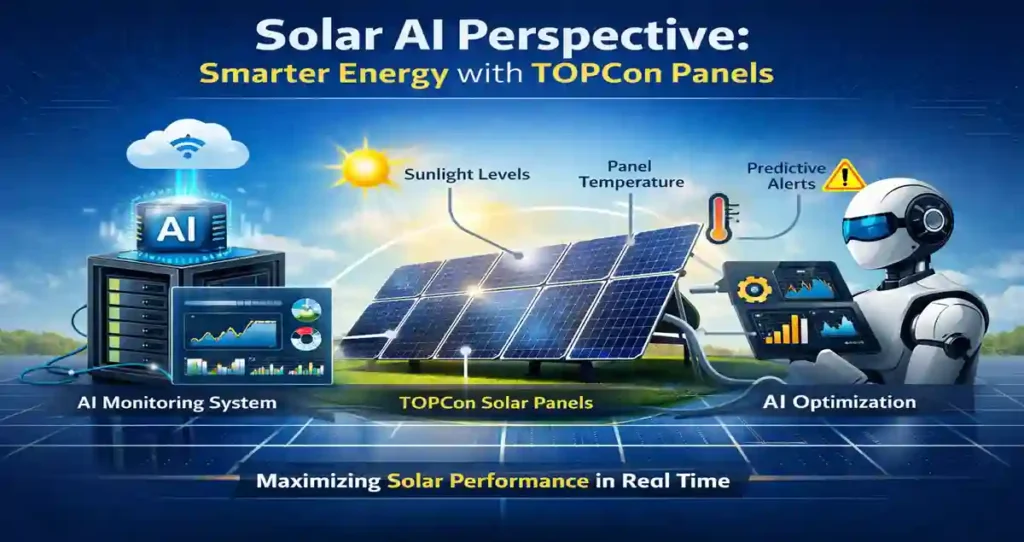
Key takeaway: By combining TOPCon solar panels with AI and smart monitoring, users gain higher efficiency, predictive maintenance, and intelligent energy management, turning a simple solar array into a future-ready, autonomous energy system.
TOPCon Solar Panels: 2026 Pros & Cons
Pros – Why TOPCon Is the 2026 Industry Favorite
- Superior Efficiency: Brands like Jinko, LONGi, Canadian Solar, and Trina reach 24.5–25.5% efficiency.
- Immune to LID: N-type silicon prevents Light-Induced Degradation.
- High-Temperature Performance: Temperature coefficient of –0.29%/°C, ideal for 40°C+ climates.TOPCon panels use N-type silicon, making them more resistant to light and heat damage. In hot regions like Dubai or Pakistan, they keep their full power even in peak summer
- Bifacial Powerhouse: Bifacial TOPCon solar panels generate energy from both sides with an 80–85% bifaciality factor.
- Best ROI: Cost gap with PERC panels has narrowed in 2026, making TOPCon practical.
- Long-Term Durability: Maintains 87–90% output after 25–30 years.
Cons – What to Watch Out For
- Moisture Sensitivity: Some cells are sensitive to humidity—use Dual-Glass modules for protection.
- UV Sensitivity: Low-quality passivation layers may degrade under strong sunlight—stick to Tier-1 brands.
- Not Absolute Peak Efficiency: HJT or Back Contact panels can exceed 26% efficiency at higher costs.
Manufacturers Leading the TOPCon Revolution
Several major solar manufacturers have already adopted TOPCon technology:
- Jinko Solar – N-type TOPCon modules with excellent bifacial performance
- LONGi Solar – Focused on cost-effective high-efficiency N-type cells
- Canadian Solar – Offers 450W TOPCon panels suitable for commercial rooftops
- Trina Solar – Leading bifacial TOPCon panels for utility-scale projects
- JA Solar & Risen Energy – Expanding TOPCon offerings worldwide
These manufacturers are producing panels trusted for residential, commercial, and industrial-scale projects, highlighting TOPCon as the next-gen standard.
Real-World Projects That Adopted TOPCon Panels
- Utility-Scale Solar Farms in Europe and the US: Large bifacial TOPCon arrays deliver high efficiency in space-constrained sites.
- Canadian Solar 450W TOPCon solar Panels – Deployed in commercial rooftops and small solar farms in Canada and Asia.
- LONGi TOPCon Residential Projects – High-efficiency installations in urban China and India.
- Trina Solar Bifacial TOPCon Installations – Carports, parking lots, and hybrid rooftops worldwide.
- Hybrid & Off-Grid Systems – N-type TOPCon panels powering remote microgrids with maximum longevity.
Engineer’s Perspective: Why TOPCon Is Redefining Solar Panel Performance
TOPCon panels are more than just another solar panel type. They are:
- Efficient: Convert more sunlight to electricity with minimal loss
- Reliable: Maintain output for decades with low degradation
- Cost-effective: Near PERC pricing with higher performance
- Future-ready: Ideal for residential rooftops, commercial buildings, and utility-scale farms
For any project aiming at maximum power, minimal degradation, and strong ROI, TOPCon solar panels are the practical choice in 2026.
Final Verdict for 2026
Choose TOPCon solar panels if:
- You want maximum efficiency without overspending
- You need long-lasting performance in hot climates
- Installing residential or commercial rooftop systems
Skip TOPCon if:
- Operating in extreme conditions, like floating solar or high humidity
- Absolute peak efficiency is your top priority, and budget is no object (HJT may be better)
For most 2026 projects, TOPCon panels deliver the best combination of efficiency, durability, and economic sense.
FAQs About TOPCon Solar Panels
What is a TOPCon solar panel?
TOPCon solar panels use N-type silicon with Tunnel Oxide Passivated Contacts to reduce electron loss, improve efficiency (24–25.5%), and provide long-term durability compared to traditional PERC or monocrystalline panels.
Are TOPCon panels compatible with existing solar systems?
Yes! They integrate seamlessly with solar inverters, MPPT and PWM charge controllers, batteries, and standard MC4 connectors, making upgrades or expansions straightforward.
Can TOPCon solar panels be used for agricultural projects?
Absolutely. They are ideal for powering solar water pumps for irrigation, livestock, and greenhouse operations, thanks to their high efficiency and reliability.
How do TOPCon panels perform in hot climates?
TOPCon panels have an excellent temperature coefficient (~–0.29%/°C), meaning they maintain high performance even in extreme heat, outperforming traditional PERC panels.
What maintenance do TOPCon solar panels require?
Maintenance is simple: regular cleaning every 6–12 months, monitoring via AI-powered systems or performance logs, and periodic checks of mounts, wiring, and connections ensure long-term output.
Can TOPCon panels work with AI systems?
Yes. They can integrate with AI-based monitoring, predictive maintenance, and energy management systems, optimizing energy harvest, battery usage, and solar water pump operations for both residential and commercial applications.
Are bifacial TOPCon panels worth it?
Yes. Bifacial TOPCon solar panels capture sunlight from both sides, increasing energy output by 10–25% depending on the surface reflection, making them ideal for rooftops, carports, and utility-scale farms.
How long do TOPCon solar panels last?
With proper installation and maintenance, TOPCon panels maintain 87–90% output after 25–30 years, making them a long-term investment for residential, commercial, and industrial projects.
Can TOPCon solar panels be combined with other solar technologies?
Yes. TOPCon panels can work alongside existing solar panels, hybrid inverters, and off-grid systems, offering flexibility for upgrading older installations or creating multi-source solar arrays.
Can TOPCon solar panels be used in an array with other panels?
Yes, but there are some considerations:
Keep voltage (Vmp) and current (Imp) similar across all panels to avoid mismatch losses.
Mixed-efficiency panels (e.g., TOPCon + PERC) may reduce the total output to match the least efficient panel.
Use MPPT solar charge controllers to maximize energy harvest from different panel types.
Separate bifacial TOPCon panels from monofacial panels to utilize rear-side energy effectively.
Ensure consistent tilt and orientation to minimize shading and performance losses.
Are TOPCon solar panels cost-effective in 2026?
Yes. Despite being slightly more expensive than PERC, the higher efficiency, longer lifespan, and low degradation make them cost-effective, with ROI often achieved in 3–5 years.