
Thousands of used solar panels hit the US market daily. Before you buy, learn the “red flags” that indicate a dying module and how to test for 90% efficiency.
As a solar engineer with years of experience in designing, testing, and installing photovoltaic systems, I’ve seen both the value and risks of the secondary solar market. Used solar panels can provide significant cost savings, but only when evaluated carefully. Panels sold as second-hand solar may vary widely in quality, efficiency, and reliability. Improperly tested modules can lead to early degradation, reduced performance, or even system failure.
This guide provides a professional, step-by-step checklist that I personally use to evaluate second-hand solar and, helping buyers maximize ROI while avoiding costly mistakes. Every step is grounded in real engineering practices and practical testing methods.
Engineer’s Inspection Checklist (Quick Evaluation Table)
| Step | Inspection Area | What to Check | Risk if Ignored |
|---|---|---|---|
| 1 | Seller Credibility | License, warehouse, reviews | Fraud or misrepresented panels |
| 2 | Removal Reason | Upgrade vs. fire/flood damage | Hidden internal damage |
| 3 | Manufacturing Data | Year, model, Vₒc, Iₛc ratings | Reduced lifespan |
| 4 | Physical Damage | Cracks, corrosion, delamination | Efficiency loss |
| 4A | Bypass Diodes | Burn marks, voltage drop | 30–33% output loss |
| 5 | Electrical Testing | Vₒc / Iₛc measurement | Internal cell failure |
| 6 | Flash/IV Reports | Performance verification | Buying degraded stock |
| 7 | Pricing Analysis | Cost per usable watt | False ROI |
| 8 | Compatibility | Voltage & connector match | System inefficiency |
| 9 | Bulk Testing | Sample test required | Large-scale failure |
| 10 | Degradation | 0.5–0.8% per year | Overestimated output |
Used vs. Refurbished vs. New Solar Panels: Engineer’s Cost, Lifespan & ROI Comparison
| Decision Factor | Used Solar Panels (Secondary Market) | Refurbished Solar Panels | New Tier-1 Solar Panels |
|---|---|---|---|
| Average Cost | $0.15 – $0.25 per Watt | $0.25 – $0.40 per Watt | $0.45 – $0.70 per Watt |
| Lifespan | 10–20 Years Remaining | 15–25 Years (after refurbishment) | 25+ Years Guaranteed |
| Best Use | Off-Grid, RVs, Agriculture | Residential upgrades, low-to-medium load systems | Residential Roofs, Grid-Tie, Critical Systems |
| Engineer’s Verdict | High ROI for non-critical loads | Good option if verified and tested | Required for high-load reliability and long-term investment |
| Key Considerations | Verify authenticity; avoid critical systems | Inspect repair quality, request test reports | Premium performance, full manufacturer warranty |
Inspection Checklist for Used and Second-Hand Solar Panels
1. Verify the Seller’s Credibility
Before purchasing second-hand solar, confirm the seller’s legitimacy. A reputable seller should be a licensed solar contractor or verified reseller, with a physical warehouse or operational address. Request business registration or proof of operations, and check verified reviews or references from previous buyers. Avoid anonymous listings or unverified sellers, especially if you plan to purchase pre-owned solar modules, since there is no guarantee of quality or authenticity.
Quick Bullet Highlights:
- Licensed contractor or verified reseller
- Physical warehouse or operational address
- Verified reviews or references
- Avoid anonymous or unverified sellers
2. Confirm the Reason for Panel Removal
Not all second-hand solars are defective. Panels may be removed due to system upgrades, roof replacements, or site decommissioning. Avoid panels removed because of fire, flooding, or electrical failures, as these can compromise performance.
Quick Bullet Highlights:
- Acceptable: system upgrades, roof replacement, decommissioning
- Avoid: fire, flood, electrical damage
3. Check Manufacturing Year and Model
Verify the manufacturer, model, rated power, voltage (Voc, Vmp), and current (Isc, Imp) for all used solar panels. Older panels or unreadable labels may indicate reduced lifespan or misrepresentation.
Quick Bullet Highlights:
- Manufacturer, model, and ratings
- Check the manufacturing year
- Avoid panels with unreadable labels
4. Inspect for Physical Damage
Visual inspection is critical. Check for cracks in the glass, delamination, yellowing, frame corrosion, or damaged junction boxes and connectors. Even minor damage can reduce efficiency and ROI for pre-owned solar modules
Quick Bullet Highlights:
- Cracks, chips, or delamination
- Frame corrosion
- Damaged junction boxes or connectors
4A. Check Bypass Diodes and Junction Box Integrity
Bypass diodes protect solar panels from hotspot damage when part of the module is shaded or faulty. In second-hand solar, failed bypass diodes are common and can significantly reduce output without visible external damage.
Open the junction box (if safely accessible) or request inspection records to verify:
- No burnt smell or discoloration
- No melted solder joints
- No cracked diode casings
- Proper sealing against moisture
A faulty bypass diode can cause one-third of a panel’s output to drop, even if the glass and frame appear intact. Always test the output voltage and compare it with the expected values to confirm diode functionality.
Quick Bullet Highlights:
- Inspect the junction box for burn marks
- Verify bypass diode condition
- Watch for a partial voltage drop
- Ensure moisture protection
5. Perform Electrical Testing
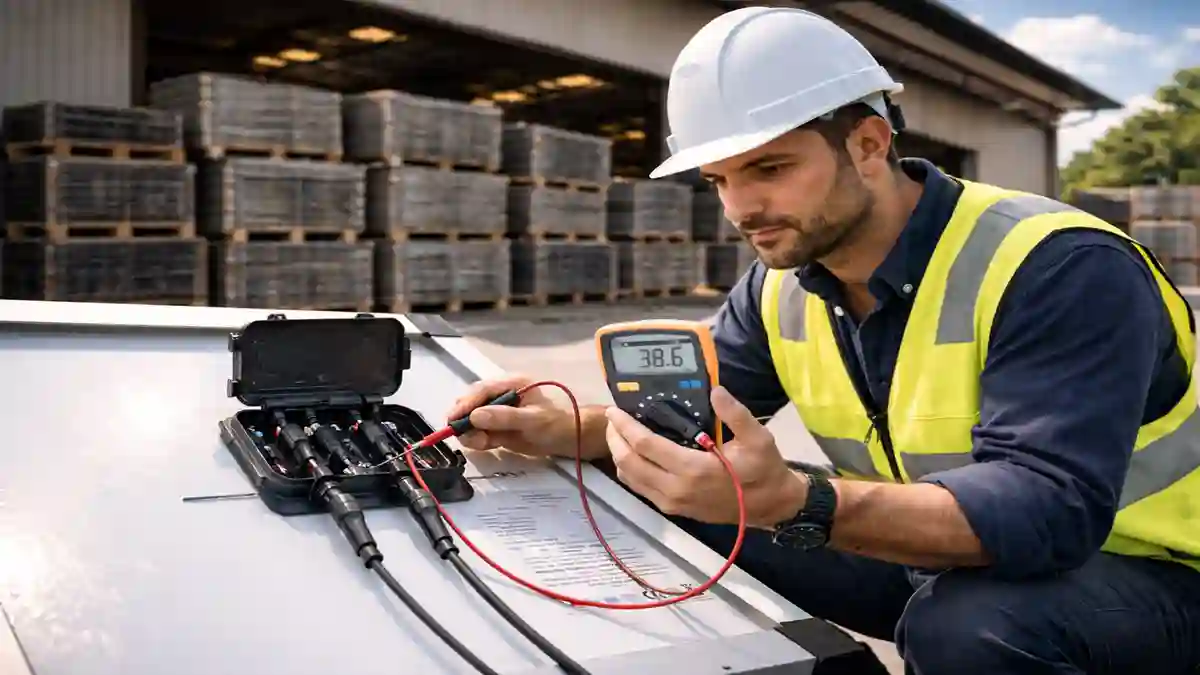
Measure open-circuit voltage (Voc) and short-circuit current (Isc) under sunlight. Use a thermal camera to detect hotspots. Panels deviating from rated specifications may have internal faults.
Quick Bullet Highlights:
- Test Voc and Isc
- Detect hotspots with a thermal camera
- Compare readings with datasheet values
6. Request Flash Test or IV Curve Reports
Professional sellers may provide flash test or IV curve reports, confirming actual power output. This is especially important when purchasing second-hand solar panels for sale in bulk.
Quick Bullet Highlights:
- Ask for flash test or IV curve reports
- Confirms panel performance
- Reduces risk in bulk purchases
7. Watch for Unrealistic Pricing
Avoid deals that seem too good to be true. Extremely low prices for cheap pre-owned solar modules may indicate degradation, damage, or misrepresented panels. Calculate cost per usable watt rather than price per panel for accurate ROI assessment.
Quick Bullet Highlights:
- Check for unusually low prices
- Calculate the cost per usable watt
- Avoid severely degraded or damaged panels
8. Ensure System Compatibility
Verify that second-hand solar match your system requirements: voltage, current, connectors, and mounting hardware. Incompatible panels can reduce efficiency or cause safety issues.
Quick Bullet Highlights:
- Check voltage, current, and connector compatibility
- Confirm mounting hardware and roof angle
- Prevent system inefficiency or hazards
9. Avoid Bulk Purchases Without Testing
Even if buying cheap second-hand solar panels in bulk, test a representative sample first to avoid large-scale failures and ensure reliable performance.
Quick Bullet Highlights:
- Test a sample before bulk purchase
- Prevent large-scale failures
- Ensure consistent performance
10. Understand Expected Degradation
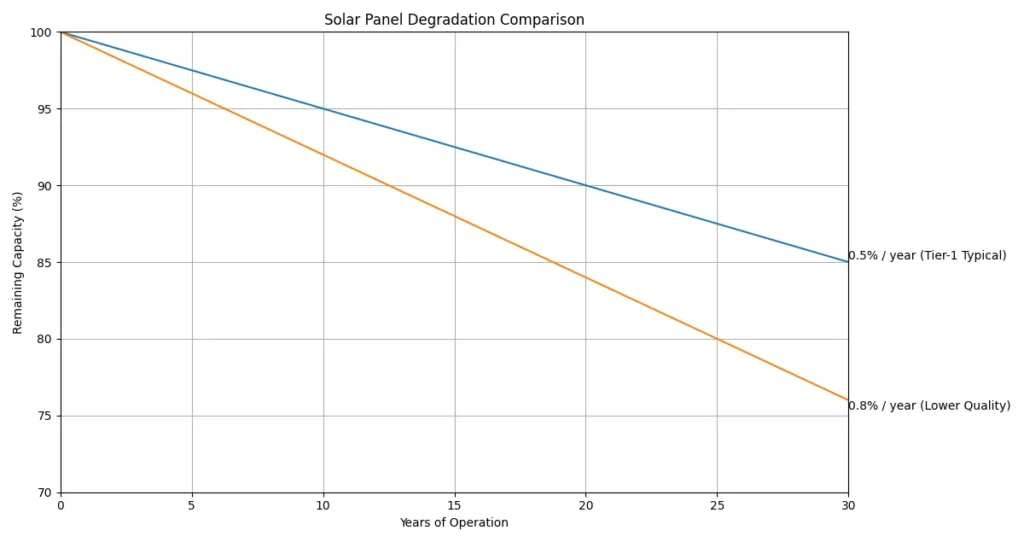
Solar panels degrade slowly, typically 0.5–0.8% per year. After 10–20 years, most panels retain 84–95% of their original capacity. Understanding degradation helps evaluate the true value of pre-owned solar modules
Quick Bullet Highlights:
- Typical degradation: 0.5–0.8% per year
- 10–20 years: ~84–95% capacity remaining
- Factor into the ROI calculation
Applications of Used and Second-Hand Solar Panels
Used solars are not only cost-effective—they can serve a wide range of practical applications. When selected and tested correctly, these panels can deliver reliable energy while significantly reducing upfront costs. Below are the most common applications:
1. Off-Grid Cabins and Remote Properties
Remote cabins, tiny homes, or seasonal shelters often need basic electricity for lighting, fans, and small appliances. Using cheap second-hand solar panels can drastically reduce installation costs without compromising daily usability.
2. Agricultural and Irrigation Systems
Farm irrigation pumps, solar water pumps, water treatment, and greenhouse lighting can benefit from second-hand solar panels. Since these systems often operate during daylight hours and don’t require premium panels, a slight efficiency loss is acceptable.
3. RVs, Vans, and Mobile Systems
Mobile solar setups for RVs, campers, or tiny homes rely on cost-effective modular panels. Second-hand solar can power lights, ventilation, and device charging while keeping the system expandable and flexible.
4. Backup Power for Workshops and Garages
Workshops, garages, or storage units often need electricity for tools, lighting, and battery charging. Installing Decommissioned Modules is a low-cost way to meet these needs without investing in premium new panels.
5. Educational and Experimental Projects
Engineering students, hobbyists, and DIY enthusiasts can use cheap second-hand solar panels for:
- Battery charging experiments
- MPPT controller testing
- Solar Inverter load trials
In these cases, cost savings outweigh warranty concerns, making pre-owned solar modules ideal for learning and experimentation.
6. Community Solar or Low-Cost Microgrids
Local community projects and non-profit solar initiatives can expand electricity access by using pre-owned solar panels. Initiatives like Solar Panels for Schools help bring power to schools, health clinics, and rural communities where budgets are limited.
Where Not to Install Pre-owned PV Panels
While used solar panels are cost-effective, they are not suitable for every application. Choosing the wrong location can reduce performance, shorten lifespan, and create potential safety risks. It’s important to understand where cheap second-hand solar panels should not be installed.
High-Risk Weather Areas
Areas prone to heavy hail, flooding, or extreme winds can damage second-hand solar faster than new ones. Panels that have already endured some wear are more susceptible to physical damage, which can result in reduced efficiency or premature failure of a solar power system. Avoid installing second-hand solar panels in locations with frequent storms or natural disasters to protect your investment and maintain ROI.
Critical Power Systems
Do not use second-hand solar in critical systems such as hospitals, data centers, or essential backup power installations. Even minor efficiency losses or unexpected failures could cause significant disruption and compromise safety. For these applications, it is better to rely on new, certified solar modules rather than second-hand solar panels.
Shaded or Low-Light Locations
Second-hand solar panels perform best in full sun. Installing them in shaded areas, narrow urban spaces, or under dense tree cover can significantly reduce efficiency, which lowers ROI. Proper siting is critical to ensure that cheap used solar panels deliver the expected energy output.
High-Humidity or Corrosive Environments
Coastal areas or industrial zones with salt spray or chemical exposure can accelerate corrosion in cheap second-hand solar panels. Panels with compromised frames, junction boxes, or connectors are especially vulnerable. Avoid installing second-hand solar panels in these conditions unless they have been specifically tested and protected against corrosion.
Roofs with Structural Issues
Do not install second-hand solar panels on roofs that are old, weak, or improperly angled. Panels may not withstand wind load on unstable structures, and improper mounting can pose serious safety hazards. Ensuring the roof’s integrity is essential before installing used solar panels to protect both the system and the building.
Refurbished vs. Used Solar Panels: Ensuring Authenticity
Understanding the difference between refurbished solar panels and used solar panels is critical for making a high-ROI purchase. Second-hand solar panels are panels previously installed but kept in their original, unaltered condition. They maintain their original power ratings, labels, and lifespan. Refurbished solar panels, on the other hand, have undergone repairs, component replacements, or reconditioning to restore performance. While refurbished panels can work, the best ROI comes from genuine used solar panels that have not been altered, repainted, or misrepresented.
1. Check Labels and Serial Numbers
Genuine used solar panels retain original manufacturer labels. Refurbished panels may have replaced, repainted, or modified labels, which can misrepresent the panel’s age or capacity.
2. Inspect Junction Boxes and Connectors
Look for signs of replacement or tampering. Refurbished panels often have new junction boxes, connectors, or wiring modifications. Authentic second-hand solar panels retain their original components.
3. Examine Glass and Frame
Minor wear is normal for used solar Modules, such as slight scratches or minor discoloration. Refurbished panels may have repaired frames, replaced glass, or polished surfaces, which can sometimes hide hidden defects.
4. Request Datasheets or Test Reports
Ask the seller for IV curves or flash test results. These confirm that the panel’s actual performance matches the manufacturer’s specifications. Refurbished panels may perform inconsistently despite visual improvements.
5. Ask the Seller Directly
Always confirm if the panel has been refurbished, repaired, or repainted. Honest sellers will disclose all modifications. Avoid panels sold as “used” if the seller cannot confirm they are unaltered.
Why Authenticity Matters
By following these steps, you ensure that the used solar panels you purchase are authentic, unaltered, and provide predictable performance. Avoiding misrepresented or artificially “refurbished” units protects your investment and maximizes ROI.
Handling Old Solar Panels: Responsible Use and Recycling
Solar panels degrade over time, and old solar panels that have reached or exceeded their expected lifespan—typically 25–30 years—require careful handling. Panels beyond this threshold may have significantly reduced efficiency, hidden internal wear, or safety risks, making them unsuitable for high-demand or critical applications. Proper assessment and recycling are essential to ensure safety, maximize value, and protect the environment.
1. Assess Remaining Lifespan
Before considering reuse, determine the panel’s age and expected degradation. Panels older than 25–30 years may operate well below rated capacity and could fail unexpectedly. Old solar panels should only be used for low-demand or experimental applications, not critical energy systems.
2. Inspect for Physical and Electrical Wear
Even if panels appear intact, check for cracks, delamination, yellowing, corrosion, or damaged connectors. Electrical testing—measuring Voc, Isc, and output under sunlight—is essential to confirm remaining performance. Panels showing excessive wear should not be reused.
3. Avoid Reuse in Critical or High-Load Systems
Do not install old solar panels in hospitals, industrial solar applications, or essential backup systems. Reduced efficiency or unexpected failure in these environments can cause serious disruptions or hazards.
4. Recycle Responsibly
Certified solar recycling programs can recover valuable materials like silicon, glass, and metals while preventing environmental contamination. Improper disposal in landfills can release toxic materials and harm the environment. Recycling is the safest and most sustainable approach for old solar panels.
5. Use for Low-Risk Applications Only
If panels are still functional but beyond their prime, they can be used in off-grid cabins, garden systems, experimental projects, or temporary installations where minor efficiency loss is acceptable. Always clearly communicate the panel’s age and expected performance.
Why Responsible Handling Matters
By evaluating lifespan, inspecting wear, and recycling old panels properly, you ensure safety, maintain environmental responsibility, and avoid unexpected failures. Respecting the designed lifespan of old solar panels maximizes long-term value and sustainability while minimizing risks.
Technical Integration: Compatibility & Maintenance Of Pre-owned PV Panels:
Buying used panels is step one. Proper integration ensures they perform safely and reliably within your complete system.
1. Inverter Compatibility
- String Inverters: Cost-effective only if all used panels are identical age/model. One weak panel drags down the entire string.
- Hybrid Inverters: Required for battery storage. Verify MPPT range handles older panels’ variable voltage.
- Microinverters/Optimizers: Engineer’s top recommendation. Each panel operates independently, eliminating the “weakest link” problem. Ideal for mixed panels or partial shade.
2. Battery Storage (BESS) Integration
- Charge Controller: Must handle the specific Vₒc (Open-Circuit Voltage) of your used array, especially cold-temperature voltage spikes.
- Array Sizing: Older panels = lower output. Calculate charging needs based on tested wattage, not nameplate ratings. You may need more panels to fully charge batteries.
3. Wiring & Connector Safety
- MC4 Connectors: Inspect for brittleness, cracking, or corrosion. Replace damaged connectors immediately—they are a leading fire risk.
- Wire Gauge: Verify cable size matches panel $I_{sc}$. Undersized wiring causes voltage drop and heat buildup.
4. Maintenance: Cleaning for Peak ROI
- Tools: Soft-bristle solar brush only. Avoid abrasives that scratch glass.
- Solutions: Deionized water or dedicated solar cleaner. No harsh detergents—they strip anti-reflective coatings and attract dust.
- Timing: Clean early morning or evening. Hot panels risk thermal shock and rapid water spotting.
Frequently Asked Questions (FAQs) – Used Solar Panels
Can I claim the 30% US Federal Tax Credit (ITC) on used solar panels?
In 2026, the IRS Section 25D typically only allows the tax credit for the “original installation” of new equipment. If you are buying second-hand panels, you generally cannot claim the 30% credit on the panel cost. However, you may still claim it for new components installed at the same time, such as a new battery or inverter.
Is it safe to mix used solar panels with my brand-new panels?
As an engineer, I advise caution. If you connect them in the same string, the entire string will drop to the current (Amps) of the weakest, oldest panel. To do this safely, use DC Power Optimizers or Microinverters to allow each panel to operate independently.
How do I know if a used panel is “dead” vs. just “old”?
Perform a Vₒc (Open-Circuit Voltage) test with a multimeter. If the reading is more than 10% below the factory label rating under full sunlight, the panel likely has internal cell damage or failed bypass diodes and should be avoided.
What is the typical lifespan remaining on a 10-year-old panel?
Most Tier-1 panels degrade at 0.5% per year. A 10-year-old panel should still provide roughly 95% of its original capacity. If it’s testing below 85%, it has aged prematurely due to poor environmental conditions or low-quality manufacturing.
Where can I find reliable used solar panels in the USA?
Reputable sources include certified solar liquidators, specialized eBay resellers with high ratings, and local decommissioning projects. Always avoid “as-is” listings that do not provide test reports or Vₒc / Iₛc data.
Do used solar panels come with a warranty?
Most used solar panels no longer carry the original manufacturer’s warranty, especially if ownership has changed. Some professional resellers may offer a limited 30–90-day testing warranty, but this is not the same as a 25-year performance guarantee. Always request written warranty terms before purchasing.
Can used solar panels cause fire risks?
They can, if improperly inspected or installed. Cracked backsheets, damaged connectors, loose MC4 terminals, or failed bypass diodes can create hotspots and arc faults. A proper electrical inspection, thermal scan, and correct mounting significantly reduce safety risks.
Are used solar panels less efficient than new panels?
Yes, but not necessarily unusable. Most Tier-1 modules degrade at 0.5–0.8% per year. A well-maintained 10–15-year-old panel can still operate at 85–95% efficiency. The key is performance testing rather than assuming age equals failure.
Can I expand my system later if I start with used panels?
It is possible, but expansion becomes more complex. Mixing different wattages, voltages, or degradation levels may reduce system efficiency. For easier future upgrades, consider using microinverters or DC optimizers to isolate performance differences between panels.
Are used solar panels environmentally responsible?
Yes, when properly tested and reused. Extending the life of functional panels reduces electronic waste and maximizes the embodied energy already invested in manufacturing. However, panels beyond 25–30 years should be recycled through certified solar recycling programs.