
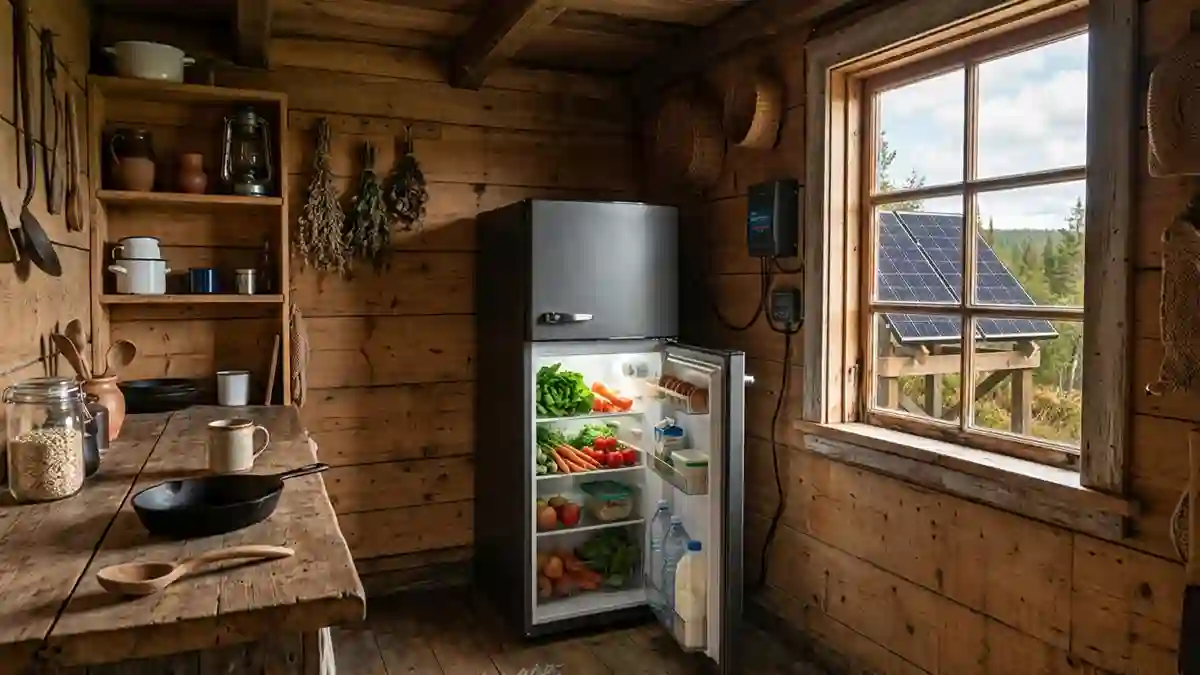
Solar fridge, solar refrigerator, or refrigerator freezer — which do you need for off-grid living? Real sizing, top models compared, and a 10-year cost breakdown.
Fresh food. Frozen meat. Cold drinks. All powered by the sun.
A solar fridge — or solar refrigerator as it is widely known — makes this possible anywhere. Off-grid cabins, homesteads, RVs, remote farms, and communities with no reliable grid power. In 2026, solar fridge technology is mature, affordable, and practical for anyone serious about off-grid living.
But choosing the right unit means understanding what type you need, how much power it draws, and how to size your system correctly. Get it right, and your fridge runs indefinitely. Get it wrong, and your batteries are dead by midnight.
This guide covers everything — simply, in order, with real numbers.
What Is a Solar Fridge?
A solar fridge — also called a solar powered refrigerator or solar energy refrigerator — is a fridge designed to run on electricity generated by solar panels rather than grid power. Most modern units are DC refrigerators, meaning they run directly on the 12V or 24V DC output of your solar battery bank.
This is the critical difference from a standard household fridge. A regular fridge runs on 120V AC power. To run a one-off solar you need a solar inverter to convert DC battery power to AC, and that conversion wastes 10–15% of your energy. A DC refrigerator bypasses the inverter entirely, connecting straight to your battery bank for maximum efficiency.
Solar fridges come in three forms — and knowing which one you need is the first decision to get right.
Solar Refrigerators and Freezers — Which Do You Need?
There are three types of solar cold storage. Each suits a different situation:
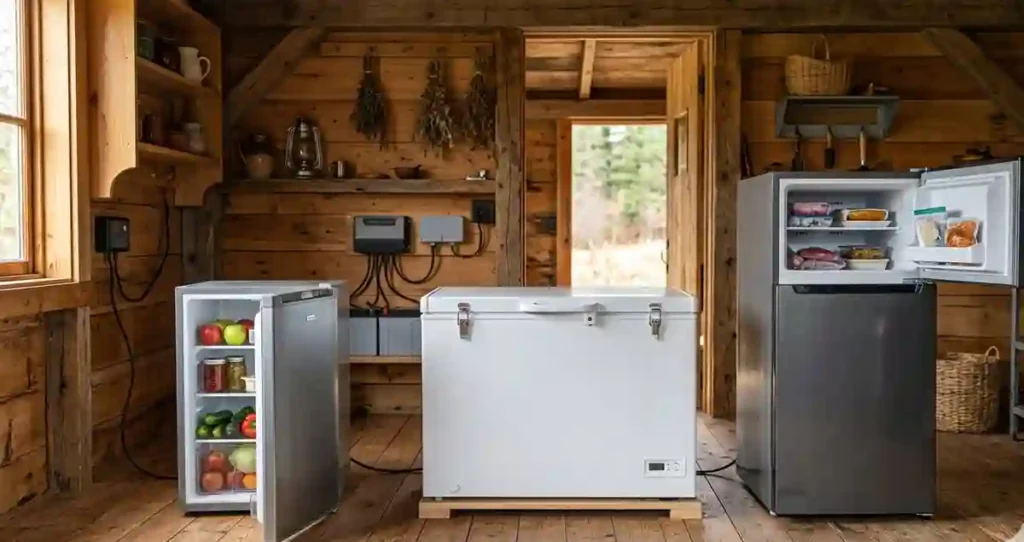
Solar fridge (cooling only) Keeps food between 35–50°F (2–10°C). Lower power draw, lower cost. The right choice if you only need refrigeration with no requirement for frozen storage. A dedicated solar fridge is the most power-efficient cooling option for off-grid use.
Solar freezer (freezing only) Holds temperatures down to -4°F (-20°C) or lower. Chest-style solar freezers are the most energy-efficient of all three types — cold air stays in when you open the lid so the compressor runs less. Best for bulk food storage, hunting, homestead food preservation, and vaccine or medicine storage in remote locations.
Solar refrigerator freezer (both in one) Independent fridge and freezer zones in a single DC refrigerator unit. Slightly higher power draw than a dedicated unit but replaces two appliances in one footprint. The most practical choice for most off-grid households where space and simplicity matter.
When people search for solar freezers and refrigerators, they are usually looking for this third option — a combo unit that handles both jobs without needing two separate appliances.
Simple rule: Need both chilled and frozen storage? Get the combo. Need only one function? A dedicated solar fridge or solar freezer is more efficient and cheaper to run.
How Much Solar Power Does a Refrigerator Need?
This is the question that matters most — and the one most guides answer vaguely. Here are the real numbers:
| Type | Size | Daily Draw | Solar Panels Needed | Battery Bank |
|---|---|---|---|---|
| Solar fridge only | 30–60L | 0.35–0.55 kWh | 100–200W | 100Ah lithium |
| Solar freezer only | 100–210L | 0.40–0.55 kWh | 150–200W | 100Ah lithium |
| Solar refrigerator freezer | 50–165L | 0.55–0.80 kWh | 200–300W | 150–200Ah lithium |
A dedicated solar fridge or freezer draws roughly 20–25% less power than a combo unit of the same size — because it only runs one cooling zone. If your solar setup is small or you are in a low-sun climate, this difference matters significantly.
Refrigerator on Solar Power — The Two Things That Determine Success
Running any refrigerator on solar power comes down to two components working together correctly:
Your solar battery: Lithium (LiFePO4) is the right choice for any solar fridge setup. A 200Ah lithium battery gives you 100Ah usable at 50% depth of discharge — enough to run a 60L DC refrigerator for 14–16 hours overnight. Lithium outlasts AGM batteries 2–3x, handles deeper discharge, and holds its capacity in hot climates where most solar fridges operate.
Your MPPT charge controller: The link between your solar panels and battery. An MPPT controller pulls 20–30% more energy from the same panels compared to a basic PWM controller — especially on partially cloudy days. For a solar fridge running 24/7, that extra daily charge is the difference between a full battery in the morning and a half-depleted one.
Pro Tip: Every quality DC refrigerator has a low-voltage cutoff that shuts the unit off before your battery is damaged. That is a safety net — not a management strategy. Size your battery correctly so it never triggers.
Solar Power for Refrigerator — What the Full System Looks Like
Understanding solar power for a refrigerator means thinking about the complete system. Here is what you need:
Solar panels: 100–300W, depending on fridge type and location. Monocrystalline panels deliver the best output per square metre. A solar panel kit — panels, MPPT controller, and cables bundled — is the most cost-effective starting point if you are building from scratch.
Solar batteries: Lithium (LiFePO4) as covered above. Size at 1.5x your fridge’s daily draw for comfortable overnight and cloudy-day coverage.
Solar inverter: Only needed if you are also running AC appliances alongside your fridge. For a DC refrigerator setup, skip it entirely. If your home needs both DC and AC loads, a hybrid inverter handles both from a single unit efficiently — no need for two separate devices.
Solar AC: If you are running a solar air conditioner on the same battery bank as your fridge, simply factor the combined daily draw into your panel sizing. The principles are identical — a larger array handles both loads.
Best Solar Refrigerators in 2026 — Full Comparison
Before comparing models, two specs separate good solar fridges from great ones. The compressor type determines longevity — a SECOP or Danfoss compressor is the industry beqnchmark for DC refrigerators, rated for 15+ years of continuous off-grid use. The refrigerant gas affects efficiency — R600a (isobutane) is the modern standard, running cleaner and more efficiently than the older R134a found in budget units.
| Model | Type | Size | Daily Draw | Price | Compressor / Gas | Best For |
|---|---|---|---|---|---|---|
| SunDanzer DCR165 ⭐ | Fridge + Freezer | 165L | 0.55 kWh | $1,199 | SECOP BD35F / R600a | Cabins & homesteads |
| Alpicool T60 | Fridge + Freezer | 60L | 0.70 kWh | $489 | Huafu / R134a | RV, van life, budget |
| Bodega 55QT Dual Zone | Fridge + Freezer | 52L | 0.75 kWh | $649 | Variable speed / R600a | Compact combo |
| Whynter FM-45G | Fridge + Freezer | 45L | 0.80 kWh | $879 | SECOP / R600a | Premium off-grid & RV |
| Iceco VL60 | Fridge only | 60L | 0.50 kWh | $429 | SECOP / R600a | Solar fridge only |
| SunDanzer DCF210 | Freezer only | 210L | 0.45 kWh | $1,349 | SECOP BD35F / R600a | Bulk freezer storage |
Prices approximate as of March 2026.
SunDanzer DCR165 — Best Overall Solar Powered Refrigerator Freezer. The benchmark DC refrigerator for serious off-grid living. SECOP BD35F compressor, R600a refrigerant, 40–55W draw across 165L of combined fridge and freezer space. Runs on 12V or 24V DC. Built to last 15+ years without a service call. If you are building a permanent off-grid home or cabin, this is the unit to buy.
Alpicool T60 — Best Budget Solar Fridge Freezer: Real dual-zone performance at $489. Runs on 12V/24V DC or 100–240V AC — switches automatically between your solar battery and shore power at a campground. App-controlled temperature reduces compressor run time without you thinking about it. The most popular solar powered refrigerator in the van life and RV community for good reason.
Iceco VL60 — Best Dedicated Solar Fridge. If you only need refrigeration, the Iceco VL60 is the pick. SECOP compressor, R600a refrigerant, 0.50 kWh/day — one of the most power-efficient solar energy refrigerators available. At $429, it costs less than most combo units while delivering premium compressor reliability.
SunDanzer DCF210 — Best Solar Freezer. The chest design keeps cold air in when you open the lid so the compressor cycles less. At just 0.45 kWh/day, it is the most energy-efficient cold storage unit on this list — and at 210L, it handles serious bulk storage for homesteads, hunting camps, and remote food storage.
Portable Solar Powered Fridge
A portable solar powered fridge is a compact, lightweight DC refrigerator designed to move with you — in a vehicle, on a boat, at a campsite, or between locations on a homestead. Unlike fixed units, portable solar fridges are built for vibration resistance, dual voltage (12V/24V DC and 100–240V AC), and efficient operation from a small battery setup.
Most portable solar fridges in the 20–60L range draw just 0.3–0.6 kWh per day — making them the easiest type to power with a modest panel and battery combination. They are also the fastest-growing segment of the solar fridge market, driven by the van life, overlanding, and RV communities.
Solar Power for RV Fridge
Running a solar power RV fridge is one of the most practical applications of DC refrigeration. Most RVs already have a 12V electrical system and roof space for panels — adding a dedicated solar fridge simply means connecting a DC unit to your existing battery bank or making a modest upgrade.
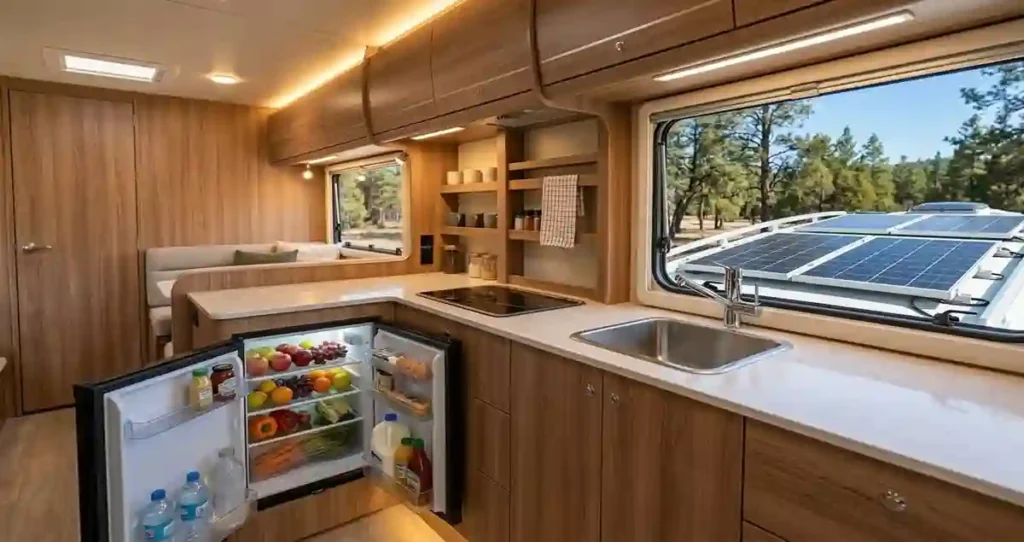
For a typical 40–60L RV solar fridge drawing 0.6 kWh per day, 200W of roof-mounted panels handles daily charging in most driving and stationary conditions, paired with a 120Ah lithium battery for overnight coverage. An MPPT controller maximises charging efficiency whether you are parked in full sun or partial shade.
The key advantage of a DC solar fridge for RV use over the traditional 3-way propane fridge: no propane cost, no flame risk, better efficiency, and it keeps running on battery power alone when you are parked away from hookups. The Alpicool T60 and Bodega 55QT are the most popular choices in the RV community — compact, app-controlled, and switchable between solar battery and shore power automatically.
Solar Refrigerator Sizing by Region
Your location determines how much panel wattage you need. More sun hours means your panels charge faster. Fewer sun hours means you need more panel capacity — not necessarily more battery.
| Region | Peak Sun Hours | Panels for 60L Fridge | Battery Bank |
|---|---|---|---|
| USA / Canada — South & West | 5–6 hrs | 200W | 150Ah lithium |
| USA / Canada — North | 3–4 hrs | 300W | 200Ah lithium |
| UK / Northern Europe | 2–4 hrs | 300–400W | 200Ah lithium |
| Southern Europe | 5–6 hrs | 200W | 150Ah lithium |
| Australia — North & Central | 6–7 hrs | 150–200W | 100Ah lithium |
| Australia — South / New Zealand | 3–5 hrs | 250–300W | 150Ah lithium |
| Nigeria / Philippines / Tropical | 5–7 hrs | 200W | 150Ah lithium |
Rule of thumb: The fewer sun hours your location gets, the bigger your panel array needs to be — not your battery. Panels compensate for low sun. Battery covers nights, not cloudy weeks.
Tropical locations like Nigeria and the Philippines are particularly well suited for solar refrigeration — 5–7 sun hours year-round, no seasonal dip, and grid power that is often unreliable or absent entirely. A complete DC refrigerator setup in these regions operates indefinitely on solar alone for approximately $1,089 total.
Is a Solar Powered Refrigerator Worth It? 10-Year Cost Breakdown
| Item | Upfront | Annual Cost | 10-Year Total |
|---|---|---|---|
| Solar fridge freezer (mid-range) | $649 | $0 | $649 |
| 200W solar panels | $280 | $0 | $280 |
| 120Ah lithium solar battery | $320 | $0 | $320 |
| Total solar setup | $1,249 | $0 | $1,249 |
| Standard grid fridge | $700 | $180/yr | $2,500 |
The solar setup saves $1,251 over 10 years at average US electricity rates. In the UK or Germany where rates are double, savings approach $2,000. In countries with unreliable grid power, add avoided food spoilage and generator fuel costs on top.
The numbers are clear — a solar energy refrigerator pays for itself and keeps paying.
Maintenance: 3 Things That Keep Your Solar Fridge Running for Years
Clean your panels regularly. Dust, bird droppings, and pollen reduce panel output by 15–25%. In dry off-grid climates this builds up faster than you expect. Use a soft solar cleaning brush with an extendable handle to safely reach roof-mounted panels without scratching the glass, then rinse with clean water. For stubborn residue like dried bird droppings or salt spray, a solar panel cleaning agent dissolves grime without damaging the anti-reflective coating that regular household detergents strip over time.
Monitor your MPPT controller monthly. A drop in daily yield on the display almost always means a dirty panel, a loose cable, or an early battery issue — all easy to catch and fix early. Most modern controllers show daily yield on a display or app, making this a 30-second check.
Clear the condenser coils every few months. Dust buildup forces the compressor to work harder, drawing more power every day. A quick brush-down every two to three months maintains peak efficiency and extends compressor life significantly.
Final Verdict
The right solar refrigerator depends on what you need to store:
- Need fridge and freezer → Solar refrigerator freezer. Best overall: SunDanzer DCR165 ($1,199). Best budget: Alpicool T60 ($489).
- Chilling only → Dedicated solar fridge. Best pick: Iceco VL60 ($429).
- Freezing only → Solar freezer. Best pick: SunDanzer DCF210 chest ($1,349).
In every case, pair your solar fridge with the right panels, a lithium battery, and an MPPT charge controller — and you have a self-sufficient cold storage system that runs anywhere in the world, indefinitely.
FAQs: Solar Refrigerator
What is a DC refrigerator, and why is it better for solar?
A DC refrigerator runs directly on 12V or 24V battery power — the same voltage your solar panels charge your batteries at. No inverter is needed, and no energy is lost converting DC to AC. A DC fridge is 10–15% more efficient than running a standard AC fridge through an inverter on the same solar system.
How much solar power does a refrigerator need?
A 60L solar powered refrigerator draws roughly 0.50–0.70 kWh per day, depending on type and ambient temperature. You need approximately 150–200W of solar panels and a 100–150Ah lithium battery to run it comfortably 24/7, including overnight.
Can I run a refrigerator on solar power without a battery?
Technically, yes, during daylight hours, but the fridge shuts off when the sun drops. A battery bank is essential for overnight operation and cloudy days. Size it at 1.5x your daily fridge drawer for comfortable coverage.
What is the difference between a solar fridge and a solar refrigerator freezer?
A solar fridge chills only (35–50°F). A solar refrigerator freezer has two independent zones — fridge and freezer — in one unit. The combo draws slightly more power but replaces two appliances. Most off-grid households choose the combo for practicality.
Which solar refrigerator is best for off-grid living?
For a permanent off-grid setup, the SunDanzer DCR165 is the benchmark — SECOP compressor, R600a refrigerant, 15+ year lifespan. For budget buyers or RV use, the Alpicool T60 at $489 delivers genuine dual-zone performance at a fraction of the price.
Are solar refrigerators good for hot climates like Nigeria or Australia?
Yes — hot sunny climates are ideal. More sun hours mean faster daily charging and a fuller battery overnight. Keep your solar fridge shaded from direct sunlight to reduce heat load on the compressor, and it will outperform its specs in a tropical climate.
How long does a solar powered refrigerator last?
Quality units with SECOP or Danfoss compressors are rated for 15–20 years of continuous operation. The compressor is the only component that typically ever needs replacing — and spare compressors are widely available.
Questions about sizing a solar refrigerator for your specific setup? Drop a comment below — we answer everyone.