
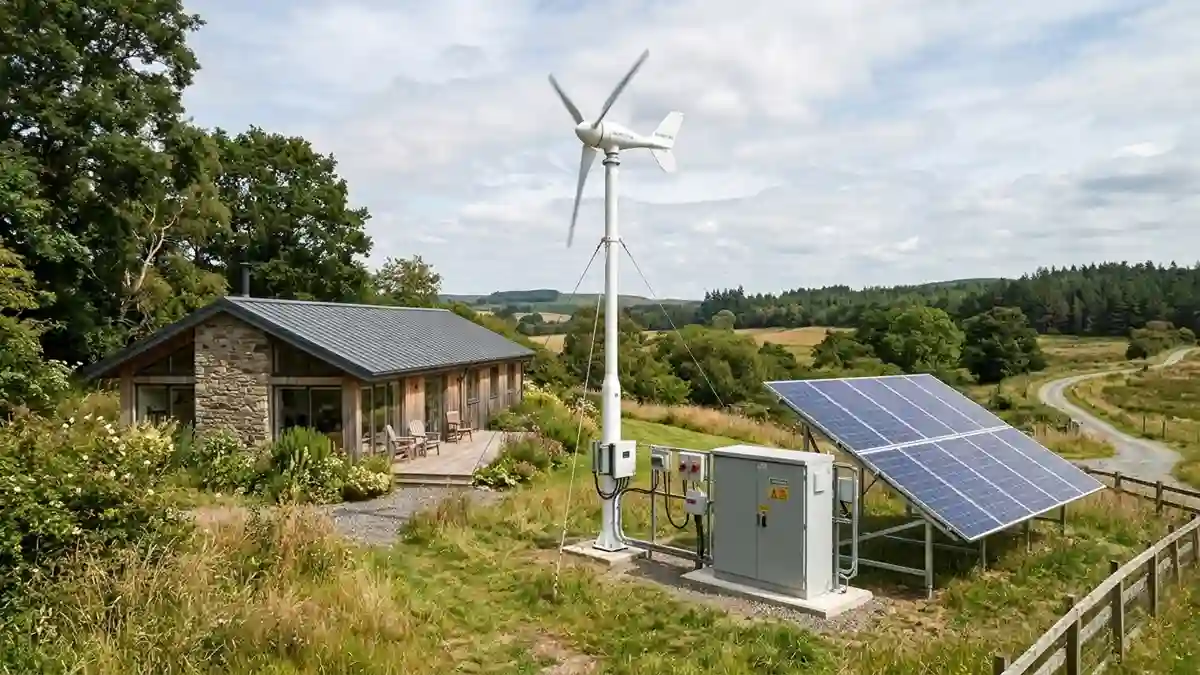
Learn how an off-grid wind turbine system works, how to size a turbine, calculate battery storage, match household loads and select the right inverter.
An off-grid home needs more than an electricity source. It needs a system that can supply power when appliances are running, store enough energy for periods of low generation, and protect equipment during changing weather conditions.
A small wind turbine for off-grid homes can help meet this requirement, particularly where wind is available during evenings, nights or seasons when solar production is lower. However, a turbine’s rated power does not tell you how much electricity it will produce every day. Actual energy depends on the wind at the installation site, tower height, rotor design, turbine power curve and electrical losses.
A practical off-grid system may combine a wind turbine with solar panels, a battery bank, charge controllers and an inverter. Solar panels convert sunlight into electricity, while the turbine converts wind energy into electrical power. The battery stores surplus energy for later use.
If you are new to the electrical side, start with our guides on how solar panels work and solar batteries and energy storage. For battery chemistry, see our LiFePO4 battery guide.
In this guide, I will explain how to estimate household energy demand, select a suitable turbine, calculate battery capacity, choose an inverter and understand the electrical protection required for an off-grid installation.
Off-Grid Wind Turbine: Sizing, Batteries, Loads and System Design
1. How an Off-Grid Wind Turbine Works
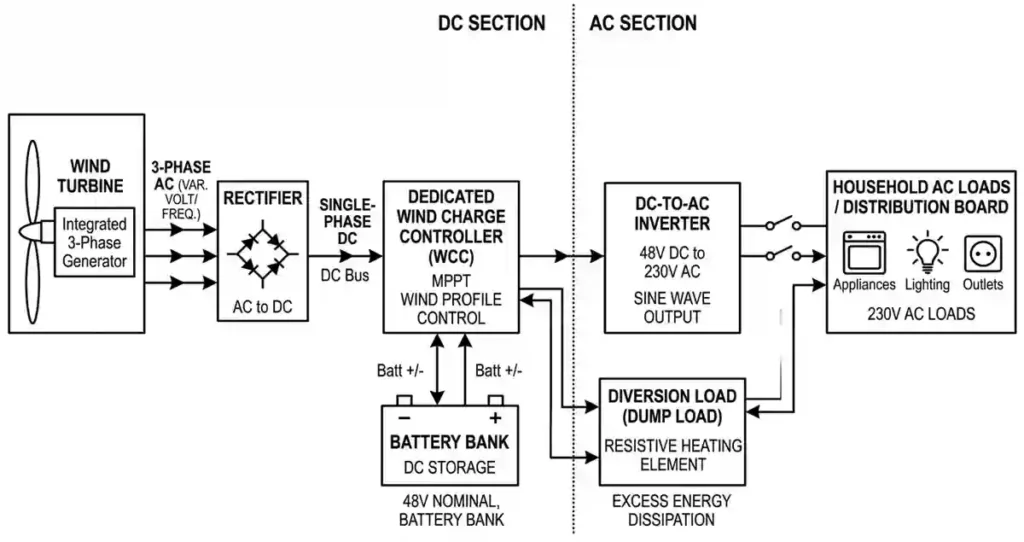
A small wind power system converts the kinetic energy of moving air into electrical energy. The turbine rotor turns when wind passes through its blades. The generator converts this mechanical movement into electricity.
The electrical output then passes through equipment selected for the turbine and battery system. Depending on the turbine design, this may include a rectifier, wind charge controller, diversion load and battery bank.
A typical battery-based system contains:
- Wind turbine and tower
- Turbine rectifier, where required
- Wind charge controller
- Diversion load or braking arrangement specified by the manufacturer
- Battery bank with a compatible battery management system
- Battery inverter
- AC distribution board and household loads
- Solar panels and a separate solar charge controller, if the system is hybrid
The wind controller regulates battery charging and manages the turbine according to its design. A diversion load may be required to manage excess turbine energy when the battery cannot accept further charge. It must be correctly rated and installed as specified by the turbine manufacturer.
The inverter converts the battery’s DC electricity into AC electricity for normal household appliances. Read our power inverter technical guide for a broader explanation of inverter operation and selection.
Important: Do not assume that a standard solar MPPT controller can safely control a wind turbine. Wind turbines have different electrical and mechanical operating requirements. Use a controller specifically approved for the selected turbine and battery configuration.
2. Calculate the Energy Requirement of the Home
The first step in system sizing is to understand how much energy the home consumes.
Make a list of the appliances, their power ratings and the number of hours they operate each day. Multiply the appliance power by its daily operating time.
Daily energy (Wh) = Appliance power (W) × Operating hours per day
For example, consider this illustrative off-grid home:
| Appliance | Quantity | Power | Daily use | Daily energy |
|---|---|---|---|---|
| LED lights | 8 | 10 W each | 5 hours | 400 Wh |
| Ceiling fans | 3 | 60 W each | 8 hours | 1,440 Wh |
| Refrigerator | 1 | 150 W average running input* | 10 equivalent hours | 1,500 Wh |
| Television | 1 | 100 W | 4 hours | 400 Wh |
| Laptop | 1 | 65 W | 5 hours | 325 Wh |
| Small appliances | 1 group | 200 W | 2 hours | 400 Wh |
| Total | 4,465 Wh |
The refrigerator entry is an illustrative energy allowance, not a claim that the compressor runs continuously for ten hours. Use measured daily consumption or the appliance’s energy label where available.
The estimated daily energy requirement is:
4,465 Wh ÷ 1,000 = 4.465 kWh per day
For preliminary planning, round this to approximately 4.5 kWh per day.
This is the home’s energy requirement, not the inverter’s required power rating. The inverter must also handle the maximum simultaneous load and the starting surge of motors such as refrigerators, pumps and compressors.
Separate daily energy from peak power
Two different measurements are needed:
- Energy (kWh): how much electricity the home uses over a period.
- Power (kW): how much electricity appliances require at a particular moment.
A home may consume 4.5 kWh per day but still need a 2 kW or larger inverter because several appliances can operate together.
For accurate sizing, record both the daily energy consumption and the maximum expected simultaneous load.
3. How to Select an Off-Grid Wind Turbine
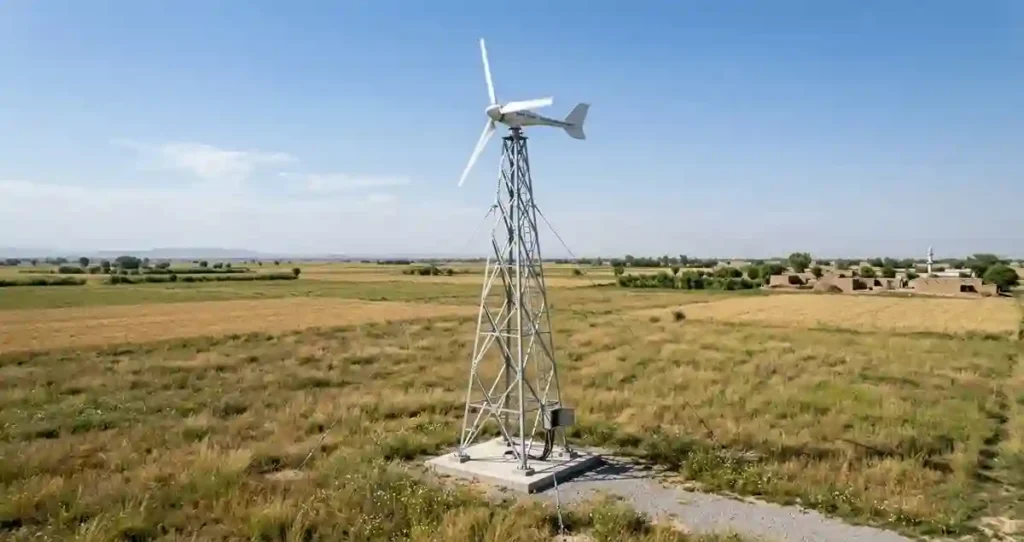
Do not select a turbine only because its advertised rating looks suitable.
A turbine rated at 1 kW does not continuously produce 1 kW. Its output changes with wind speed. It may produce little or no useful energy below its cut-in wind speed, increase output as wind strengthens, and stop or limit operation when its protection system reaches the specified high-wind condition.
The most useful manufacturer information is the power curve. It shows the electrical output expected at different wind speeds.
Before selecting a turbine, check:
- Rated power and the wind speed at which that rating applies.
- Cut-in, rated and cut-out wind speeds.
- Power curve and annual energy estimate.
- Rotor diameter and swept area.
- Recommended tower height and installation conditions.
- Controller, rectifier and battery compatibility.
- Overspeed protection and braking arrangements.
- Warranty, maintenance requirements and service availability.
- Applicable safety testing or certification.
The US Department of Energy’s Small Wind Guidebook explains why annual energy production, site wind conditions and turbine power curves are more useful for evaluating a system than rated power alone.
Check the wind resource before buying
Wind conditions can vary significantly across a property. Nearby buildings, trees, hills and other obstacles can create turbulence and reduce energy production.
A turbine installed on a short rooftop mast may experience very different wind conditions from the same turbine mounted on a properly selected tower in an unobstructed location.
Use local wind-resource information as an initial screening tool. For a serious investment, obtain a site assessment at or near the proposed hub height. Where justified, collect on-site wind measurements and assess wind speed distribution, direction, turbulence and seasonal variation.
The NREL Small Wind Site Assessment Guidelines provide a useful framework for evaluating a small wind installation.
4. Estimate Wind Turbine Energy Production
A preliminary energy estimate can help compare a turbine with the home’s electricity requirement.
A simple planning formula is:
Daily energy (kWh) = Average power output (kW) × 24 hours
Suppose a turbine has an estimated average electrical output of 0.25 kW over a representative day.
Daily energy = 0.25 × 24 = 6 kWh per day
This is an illustrative example. The 0.25 kW average must be supported by the turbine’s power curve and the actual site’s wind-speed distribution. It must not be assumed from a 1 kW nameplate rating.
If the home consumes 4.5 kWh per day, the example suggests that the turbine could produce more than the average daily energy requirement under those assumed conditions. However, this does not prove that the home will have reliable electricity every hour. Wind may be weak for several consecutive days, and generation may not coincide with demand.
For a real design, estimate annual and seasonal energy production using:
- The turbine’s verified power curve
- Wind-speed frequency distribution at the proposed hub height
- Tower height and local terrain
- Turbulence and nearby obstacles
- Turbine availability and expected downtime
- Controller, wiring, battery and inverter losses
Do not use a generic capacity factor as a substitute for a site-specific production estimate.
5. Battery Sizing for an Off-Grid Wind Turbine System
The battery bank stores electricity for use when the turbine is not generating enough power.
Battery sizing depends on daily energy consumption, required backup duration, allowable depth of discharge, battery efficiency and system voltage.
A simple preliminary calculation is:
Nominal battery capacity (kWh) = Daily load (kWh) × Autonomy days ÷ (Usable depth of discharge × Battery efficiency)
Consider the example home using 4.5 kWh per day.
Assume:
- Daily energy requirement: 4.5 kWh
- Desired autonomy: 2 days
- Usable depth of discharge: 80% (0.80)
- Battery discharge efficiency allowance: 95% (0.95)
Required nominal battery capacity:
4.5 × 2 ÷ (0.80 × 0.95)
= 9 ÷ 0.76
= 11.84 kWh
A preliminary selection would therefore be approximately 12 kWh nominal battery capacity, subject to the manufacturer’s limits, temperature conditions, reserve requirements and final design.
This calculation is an energy estimate. The battery must also be able to supply the required continuous and peak discharge power.
Why two days of battery storage may not be enough
Two days of autonomy is an example, not a universal design rule. A remote home with limited repair access, long calm periods or critical loads may need more storage or a backup generator.
A larger battery cannot solve every generation problem economically. It is often better to improve the wind resource, add solar generation, reduce unnecessary loads or provide a properly sized backup source.
Choosing the battery chemistry
Lithium iron phosphate (LiFePO4) batteries are commonly considered for modern stationary storage because of their cycle-life and usable-capacity characteristics. However, the correct choice depends on the battery’s specifications, operating temperature, charging limits, inverter compatibility, safety features and service support.
For a LiFePO4 battery, check:
- Nominal voltage and capacity
- Recommended charge and discharge current
- Maximum continuous discharge power
- BMS communication compatibility
- Low- and high-temperature charging limits
- Short-circuit and overcurrent protection
- Manufacturer warranty and cycle-life conditions
Read our guides to LiFePO4 batteries for solar and solar battery sizing.
6. Select the Correct Battery Voltage
Off-grid battery systems commonly use 12 V, 24 V or 48 V architectures, depending on system size and equipment availability.
For a given power level, a higher DC voltage generally means lower current. This can reduce cable size and resistive losses, provided the equipment is designed for that voltage.
For example, a 2,000 W inverter operating at an idealized 48 V DC input draws:
Current = Power ÷ Voltage
2,000 ÷ 48 = 41.7 A
At 24 V:
2,000 ÷ 24 = 83.3 A
Actual current will be higher after allowing for inverter losses and voltage variation under load.
This is one reason 48 V systems are often practical for larger residential off-grid installations. The final voltage must match the turbine controller, battery, inverter and protection equipment.
7. Inverter Sizing and Household Loads
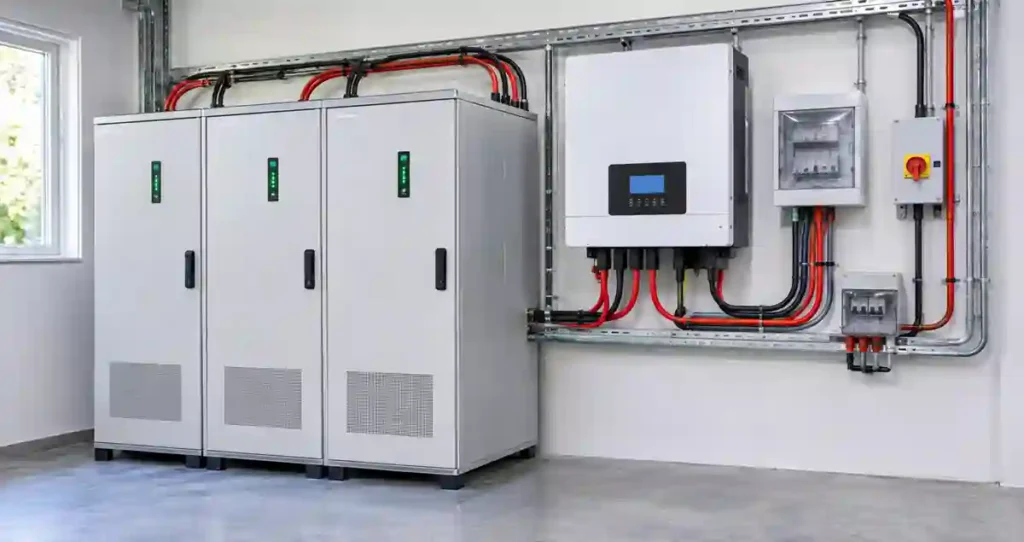
The inverter must supply the home’s maximum simultaneous AC load and handle the starting requirements of appliances with motors.
For example, assume the home has a maximum expected simultaneous load of 1,600 W. A preliminary inverter selection may be around 2 kW, provided its continuous rating, surge capability, temperature derating and power factor are suitable for the actual appliances.
Do not size the inverter from daily kWh alone.
Check:
- Continuous rated output
- Short-duration surge rating and surge duration
- Output voltage and frequency
- Single-phase or three-phase requirements
- Battery input voltage range
- Maximum DC input current
- Compatibility with the battery BMS
- Efficiency at typical operating loads
- Protection, grounding and neutral arrangements
If the system also includes solar panels, use an inverter or power-conversion architecture designed for the intended PV and battery arrangement. A wind turbine must not be connected to an ordinary solar PV input unless the equipment manufacturer explicitly supports that connection.
See our hybrid inverter guide and inverter size calculator.
8. Should You Combine Wind and Solar?
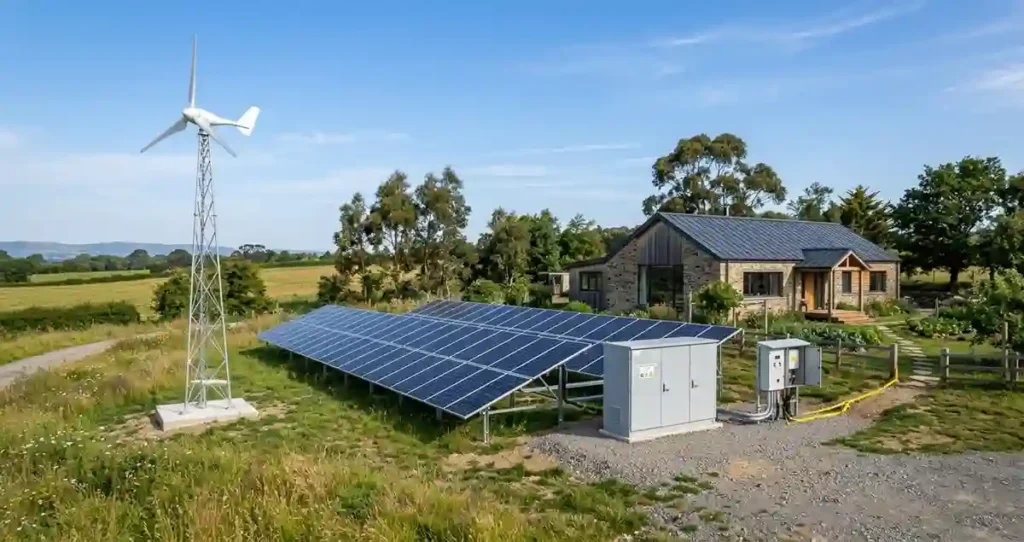
For many off-grid homes, a wind-and-solar hybrid system can be more practical than relying on only one renewable source.
Solar generation is generally strongest during daylight hours. Wind generation may occur during the night or in seasons when solar production is lower. The two sources can complement each other, but their actual relationship depends on local weather patterns.
A hybrid arrangement may include:
- Solar PV modules and a solar MPPT controller
- Wind turbine and its dedicated wind controller
- Battery bank
- Battery inverter
- Diversion load or turbine braking system, where required
- Generator backup, where appropriate
The controllers must be compatible with the same battery chemistry and voltage. Their charge settings must be coordinated so that the battery is not exposed to conflicting charging limits.
Our guides to the solar and wind hybrid system and wind and solar hybrid controller explain the system architecture and controller functions in more detail.
9. Electrical Protection and System Safety
An off-grid wind installation includes rotating machinery, electrical generation, battery storage and power-conversion equipment. Protection must be designed for the specific turbine and battery system.
Important design considerations include:
Turbine overspeed and braking: Use the turbine manufacturer’s approved overspeed protection and shutdown method. Do not assume that disconnecting the battery or opening a circuit breaker is a safe way to stop a wind turbine.
Diversion load: Where the turbine controller requires a diversion load, it must be correctly rated and connected. The load may need to dissipate excess energy when the battery is full or cannot accept additional charge.
Overcurrent protection: Select fuses and circuit breakers for the actual DC or AC circuit, voltage, interrupting rating and conductor protection requirements.
Cables and voltage drop: Long cable runs can cause significant losses, especially on low-voltage DC circuits. Select conductor size based on current, distance, installation method, temperature and allowable voltage drop.
Grounding and lightning protection: Tower grounding, bonding, surge protection and lightning-risk measures must be designed for the site and applicable local requirements.
Battery protection: Use a battery with an appropriate BMS or approved protection arrangement. Provide suitable isolation, overcurrent protection, ventilation or environmental control as required by the battery manufacturer and local code.
Mechanical safety: The tower, foundation, anchors, guy wires and access arrangements must be designed for the turbine’s loads and local environmental conditions. Do not treat a small turbine as a simple rooftop appliance.
10. Common Mistakes in Off-Grid Wind Turbine Design
A common mistake is selecting a turbine by its rated kilowatts without checking its power curve. This can lead to an installation that produces much less energy than expected.
Another mistake is mounting the turbine too close to buildings or trees. Turbulent wind can reduce performance and increase mechanical loading.
Some system designers also select a battery using only the daily load figure. They overlook autonomy, depth of discharge, efficiency, peak discharge power and the possibility of several low-generation days.
Other mistakes include:
- Connecting a wind turbine to a solar-only charge controller.
- Ignoring the turbine’s diversion-load or braking requirements.
- Selecting an inverter only from the average daily energy.
- Using undersized cables on long DC runs.
- Ignoring battery temperature and charging limits.
- Assuming solar and wind will always produce at different times.
- Omitting a backup plan for extended periods of low renewable generation.
- Failing to check local tower-height, setback and building requirements.
A well-designed system must consider energy, power, protection and site conditions together.
11. Is an Off-Grid Wind Turbine Worth It for an Off-Grid Home?
A small wind turbine may be worthwhile where the site has a reliable wind resource, sufficient space for a suitable tower and a genuine need for additional generation.
It may be a poor investment where wind is weak, turbulent or obstructed, or where the cost of the tower and installation is high compared with the energy produced.
Before purchasing equipment, compare the estimated annual energy production with the home’s annual consumption. Include the full installed cost, maintenance, replacement parts, battery replacement and backup-generation requirements.
For some homes, solar panels and batteries may provide a simpler solution. For others, especially sites with useful night-time or seasonal wind, adding a turbine may improve energy availability.
The correct answer comes from site assessment and a realistic energy model, not the turbine’s advertised rating.
12. Can AI Help Monitor an Off-Grid Wind Turbine System?
Monitoring software can help an off-grid system owner understand how the turbine, solar array and battery are performing.
A monitoring platform may record wind generation, PV production, battery state of charge, inverter output, alarms and energy consumption. This information can help identify unusual changes, charging problems or equipment downtime.
AI-based analytics may eventually help identify patterns and flag possible faults earlier. However, monitoring and prediction do not replace physical inspection, manufacturer protection systems or qualified electrical maintenance.
The most useful starting point is reliable data collection and clear performance limits for each component.
13. Engineering Standards and Electrical Codes
Small wind turbines and battery-based off-grid systems must comply with the standards and electrical regulations applicable to their installation location. The following references are useful starting points, but they are not a substitute for checking the locally adopted code and the equipment manufacturer’s instructions.
IEC 61400-2 — Small Wind Turbines
This standard addresses the safety, design, installation, maintenance and operation of small wind turbines, including their mechanical and electrical subsystems, support structures and foundations. Confirm the applicable edition and any national adoption before specifying equipment.
Official reference: https://webstore.iec.ch/en/publication/5433
NFPA 70 — National Electrical Code (NEC), Article 694
In the United States, Article 694 addresses small wind electric systems. Applicable requirements may cover equipment, wiring, disconnects, grounding and other installation matters. The adopted NEC edition and local amendments must be checked with the authority having jurisdiction.
Official reference: https://www.nfpa.org/codes-and-standards/nfpa-70-standard-development/70
UL 6142 — Small Wind Turbine Systems
This is a product-safety standard relevant to small wind turbine systems. Check the certification and listing applicable to the actual turbine model rather than relying on a general marketing statement.
UL 1973 — Stationary Batteries
UL 1973 covers battery systems for stationary energy-storage applications, including batteries used with PV and wind systems. Confirm the applicable product certification and installation requirements.
Official reference: https://www.shopulstandards.com/ProductDetail.aspx?productId=UL1973_3_S_20220225
UL 9540 — Energy Storage Systems and Equipment
UL 9540 addresses energy-storage systems as complete equipment or matched assemblies. It is not interchangeable with a battery-cell or battery-only certification. Where applicable, confirm system-level certification and local fire and electrical requirements.
Official reference: https://shopulstandards.com/ProductDetail.aspx?productId=UL9540
Local electrical and structural requirements
Tower foundations, wind loading, lightning protection, battery installation, wiring and fire safety must also comply with local building, electrical and fire requirements. In countries outside the United States, do not assume that NEC provisions apply automatically.
14. Engineer’s Note
When I approach an off-grid renewable energy design, I separate the problem into four questions:
- How much energy does the home consume each day?
- How much power is required when several appliances operate together?
- What energy can the selected renewable sources realistically generate at the site?
- How much storage and backup capacity is needed when generation is insufficient?
These questions prevent a common design error: choosing a turbine and battery first, then trying to make the household load fit the equipment.
The turbine, controller, battery and inverter must be selected as a compatible system. A reliable design begins with the load profile and site assessment.
15. Engineer’s Field Notes
Before finalizing a small wind turbine installation, document the following:
- Daily and seasonal household energy consumption.
- Maximum simultaneous load and motor-starting requirements.
- Local wind data and the proposed turbine hub height.
- Nearby buildings, trees, terrain and turbulence sources.
- Turbine power curve and estimated annual energy production.
- Tower type, foundation, guy-wire space and maintenance access.
- Battery capacity, usable energy, discharge rating and BMS compatibility.
- Controller, diversion load and overspeed protection requirements.
- Inverter continuous rating and surge capability.
- Cable lengths, conductor sizes, voltage drop and protection devices.
- Grounding, bonding, lightning and surge protection.
- Backup generator or alternative supply requirements.
- Local permits, electrical codes and product certifications.
A site-specific design should record its assumptions and expected performance so that actual system operation can be compared with the original estimate.
Frequently Asked Questions
1. Can an Off-Grid Wind Turbinepower an off-grid home?
Yes, if the site has a suitable wind resource and the turbine is correctly sized. The system also needs compatible charging equipment, battery storage and an inverter for normal AC appliances.
2. What size wind turbine is needed for an off-grid house?
There is no universal size. The required turbine depends on daily energy use, site wind conditions, tower height, turbine power curve and the contribution from other sources such as solar panels.
3. Does Off-Grid Wind Turbine needs batteries?
A battery-based off-grid system needs energy storage to supply loads when the turbine is not generating enough power. Other system architectures are possible, but they must provide a suitable way to balance generation and demand.
4. How many days of battery backup should an off-grid home have?
Two days can be used as an initial example, but the correct autonomy depends on weather patterns, critical loads, backup-generator availability, cost and the required reliability.
5. Can I connect an Off-Grid Wind Turbine to a solar hybrid inverter?
Only if the inverter manufacturer explicitly supports the turbine connection and the required controller or interface. A normal PV input is not automatically suitable for wind-turbine output.
6. Is a 1 kW wind turbine enough for a house?
A 1 kW rating describes output under specified test or operating conditions. It does not mean the turbine produces 1 kW continuously. Check its power curve and estimated annual energy production at the actual site.
7. Can wind and solar charge the same battery bank?
Yes, when both charging systems are designed for the same battery voltage and chemistry, and their charging settings and protection arrangements are coordinated.
8. Is a rooftop wind turbine suitable for an off-grid home?
Not automatically. Rooftop turbulence, structural vibration, noise, mounting loads and maintenance access can make rooftop installations unsuitable. A proper site and structural assessment is necessary.
Final Thoughts
A small wind turbine can be a useful part of an off-grid home’s energy supply, but successful design depends on more than selecting a generator with an attractive power rating.
Start with the household load, assess the wind resource, use the turbine power curve to estimate production, size the battery for the required autonomy and select an inverter that can handle the actual operating loads. Include the correct controller, braking or diversion arrangement, wiring and electrical protection.
Where the site supports both resources, combining wind with solar can improve energy availability. The most reliable system is the one designed around real site conditions and measured energy needs.
Related guides
- Solar and Wind Hybrid System: Design, Sizing, Cost, and Working
- Wind and Solar Hybrid Controller: Wiring, Inputs and Protection
- Home Wind Turbine: Cost, Output, Sizing and Is It Worth It?
- Wind Turbine Inverter: Grid-Tie, Off-Grid and Hybrid Options
- Home Wind Turbine Kits: What You Need and How to Choose
- Wind Turbine Parts Explained: Components and Their Functions
Related guides on SolarVisionAI.com
- Monocrystalline Solar Panels 2026: Still Worth It or Hype
- Polycrystalline Solar Panels: Worth Buying in 2026?
- Thin-film Solar Panels: When They Beat Silicon (2026)
- BIPV Solar Panels: Building-Integrated PV Complete Guide
- Portable Solar Panels: Engineer’s Buyer’s Guide 2026
- CPV Solar Panels: Concentrated Photovoltaic Explained
- Skin Solar Panel: What “Solar Skin” Actually Means
- Solar Fence Post Lights: Cap Sizes, Types & Install Guide
- Bifacial Solar Panels in 2026: How to Boost Energy Output
- Solar Charge Controller: The Complete Guide
- MC4 Connectors: Solar Safety & Installation Guide
- Solar Panel Types, Efficiency & Benefits
- Solar Water Pump Guide
- Commercial Solar Panel Installation: Engineering Guide
- Solar Fence Post Lights: Cap Sizes, Types & Install Guide
- BESS — Battery Energy Storage System Guide
- Commercial Solar Panel Installation
- Solar Refrigerator & DC Fridge — Complete 2026 Guide
- Bifacial Solar Panel Albedo Effect Guide
- TOPCon: Why TOPCon Solar Panel is a Proven Smart Investment in 2026
- HJT: Why TOPCon Solar Panel is a Proven Smart Investment in 2026
- PERC: PERC Solar Panel: Still Relevant or Already Outdated?
- Perovskite: Perovskite Solar Panels: The 2026 Reality Check
- N-Type vs P-Type: N-Type vs P-Type Solar Panels: Honest Comparison
- ABC: ABC (all back contact) Solar Panel: Back Contact Technology Explained
- IBC: IBC Solar Panels: Interdigitated Back Contact Guide
- Tandem: Tandem Solar Panels: Are Stacked Cells Ready for Rooftops?