
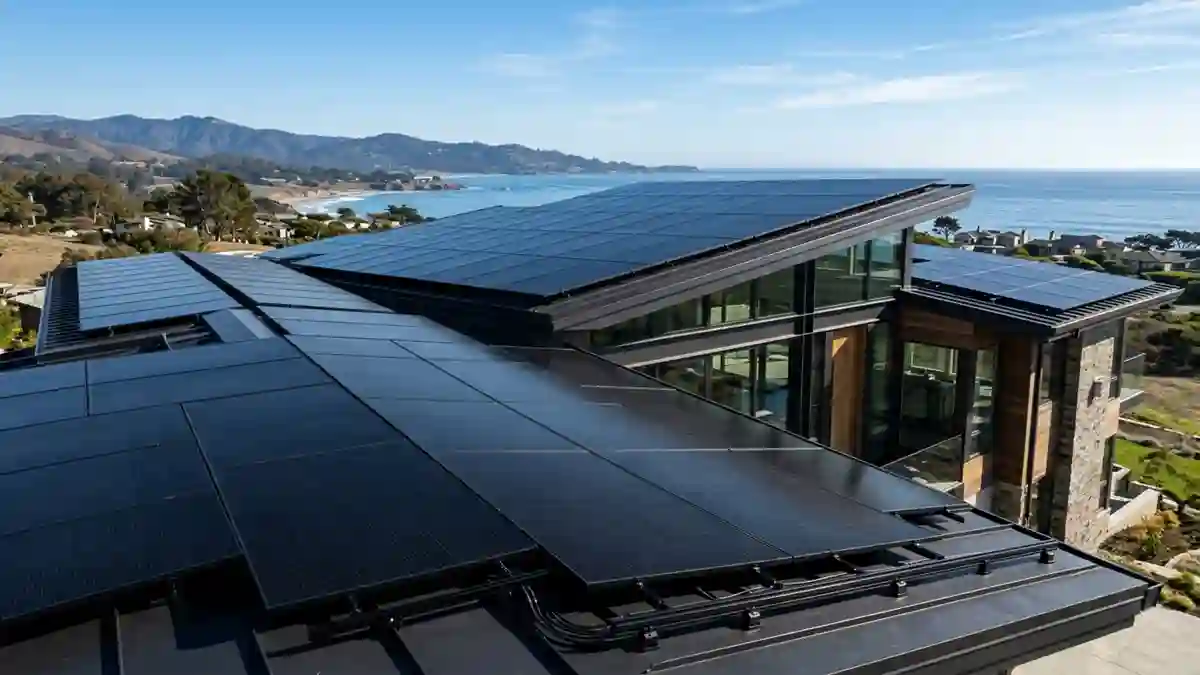
ABC (all back contact) solar panel technology explained — how it works, real efficiency gains, and whether the premium is worth it.
ABC solar panels are the technology I get asked about the least and am consistently most impressed by when I review the actual datasheet numbers. “All Back Contact” is exactly what it sounds like — every electrical contact on the cell is moved to the rear surface, leaving the entire front face free to absorb light without the shading losses that standard front-contact busbars and fingers create.
This guide is part of our Technology cluster, and pairs naturally with our IBC Solar Panels guide, since IBC (Interdigitated Back Contact) is technically the more precise term for the same underlying concept most manufacturers now market as ABC.
How ABC (all back contact) Solar Panel Actually Work
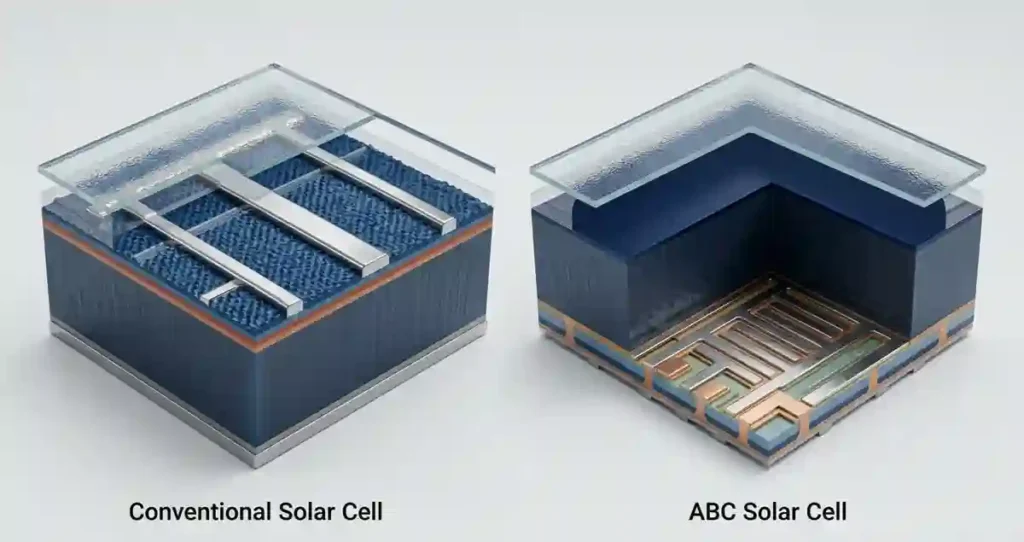
Standard cells have metal busbars and fine grid lines running across the front surface to collect current — and every square millimeter of metal on that front face is light that never reaches the silicon underneath. Back contact designs move both the positive and negative contacts to the rear of the cell, in an interdigitated pattern, eliminating front-surface shading losses entirely. The result is a genuine efficiency gain, and also a cleaner, uniform black front surface with no visible grid lines, which increasingly matters to clients who care about aesthetics as much as output.
Engineer’s Note: The aesthetic benefit of ABC panels — no visible busbars or grid lines on the front — gets undersold in most marketing, but I’ve had more than one client choose this technology primarily for how clean the array looks on their roof, with the efficiency gain as a secondary bonus. For street-visible installations, that’s a legitimate factor, not just vanity.
Technical Specifications
| Specification | Typical Value | Why It Matters |
|---|---|---|
| Cell Technology | All Back Contact (ABC) | Eliminates front-side busbars |
| Typical Efficiency | 24–25% | Higher energy density |
| Annual Degradation | ~0.35–0.4% | Better long-term output |
| Temperature Coefficient | ~−0.29%/°C | Better hot-weather performance |
| Product Warranty | 15–25 Years | Manufacturer confidence |
| Performance Warranty | 30 Years | Long-term energy production |
| Certifications | IEC 61215, IEC 61730 | Safety and durability |
Efficiency and Cost Reality
| Metric | ABC / Back Contact | Standard Front-Contact Cell | Industry Reference |
| Typical efficiency | 22.5% – 25%+ | 18% – 22% | NREL |
| Front-surface shading loss | None — contacts on rear | 2–3% typical loss from grid lines | Fraunhofer ISE |
| Visual appearance | Uniform, no visible grid lines | Visible busbars and fingers | PV Magazine |
| Manufacturing cost premium | High — complex rear wiring | Baseline | IRENA |
Engineering Assessment
| Feature | Rating | Engineering Assessment |
|---|---|---|
| Efficiency | ★★★★★ | Among the highest commercially available. |
| Reliability | ★★★★★ | Excellent long-term performance. |
| Heat Performance | ★★★★★ | Outstanding temperature behavior. |
| Appearance | ★★★★★ | Completely black aesthetic with no front contacts. |
| Cost | ★★★☆☆ | Premium technology with higher upfront cost. |
| Long-Term Value | ★★★★★ | Excellent lifetime energy production. |
| Overall Recommendation | ★★★★★ | Best for premium residential installations. |
Advantages and Disadvantages
| Advantages | Disadvantages |
| Highest efficiency among mainstream commercially available cell types | Significant manufacturing cost premium over standard front-contact cells |
| Clean, uniform aesthetic with no visible front-surface grid lines | More complex rear-side wiring increases manufacturing complexity |
| No front-surface shading losses from busbars or grid fingers | Limited number of manufacturers currently producing at scale |
| Excellent low-light performance due to unobstructed front surface | Repair and diagnostics can be more complex given rear-side circuitry |
Real-World Applications of ABC (all back contact) Solar Panel
I’ve specified ABC panels twice for US clients in HOA-governed neighborhoods where the roof was highly visible from the street and the client explicitly prioritized appearance alongside performance — in both cases, the uniform black surface with no visible wiring pattern was the deciding factor over an equivalent-efficiency TOPCon option that would have looked more conventional. Both projects also happened to benefit from the genuine efficiency gain, which made the premium easier to justify.
The pattern I’d expect to see more of going forward, based on where manufacturing investment is heading, is ABC becoming standard on premium residential product lines specifically because of that aesthetic advantage — architects and design-conscious homeowners are willing to pay for it independent of the efficiency argument.
Field Note: One client initially assumed the higher price of ABC panels meant a scam or unnecessary upsell, since they’d never heard the term before. Walking them through the datasheet — real efficiency numbers, real manufacturer certification — resolved that quickly. Unfamiliar terminology on a quote is a reasonable thing to be skeptical about; it’s worth asking your installer to explain rather than dismissing outright.
Where ABC (all back contact) Solar Panel Make the Most Sense
| Installation Scenario | Recommendation | Engineering Assessment |
|---|---|---|
| Premium Residential Homes | ★★★★★ | Excellent choice for maximizing roof output. |
| Luxury Homes | ★★★★★ | Outstanding aesthetics and efficiency. |
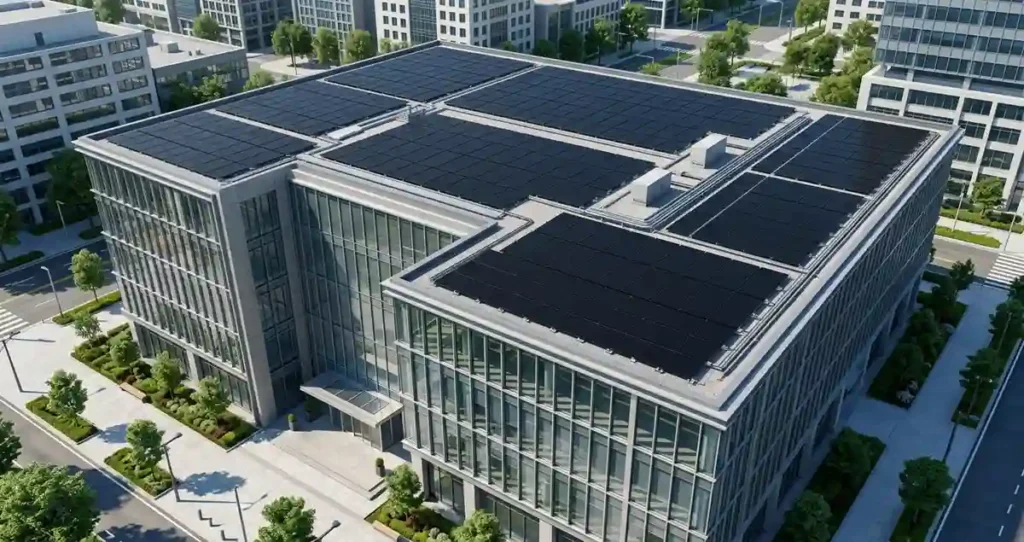
| Commercial Buildings | ★★★★☆ | High performance where roof space is valuable. |
| Space-Constrained Roofs | ★★★★★ | One of the best technologies available. |
| Utility Scale | ★★★☆☆ | Premium cost often outweighs benefits. |
Where It Doesn’t Make Sense
Purely cost-driven projects where budget is the primary constraint and the roof isn’t visually prominent. The efficiency gain over TOPCon is real but incremental, and the price premium is currently significant enough that most cost-sensitive clients are better served by TOPCon or even PERC.
It’s also worth noting that ABC’s aesthetic advantage matters far less on roof sections not visible from ground level or the street — a rear-facing roof slope, for instance, gains little practical benefit from the uniform black finish, since nobody will ever see it up close. I always encourage clients to reserve the ABC premium for genuinely visible sections and consider a more cost-effective technology for hidden roof areas within the same project.
It’s also worth noting that ABC’s aesthetic advantage matters far less on roof sections not visible from ground level or the street — a rear-facing roof slope, for instance, gains little practical benefit from the uniform black finish, since nobody will ever see it up close. I always encourage clients to reserve the ABC premium for genuinely visible sections and consider a more cost-effective technology for hidden roof areas within the same project.
Buying Checklist
• Verify the module actually uses genuine ABC (All Back Contact) cell architecture rather than standard back-contact marketing terminology.
• Compare the cost premium against TOPCon and HJT before purchasing.
• Confirm module efficiency exceeds 24%.
• Review the manufacturer’s degradation warranty.
• Verify IEC 61215 and IEC 61730 certifications.
• Check temperature coefficient if installing in hot climates.
• Choose a reputable Tier 1 manufacturer with proven field performance.
• Compare total lifetime energy production rather than purchase price alone.
For the more precisely named version of this same underlying technology, see our IBC Solar Panels guide. For the mainstream N-type alternative at a lower price point, see our TOPCon Solar Panels guide.
For US clients in planned communities or HOA-restricted neighborhoods, I’d specifically recommend budgeting time to check with the HOA architectural review board before committing to any panel technology, ABC included — some communities have specific aesthetic guidelines that go beyond just “solar panels are allowed,” and a uniform, low-glare ABC panel can sometimes ease that approval process compared to a visibly framed, busbar-heavy standard panel.
Standards & Certifications
| Standard | Why It Matters |
|---|---|
| IEC 61215 | Mechanical durability |
| IEC 61730 | Electrical safety |
| IEC 62804 | PID resistance |
| UL 61730 | North American compliance |
| ISO 9001 | Manufacturing quality |
Who Should Buy ABC Solar Panels?
Recommended for:
• Premium residential homeowners
• Luxury homes
• Limited roof space
• High-efficiency installations
• Homeowners seeking premium aesthetics
• Buyers planning 25–30 year ownership
• Customers prioritizing maximum energy density
Who Should Avoid ABC Solar Panels?
Less suitable for:
• Budget-conscious buyers
• Utility-scale solar farms
• Large ground-mounted systems
• Projects focused on lowest upfront cost
• Installations with abundant roof space
• Temporary solar installations
Engineering Reality Check
Marketing Claim
“ABC solar panels are simply another marketing name for back-contact panels.”
Engineering Reality
ABC (All Back Contact) is an advanced cell architecture that moves all electrical contacts to the rear of the cell, eliminating front-side shading losses and improving efficiency. While not every back-contact panel uses ABC technology, genuine ABC modules rank among the highest-efficiency commercial solar panels available in 2026.
How I Explain the Premium to Clients
The conversation I have most often with ABC-curious clients starts with managing expectations about availability. Because relatively few manufacturers have mastered the rear-contact manufacturing process at scale, sourcing genuine ABC panels with a solid warranty can take more lead time than a standard TOPCon order, and I always flag that upfront so a project timeline doesn’t get derailed by an unexpectedly long wait for stock.
I also make a point of separating the aesthetic argument from the efficiency argument when I quote ABC against alternatives, because clients weigh those two factors very differently. Some are willing to pay the full premium purely for the clean, uniform look on a highly visible roof, independent of whatever efficiency gain comes with it. Others only care about the numbers, in which case I’m honest that TOPCon delivers most of the same performance at a meaningfully lower price.
Frequently Asked Questions
Are ABC solar panels worth buying in 2026?
Yes. ABC solar panels offer some of the highest commercial efficiencies available and are an excellent choice for premium residential and commercial installations where roof space is limited.
How efficient are ABC solar panels?
Most commercial ABC solar panels achieve module efficiencies of approximately 24% to 25%, outperforming many conventional PERC and TOPCon products.
Are ABC solar panels better than TOPCon?
ABC generally provides higher efficiency and improved aesthetics, while TOPCon often offers a better balance between performance and cost. The best choice depends on budget and available roof space.
Do ABC solar panels perform well in hot climates?
Yes. Their lower temperature coefficient allows them to maintain higher power output during high-temperature operation compared with many older technologies.
Can ABC solar panels be used with lithium batteries?
Yes. Battery compatibility depends on the inverter and energy storage system rather than the solar panel technology.
Are ABC solar panels compatible with net metering?
Yes. Net metering eligibility depends on local regulations and inverter certification, not on the panel technology.
How long do ABC solar panels last?
Quality ABC solar panels are expected to operate for 30 years or more, with annual degradation typically around 0.35–0.4%.
What certifications should ABC solar panels have?
Look for IEC 61215, IEC 61730, IEC 62804, UL 61730 (where applicable), and products manufactured under ISO 9001 quality systems.
Is ABC the same as IBC solar technology?
They describe the same core concept — moving all electrical contacts to the rear of the cell — with ABC (All Back Contact) being a more recent marketing term and IBC (Interdigitated Back Contact) being the more technically precise original term used in research literature.
Are ABC panels worth the extra cost?
For clients prioritizing maximum efficiency and aesthetic uniformity, yes. For purely cost-driven projects with ample roof space, the premium is harder to justify compared to TOPCon, which delivers most of the efficiency benefit at a lower price.
Why don’t ABC panels have visible grid lines?
Because all electrical contacts are located on the rear of the cell rather than the front, leaving the entire front surface free of the metal busbars and fine grid lines that standard panels use to collect current. This is also why ABC panels are sometimes marketed under aesthetic-focused branding rather than purely technical terminology — the visual difference is immediately obvious even to buyers with no engineering background.
References
I always remind clients that a slightly less flashy technology choice, properly matched to their actual project constraints, beats an impressive-sounding technology chosen for the wrong reasons every time. That principle applies just as much to ABC as it does to any other premium option covered across this Technology cluster.
Efficiency figures for back-contact cell architectures are drawn from NREL’s Best Research-Cell Efficiency Chart. Manufacturing and cost context references Fraunhofer ISE’s Photovoltaics Report and IRENA’s Power Generation Costs data.
Related guides on SolarVisionAI.com
- Monocrystalline Solar Panels 2026: Still Worth It or Hype
- Polycrystalline Solar Panels: Worth Buying in 2026?
- Thin-film Solar Panels: When They Beat Silicon (2026)
- BIPV Solar Panels: Building-Integrated PV Complete Guide
- Portable Solar Panels: Engineer’s Buyer’s Guide 2026
- CPV Solar Panels: Concentrated Photovoltaic Explained
- Skin Solar Panel: What “Solar Skin” Actually Means
- Solar Fence Post Lights: Cap Sizes, Types & Install Guide
- Solar Charge Controller: The Complete Guide
- MC4 Connectors: Solar Safety & Installation Guide
- Solar Panel Types, Efficiency & Benefits
- Solar Water Pump Guide
- Commercial Solar Panel Installation: Engineering Guide
- Solar Fence Post Lights: Cap Sizes, Types & Install Guide
- BESS — Battery Energy Storage System Guide
- Commercial Solar Panel Installation