
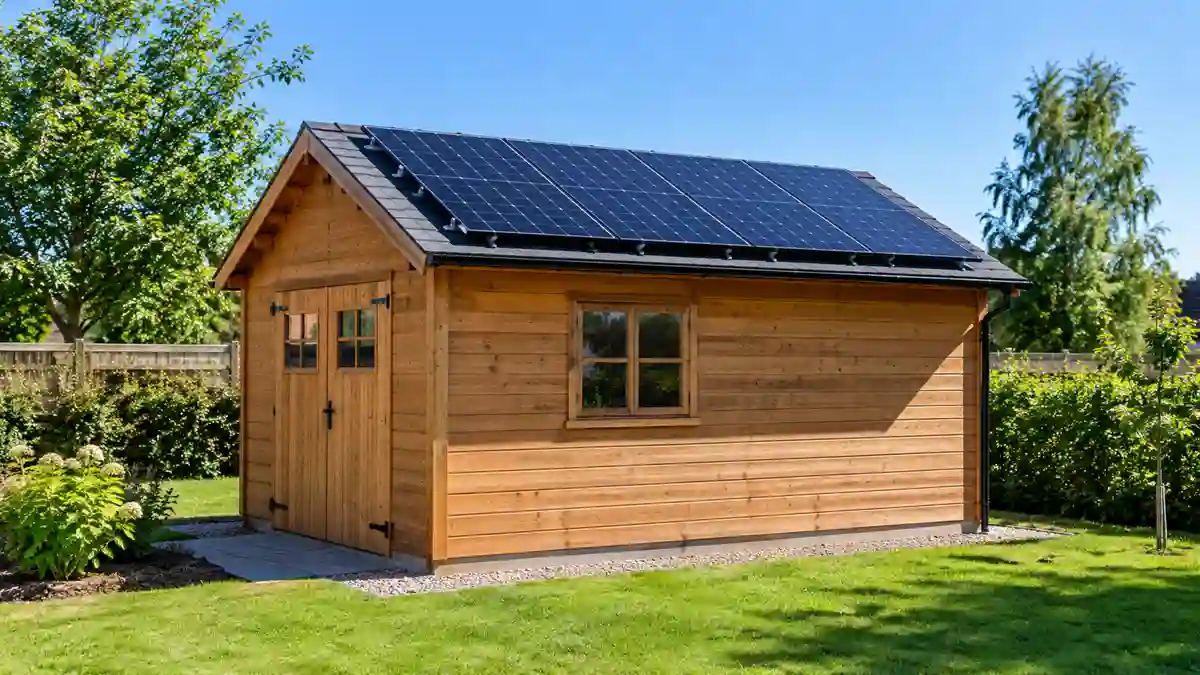
Solar panel for shed: choosing between monofacial and bifacial panels, the right battery and controller, and how to handle shading properly.
Most “solar panel for shed” guides online give you the same outdated setup: a single 100W panel, a basic PWM controller, and a lead-acid battery, good enough for a light bulb and not much else. I’d rather walk you through what I’d actually spec today. Panel technology, battery chemistry, and controller design have all moved forward, and a shed is small enough that getting these choices right costs very little extra while making a real difference in how much you can actually run.
Quick answer: For a shed, size your solar panel around what you want to power, not a generic wattage. A 100 to 200W solar panel covers basic lighting and device charging; 400W or more supports power tools and small appliances through an inverter. Use an MPPT controller rather than an older PWM type, since MPPT recovers more power meaningfully, especially if the shed panel sees any partial shade. Pair it with a LiFePO4 battery rather than lead-acid for the same reasons that apply to any off-grid setup: more usable capacity, longer life, and no maintenance.
1. Monofacial or Bifacial: Which Panel Actually Makes Sense for a Shed?
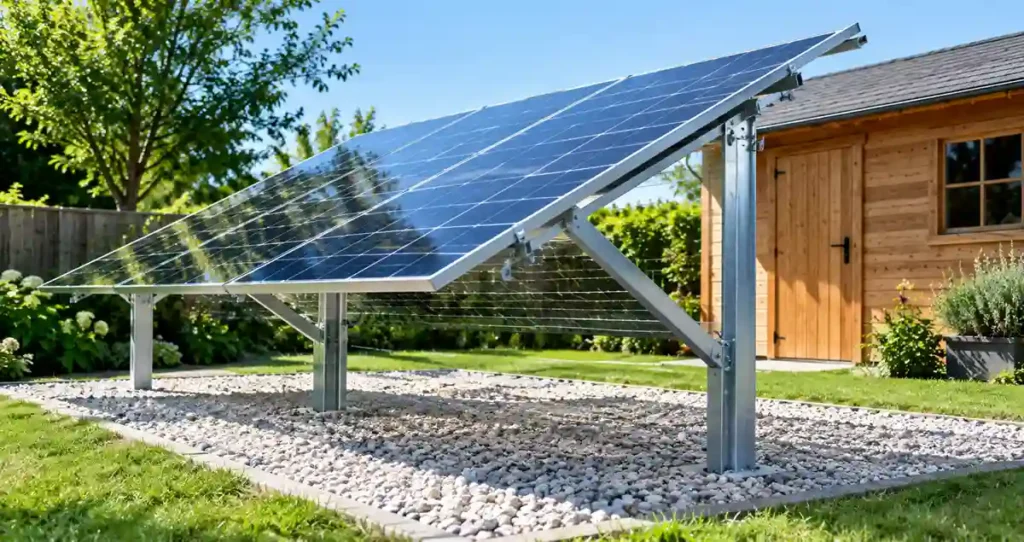
This decision gets skipped in almost every shed guide, and it shouldn’t be, because a shed roof is actually a reasonable candidate for bifacial panels in specific situations.
| Panel Type | How It Works | Best for a Shed When… |
|---|---|---|
| Monofacial | Captures light on the front face only | The panel is roof-mounted flush, or ground clearance underneath is minimal |
| Bifacial | Captures light on both front and rear faces, gaining extra output from reflected light | The panel is pole-mounted or tilted with real clearance underneath, over light-colored gravel, a white roof, or snow |
A flush-mounted panel on a shed roof gets essentially no benefit from bifacial technology, there’s no light reaching the back face. But if you’re mounting the panel on a tilted rack or a pole beside the shed with open space underneath, bifacial can realistically add several percent more output for a relatively small cost difference. For the full technical comparison, see our guide to monofacial vs bifacial solar panels, and if you’re going the bifacial route, our guide on how bifacial panels boost energy output covers mounting height and reflectivity, both of which matter more than the panel spec sheet.
Engineer’s Note: Don’t buy bifacial panels for a flush roof mount, you’re paying for a feature the installation can’t use. Match the panel technology to the actual mounting geometry, not the other way around.
2. Sizing the Panel to What You Actually Want to Run
| Shed Use Case | Suggested Panel Size | What It Realistically Supports |
|---|---|---|
| Basic lighting, phone/device charging | 100 to 200W | LED lighting, small electronics, a few hours a day |
| Lighting plus a small fridge or fan | 300 to 400W | The above, plus a small DC fridge or ventilation fan |
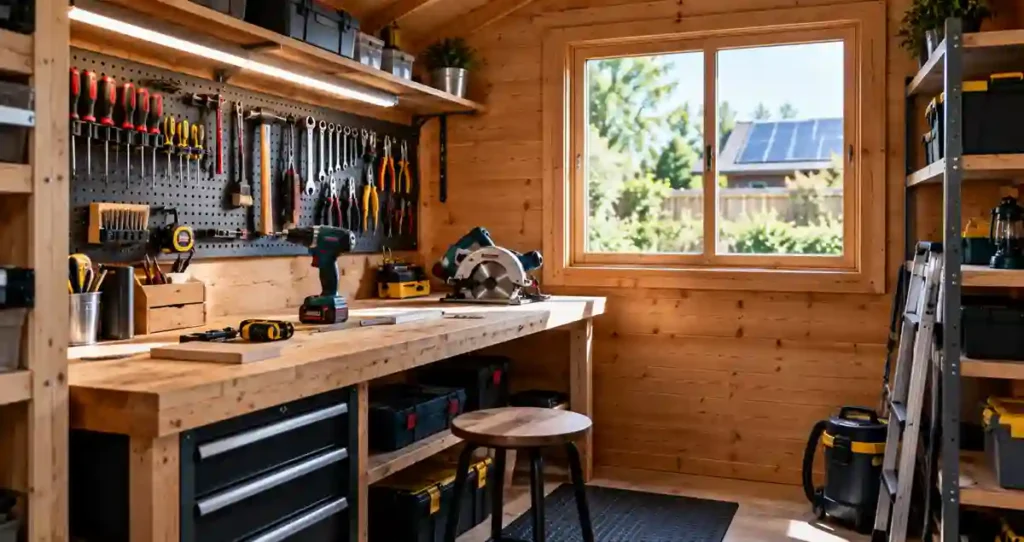
| Power tools, small appliances via inverter | 400 to 800W | Drills, saws, a shop vacuum, run through a properly sized inverter |
| Workshop with regular tool use | 800W+ or multiple panels | Sustained daily use, ideally paired with a larger battery bank |
Use our solar panel size calculator to size this against your actual daily watt-hour needs rather than guessing from a table. If you’re planning to run power tools through an inverter, our inverter size calculator accounts for the startup surge that tools draw, which is often several times their running wattage and is the detail most basic shed guides miss entirely.
3. The Battery: Skip Lead-Acid
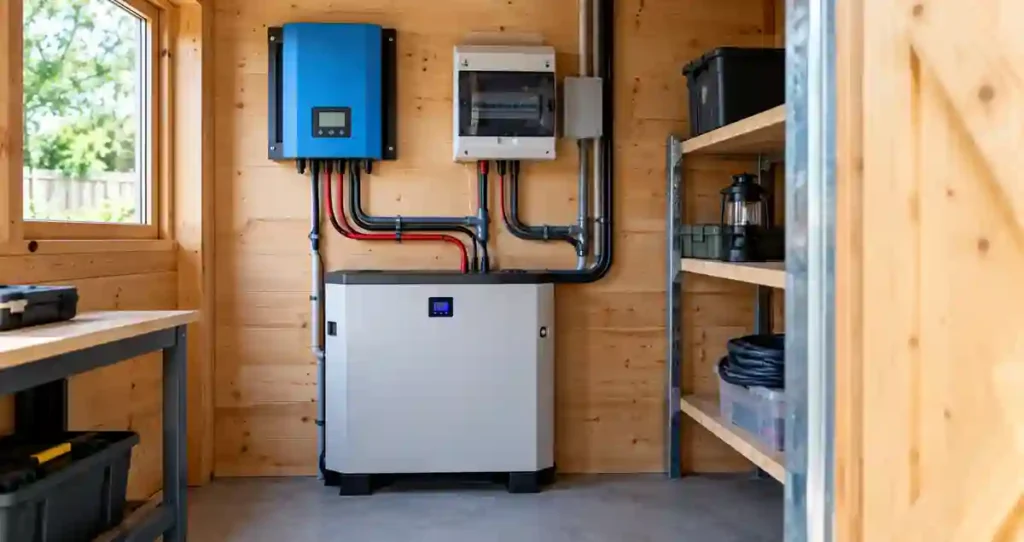
A lot of older shed solar guides default to a cheap lead-acid battery because it’s familiar. I wouldn’t recommend it today. A LiFePO4 battery costs more upfront but gives you 80 to 100% usable capacity instead of roughly 50%, lasts thousands of cycles instead of a few hundred, and needs zero maintenance in a space you’re probably not checking on daily.
For a shed-scale system, a 12V LiFePO4 battery is usually the right voltage, our 12V vs 24V vs 48V guide explains when it makes sense to move up, which is mainly once you’re running an inverter above roughly 1,500W. For the chemistry itself and why it suits this kind of daily, unsupervised cycling, see our LiFePO4 battery guide.
4. MPPT, Not PWM, and Why It Matters More on a Shed
This is the single biggest upgrade over the “basic shed setup” advice you’ll find elsewhere. A PWM controller simply connects the panel to the battery and throttles current; it can’t recover extra power from a panel rated above the battery voltage, and it loses significant efficiency whenever the panel is even partially shaded.
An MPPT controller continuously tracks the panel’s optimal operating point and converts excess voltage into extra current, recovering power a PWM controller simply wastes. On a shed, this matters more than on a house roof, because sheds often sit near trees, fences, or the main structure, exactly the kind of partial shading where MPPT’s advantage is largest.
Set the controller to a lithium charge profile if you’re using LiFePO4, our lithium charge controller guide walks through the correct voltage settings, and our MPPT controller guide covers sizing the controller to your panel.
5. If the Shed Gets Real Shade, Think About the Inverter Side Too
If your shed sits in partial shade for part of the day, you have two levers, not just one. Most guides stop at “get an MPPT controller,” but the inverter setup matters too, especially if you’re running an inverter rather than just DC loads.
- A hybrid inverter with a wider MPPT input range can keep pulling usable power from a partially shaded panel longer than a basic inverter paired with a simple controller.
- If you’re running mixed loads (lighting plus occasional power tools), sizing the inverter correctly avoids the common mistake of undersizing it for startup surge and then losing efficiency to the inverter working outside its ideal load range.
- Bypass diodes in the panel itself matter here too, a panel with properly placed bypass diodes loses far less output to partial shading on a portion of the array than one without. Our guide to solar panel bypass diodes explains what to check on the datasheet.
See our hybrid inverter guide for the full picture on how these decisions interact, and if the shed is part of a larger off-grid setup rather than a standalone system, our off-grid solar system guide covers the complete layout.
Engineer’s Note: People often treat shading as purely a controller problem. It’s not. A well-placed panel with good bypass diodes, paired with an MPPT controller sized correctly, recovers far more real-world power than throwing a bigger panel at a badly shaded spot and hoping the controller makes up the difference.
6. A Realistic Modern Shed Setup
| Component | What I’d Actually Spec |
|---|---|
| Panel | Monofacial for flush roof mount, bifacial only with real rear clearance |
| Panel size | Sized to actual load via the calculator in Section 2, not a generic 100W or 300W default |
| Controller | MPPT, set to a lithium charge profile |
| Battery | 12V LiFePO4, sized for your daily watt-hours plus a day of reserve |
| Inverter (if running tools/appliances) | Sized for startup surge, not just running wattage, hybrid-capable if the panel sees partial shade |
7. Solar Panel for Shed Applications: Residential, Commercial and Off-Grid Uses
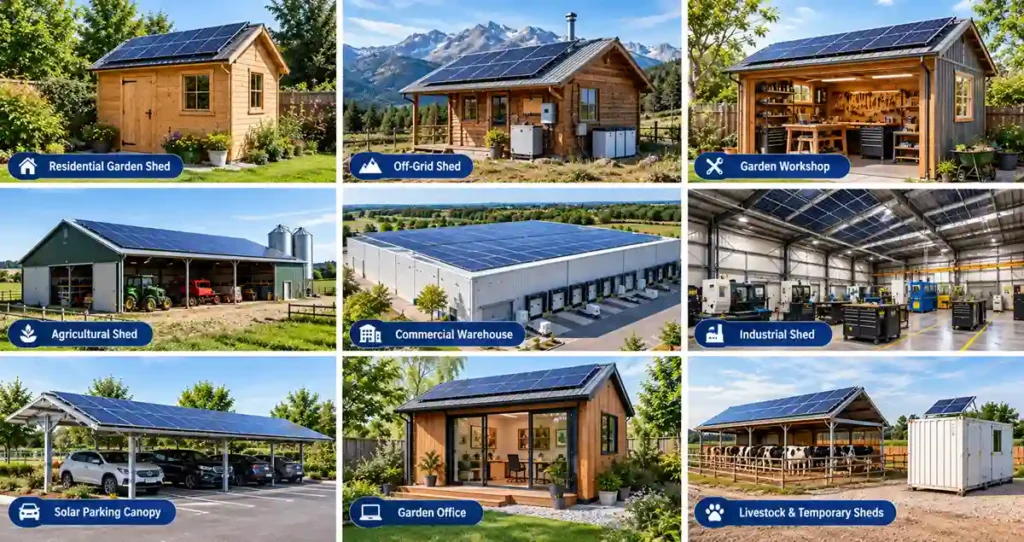
A solar panel for a shed can do more than power a garden light. With the right combination of solar panels, battery storage, charge controller, and inverter, a shed can support everything from basic residential electricity needs to commercial equipment and industrial storage facilities. The ideal system depends on the shed’s location, daily energy consumption, available roof space, shading, and whether grid electricity is available.
1. Residential Garden Sheds
Garden sheds can use solar power for LED lighting, phone charging, security cameras, small fans, and other low-power devices. A compact solar system with a battery is useful where running a dedicated electrical cable from the house would be expensive or impractical.
2. Off-Grid Sheds and Remote Buildings
For sheds located away from the utility grid, solar panels paired with battery storage can provide independent electricity. Applications include remote storage buildings, rural workshops, field shelters, and small agricultural structures. System sizing should account for daily consumption, cloudy weather, and the required backup period.
3. Backyard Workshops and Hobby Sheds
A solar-powered workshop can support workbench lighting, battery chargers, cordless tools, ventilation fans, and selected power tools. Higher-power equipment requires careful sizing of the inverter, battery discharge capability, and solar array to accommodate startup surges and simultaneous loads.
4. Agricultural and Farm Sheds
Farm sheds can use solar energy for lighting, monitoring equipment, security systems, small ventilation loads, and selected agricultural devices. Larger applications, such as water pumps or refrigeration, require a load-specific design rather than a basic shed solar kit.
5. Commercial Storage Sheds and Warehouses
Small commercial storage buildings can use rooftop solar panels to power lighting, CCTV, access-control systems, communications equipment, and low-power monitoring devices. Larger storage facilities may benefit from a properly engineered rooftop solar installation, subject to roof capacity, electrical demand, and applicable safety requirements.
6. Industrial Sheds and Workshops
Industrial sheds may use solar power for auxiliary lighting, monitoring systems, control equipment, and selected workshop loads. Operating machinery, compressors, and other high-demand equipment generally requires a larger engineered solar system, appropriate three-phase equipment where necessary, and a detailed assessment of peak demand.
7. Parking Sheds and Solar Canopies
Solar panels installed over parking shelters can provide shade while generating electricity for nearby buildings, outdoor lighting, security equipment, and electric-vehicle charging. The structure must be designed to handle the panels, wind loads, drainage, and electrical installation requirements.
8. Garden Offices and Hobby Studios
A garden office or studio can use solar energy for laptops, monitors, internet equipment, lighting, and ventilation. Battery storage can help supply electricity after sunset, while heating, air conditioning, and other energy-intensive loads may require a substantially larger system.
9. Livestock and Animal Shelters
Solar panels can support lighting, security cameras, environmental monitoring, and small ventilation systems in suitable animal shelters. Ventilation and water-related equipment should be sized carefully because interruptions can affect animal welfare.
10. Temporary and Portable Sheds
Construction-site storage units, temporary workshops, and portable buildings can use modular solar panels and battery systems where conventional power is unavailable. Portable installations should include secure mounting, weather-resistant equipment, suitable cable protection, and safe battery placement.
How to Choose the Right Solar System for Your Shed
Before selecting a solar panel for a shed, estimate the daily energy consumption in watt-hours, determine the maximum simultaneous load, assess available sunlight and shading, and decide how much battery backup is required. Small lighting applications may need only a compact system, while workshops, commercial facilities, and industrial sheds can require substantially larger arrays and inverters.
The best approach is to size the system around the actual electrical loads rather than choosing a panel solely by shed size.
Frequently Asked Questions
What size solar panel do I need for a shed?
It depends entirely on what you’re running. 100 to 200W covers basic lighting and charging, 400W or more supports power tools through an inverter. Size it against your actual daily usage with our solar panel size calculator rather than defaulting to a generic wattage.
Should I use a monofacial or bifacial solar panel for my shed?
Monofacial for a flush roof mount, since there’s no rear-face light to capture. Bifacial only makes sense with a tilted or pole-mounted panel that has real clearance and a reflective surface underneath.
Do I need an MPPT controller for a shed solar panel, or is PWM fine?
MPPT is worth the extra cost, especially since sheds commonly sit in partial shade from nearby structures or trees, exactly where MPPT’s efficiency advantage over PWM is largest
What battery should I use for a shed solar system?
LiFePO4 rather than lead-acid. It gives significantly more usable capacity, lasts far longer, and needs no maintenance, which matters in a space you’re not checking daily.
Can I run power tools off a shed solar system?
Yes, with a correctly sized inverter and battery bank. Size the inverter for the tool’s startup surge, not just its running wattage, that’s the detail most basic shed solar guides get wrong.
Related Guides
- 24V 200Ah LiFePO4 Battery: Specs, Uses & Buying Guide
- LiFePO4 vs Lithium-Ion: Which Battery Should You Buy?
- LiFePO4 Battery: How It Works, Specs & Buying Guide
- LiFePO4 Batteries for Solar: How to Choose & Size Right
- 48V 200Ah LiFePO4 Battery: Specs, Sizing & Home Storage Guide
- LiFePO4 Battery Charger: Voltage, Amps & Settings
- Solar Panel Repair Guide: Diagnose Problems, Costs & Fixes
- IRS Form 5695 for 2025: Solar Tax Credit Guide
Related guides on SolarVisionAI.com
- Monocrystalline Solar Panels 2026: Still Worth It or Hype
- Polycrystalline Solar Panels: Worth Buying in 2026?
- Thin-film Solar Panels: When They Beat Silicon (2026)
- BIPV Solar Panels: Building-Integrated PV Complete Guide
- Portable Solar Panels: Engineer’s Buyer’s Guide 2026
- CPV Solar Panels: Concentrated Photovoltaic Explained
- Skin Solar Panel: What “Solar Skin” Actually Means
- Solar Fence Post Lights: Cap Sizes, Types & Install Guide
- Bifacial Solar Panels in 2026: How to Boost Energy Output
- Solar Charge Controller: The Complete Guide
- MC4 Connectors: Solar Safety & Installation Guide
- Solar Panel Types, Efficiency & Benefits
- Solar Water Pump Guide
- BESS — Battery Energy Storage System Guide
- Commercial Solar Panel Installation
- Solar Refrigerator & DC Fridge — Complete 2026 Guide
- Bifacial Solar Panel Albedo Effect Guide
- TOPCon: Why TOPCon Solar Panel is a Proven Smart Investment in 2026
- HJT: Why Heterojunction Is the Hot Climate Champion
- PERC: PERC Solar Panel: Still Relevant or Already Outdated?
- Perovskite: Perovskite Solar Panels: The 2026 Reality Check
- N-Type vs P-Type: N-Type vs P-Type Solar Panels: Honest Comparison
- ABC: ABC (all back contact) Solar Panel: Back Contact Technology Explained
- IBC: IBC Solar Panels: Interdigitated Back Contact Guide
- Tandem: Tandem Solar Panels: Are Stacked Cells Ready for Rooftops?
.