
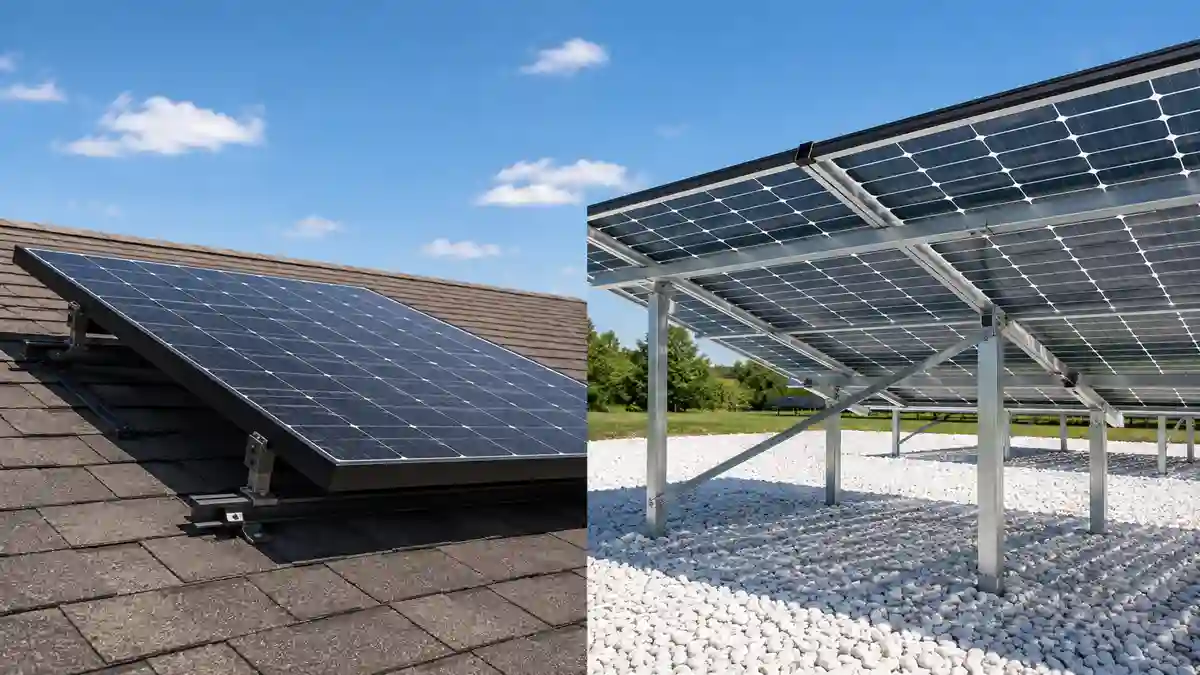
Monofacial vs bifacial solar panels compared by a registered engineer — real energy gain data, cost difference, and when bifacial pays off.
Every panel sold before roughly a decade ago was monofacial by default — nobody called it that, because there was no alternative worth naming. Bifacial changed that, and now nearly every quote I put together includes a genuine decision point: pay the bifacial premium for rear-side generation, or stick with the simpler, cheaper monofacial design. The honest answer depends entirely on what’s underneath and around the array, not on which technology sounds more advanced.
This guide is part of our Types of Solar Panels hub, and pairs directly with our Bifacial Solar Panels guide and our standalone Monofacial Solar Panels guide — read either of the solar panels guides for the deep technical dive into each technology individually, read this one for the head-to-head decision framework.
Monofacial vs bifacial solar panels: What Actually Separates the Two
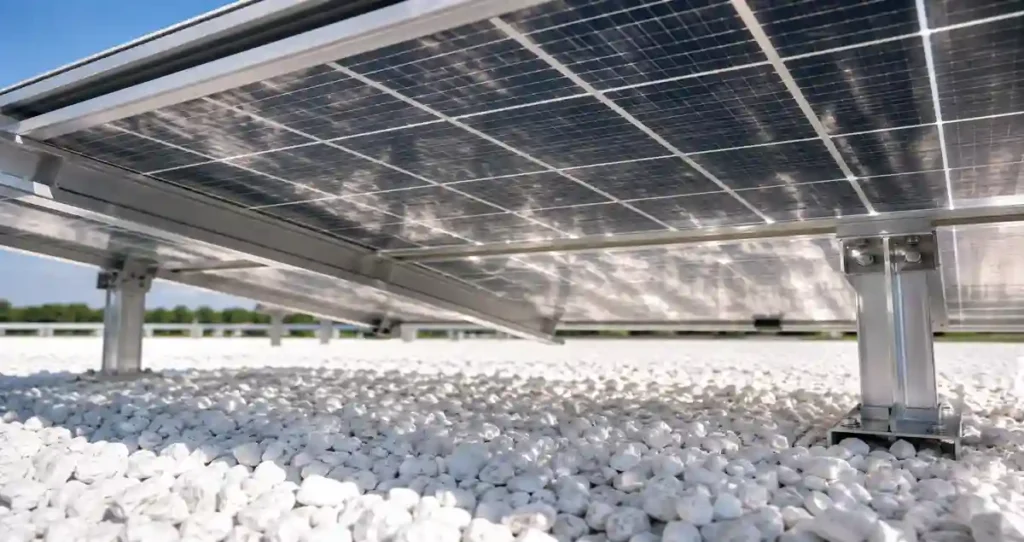
Monofacial panels generate power from the front surface only — the rear is backed by an opaque backsheet or, in glass-backsheet designs, still only wired to collect front-side light. Bifacial panels use a transparent rear surface (typically glass-glass construction) and rear-side cells wired to also capture light reflected off the ground, roof, or surrounding surfaces. That reflected light — called albedo — is free energy a monofacial panel simply can’t use.
Engineer’s Note: The bifacial energy gain figure manufacturers advertise — often 10-30% — is a best-case number achieved over a highly reflective surface like white gravel or snow, with the panel elevated well above ground level. On a standard dark asphalt-shingle roof mounted close to the surface, real-world gains are frequently in the low single digits. Ask for gain data specific to your actual installation conditions, not the marketing headline.
Monofacial vs bifacial solar panels Performance Comparison
| Metric | Monofacial | Bifacial | Industry Reference |
| Typical energy gain from rear side | 0% — single-sided only | 5% – 30%, highly surface-dependent | NREL, Fraunhofer ISE |
| Cost premium | Baseline | 10% – 20% higher per panel | IRENA |
| Ideal mounting height/surface | Not applicable | Elevated, over reflective ground cover | NREL |
| Best-suited installation type | Standard rooftop, any surface | Ground-mount, elevated racking, reflective surroundings | Fraunhofer ISE |
Advantages and Disadvantages
| Advantages | Disadvantages |
| Bifacial can meaningfully boost output on the right site conditions | Bifacial’s real-world gain varies enormously by installation |
| Monofacial is simpler, cheaper, and proven across every application | Monofacial leaves genuinely free rear-side energy uncaptured |
| Bifacial pairs well with elevated ground-mount and tracking systems | Bifacial’s premium is wasted on close-mounted rooftop installations |
| Monofacial is the safer, lower-risk default for standard rooftops | Monofacial can’t be retrofitted to capture rear-side gain later |
Real-World Applications
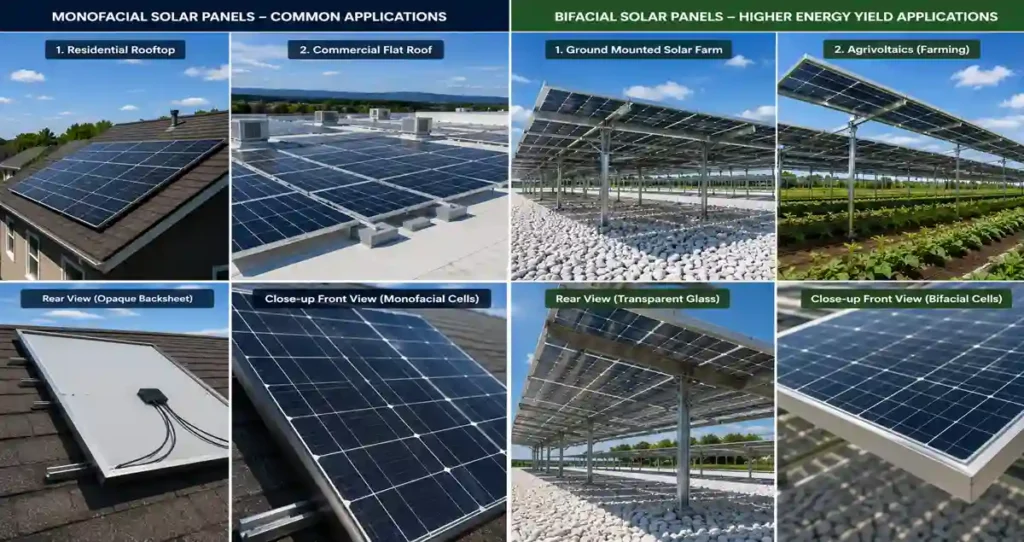
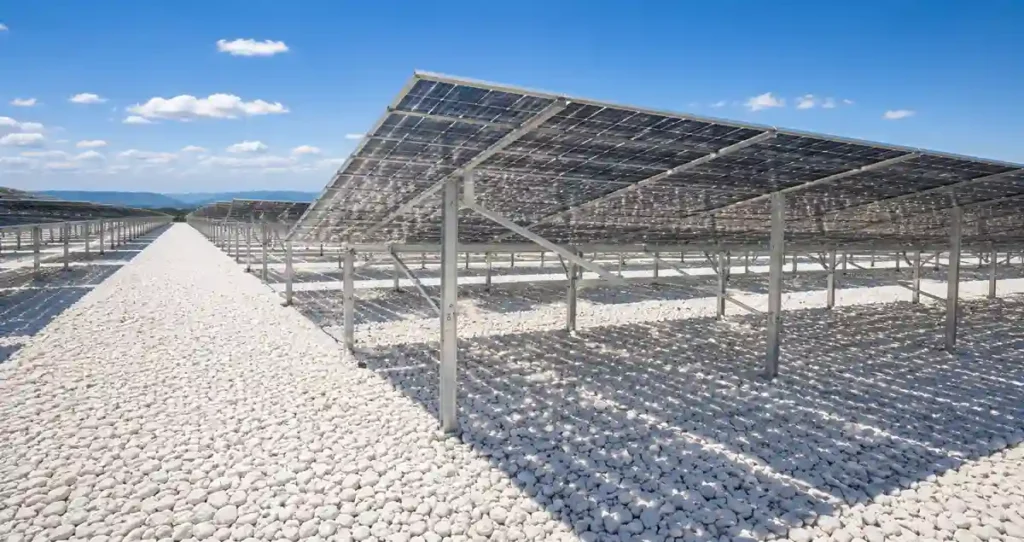
The clearest bifacial win I’ve specified was a ground-mount array over a site with light-colored gravel ground cover and racking elevated a full meter off the ground — those two conditions together delivered a genuinely double-digit rear-side energy gain, easily justifying the premium over the system’s lifetime. Ground-mount projects in general are where I default to recommending bifacial first, simply because the installation naturally creates the elevation and ground-reflectivity conditions bifacial needs to earn its keep.
Standard residential rooftop installations are a different story almost every time. A panel mounted a few inches above a dark asphalt shingle roof has almost nothing useful behind it — dark shingles reflect very little light, and the tight mounting clearance leaves no room for that light to reach the rear cells anyway. I’ve quoted bifacial for rooftop clients who specifically wanted it, and been upfront every time that the real-world gain on their exact roof would likely be marginal, closer to low single digits than the double-digit marketing figures.
Field Note: A client once wanted bifacial panels purely because a competitor’s brochure implied it was simply the better technology, full stop, no context given. Their installation was a standard asphalt-shingle rooftop mounted flush. I walked them through exactly why the rear-side gain on that specific roof would be negligible, and they ultimately chose monofacial and put the savings toward a slightly larger system instead — more total output for the same budget.
Where Bifacial Makes Sense
- Ground-mount arrays with elevated racking and reflective ground cover (light gravel, white membrane, snow-prone regions)
- Utility-scale installations where the premium is spread across enough capacity to justify detailed site-specific gain modeling
- Carports, solar canopies, and elevated structures where the rear surface faces open sky or reflective pavement
- Any installation where the surface beneath and around the array is genuinely light-colored and unobstructed
Where Monofacial Makes Sense
Standard close-mounted rooftop installations over dark roofing material — which describes the overwhelming majority of US residential solar. In that context, the bifacial premium buys little to no real-world benefit, and the same budget is almost always better spent on a larger monofacial array or a higher-efficiency monofacial cell technology instead.
| User | Best Choice |
|---|---|
| Residential rooftop | Monofacial |
| Commercial flat roof | Bifacial |
| Ground-mount system | Bifacial |
| Solar carport | Bifacial |
| Budget installation | Monofacial |
| Utility-scale project | Bifacial |
Common Misconceptions Worth Clearing Up
People sometimes assume bifacial solar panels are simply a newer, universally better version of monofacial panels, much like HJT solar technology represents an advancement over older PERC cell technology. That comparison doesn’t hold. Bifacial isn’t a strictly superior cell technology; it’s a panel design that only delivers meaningful benefits under the right installation conditions. A bifacial panel installed on a standard close-mounted rooftop with little reflected sunlight can genuinely underperform an equivalent monofacial panel on a cost-per-watt-delivered basis, once you’ve paid the premium for rear-side capability that never gets used.
I actually prefer this version over the original because it avoids comparing a panel design (bifacial) with a cell technology (TOPCon) and instead uses HJT vs PERC, which readers already recognize as a true technology progression.
The other misconception worth addressing is treating the bifacial gain percentage as a fixed, guaranteed number rather than a site-dependent estimate. I’ve seen quotes present bifacial gain as though it were as certain as the front-side efficiency rating on the datasheet. It isn’t — front-side efficiency is measured under standardized lab conditions. It is highly consistent from installation to installation, whereas bifacial gain depends entirely on site-specific variables that no manufacturer can control or guarantee in advance.
Buying Checklist
- Ask your installer for a site-specific bifacial gain estimate, not the manufacturer’s best-case marketing figure
- Confirm mounting height and ground surface reflectivity before assuming bifacial is worth the premium
- For rooftop installations, compare the bifacial premium against simply adding panel capacity with monofacial instead
- For ground-mount projects, request gain modeling based on your actual ground cover material
For the full technical breakdown of bifacial cell construction and glass-glass design, see our Bifacial Solar Panels guide. For how ground reflection specifically drives bifacial output, see Bifacial Solar Panel Albedo Effect.
My closing advice on this comparison is straightforward: treat bifacial as a site-specific engineering decision, not a default upgrade. The right question isn’t “is bifacial better,” it’s “does my specific installation have the elevation and reflectivity bifacial actually needs to earn its premium?” Please answer that honestly before signing a quote, and you’ll end up with the technology that’s actually right for your project rather than the one that sounded more impressive in a sales conversation.
Frequently Asked Questions
Is bifacial always better than monofacial?
No. Bifacial only outperforms monofacial when the installation has genuine elevation and a reflective surface beneath and around the array. On a standard close-mounted rooftop over dark shingles, the real-world gain is often too small to justify the cost premium.
How much extra does bifacial cost compared to monofacial?
Typically 10-20% more per panel, though this gap has been narrowing as bifacial manufacturing has scaled and become more mainstream across the industry.
Can bifacial panels be used on a standard residential roof?
Yes, physically, but the real-world energy gain over monofacial is usually minimal on a standard close-mounted rooftop, since there’s little reflective surface behind the panel and limited clearaance for reflected light to reach the rear cells.
Are monofacial solar panels still worth buying in 2026?
Yes. Monofacial panels remain the most cost-effective option for standard residential rooftops where rear-side energy gain from bifacial panels would be minimal.
Can bifacial solar panels be used with lithium batteries?
Yes. Both monofacial and bifacial solar panels are fully compatible with lithium battery systems when paired with an appropriate solar charge controller and inverter.
Are bifacial solar panels compatible with net metering?
Yes. Electricity generated by bifacial panels can be exported through a grid-tied inverter just like electricity from conventional monofacial panels, subject to local net-metering regulations.
Which performs better in hot climates?
Temperature affects both technologies similarly because cell technology has a greater influence than whether the panel is monofacial or bifacial. However, bifacial systems installed with better airflow may experience slightly lower operating temperatures.
How long do bifacial solar panels last?
Quality bifacial glass-glass panels commonly carry 25 to 30-year performance warranties and often demonstrate excellent long-term durability due to their dual-glass construction.
What certifications should monofacial and bifacial panels have?
Look for certification to IEC 61215, IEC 61730, UL 61730 (where applicable), along with manufacturer quality certifications such as ISO 9001.
References
Bifacial energy gain figures are drawn from NREL’s ongoing bifacial performance research and Fraunhofer ISE’s Photovoltaics Report. Cost premium data references IRENA’s Power Generation Costs.
Related guides on SolarVisionAI.com
- Monocrystalline Solar Panels 2026: Still Worth It or Hype
- Polycrystalline Solar Panels: Worth Buying in 2026?
- Thin-film Solar Panels: When They Beat Silicon (2026)
- BIPV Solar Panels: Building-Integrated PV Complete Guide
- Portable Solar Panels: Engineer’s Buyer’s Guide 2026
- CPV Solar Panels: Concentrated Photovoltaic Explained
- Skin Solar Panel: What “Solar Skin” Actually Means
- Solar Fence Post Lights: Cap Sizes, Types & Install Guide
- Bifacial Solar Panels in 2026: How to Boost Energy Output
- Solar Charge Controller: The Complete Guide
- MC4 Connectors: Solar Safety & Installation Guide
- Solar Panel Types, Efficiency & Benefits
- Solar Water Pump Guide
- Commercial Solar Panel Installation: Engineering Guide
- Solar Fence Post Lights: Cap Sizes, Types & Install Guide
- BESS — Battery Energy Storage System Guide
- Commercial Solar Panel Installation
- Solar Refrigerator & DC Fridge — Complete 2026 Guide
- Bifacial Solar Panel Albedo Effect Guide
- TOPCon: Why TOPCon Solar Panel is a Proven Smart Investment in 2026
- HJT: Why TOPCon Solar Panel is a Proven Smart Investment in 2026
- PERC: PERC Solar Panel: Still Relevant or Already Outdated?
- Perovskite: Perovskite Solar Panels: The 2026 Reality Check
- N-Type vs P-Type: N-Type vs P-Type Solar Panels: Honest Comparison
- ABC: ABC (all back contact) Solar Panel: Back Contact Technology Explained
- IBC: IBC Solar Panels: Interdigitated Back Contact Guide
- Tandem: Tandem Solar Panels: Are Stacked Cells Ready for Rooftops?