
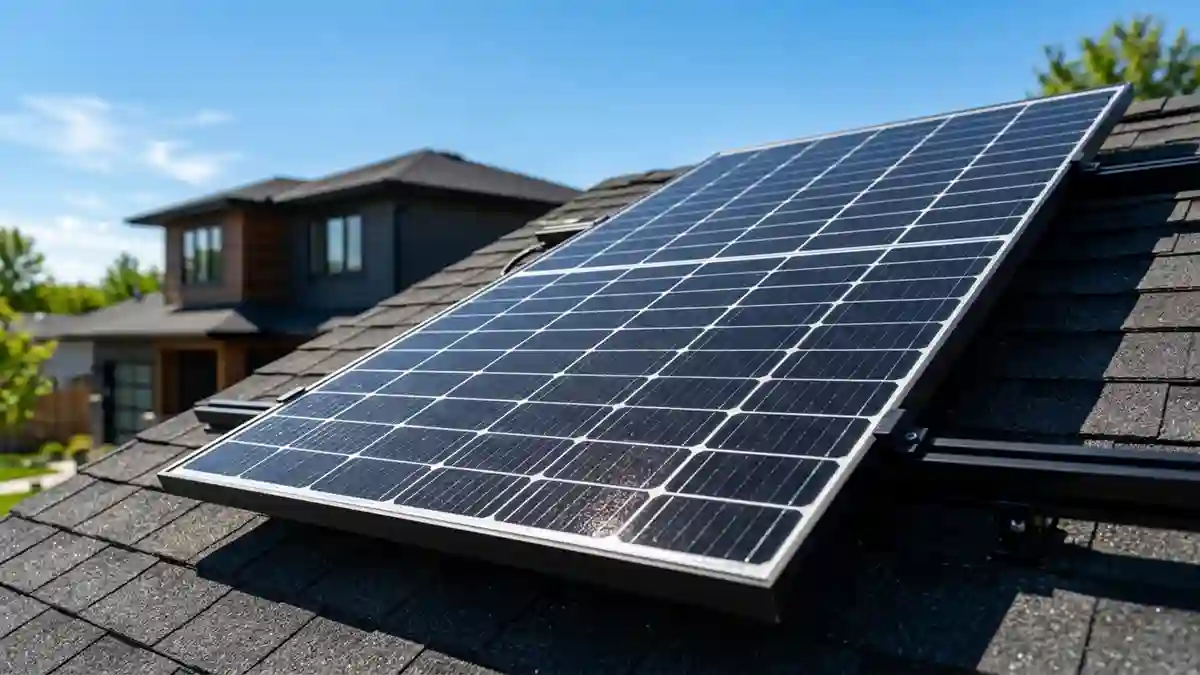
Learn how half-cut solar panels handle partial shading and reduce internal losses. An engineer breaks down whether they’re worth buying in 2026.
Half-cut cell technology is one of those genuinely clever engineering ideas that sounds almost too simple to matter — cut every standard solar cell in half — and yet it quietly became the mainstream standard across nearly the entire industry within a few short years. Understanding why such a basic-sounding change delivers a real, measurable performance improvement is worth five minutes of anyone’s time before comparing solar panels‘ datasheets.
This guide is part of our Solar Panel Technology hub and our Types of Solar Panels hub, where we explain the engineering innovations behind modern photovoltaic modules and help you choose the right solar panel technology for different applications.
What Half-Cut Actually Changes
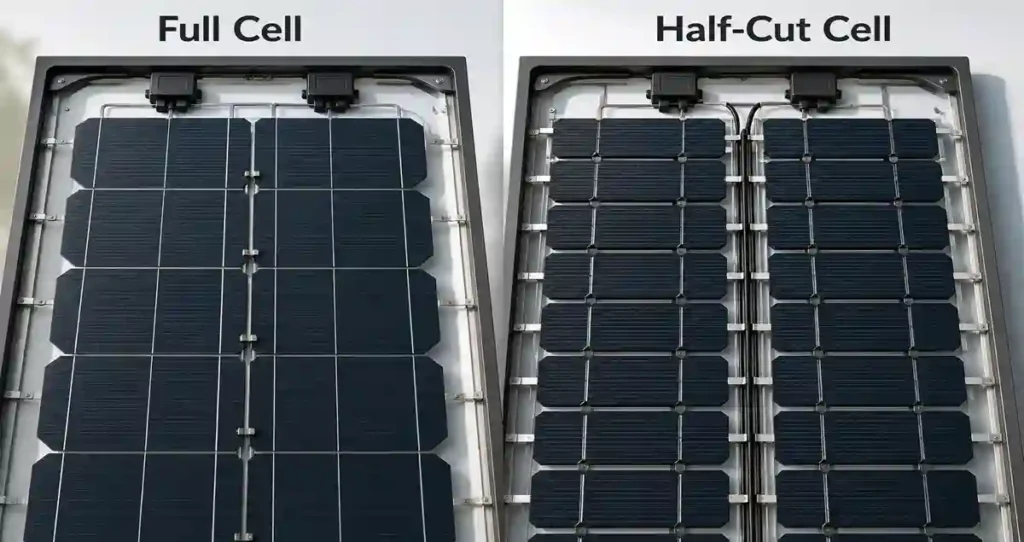
A standard full-size solar cell is physically cut in half using a laser scribing process, producing two half-sized cells that are then wired in a modified series-parallel configuration rather than a single continuous string. The cell material and semiconductor chemistry underneath is completely unchanged — a half-cut monocrystalline cell is still monocrystalline, a half-cut polycrystalline cell is still polycrystalline. What changes is purely the physical geometry and how the cells are electrically connected.
Engineer’s Note: The efficiency gain from half-cutting isn’t about the cells themselves becoming more efficient at converting light — it’s about reducing resistive power loss in the connections between cells. Current flowing through a smaller half-cell encounters less internal electrical resistance than the same current flowing through a full-size cell, and since resistive losses scale with the square of current, halving the cell size meaningfully cuts that loss. It’s a wiring-efficiency gain, not a photovoltaic-efficiency gain, and that distinction matters when you’re evaluating manufacturer claims.
Why Half-Cut Dramatically Improves Shading Tolerance
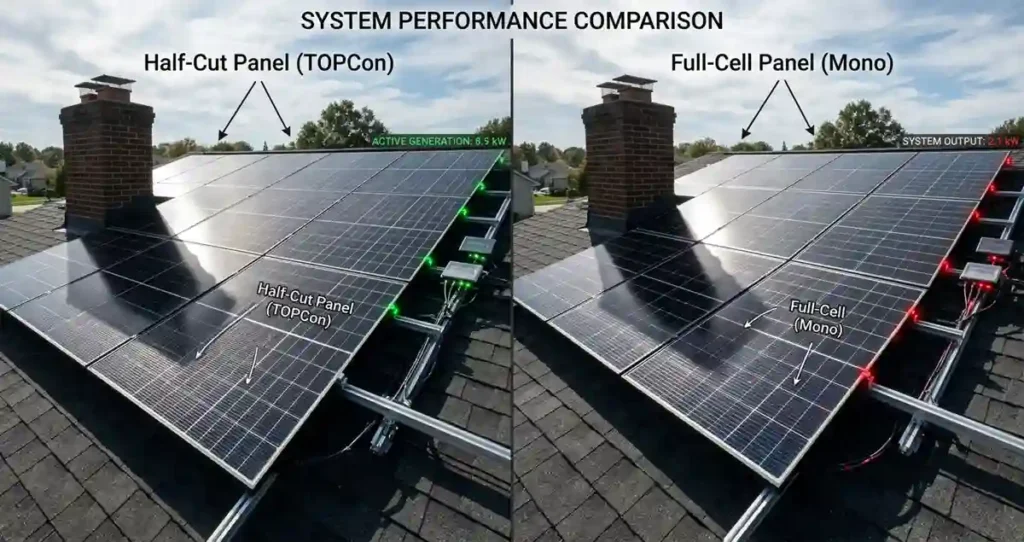
This is the second, and arguably more practically important, benefit of half-cut construction. In a standard full-cell panel, the cells are wired in a single series string, meaning a shadow falling on even one cell can drag down the output of the entire string it’s part of, since current in a series circuit is limited by the weakest link. Half-cut panels typically wire the top and bottom halves of the panel as two independent parallel circuits, so a shadow affecting the bottom half of the panel doesn’t necessarily choke off the top half’s output the same way it would in a full-cell design.
In practical terms, this means a half-cut panel partially shaded by a chimney, a tree branch, or a roof vent typically retains meaningfully more of its total output than an equivalent full-cell panel facing the identical shading pattern. It doesn’t eliminate shading losses — physics doesn’t allow that — but it substantially reduces the disproportionate impact a small shadow can have on total panel output.
Field Note: I’ve reviewed performance data from residential installations with partial roof shading from vent pipes and antenna mounts, comparing half-cut and full-cell panels installed under nearly identical shading conditions. The half-cut panels consistently retained a noticeably higher percentage of unshaded output than the full-cell comparison points I’ve reviewed, exactly matching the theoretical parallel-circuit advantage half-cut construction is supposed to deliver.
Half-Cut vs Full-Cell at a Glance
| Feature | Half-Cut Panels | Full-Cell Panels |
|---|---|---|
| Cell Design | Laser-cut half cells | Standard full-size cells |
| Internal Resistance | Lower | Higher |
| Partial Shading Performance | Excellent | Moderate |
| Power Loss | Lower | Higher |
| Micro-Crack Resistance | Better | Standard |
| Typical Market Availability | Industry standard | Becoming less common |
Performance Comparison
| Metric | Half-Cut | Full Cell (Standard) | Industry Reference |
| Resistive power loss | Lower — smaller cells reduce internal resistance | Higher — full-size cells carry more current per cell | NREL |
| Shading tolerance | Significantly better — independent parallel circuits | Poor — single string vulnerable to one shaded cell | Fraunhofer ISE |
| Typical efficiency gain | 0.5% – 1% higher than equivalent full-cell panel | Baseline | NREL |
| Micro-crack resistance | Better — smaller cells flex less under thermal stress | More vulnerable to full-cell cracking under stress | Fraunhofer ISE |
| Manufacturing cost premium | Minimal — now standard across most manufacturers | N/A — being phased out as a standalone category | IRENA |
Advantages and Disadvantages
| Advantages | Disadvantages |
| Meaningfully better shading tolerance from independent circuit halves | More cell interconnections increase manufacturing complexity slightly |
| Lower resistive losses translate to a real, if modest, efficiency gain | More solder joints theoretically means more potential failure points |
| Better resistance to micro-cracking from thermal and mechanical stress | Minimal cost premium, though this has essentially disappeared industry-wide |
| Now the mainstream standard — widely available across every manufacturer tier | Marketing sometimes overstates the gain as bigger than the real 0.5-1% figure |
Real-World Applications
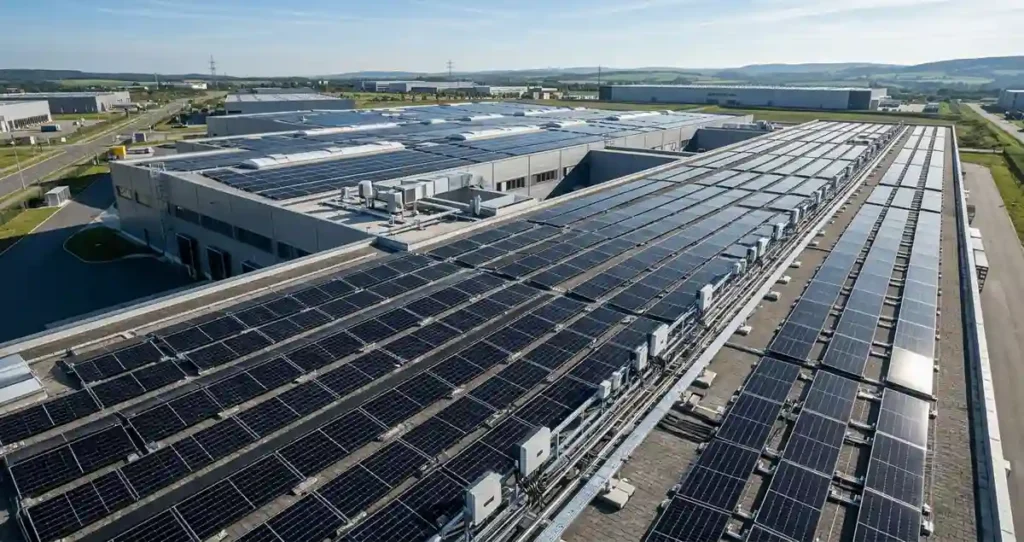
Half-cut has become such a standard industry practice that I now specify it by default on nearly every project, simply because the cost premium that once justified choosing full-cell has essentially disappeared. The clearest cases where half-cut’s specific advantages matter most are residential rooftops with any partial shading risk — a chimney, a neighboring tree, roof-mounted equipment — where the improved shading tolerance directly translates into more consistent real-world output compared to a full-cell panel facing the same obstruction.
I’ve also seen half-cut’s micro-crack resistance matter on projects in regions with significant daily temperature swings, where the thermal expansion and contraction cycling that panels experience over 25 years puts real mechanical stress on cell material. Smaller half-cut cells flex less under that stress than full-size cells, which is a genuine, if less frequently discussed, durability advantage beyond the headline efficiency and shading numbers.
Field Note: During recent commercial rooftop surveys, I noticed that nearly every Tier 1 manufacturer now supplies half-cut modules as the standard option rather than traditional full-cell panels. In practice, many customers receive half-cut technology without specifically requesting it because manufacturers have adopted it as the industry baseline. Today, I rarely recommend purchasing a conventional full-cell panel unless it is available at a substantial discount for a specific project or required for compatibility with an existing system.
Applications of Half-Cut Solar Panels
| Application | Suitability | Why It’s Recommended |
|---|---|---|
| Residential Rooftops | ★★★★★ | Better tolerance to partial shading from chimneys, vents, and nearby trees. |
| Commercial Rooftops | ★★★★★ | Reduces energy losses caused by rooftop equipment and HVAC units. |
| Utility-Scale Solar Farms | ★★★★★ | Improves long-term reliability and overall energy yield. |
| Agricultural Buildings | ★★★★★ | Handles seasonal shading better than conventional full-cell panels. |
| Solar Carports | ★★★★★ | Performs well where occasional shading from surrounding structures occurs. |
| Off-Grid Systems | ★★★★★ | Maximises energy production in changing sunlight conditions. |
| RVs & Marine | ★★★★☆ | Suitable where installation space is limited and reliability is important. |
Common Misconceptions Worth Clearing Up
People sometimes assume half-cut is a distinct panel type competing against monocrystalline or polycrystalline, similar to how PERC or TOPCon gets discussed. It isn’t — half-cut is a cell-cutting and wiring technique that gets applied on top of whatever base cell chemistry a panel uses. A half-cut panel can be monocrystalline PERC, monocrystalline TOPCon, or polycrystalline — the half-cut question and the cell-chemistry question are answered independently on a real datasheet, much like the busbar count question.
The other misconception is assuming half-cut eliminates shading losses entirely. It substantially reduces the disproportionate impact of partial shading compared to full-cell construction, but a heavily shaded panel of any construction will still produce less power than an unshaded one. Half-cut improves the shading response curve; it doesn’t repeal the underlying physics of reduced light reaching the cells.
Buying Checklist
- Confirm half-cut construction is paired with the cell chemistry (PERC, TOPCon, HJT, etc.) you actually want — they’re independent specifications
- For roofs with any partial shading risk, prioritize half-cut over full-cell wherever the option exists
- Don’t pay a significant premium for half-cut specifically — it’s now close to industry-standard and shouldn’t command a large price gap
- Ask your installer about busbar count alongside half-cut construction, since the two often get specified together
For the direct comparison against older full-cell construction, see our Half Cut vs Full Cell Solar Panels guide.
My closing take on half-cut technology is that it’s a rare case in the solar industry where an almost universally beneficial improvement arrived at essentially no added cost to the buyer. Most efficiency gains in this industry come with a real trade-off — a price premium, a durability question mark, a supply availability issue. Half-cut largely sidestepped all three, which is exactly why it became the default so quickly and why I don’t hesitate to recommend it as a baseline expectation on any new panel purchase today, regardless of budget tier.
Engineering Assessment
| Feature | Rating |
|---|---|
| Energy Efficiency | ★★★★★ |
| Shading Performance | ★★★★★ |
| Electrical Reliability | ★★★★★ |
| Mechanical Strength | ★★★★★ |
| Long-Term Value | ★★★★★ |
| Overall Recommendation | ★★★★★ |
Frequently Asked Questions
Are half-cut solar panels worth the extra cost?
In most cases the cost premium is now minimal to nonexistent, since half-cut has become the mainstream standard across the industry. Given that, yes — the shading tolerance and modest efficiency gain make it worth choosing over full-cell wherever available at a comparable price.
Do half-cut panels produce more power than full-cell panels?
Typically 0.5-1% more, primarily from reduced resistive losses rather than any change in the underlying photovoltaic cell efficiency. The more significant real-world benefit is improved shading tolerance, not the raw efficiency number.
Can half-cut technology be combined with other cell technologies, such as TOPCon?
Yes. Half-cut is a cell-cutting and wiring technique independent of cell chemistry, and is commonly combined with PERC, TOPCon, and other mainstream cell technologies on the same panel. In fact, most premium panels sold today combine half-cut construction with an advanced cell chemistry as a matter of course, rather than treating them as separate purchasing decisions.
References
Efficiency and shading tolerance data for half-cut cell construction are drawn from NREL’s panel performance research and Fraunhofer ISE’s Photovoltaics Report. Manufacturing cost trend context references IRENA’s Power Generation Costs.
Related guides on SolarVisionAI.com
- Monocrystalline Solar Panels 2026: Still Worth It or Hype
- Polycrystalline Solar Panels: Worth Buying in 2026?
- Thin-film Solar Panels: When They Beat Silicon (2026)
- BIPV Solar Panels: Building-Integrated PV Complete Guide
- Portable Solar Panels: Engineer’s Buyer’s Guide 2026
- CPV Solar Panels: Concentrated Photovoltaic Explained
- Skin Solar Panel: What “Solar Skin” Actually Means
- Solar Fence Post Lights: Cap Sizes, Types & Install Guide
- Bifacial Solar Panels in 2026: How to Boost Energy Output
- Solar Charge Controller: The Complete Guide
- MC4 Connectors: Solar Safety & Installation Guide
- Solar Panel Types, Efficiency & Benefits
- Solar Water Pump Guide
- Commercial Solar Panel Installation: Engineering Guide
- Solar Fence Post Lights: Cap Sizes, Types & Install Guide
- BESS — Battery Energy Storage System Guide
- Commercial Solar Panel Installation
- Solar Refrigerator & DC Fridge — Complete 2026 Guide
- Bifacial Solar Panel Albedo Effect Guide
- TOPCon: Why TOPCon Solar Panel is a Proven Smart Investment in 2026
- HJT: Why TOPCon Solar Panel is a Proven Smart Investment in 2026
- PERC: PERC Solar Panel: Still Relevant or Already Outdated?
- Perovskite: Perovskite Solar Panels: The 2026 Reality Check
- N-Type vs P-Type: N-Type vs P-Type Solar Panels: Honest Comparison
- ABC: ABC (all back contact) Solar Panel: Back Contact Technology Explained
- IBC: IBC Solar Panels: Interdigitated Back Contact Guide
- Tandem: Tandem Solar Panels: Are Stacked Cells Ready for Rooftops?