
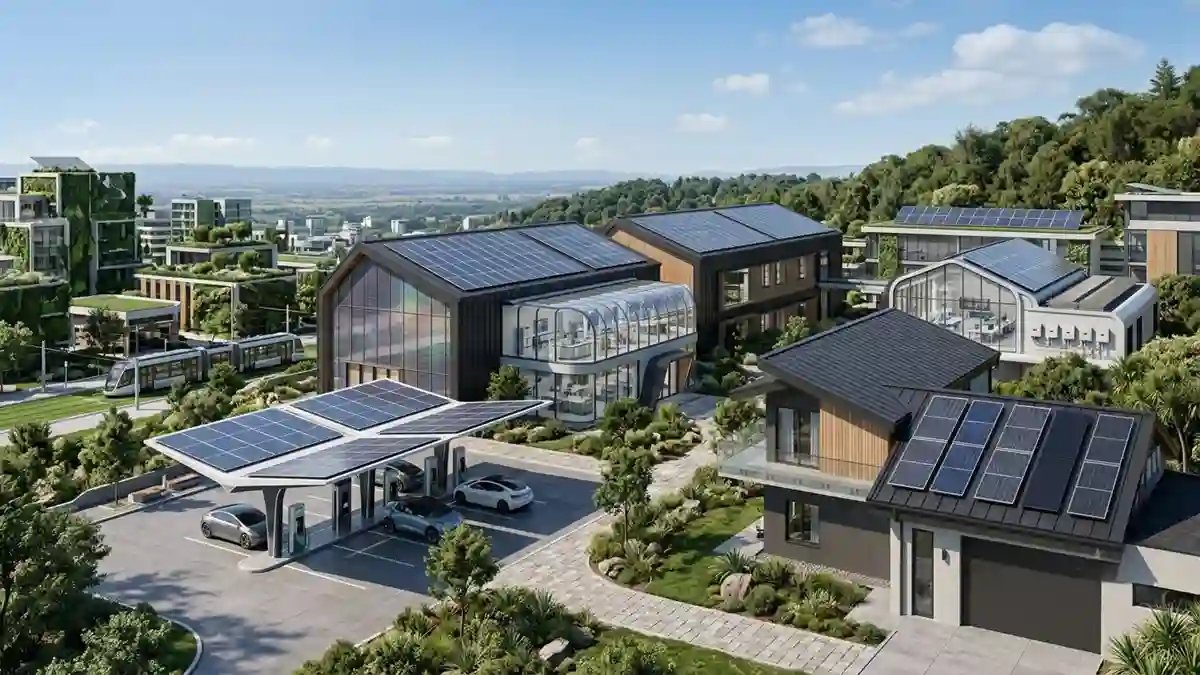
Solar panel technology explained by a registered engineer — TOPCon, HJT, PERC, Perovskite, N-Type vs P-Type, ABC, IBC, and Tandem cells compared.
Every panel type covered in our Types of Solar Panels guide — monocrystalline, polycrystalline, thin-film, and the rest — is built from silicon or thin-film cells engineered using one of several competing cell technologies. That’s a separate question from panel type, and it’s the one that actually explains why two monocrystalline panels from two different manufacturers can carry very different price tags and efficiency numbers on their datasheets.
I wrote this guide as the companion piece to our Types hub — read that one to decide what form factor and cell chemistry fits your project, read this one to understand what’s actually happening inside the cell that determines how much power it produces. Every technology below gets its own dedicated guide; this page is the map connecting them.
Engineer’s Note: If you read nothing else on this page, read this: cell technology and solar panel type are two independent decisions, not one. A monocrystalline panel can use PERC, TOPCon, HJT, or back-contact cell architecture — the silicon type and the cell technology are answered separately on a real datasheet, and conflating them is the single most common confusion I clear up with clients.
Quick Facts: Solar Panel Technology
| Feature | Details |
|---|---|
| Covers | TOPCon, HJT, PERC, ABC, IBC, Perovskite, Tandem, N-Type & P-Type |
| Highest Commercial Efficiency | ABC / IBC (22–25%+) |
| Best Value | TOPCon |
| Best Budget Option | PERC |
| Best Emerging Technology | Perovskite Tandem |
| Typical Lifespan | 25–30 Years |
| Best For | Residential, Commercial & Utility Projects |
| Overall Recommendation | Compare technology based on budget, roof space, and long-term performance |
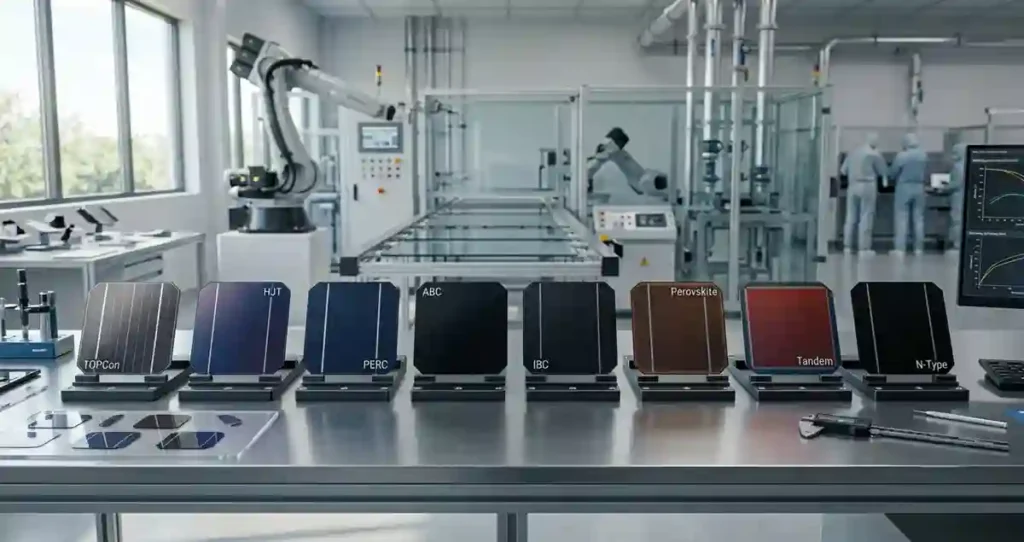
TOPCon Solar Panels
TOPCon has become the mainstream direction the entire industry is shifting toward, built on N-type silicon with an added tunnel-oxide passivation layer that pushes efficiency to 22–23.5%. It’s the technology I specify most often today for clients prioritizing long-term output over the lowest possible upfront cost.
| Advantages | Disadvantages |
| Higher efficiency ceiling than PERC, with better long-term degradation | Moderate cost premium over PERC, though narrowing every year |
| N-type base silicon avoids boron-oxygen light-induced degradation | Requires newer manufacturing equipment than legacy PERC lines |
| Becoming the mainstream standard across premium product lines | Still a step below HJT and back-contact ceilings on raw efficiency |
HJT Solar Panels
Heterojunction technology layers thin amorphous silicon over a crystalline silicon wafer, combining the strengths of both materials. HJT posts some of the best temperature coefficients of any mainstream cell technology, which is why it comes up constantly in hot-climate installation conversations.
| Advantages | Disadvantages |
| Excellent temperature coefficient — retains output better in extreme heat | Higher manufacturing cost than PERC or standard TOPCon |
| Strong low-light performance from the amorphous silicon layer | Fewer manufacturers currently producing at large scale |
| Bifacial-friendly design, well suited to ground-mount and dual-sided arrays | Premium pricing limits accessibility for budget-driven projects |
PERC Solar Panels
PERC added a reflective rear passivation layer to standard silicon cells, pushing efficiency to 20–22% at very little added manufacturing cost. It dominated the industry for the better part of a decade and remains the most cost-effective option for space-abundant, budget-driven projects today.
| Advantages | Disadvantages |
| Mature, low-cost manufacturing with excellent value per watt | Efficiency ceiling below TOPCon, HJT, and back-contact technology |
| Widely available across nearly every manufacturer tier | Slightly more prone to light-induced degradation than N-type cells |
| Reliable, well-understood technology with a long track record | Being phased out of flagship product lines industry-wide |
Perovskite Solar Panels
Perovskite represents the most significant efficiency jump in years, especially stacked as a tandem layer on silicon, but field durability data is still being established. I treat this as a technology to watch closely, not yet one to build a 25-year investment around.
| Advantages | Disadvantages |
| Highest efficiency ceiling of any near-term silicon-adjacent technology | Field lifespan not yet proven at silicon’s 25-year benchmark |
| Lower manufacturing energy and temperature requirements than silicon | Historical sensitivity to moisture and heat still being engineered out |
| Rapid year-over-year efficiency improvement in lab settings | Very limited commercial availability as of 2026 |
N-Type vs P-Type Solar Panels
The doping type of the silicon wafer — boron for P-type, phosphorus for N-type — underlies nearly every cell technology comparison on this page. N-type’s freedom from boron-oxygen degradation is the fundamental reason TOPCon and HJT outperform PERC over the long term.
| Advantages | Disadvantages |
| N-type avoids boron-oxygen light-induced degradation entirely | N-type carries a manufacturing cost premium, though it’s narrowing |
| Higher efficiency ceiling underpins TOPCon and HJT performance | P-type requires more careful LID mitigation strategies |
| P-type remains a legitimate lower-cost choice for space-abundant projects | P-type’s efficiency ceiling trails N-type by several percentage points |
ABC Solar Panels
All Back Contact technology moves every electrical contact to the rear of the cell, eliminating front-surface shading losses entirely. The result is both the highest efficiency among mainstream commercial cells and a clean, uniform aesthetic with no visible grid lines.
| Advantages | Disadvantages |
| Highest efficiency among mainstream commercially available cell types | Significant manufacturing cost premium over front-contact cells |
| Clean, uniform aesthetic with no visible busbars or grid lines | Fewer manufacturers producing at scale, limiting availability |
| Excellent low-light performance from an unobstructed front surface | Rear-side wiring adds complexity to diagnostics and repair |
IBC Solar Panels
Interdigitated Back Contact is the original technical term for the same rear-contact concept marketed today as ABC. Its interlocking contact geometry delivers an excellent fill factor, translating headline efficiency into genuinely higher real-world energy yield.
| Advantages | Disadvantages |
| Excellent fill factor from minimized resistive losses in contact design | Precision manufacturing requirements increase production cost |
| Strong low-light and diffuse-light performance | Premium pricing limits accessibility for budget-driven projects |
| Decades of research pedigree behind the underlying design | Rear-side wiring adds complexity to installation diagnostics |
Tandem Solar Panels
Tandem cells stack two semiconductor layers with complementary spectral sensitivity — most commonly perovskite on silicon — capturing more of the light spectrum than either material alone. It’s the architecture behind most of the genuinely exciting efficiency records in current solar research.
| Advantages | Disadvantages |
| Highest efficiency ceiling of any near-term commercially viable technology | Field durability not yet proven at silicon’s 25-year benchmark |
| Builds on proven silicon manufacturing rather than replacing it | Very limited commercial product availability as of 2026 |
| Clear technical pathway beyond silicon’s theoretical efficiency limit | Manufacturing complexity of precision multi-layer deposition is significant |
Efficiency Compared Across Every Cell Technology
| Cell Technology | Typical Efficiency | Industry Reference |
| PERC | 20% – 22% | NREL, Fraunhofer ISE |
| TOPCon | 22% – 23.5% | NREL, Fraunhofer ISE |
| HJT | 22% – 24% | NREL, Fraunhofer ISE |
| N-Type (general) | 22% – 24%+ | NREL |
| P-Type (general) | 18% – 22% | NREL |
| ABC / IBC (back contact) | 22% – 25%+ | NREL, Fraunhofer ISE |
| Perovskite-Silicon Tandem | 33%+ (lab record) | NREL |
| CPV (multi-junction, for reference) | 40%+ (utility-scale only) | NREL, Fraunhofer ISE |
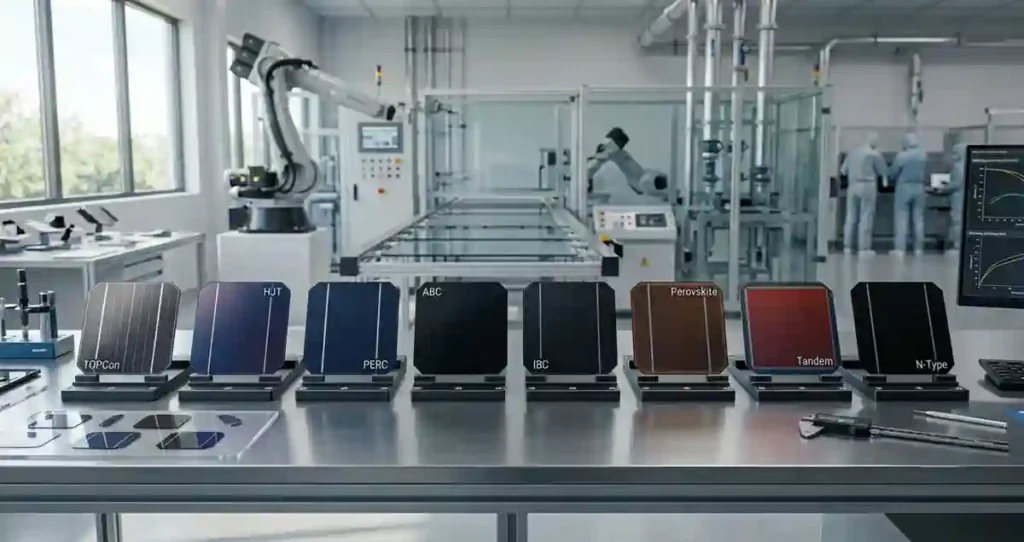
Which Cell Technology Should You Actually Choose?
| Your Priority | Best Technology | Why It’s the Best Choice | Industry Reference |
| Lowest cost with ample roof space | PERC | Mature, low-cost manufacturing with reliable, well-proven performance | IRENA |
| Best long-term value on a space-constrained roof | TOPCon | Higher efficiency and better degradation profile than PERC at a manageable premium | NREL, Fraunhofer ISE |
| Hot climate or high ambient temperature installation | HJT | Best-in-class temperature coefficient minimizes heat-related output loss | Fraunhofer ISE |
| Maximum efficiency and clean aesthetic, budget flexible | ABC / IBC | Highest mainstream efficiency with no visible front-surface wiring | NREL |
| Watching emerging technology, not buying yet | Perovskite / Tandem | Highest long-term potential, but field durability still being established | NREL, PV Magazine |
Note: The recommendations above are based on current industry practices and performance data published by the National Renewable Energy Laboratory (NREL), the Fraunhofer Institute for Solar Energy Systems (Fraunhofer ISE), the International Renewable Energy Agency (IRENA), and technical insights from PV Magazine. Product performance may vary depending on manufacturer, panel type, installation quality, and local environmental conditions. Compliance with IEC 61215 and IEC 61730 remains essential when selecting certified solar modules.
Engineering Assessment
| Feature | Rating | Engineering Assessment |
|---|---|---|
| Efficiency | ★★★★★ | Modern cell technologies such as TOPCon, HJT, ABC/IBC, and Tandem continue pushing photovoltaic efficiency to record levels. |
| Reliability | ★★★★★ | Silicon-based technologies have decades of proven field performance, while emerging technologies are steadily improving. |
| Long-Term Value | ★★★★★ | Selecting the right technology for your project can significantly improve lifetime energy production and return on investment. |
| Innovation | ★★★★★ | Rapid advances in passivation, back-contact cells, tandem architectures, and perovskite materials continue reshaping the solar industry. |
| Commercial Availability | ★★★★☆ | PERC, TOPCon, HJT, and ABC/IBC are commercially available worldwide, while Tandem and Perovskite remain in early commercialization. |
| Future Potential | ★★★★★ | Tandem and Perovskite technologies are expected to define the next generation of ultra-high-efficiency solar modules. |
| Overall Recommendation | ★★★★★ | Understanding solar panel technology is essential for choosing the right module for efficiency, durability, climate, and long-term value. |
Buying Checklist
Before selecting a solar panel technology, verify the following:
• Identify whether the panel uses PERC, TOPCon, HJT, ABC, IBC, or another cell technology.
• Confirm whether the cells are N-type or P-type.
• Compare module efficiency—not just panel wattage.
• Review the temperature coefficient if installing in hot climates.
• Verify annual degradation rates from the manufacturer.
• Ensure compliance with IEC 61215 and IEC 61730 certification standards.
• Compare both product warranty and performance warranty.
• Select technology based on roof space, budget, and long-term energy goals rather than marketing claims.
Who Should Buy?
Who Should Choose Modern Solar Panel Technology?
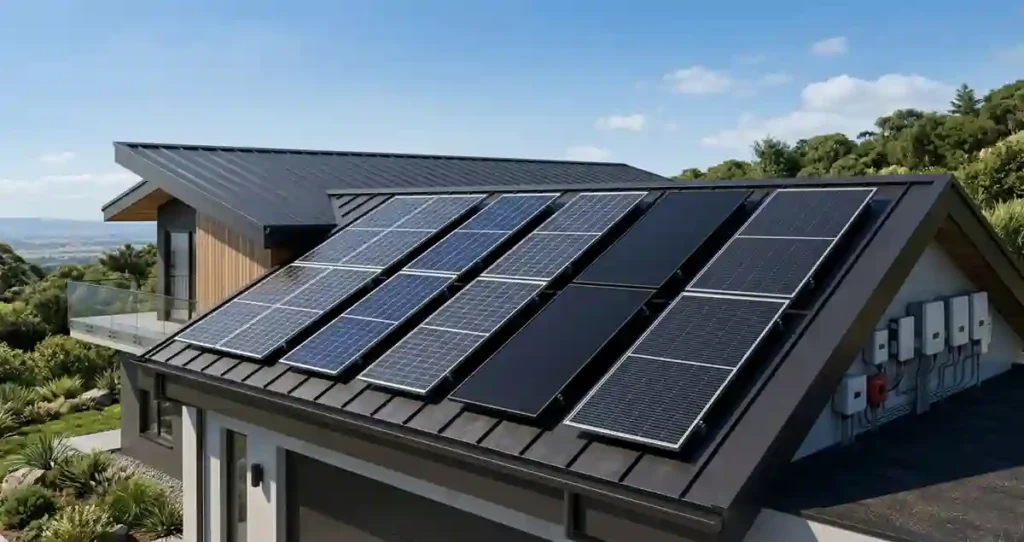
• Homeowners installing new rooftop solar systems
• Commercial and industrial building owners
• Utility-scale solar developers
• Buyers comparing TOPCon, HJT, and PERC
• Engineers and EPC contractors
• Architects designing energy-efficient buildings
• Anyone planning a long-term solar investment
• Buyers seeking the latest photovoltaic technologies
Who Should Avoid?
Who Doesn’t Need This Level of Technical Detail?
• Buyers looking only for basic solar pricing
• Users purchasing small portable solar chargers
• Temporary off-grid camping installations
• Consumers focused solely on panel appearance
• Anyone who simply wants an installer to choose the technology
How This Connects to Panel Type and Panel Anatomy
Cell technology is one layer of a much larger picture. For the panel form factors these cells get built into — monocrystalline, polycrystalline, thin-film, BIPV, and more — see our Types of Solar Panels guide. For the full efficiency methodology referenced throughout this guide, see Solar Panel Efficiency 2026.
Frequently Asked Questions
What is the difference between PERC and TOPCon?
PERC adds a reflective rear passivation layer to standard P-type silicon cells, reaching 20-22% efficiency. TOPCon uses N-type silicon with an added tunnel-oxide layer, reaching 22-23.5% efficiency with better long-term degradation, at a moderate cost premium.
Is HJT better than TOPCon?
HJT typically offers a better temperature coefficient and slightly higher efficiency ceiling than TOPCon, making it especially strong in hot climates, but it carries a higher manufacturing cost and is produced by fewer manufacturers at scale.
Are ABC and IBC solar panels the same technology?
Yes — IBC (Interdigitated Back Contact) is the original technical term, and ABC (All Back Contact) is newer consumer-facing branding for the same underlying rear-contact cell concept.
When will perovskite and tandem solar panels be mainstream?
Independently verified multi-year field data is still being established as of 2026. Most industry observers expect broader commercial availability with proven warranties within the next several years, though exact timing depends on durability testing outcomes.
Does cell technology matter more than panel type?
They matter for different reasons. Panel type (monocrystalline, thin-film, BIPV, etc.) determines form factor and application fit. Cell technology (PERC, TOPCon, HJT, etc.) determines efficiency and long-term degradation within that panel type. Both should factor into a purchasing decision.
Are solar panel technologies compatible with lithium batteries?
Yes. Modern solar panel technologies including PERC, TOPCon, HJT, ABC, IBC, and Tandem solar panels are fully compatible with lithium battery systems. Battery compatibility depends on the inverter and charge controller rather than the solar cell technology itself. As long as the system is correctly designed, any of these technologies can be paired with lithium iron phosphate (LiFePO₄) or other lithium battery chemistries.
Are modern solar panel technologies compatible with net metering?
Yes. Solar panel technology does not affect eligibility for net metering. PERC, TOPCon, HJT, ABC, IBC, and other modern photovoltaic technologies can all participate in net metering programs provided the complete solar installation complies with local utility requirements, grid standards, and electrical regulations.
Which solar panel technology performs best in hot climates?
HJT (Heterojunction) solar panels generally perform best in hot climates because they have one of the industry’s lowest temperature coefficients, allowing them to lose less power as temperatures rise. TOPCon panels also perform very well in high-temperature environments, while PERC panels remain a dependable option for cost-conscious installations.
What certifications should modern solar panels have?
Look for internationally recognized certifications such as IEC 61215 for long-term performance and reliability, IEC 61730 for electrical safety, IEC 62804 for Potential Induced Degradation (PID) resistance, UL 61730 for North American compliance, and ISO 9001 certification for manufacturing quality management. These certifications indicate that a solar panel has been tested for durability, safety, and long-term performance.
Which solar panel technology has the longest lifespan?
N-type technologies such as TOPCon, HJT, ABC, and IBC generally offer the longest expected service life because they experience lower long-term degradation than conventional P-type PERC panels. Most premium N-type modules carry 25 to 30-year performance warranties and are expected to retain a higher percentage of their original power output throughout their operating life.
The Full Cluster — Navigation
- TOPCon: Why TOPCon Solar Panel is a Proven Smart Investment in 2026
- HJT: Why TOPCon Solar Panel is a Proven Smart Investment in 2026
- PERC: PERC Solar Panel: Still Relevant or Already Outdated?
- Perovskite: Perovskite Solar Panels: The 2026 Reality Check
- N-Type vs P-Type: N-Type vs P-Type Solar Panels: Honest Comparison
- ABC: ABC (all back contact) Solar Panel: Back Contact Technology Explained
- IBC: IBC Solar Panels: Interdigitated Back Contact Guide
- Tandem: Tandem Solar Panels: Are Stacked Cells Ready for Rooftops?
Related guides on SolarVisionAI.com
- Monocrystalline Solar Panels 2026: Still Worth It or Hype
- Polycrystalline Solar Panels: Worth Buying in 2026?
- Thin-film Solar Panels: When They Beat Silicon (2026)
- BIPV Solar Panels: Building-Integrated PV Complete Guide
- Portable Solar Panels: Engineer’s Buyer’s Guide 2026
- CPV Solar Panels: Concentrated Photovoltaic Explained
- Skin Solar Panel: What “Solar Skin” Actually Means
- Solar Fence Post Lights: Cap Sizes, Types & Install Guide
- Solar Charge Controller: The Complete Guide
- MC4 Connectors: Solar Safety & Installation Guide
- Solar Panel Types, Efficiency & Benefits
- Solar Water Pump Guide
- Commercial Solar Panel Installation: Engineering Guide
- Solar Fence Post Lights: Cap Sizes, Types & Install Guide
- BESS — Battery Energy Storage System Guide
- Commercial Solar Panel Installation
References
Efficiency figures across all cell technologies are drawn from NREL’s Best Research-Cell Efficiency Chart and Fraunhofer ISE’s Photovoltaics Report. Cost and market context references IRENA’s Power Generation Costs and ongoing coverage from PV Magazine. Certification requirements referenced throughout follow IEC 61215 and IEC 61730.