
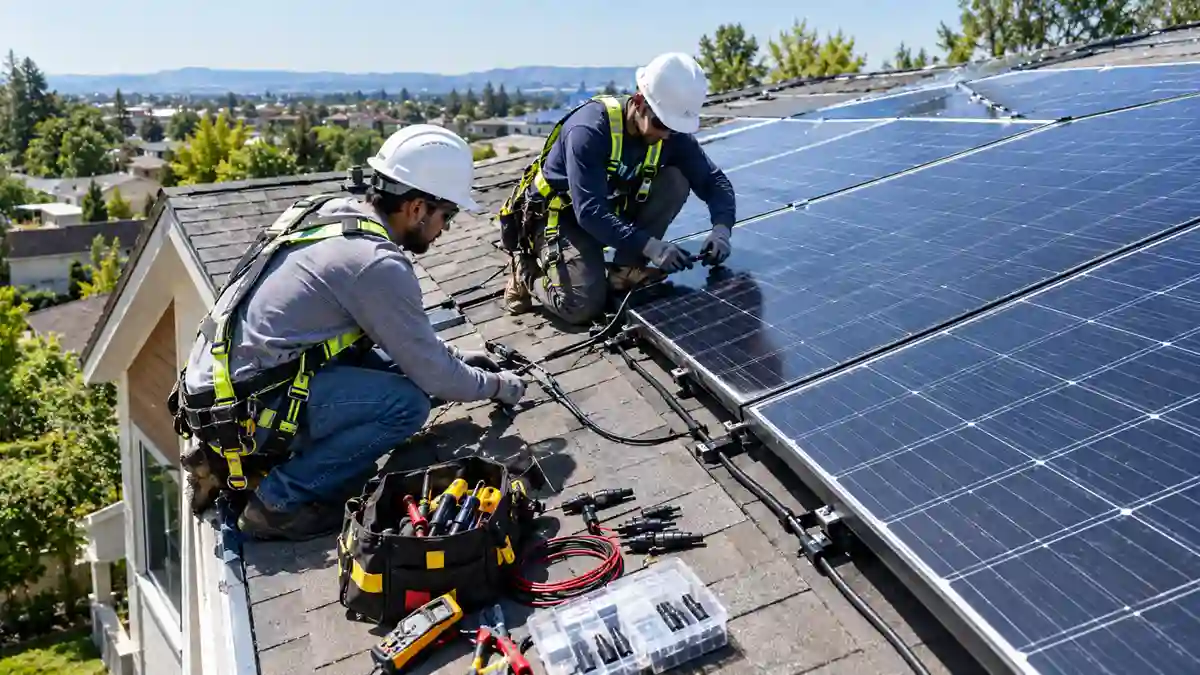
Learn what a solar array is, how panels are connected, how to calculate array size, what affects installation costs, and how to improve solar energy production.
When planning a solar installation, one of the first terms you will encounter is solar array. The term sounds straightforward, but understanding what an array actually includes can help you make better decisions about system size, inverter selection, roof space, and installation costs.
In my work across solar engineering, system design, and installation-related projects, I have learned that choosing the right number of panels is only one part of a successful installation. The panels must also work within the electrical limits of the inverter, fit the available space, and deliver the energy the property needs.
A properly designed solar panel array brings these factors together. This guide explains how solar arrays work, how to calculate their capacity, how panels are connected, and what to consider before installing one.
What Is a Solar Array?
A solar array is a group of solar photovoltaic (PV) modules arranged and electrically connected to generate electricity as part of a solar power system. The modules may be connected in series, parallel, or a combination of both, depending on the system design.
A single solar panel is one module. When multiple modules are installed and connected to operate together, they form an array.
The term is sometimes used differently across the solar industry. In this guide, solar array refers primarily to the interconnected PV modules, rather than the entire installation.
Solar Panel vs. Solar Array vs. Solar System
These terms are related, but they do not mean exactly the same thing.
| Term | Meaning |
|---|---|
| Solar panel | An individual PV module that converts sunlight into electricity |
| Solar array | A group of PV modules arranged and connected to generate electricity |
| Solar power system | The complete installation, including the array, inverter, wiring, mounting equipment, and other required components |
| Solar battery storage | Equipment that stores electrical energy for later use, where included in the system |
For example, a home may have 18 solar panels connected to an inverter. The 18 modules form the solar array, while the complete installation includes the inverter, mounting structure, electrical protection, wiring, and any additional equipment.
The panel technology selected for the array also matters. Read our guide to types of solar panels to understand the differences between conventional monocrystalline modules and newer cell technologies.
How Does a Solar Array Work?
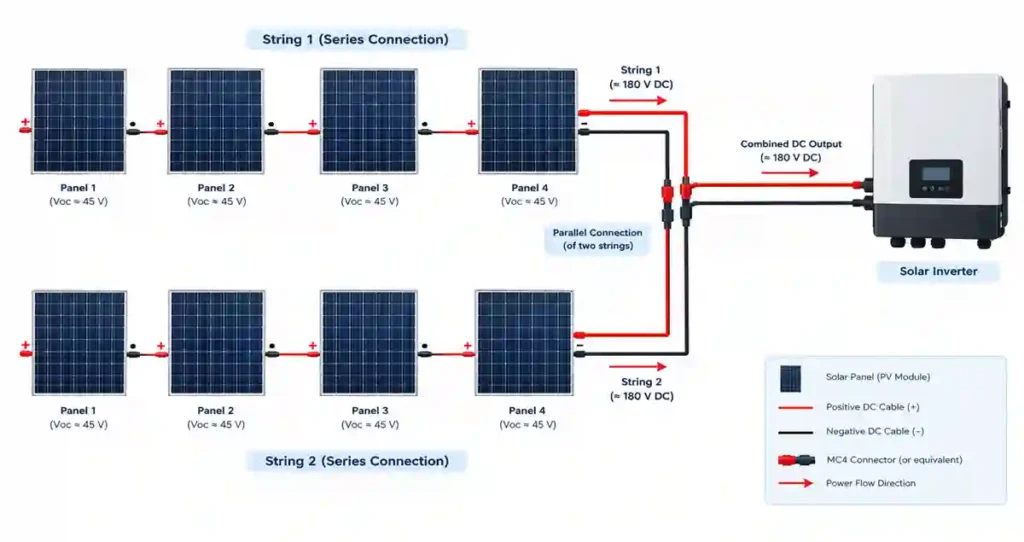
A solar array generates electricity through the photovoltaic effect. When sunlight reaches the semiconductor material inside a solar cell, it helps generate an electrical current.
Individual cells are connected inside each module to produce useful electrical output. Multiple modules then work together to provide the voltage and current required by the system.
In a typical grid-connected installation, the process works as follows:
- Sunlight reaches the panels. The PV cells generate direct current (DC) electricity.
- The modules supply DC power. Their electrical connections determine the array’s operating voltage and current.
- The inverter converts the electricity. It converts DC power into alternating current (AC) for compatible building loads and, where permitted, the utility grid.
- The electricity serves the property’s demand. Solar generation may supply appliances and other loads, with any surplus handled according to the system configuration and applicable utility rules.
- Optional battery storage stores energy. A compatible battery system can store some available energy for later use, subject to its charging capacity, usable capacity, and operating configuration.
The amount of electricity generated changes throughout the day. Solar irradiance, panel temperature, shading, orientation, inverter operation, and other conditions affect actual output.
For a more detailed explanation of photovoltaic electricity generation, read our guide to how a solar panel works.
How Are Solar Panels Connected in an Array?
The electrical connection between modules is one of the most important parts of array design. It determines the voltage and current presented to the inverter or other connected equipment.
Solar modules are commonly connected in series, parallel, or series-parallel configurations.
1. Series Connection
In a series connection, the positive terminal of one module connects to the negative terminal of the next. The connected modules form a string.
The voltages add together, while the string current is approximately the same as the current through each module under matching operating conditions.
For example, assume a solar module has these illustrative electrical ratings:
- Maximum power voltage (Vmp): 40 V
- Maximum power current (Imp): 10 A
- Rated power: 400 W
Connecting 10 identical modules in series gives the following nominal values at their maximum power point:
- String voltage: 10 × 40 V = 400 V
- String current: approximately 10 A
- Array power: 10 × 400 W = 4,000 W, or 4 kW
These are illustrative values under the stated operating assumptions, not a final design specification.
2. Parallel Connection
In a parallel connection, compatible strings are connected positive-to-positive and negative-to-negative.
The voltage remains approximately the same across the parallel branches, while their currents add together.
Using the example above, two identical 10-module strings connected in parallel would have nominal values of:
- Operating voltage: approximately 400 V
- Combined current: approximately 20 A
- Total rated DC power: 8 kW
Actual operating values depend on irradiance, temperature, module characteristics, and system conditions.
3. Series-Parallel Configuration
Larger arrays commonly use several series-connected strings connected in parallel. This arrangement allows the designer to reach the required system voltage and current while accommodating the available modules and inverter inputs.
However, the number of modules per string cannot be selected from power ratings alone.
A proper design must check the module’s open-circuit voltage (Voc), maximum power voltage (Vmp), short-circuit current (Isc), and maximum power current (Imp) against the inverter’s operating limits.
Cold temperatures can increase a module’s open-circuit voltage. At the other end of the operating range, high module temperatures can reduce operating voltage. The design must account for these conditions as well as inverter input-current limits, MPPT operating ranges, and the applicable electrical code.
For more information, see our solar inverter selection guide.
How to Calculate Solar Array Size
Solar array capacity is usually expressed in kilowatts (kW) or watts (W). The calculation is straightforward when the number of panels and their rated output are known.
Formula:
Solar array capacity (kW) = Number of panels × Panel wattage (W) ÷ 1,000
Example: Calculating a 7.2 kW Solar Array
Suppose a property owner is considering 18 solar panels rated at 400 W each.
The calculation is:
18 × 400 W = 7,200 W
7,200 W ÷ 1,000 = 7.2 kW
The resulting array has a rated DC capacity of 7.2 kW under standard test conditions.
This figure does not mean the array will continuously deliver 7.2 kW in the field. Actual output varies with sunlight, temperature, shading, and electrical losses.
If the panels are rated at 500 W instead, the same number of modules would produce a rated array capacity of 9 kW.
This is why panel count alone does not tell you the size of a solar installation. Panel wattage must also be considered.
How Much Electricity Can a Solar Array Produce?
Installed capacity and energy production are different measurements.
- Kilowatts (kW) describe power at a particular moment.
- Kilowatt-hours (kWh) measure the amount of energy generated or consumed over time.
A simplified estimate of daily energy production is:
Daily energy (kWh) = Array capacity (kW) × Equivalent peak sun hours × Performance ratio
For example, assume a 7.2 kW array receives an average of five equivalent peak sun hours per day and has an assumed performance ratio of 0.80.
7.2 × 5 × 0.80 = 28.8 kWh per day
This is an illustrative estimate, not a production guarantee. Actual daily and annual generation depends on local solar resources, seasonal variation, shading, module temperature, inverter efficiency, soiling, downtime, and other losses.
For a preliminary sizing calculation, try our solar panel size calculator. For electrical demand and inverter compatibility, see our inverter size calculator.
How Many Solar Panels Does a Home Need?
There is no single panel count that suits every home. The appropriate array size depends on electricity consumption, the amount of energy the owner wants solar to supply, local solar conditions, available roof space, and the system’s electrical design.
A practical starting point is to review electricity bills and determine average daily or monthly consumption. The next step is to estimate the required solar generation using an appropriate local energy-yield assumption.
For example, a homeowner targeting an 8 kW array could use:
- 20 panels rated at 400 W each; or
- 16 panels rated at 500 W each.
Both configurations have a nominal capacity of 8 kW, but they do not necessarily occupy the same roof area. Module dimensions, access routes, roof obstructions, spacing, and mounting arrangements all influence the final layout.
The design should also account for the inverter’s DC input limits and whether the property needs battery backup or future expansion.
For a broader overview of system configurations, costs, and return on investment, see our solar power system types, cost, and ROI guide.
Solar Array Layout: Roof-Mounted vs. Ground-Mounted
The physical location of an array affects its orientation, tilt, accessibility, installation cost, and energy production.
Roof-Mounted Solar Arrays
Roof-mounted arrays are common in residential and commercial installations because they use existing building space.
Before installation, the designer should consider:
- Available roof area and structural condition
- Roof orientation and slope
- Shading from trees, chimneys, nearby buildings, and other obstructions
- Waterproofing and mounting attachment details
- Maintenance access and safe working clearances
- Cable routing and inverter location
An apparently large roof may not provide enough usable area for the proposed capacity once obstructions, access requirements, and setbacks are considered.
Ground-Mounted Solar Arrays
Ground-mounted arrays are installed on structures anchored to the ground. They may be suitable for properties with available land, commercial facilities, agricultural sites, and larger solar projects.
Ground mounting can provide more freedom to select module orientation and tilt. It can also make maintenance access easier, depending on the layout.
However, the design must account for land availability, soil conditions, foundations, wind loading, cable routes, drainage, security, and the cost of the supporting structure.
Ground-mounted systems do not automatically produce more electricity than roof-mounted systems. Performance depends on the design and site conditions.
For a more detailed comparison, read our ground-mount vs. roof-mount solar guide.
Solar Array Orientation, Tilt, and Shading
An array’s layout influences how much sunlight its modules receive and how efficiently they operate.
Orientation and Tilt
The preferred orientation and tilt depend on the site’s latitude, roof geometry, local weather patterns, shading, and the timing of electricity demand.
For example, a roof that faces different directions may require separate strings or MPPT inputs to accommodate different operating conditions. The best configuration is not always the one that maximizes theoretical midday output; the property’s energy-use pattern may also matter.
Shading
Shading can reduce solar output when trees, buildings, chimneys, or other obstructions block sunlight. The effect depends on the shading pattern, module construction, string arrangement, bypass-diode operation, and the inverter or module-level electronics being used.
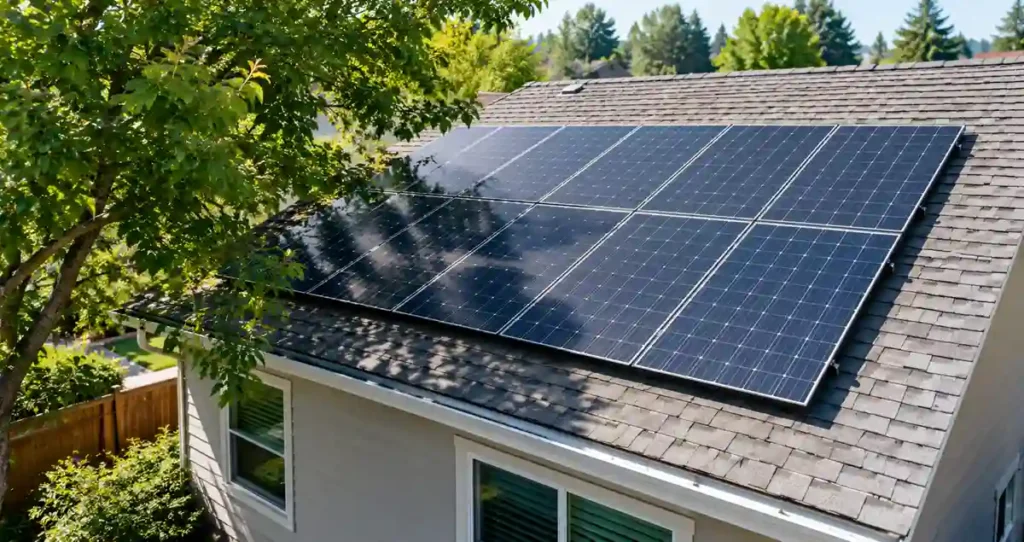
During site assessment, the designer should identify shading throughout relevant times of day and seasons rather than checking only the roof’s appearance at noon.
Inverter Options for Different Layouts
String inverters, microinverters, and power optimizers can suit different array layouts.
A conventional string inverter may be appropriate where modules have reasonably similar orientations and shading conditions. Module-level electronics may provide additional flexibility when modules experience different shading or orientation conditions, but they also introduce equipment costs and other design considerations.
No inverter configuration is automatically best for every property.
Our solar microinverter guide and string inverter guide explain these approaches in greater detail.
Solar Array Cost: What Determines the Price?
The cost of a solar array depends on its rated capacity, module selection, mounting arrangement, electrical design, installation location, labor, and local requirements.
It is important to distinguish the cost of the PV modules from the cost of a complete installed solar power system.
A complete installation may include:
- Solar modules
- Inverter or inverters
- Mounting structure and attachment hardware
- DC and AC cables and connectors
- Electrical protection and isolation equipment
- Monitoring equipment
- Installation labor
- Permits, inspections, and utility-related work where applicable
Battery storage adds further costs, including batteries, compatible power-conversion equipment where required, protection, and installation.
Why Two Arrays of the Same Size Can Cost Different Amounts
Two 8 kW arrays can have different installed prices even if their nominal capacities are identical.
One may use a straightforward roof layout with short cable runs. Another may require specialized mounting, additional electrical work, longer cable routes, structural improvements, or equipment to accommodate multiple roof orientations.
The panel price alone therefore does not provide a complete basis for comparing quotations.
When reviewing an estimate, check the equipment specifications, inverter capacity, mounting scope, protection devices, installation inclusions, warranties, and any exclusions. Also compare the expected annual energy production and the assumptions used to calculate it.
Because installation prices vary substantially by country, region, system type, and date, use a market-specific cost estimate rather than applying a universal price per kilowatt.
For a more detailed breakdown, read our solar panel installation cost guide and our commercial solar installation cost guide.
Can You Add More Panels to an Existing Solar Array?
Adding panels may be possible, but it should not be treated as a simple matter of connecting additional modules to the existing wiring.
Before expanding an array, the installer or designer should review:
- The inverter’s maximum permitted DC input power
- The maximum input voltage and current
- MPPT voltage ranges and available inputs
- Existing string configuration and module specifications
- Roof space, shading, mounting capacity, and cable routing
- Electrical protection and applicable regulations
Adding modules with different electrical characteristics to an existing string may create performance or compatibility issues. The correct solution depends on the equipment and proposed configuration.
If the expansion includes battery storage, the assessment must also cover inverter compatibility, battery voltage, charging and discharging power, usable energy capacity, and the intended backup loads.
A battery’s energy capacity, measured in kWh, is different from its power rating, measured in kW. A system designed to supply a few essential circuits during an outage may require a different configuration from one intended to support most of a property’s loads.
Our solar battery installation guide and solar battery size calculator can help with the next stage of planning.
Residential vs. Commercial Solar Arrays
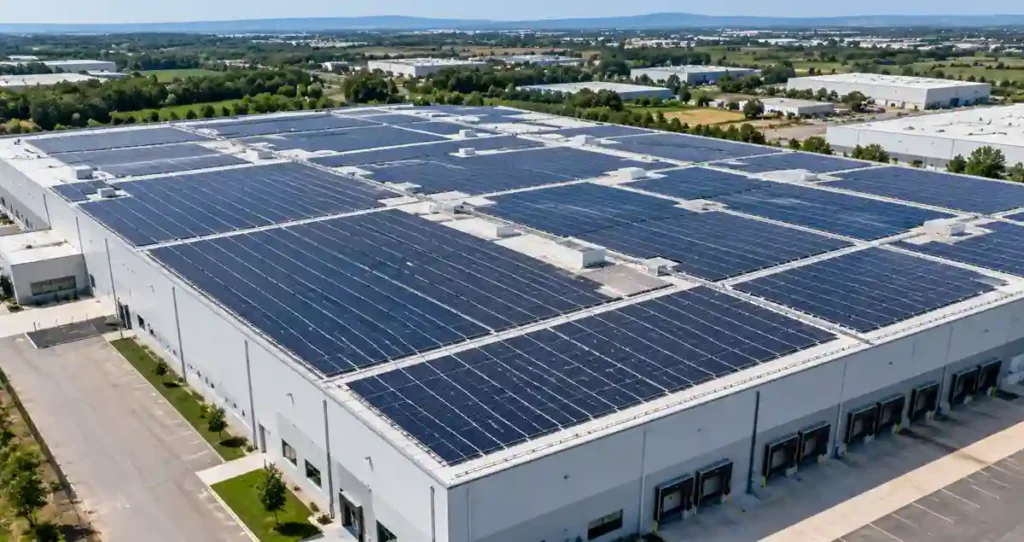
Residential and commercial arrays use the same basic photovoltaic principles, but their scale, electrical arrangements, mounting requirements, and project constraints can differ significantly.
| Design factor | Residential array | Commercial array |
|---|---|---|
| Typical application | Homes and small properties | Offices, warehouses, factories, and other commercial facilities |
| Capacity | Often several kW to tens of kW | Can range from tens of kW to several MW |
| Mounting | Commonly rooftop | Rooftop, ground-mounted, or solar carport |
| Inverter arrangement | Often one inverter or a small number of units | May use multiple string inverters or other suitable configurations |
| Electrical design | Based on household loads and supply arrangements | May involve three-phase systems, larger distribution equipment, and load studies |
| Site assessment | Roof condition, shading, household demand | Structural capacity, energy demand profile, interconnection, protection, and operational constraints |
These are broad comparisons, not fixed limits. Residential projects can be larger, and commercial installations can be relatively small.
For larger projects, array design should be coordinated with the site’s electrical infrastructure, operating schedule, structural requirements, and utility interconnection conditions.
Read our commercial solar panel installation guide for further information.
An Engineer’s Perspective: What I Consider When Assessing a Solar Array
In my work in solar engineering, I have seen why a successful solar installation requires more than selecting a panel wattage and multiplying it by the number of modules.
The first question I consider is what the system is expected to achieve. A homeowner looking to reduce daytime electricity purchases may need a different configuration from a facility that operates heavy equipment during the day or requires backup power during outages.
I then consider the available installation area, the orientation and condition of the roof or mounting location, and any potential shading. These details influence how many modules can realistically be installed and how they should be arranged.
The electrical design is equally important. The selected inverter must be compatible with the proposed array, including its operating voltage, current, and string configuration. The design must also account for environmental conditions and the equipment manufacturer’s limits.
Finally, I look beyond the initial rated capacity. Expected energy production, installation requirements, maintenance access, future expansion, and the owner’s actual energy needs all influence whether a proposed system is a practical solution.
My main takeaway is that a larger array is not automatically a better array. A well-designed system is one that uses the available space effectively, operates within the equipment’s limits, and meets the property’s energy requirements.
Frequently Asked Questions About Solar Arrays
What is a solar array?
A solar array is a group of photovoltaic modules arranged and electrically connected to generate electricity. It forms the panel-generating portion of a solar power system.
How many panels are in a solar array?
There is no fixed number. An array may contain just a few modules or thousands, depending on its application and required capacity. The number of panels and their individual wattage together determine the rated DC capacity.
How many panels are needed for a 10 kW solar array?
The panel count depends on module wattage. For example, 25 panels rated at 400 W each provide 10 kW of rated DC capacity. Twenty panels rated at 500 W each also provide 10 kW.
What is the difference between a solar array and a solar farm?
A solar array is a group of interconnected PV modules. A solar farm is a larger solar electricity-generation facility that contains arrays along with supporting electrical, structural, and site infrastructure.
Does a solar array work on cloudy days?
Yes. Solar modules can generate electricity from diffuse sunlight, although their output is generally lower than under strong direct sunlight. The actual reduction depends on cloud conditions, solar irradiance, and system characteristics.
Can a solar array work without an inverter?
PV modules generate DC electricity, so an inverter is not necessary for every possible DC application. However, an inverter is generally required when a conventional solar installation must supply AC building loads or connect to the AC utility grid.
Does a solar array need a battery?
No. A grid-connected solar system can operate without battery storage. A battery may be useful when the owner wants to store energy for later use or provide backup during outages, provided the system is designed for that purpose.
How much roof space does a solar array need?
The required area depends on the number and physical dimensions of the modules, their arrangement, roof geometry, access requirements, and local rules. A preliminary estimate should use the actual module dimensions and usable roof area rather than panel count alone.
What is the difference between solar array capacity and energy production?
Capacity is normally expressed in kW and describes rated power. Energy production is measured in kWh over a period of time. A 7.2 kW array does not produce 7.2 kWh every hour under all conditions; actual energy depends on sunlight and system performance.
Final Thoughts
A solar array is the foundation of a photovoltaic installation, but its performance depends on much more than the number of panels installed. Panel wattage, electrical configuration, inverter compatibility, mounting, shading, and local solar conditions all influence the final result.
Whether you are planning a residential rooftop system or a larger commercial installation, begin with your energy requirements and site conditions. Then select an array configuration that meets those needs while remaining within the electrical and structural limits of the project.
A careful design helps make better use of the available space, supports reliable operation, and provides a more realistic basis for estimating energy production and project costs.
Related Guides
- 24V 200Ah LiFePO4 Battery: Specs, Uses & Buying Guide
- LiFePO4 vs Lithium-Ion: Which Battery Should You Buy?
- LiFePO4 Battery: How It Works, Specs & Buying Guide
- LiFePO4 Batteries for Solar: How to Choose & Size Right
- 48V 200Ah LiFePO4 Battery: Specs, Sizing & Home Storage Guide
- LiFePO4 Battery Charger: Voltage, Amps & Settings
- Solar Panel Repair Guide: Diagnose Problems, Costs & Fixes
- IRS Form 5695 for 2025: Solar Tax Credit Guide
Related guides on SolarVisionAI.com
- Monocrystalline Solar Panels 2026: Still Worth It or Hype
- Polycrystalline Solar Panels: Worth Buying in 2026?
- Thin-film Solar Panels: When They Beat Silicon (2026)
- BIPV Solar Panels: Building-Integrated PV Complete Guide
- Portable Solar Panels: Engineer’s Buyer’s Guide 2026
- CPV Solar Panels: Concentrated Photovoltaic Explained
- Skin Solar Panel: What “Solar Skin” Actually Means
- Solar Fence Post Lights: Cap Sizes, Types & Install Guide
- Bifacial Solar Panels in 2026: How to Boost Energy Output
- Solar Charge Controller: The Complete Guide
- MC4 Connectors: Solar Safety & Installation Guide
- Solar Panel Types, Efficiency & Benefits
- Solar Water Pump Guide
- BESS — Battery Energy Storage System Guide
- Commercial Solar Panel Installation
- Solar Refrigerator & DC Fridge — Complete 2026 Guide
- Bifacial Solar Panel Albedo Effect Guide
- TOPCon: Why TOPCon Solar Panel is a Proven Smart Investment in 2026
- HJT: Why Heterojunction Is the Hot Climate Champion
- PERC: PERC Solar Panel: Still Relevant or Already Outdated?
- Perovskite: Perovskite Solar Panels: The 2026 Reality Check
- N-Type vs P-Type: N-Type vs P-Type Solar Panels: Honest Comparison
- ABC: ABC (all back contact) Solar Panel: Back Contact Technology Explained
- IBC: IBC Solar Panels: Interdigitated Back Contact Guide
- Tandem: Tandem Solar Panels: Are Stacked Cells Ready for Rooftops?