
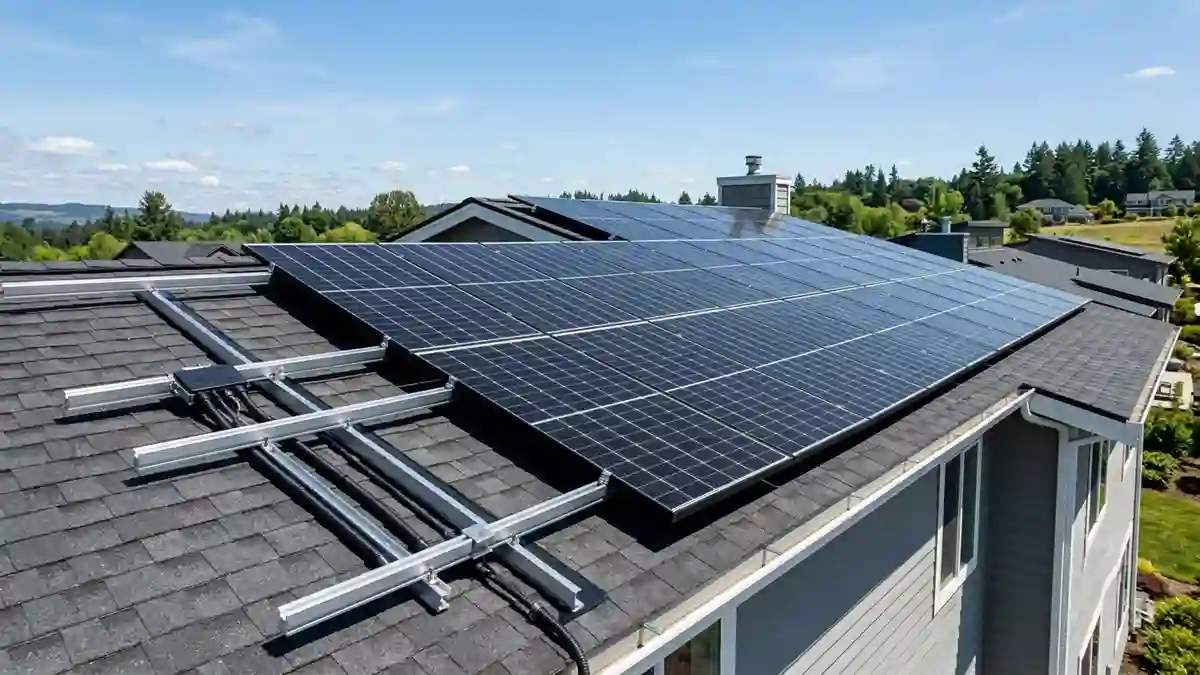
PERC solar panel technology explained — how it works, real efficiency data, and whether it’s still worth choosing over TOPCon in 2026.
PERC was the technology that quietly took over the entire solar industry for the better part of a decade, and most homeowners who bought a panel anytime between 2018 and 2023 own one without realizing it. It’s not a panel type in the way monocrystalline or polycrystalline are — it’s a cell architecture that gets layered onto standard silicon cells, and understanding it clarifies a lot of confusing spec-sheet language you’ll run into while shopping.
This guide is part of our Technology cluster, sitting alongside our coverage of TOPCon, HJT, and the newer cell architectures competing to replace PERC as the industry default.
Quick Facts: PERC Solar Panels
| Feature | Details |
|---|---|
| Technology | Passivated Emitter and Rear Cell (PERC) |
| Typical Efficiency | 20–22% |
| Expected Lifespan | 25–30 Years |
| Annual Degradation | ~0.5% |
| Best For | Residential, Commercial, Utility Projects |
| Primary Advantage | Higher efficiency at a lower manufacturing cost |
| Main Limitation | Gradually being replaced by TOPCon and HJT |
| Typical Warranty | 25-Year Performance Warranty |
How PERC Solar Panels Work: What PERC Actually Changed
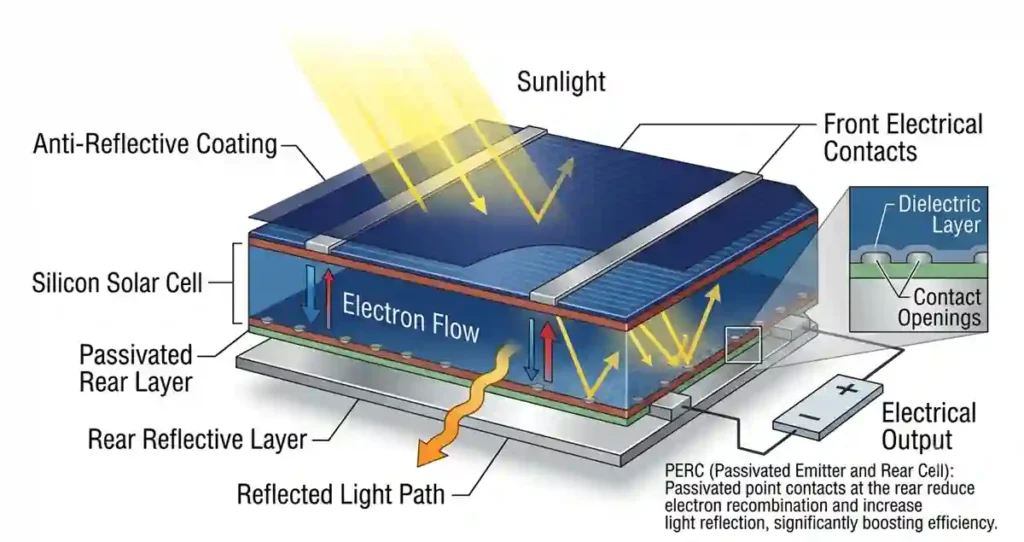
PERC stands for Passivated Emitter and Rear Cell. The innovation is a thin reflective and insulating layer added to the back of a standard silicon cell. That layer does two things: it reflects unabsorbed light back into the cell for a second chance at conversion, and it reduces electron recombination losses at the rear surface. Both effects push efficiency up by roughly 1 percentage point compared to the standard cell architecture that preceded it — which sounds modest until you realize that gain came at very little added manufacturing cost, which is exactly why it became the default so fast.
Engineer’s Note: I get asked constantly whether PERC is a panel type a client should look for on a spec sheet. It isn’t something you choose instead of monocrystalline or polycrystalline — it’s an enhancement layered onto either. When a datasheet says “monocrystalline PERC,” that’s describing the cell architecture on top of the base silicon type, not a separate product category.
Technical Specifications
| Specification | Typical Value | Why It Matters |
|---|---|---|
| Cell Technology | PERC Monocrystalline or Polycrystalline | Improves light absorption |
| Module Efficiency | 20–22% | Higher energy production |
| Temperature Coefficient | ~−0.35%/°C | Better hot-weather performance |
| Annual Degradation | ~0.5% | Long-term energy output |
| Product Warranty | 12–25 Years | Manufacturer confidence |
| Performance Warranty | 25 Years | Long-term reliability |
| Certifications | IEC 61215, IEC 61730 | Safety and durability |
Efficiency and Where PERC Sits Today
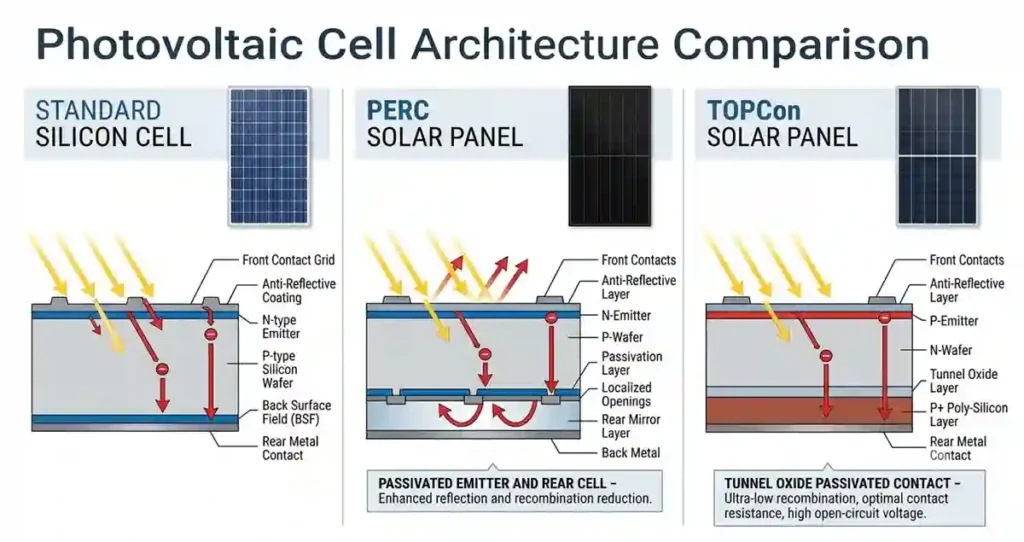
| Metric | PERC | Standard (Non-PERC) Cell | TOPCon (Successor) | Industry Reference |
| Typical efficiency | 20% – 22% | 18% – 20% | 22% – 23.5% | NREL |
| Rear-side light capture | Reflective passivation layer | None | Improved passivation + tunnel oxide | Fraunhofer ISE |
| Manufacturing cost premium | Low — mature process | Baseline | Moderate — newer equipment | IRENA |
| Degradation rate | ~0.5%/year | ~0.6-0.7%/year | ~0.4%/year | Fraunhofer ISE |
Engineering Assessment
| Feature | Rating | Engineering Assessment |
|---|---|---|
| Efficiency | ★★★★☆ | Excellent for mainstream residential systems. |
| Reliability | ★★★★★ | Proven technology with decades of field data. |
| Heat Performance | ★★★★☆ | Performs well but trails newer N-type technologies. |
| Installation | ★★★★★ | Compatible with virtually all mounting systems. |
| Cost | ★★★★★ | Outstanding value for money. |
| Long-Term Value | ★★★★☆ | Still highly competitive despite newer technologies. |
| Overall Recommendation | ★★★★☆ | A dependable choice where roof space is not a limiting factor. |
Advantages and Disadvantages
| Advantages | Disadvantages |
| Mature, well-understood manufacturing process at low cost | Efficiency ceiling lower than TOPCon or HJT |
| Meaningful efficiency gain over older standard cells | Being phased out by manufacturers in favor of newer tech |
| Widely available across almost every manufacturer tier | Slightly more prone to LID (light-induced degradation) |
| Excellent value — often the cheapest per-watt option available | Fewer premium product lines still use it as flagship tech |
Real-World Applications
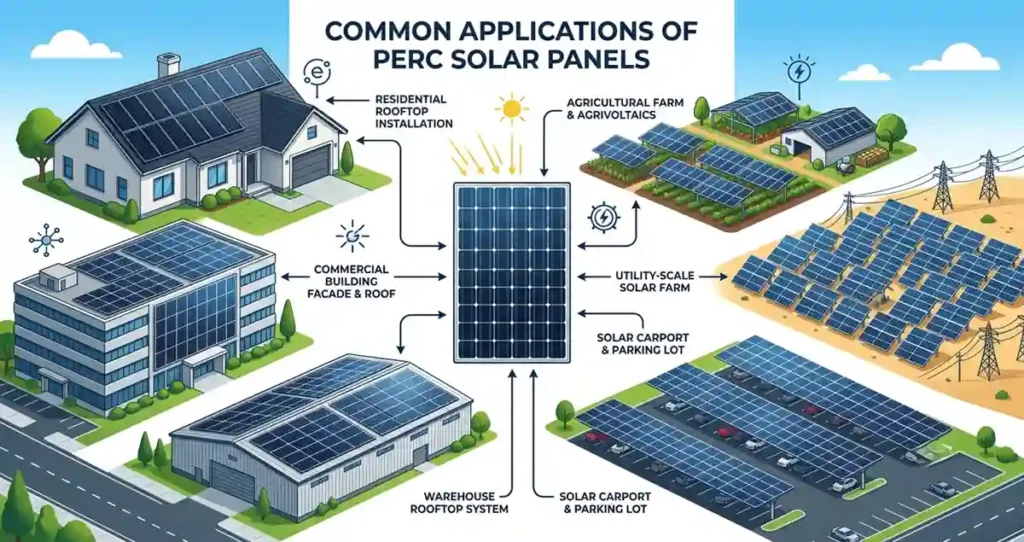
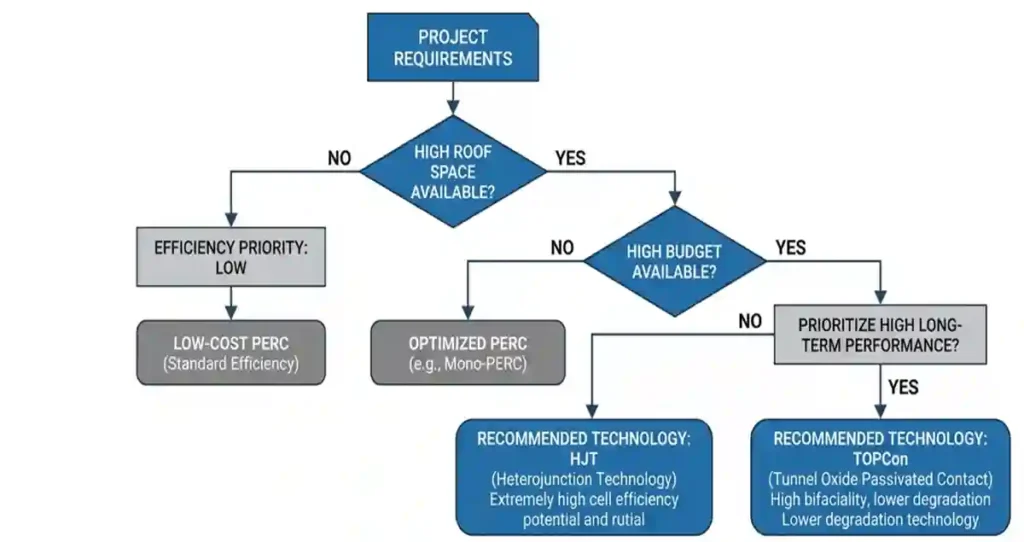
In the US residential market specifically, where sun-belt states often mean generously sized roofs relative to system needs, I still specify PERC panels regularly for clients running tight budgets on straightforward residential jobs where the roof isn’t heavily space-constrained. One recurring project type is exactly this: a client with a completely unshaded, generously sized roof who just wants the lowest cost-per-watt system that still carries a solid manufacturer warranty. PERC hits that brief perfectly — it’s cheap, it’s proven, and the efficiency gap versus TOPCon rarely matters when there’s no space constraint driving the decision.
The other pattern I see constantly, working with clients across very different climates, is that PERC’s rear passivation layer performs consistently regardless of ambient temperature extremes — I’ve specified the same PERC modules for installations in both cold, overcast environments and very hot, high-irradiance ones, and the technology behaves predictably in both. That consistency is part of why it remained the default for so long: it’s not the most efficient option in either extreme, but it’s reliable everywhere.
Field Note: A client once pushed hard for TOPCon panels purely because their installer called it “the newer technology,” without any real analysis of whether the efficiency gain justified the price premium on their specific project. On their roof — large, unshaded, no space constraint — PERC would have delivered the same net system output for meaningfully less money. Newer isn’t automatically better for every project; it depends entirely on whether you’re actually constrained by the thing the newer technology improves.
Where PERC No Longer Makes Sense
If your roof is space-constrained and every watt per square meter matters, TOPCon or HJT solar panels will now deliver better lifetime value, because manufacturing costs for those newer architectures have fallen enough that the price premium per extra watt has become quite reasonable. PERC’s advantage was always “almost as good, meaningfully cheaper” — and as that price gap narrows, the case for choosing it specifically gets weaker every year.
Where PERC Solar Panels Make the Most Sense
After Real-World Applications
| Installation Scenario | Recommendation | Engineering Assessment |
|---|---|---|
| Residential Homes | ★★★★★ | Excellent balance of cost and performance. |
| Commercial Buildings | ★★★★☆ | Ideal where budgets matter. |
| Agricultural Buildings | ★★★★★ | Great value on large roof areas. |
| Utility-Scale Solar Farms | ★★★★☆ | Still viable where cost is prioritized. |
| Space-Constrained Roofs | ★★★☆☆ | TOPCon generally offers better value. |
Common Misconceptions Worth Clearing Up
The most common confusion I run into is treating PERC as competing directly against monocrystalline or polycrystalline, when it’s actually a layer that sits on top of either. You can have monocrystalline PERC or polycrystalline PERC — the cell chemistry question and the PERC-or-not question are answered independently of each other on a real datasheet.
A related point worth clarifying for buyers comparing US quotes: some sales materials use “PERC” as though it were a premium marketing term on its own, when in practice it has been the mainstream standard for years and carries no special premium justification today. If a quote emphasizes PERC as a standout feature without comparing it against current TOPCon pricing, that’s worth double-checking against the broader market before assuming it represents good value.
The second misconception is assuming PERC is obsolete simply because TOPCon is newer. Obsolete would mean it no longer serves any project well — that’s not true yet. It’s aging, and its market share is shrinking, but for cost-driven, space-abundant projects, it remains a completely rational choice in 2026.
Standards & Certifications
| Standard | Why It Matters |
|---|---|
| IEC 61215 | Mechanical durability and long-term performance |
| IEC 61730 | Electrical and fire safety |
| IEC 62804 | Potential Induced Degradation (PID) resistance |
| UL 61730 | North American safety compliance |
| ISO 9001 | Manufacturing quality management |
Buying Checklist
- Confirm whether the panel is monocrystalline PERC or polycrystalline PERC — the datasheet should specify both
- Compare the price-per-watt gap against TOPCon for your specific system size before assuming PERC is automatically cheaper overall
- Check the manufacturer’s stated LID (light-induced degradation) mitigation — this varies between PERC producers
- Verify Tier 1 manufacturer status and UL 1703 certification if installing in the US market, regardless of cell architecture
For the technology that’s steadily replacing PERC as the industry default, see our TOPCon Solar Panels guide.
One last point worth making: in the US market, where residential solar financing often stretches over 15-25 years, the total cost difference between PERC and TOPCon on a typical system usually amounts to a few hundred dollars either way. That’s a meaningful number, but it’s worth weighing against the loan or lease structure your installer is proposing, not just the sticker price of the panels themselves. A slightly more expensive TOPCon system financed over two decades often works out to a negligible monthly difference compared to PERC.
Who Should Buy PERC Solar Panels?
Recommended for:
- Homeowners seeking reliable long-term performance
- Commercial building owners
- Agricultural facilities
- Utility-scale projects focused on value
- Budget-conscious buyers
- Customers are replacing older solar panel arrays
Who Should Avoid PERC Solar Panels?
Less suitable for:
- Homes with very limited roof space
- Buyers prioritizing maximum efficiency
- Premium residential installations
- Projects targeting the highest energy density
- Customers specifically seeking the latest N-type technologies
Engineering Reality Check
Marketing Claim
“PERC solar panels are outdated.”
Engineering Reality
PERC solar panels are no longer the newest technology, but they remain one of the most reliable and cost-effective photovoltaic solutions available. For projects with sufficient installation space, the efficiency difference between PERC and newer technologies such as TOPCon is often too small to justify a significantly higher investment.
Frequently Asked Questions
Is PERC better than standard monocrystalline panels?
PERC is an enhancement applied to monocrystalline or polycrystalline cells, not a competing alternative. A monocrystalline PERC panel is simply a monocrystalline panel with roughly 1 percentage point higher efficiency than a non-PERC version of the same cell type.
Is PERC being discontinued?
Not discontinued, but declining in market share as manufacturers shift flagship production toward TOPCon and HJT. PERC remains widely available and is often the most cost-effective option for space-abundant installations.
How much more efficient is PERC than a standard cell?
Roughly 1 percentage point, translating to 20-22% typical efficiency versus 18-20% for older standard cell architectures of the same silicon type.
Is PERC better than standard monocrystalline panels?
PERC is an enhancement applied to monocrystalline or polycrystalline cells, not a competing alternative. A monocrystalline PERC panel is simply a monocrystalline panel with roughly 1 percentage point higher efficiency than a non-PERC version of the same cell type.
Is PERC being discontinued?
Not discontinued, but declining in market share as manufacturers shift flagship production toward TOPCon and HJT. PERC remains widely available and is often the most cost-effective option for installations where roof space is not a limiting factor.
How much more efficient is PERC than a standard cell?
PERC typically improves module efficiency by around one percentage point, with most commercial modules achieving 20–22% efficiency compared to approximately 18–20% for older non-PERC designs.
Are PERC solar panels still worth buying in 2026?
Yes. PERC solar panels remain an excellent choice for homeowners and businesses seeking reliable performance at a competitive price. While TOPCon and HJT offer higher efficiencies, PERC continues to provide outstanding value where installation space is sufficient.
Can PERC solar panels be used with lithium batteries?
Yes. PERC solar panels are fully compatible with lithium battery systems. Battery compatibility depends primarily on the inverter and charge controller rather than the solar cell technology.
Are PERC solar panels compatible with net metering?
Yes. PERC solar panels can be used in grid-connected systems that participate in net metering, provided the inverter and installation comply with local utility and regulatory requirements.
How long do PERC solar panels last?
Most quality PERC solar panels have an expected service life of 25 to 30 years, with annual degradation typically around 0.5%, allowing them to maintain strong energy production throughout their operational lifetime.
Do PERC solar panels perform well in hot climates?
Yes. PERC solar panels perform reliably in warm climates and generally have a temperature coefficient of around −0.35%/°C. Although newer N-type technologies often perform slightly better under extreme heat, PERC remains a dependable choice for most installations.
What certifications should PERC solar panels have?
Look for internationally recognized certifications such as IEC 61215 for durability testing and IEC 61730 for electrical safety. Depending on the market, additional certifications such as UL 61730 or other regional compliance standards may also be required.
References
The takeaway I’d want every reader comparing PERC against newer alternatives to walk away with: PERC earned its decade of dominance honestly, through genuine reliability and cost-effectiveness, and it still earns its place on plenty of well-matched US residential projects today. Respect the technology for what it is rather than dismissing it purely because something newer exists.
How PERC Fits Into a Broader Project Conversation
When I put together competing quotes for a client, PERC almost always appears as the value baseline against which every premium technology gets measured — TOPCon, HJT, IBC all get evaluated in terms of how much extra efficiency they buy over a PERC baseline, and whether that extra efficiency is worth the added cost for that specific project. That framing helps clients make an informed decision rather than assuming that more expensive automatically means better for their situation.
I’ve had projects where a detailed side-by-side comparison led the client back to PERC after initially wanting to jump straight to the newest technology available, simply because the math didn’t support the premium for their specific roof and budget. I’ve had other projects go the opposite direction once the numbers were run properly. The value of doing that comparison honestly, rather than defaulting to whatever’s newest, is exactly why I build these guides the way I do.
Efficiency figures for PERC and comparative cell architectures are drawn from NREL’s Best Research-Cell Efficiency Chart. Manufacturing cost and degradation data reference Fraunhofer ISE’s Photovoltaics Report, and cost-trend context comes from IRENA’s Power Generation Costs data.
Related guides on SolarVisionAI.com
- Monocrystalline Solar Panels 2026: Still Worth It or Hype
- Polycrystalline Solar Panels: Worth Buying in 2026?
- Thin-film Solar Panels: When They Beat Silicon (2026)
- BIPV Solar Panels: Building-Integrated PV Complete Guide
- Portable Solar Panels: Engineer’s Buyer’s Guide 2026
- CPV Solar Panels: Concentrated Photovoltaic Explained
- Skin Solar Panel: What “Solar Skin” Actually Means
- Solar Fence Post Lights: Cap Sizes, Types & Install Guide
- Solar Charge Controller: The Complete Guide
- MC4 Connectors: Solar Safety & Installation Guide
- Solar Panel Types, Efficiency & Benefits
- Solar Water Pump Guide
- Commercial Solar Panel Installation: Engineering Guide
- Solar Fence Post Lights: Cap Sizes, Types & Install Guide
- BESS — Battery Energy Storage System Guide
- Commercial Solar Panel Installation