
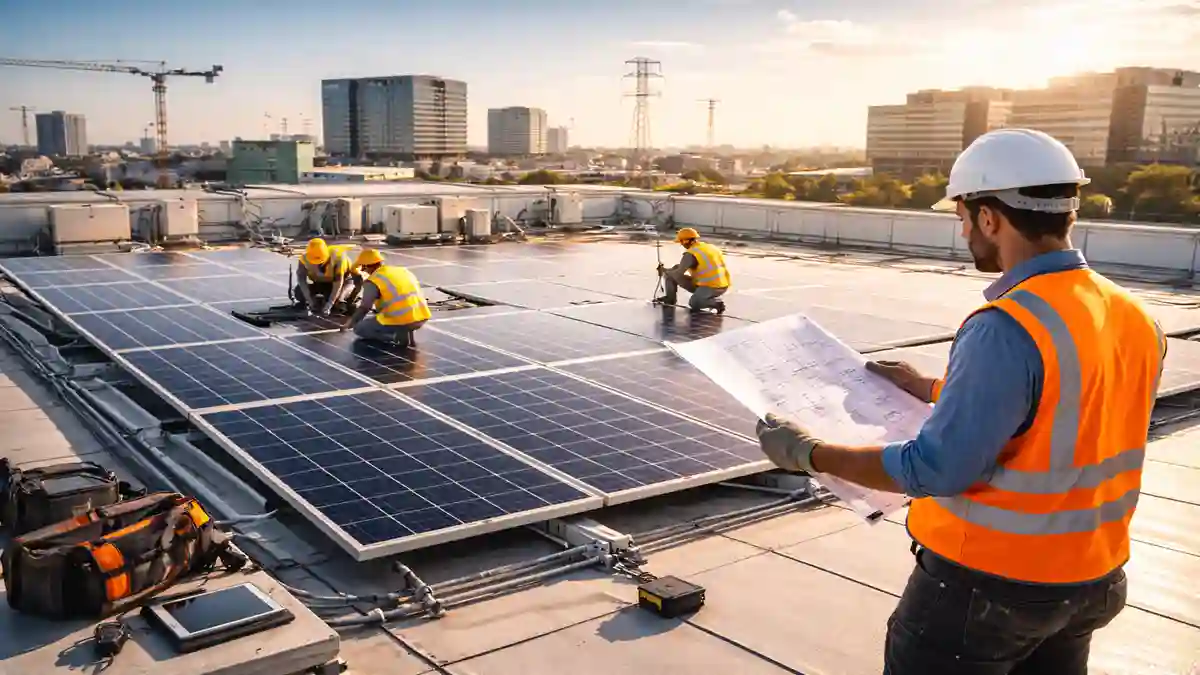
Complete commercial solar panel installation guide for 2026 covering structural design, 3-phase systems, utility interconnection, costs, and ROI. Engineer-written.
Commercial solar is a different discipline from residential solar. Not harder, necessarily — but different in ways that matter enormously to the outcome.
I’ve walked the rooftops of warehouses carrying 40-year-old steel decking, stood in electrical rooms with 2,000A switchgear, and reviewed structural reports that told a building owner his roof couldn’t handle the system he’d already been quoted for. I’ve also seen commercial solar projects done with the kind of engineering rigor that turns a facility’s electricity bill from a liability into a managed, predictable cost for the next 25 years.
The difference between those two outcomes is almost entirely about what happens before installation begins — the structural analysis, the load calculations, the utility interconnection engineering, and the permit documentation. Get those right, and a commercial solar installation is a straightforward engineering project. Skip them, and you are building on a foundation of assumptions that will eventually cost someone real money.
This guide covers the full commercial solar installation process the way it should be approached: as an engineering project with real load calculations, real code references, and real-world cost data. Whether you are a facility manager, a building owner, or a commercial real estate developer, this is what you need to know before you sign a contract.
1. Commercial Solar Panel Installation vs. Residential Solar: The Engineering Differences That Actually Matter
The fundamental physics is the same — photovoltaic cells convert sunlight to DC electricity, an inverter converts it to AC, and the grid interconnects it. But the engineering scope of a commercial installation differs from residential in six fundamental ways that affect every decision in the project.
| Engineering Factor | Residential (3–15 kW) | Commercial (25 kW–5 MW+) | Why It Matters |
| System voltage | 240V AC single-phase | 208–480V AC three-phase | 3-phase requires different inverters, wiring, and protection devices |
| Structural loading | 2.5–4 lbs/sq ft added dead load | 3–6 lbs/sq ft; ballasted systems up to 10 lbs/sq ft | Commercial roofs often have less structural margin than assumed |
| Inverter architecture | Single string or micro | Central, string, or distributed utility-scale | Inverter selection affects SCADA integration, protection relay coordination |
| Utility interconnection | NEC 705 residential process | IEEE 1547-2018 + utility-specific IAS | Commercial requires protection relay settings, anti-islanding testing |
| Permit authority | Local AHJ building dept. | AHJ + utility + sometimes state PUC | Multiple approval bodies; longer timelines; engineering sign-off required |
| Fire code | IFC 605.11 residential setbacks | IFC 605.11 + NFPA 1 Section 6.30 + local amendments | Access pathway requirements more complex on large flat commercial roofs |
| Metering | Single revenue-grade meter | Revenue-grade meter + CT metering + demand metering | Commercial utility tariffs have demand charges that affect ROI significantly |
The single most consequential difference for project economics is the last one: demand charges. Most commercial utility tariffs include a demand charge — a fee based on your highest 15-minute power draw in a billing period — that can account for 30 to 50% of a commercial electricity bill. A solar power system that reduces energy consumption does not automatically reduce demand charges unless it is paired with a battery or sophisticated load management. This is why commercial solar ROI calculations require a full analysis of utility bills, not just a kilowatt-hour offset calculation.
Engineer’s Note: Always request 12 months of utility bills — not just one — before finalizing a commercial solar design. Demand charge patterns vary seasonally. A system designed only on average kWh consumption will consistently underperform its financial projections if the demand charge component is not addressed.
2. Roof Load Assessment for Buildings Commercial Solar Panel Installation
This is the step where more commercial solar projects fail than any other. And by fail, I do not mean they fall off the roof — I mean they get designed, quoted, partially installed, and then halted when a structural engineer flags a load problem that should have been identified in week one.
Every commercial solar installation on a roof requires a structural analysis. Full stop. The International Building Code (IBC) Section 1607 governs live and dead load requirements, and adding solar panels creates a new permanent dead load on a structure that was designed without it. The question is never whether to do the structural analysis — the question is whether to do it before or after you’ve signed a contract and started procurement.
What the Structural Assessment Covers
- Existing roof dead load capacity — what the structure was designed to carry
- Current actual dead load — roofing membrane layers, HVAC equipment, existing penetrations
- Available reserve capacity for solar dead load addition
- Rafter or steel deck span and condition — particularly critical in buildings over 20 years old
- Point load capacity at proposed mounting locations
- Wind uplift calculations per ASCE 7-22 for the specific geographic location
- Snow load considerations in applicable climate zones (ASCE 7-22 Chapter 7)
Load Values by Mounting System Type
| Mounting System | Typical Added Dead Load | Roof Type Compatibility | Structural Risk Level |
| Penetrating rail system (attached to structure) | 2.5–4.0 lbs/sq ft | TPO, EPDM, metal standing seam, built-up | Low — load distributed through structural members |
| Ballasted flat-roof system (non-penetrating) | 5.0–10.0 lbs/sq ft | Flat/low-slope TPO, EPDM, modified bitumen | High — requires careful structural analysis; common failure point |
| Standing seam metal roof clamps (non-penetrating) | 2.5–3.5 lbs/sq ft | Standing seam metal only | Low — clamp-on, no roof penetrations |
| Ground-mounted (on-site, separate foundation) | N/A to roof | N/A | Zero roof risk — separate foundation engineering required |
Field Note: I have reviewed commercial proposals where a ballasted system was specified on a 1960s-era flat roof. The structural report came back showing the roof could handle 4.2 lbs/sq ft of additional dead load. The ballasted system required 8.8 lbs/sq ft. The commercial solar installer had to completely redesign to a penetrating system with a lower module count, after four weeks of procurement delay, and the client had already budgeted for the original system size. Structural analysis in week one costs $1,500 to $4,000. Structural redesign in week six costs that, plus schedule delay, plus relationship damage.
Roof Membrane Compatibility
Beyond structural capacity, the existing roof membrane condition is a critical project risk on commercial installations. Installing a solar system on a membrane that needs replacement in 3 to 5 years means pulling the entire array off the roof for reroof work — a cost of $15,000 to $60,000 depending on system size, and an operational disruption that eliminates years of energy savings.
A pre-installation roof condition assessment should include membrane age and condition, remaining useful life estimate, existing leak history, and drainage pattern analysis to ensure solar mounting does not create ponding. This is typically performed by a licensed roofing consultant, not the solar installer — make sure the scopes are clearly separated.
3. System Sizing for Commercial Energy Needs
Commercial system sizing starts with a utility bill analysis, not a roof measurement. The roof constrains what you can fit; the energy load and tariff structure determine what you should fit.
Step 1: Full Utility Bill Analysis
Twelve months of commercial utility bills reveal four numbers critical to the system design:
- Total annual kWh consumption: Determines the raw generation target
- Monthly consumption pattern: Seasonal variation affects string configuration and tilt optimization
- Peak demand (kW): The 15-minute peak that drives demand charges — solar alone rarely reduces this
- Tariff structure: Time-of-use rates, demand charge tiers, net metering compensation rate — all affect ROI calculation
Step 2: System Size Determination
| Commercial Facility Type | Typical Annual Consumption | Recommended System Range | Notes |
| Small office (5,000–15,000 sq ft) | 40,000–120,000 kWh/yr | 25–75 kW | Good solar candidate; often grid-tied only |
| Retail/strip mall unit | 60,000–200,000 kWh/yr | 40–120 kW | HVAC dominant load; summer peak alignment is favorable |
| Warehouse/distribution center | 150,000–600,000 kWh/yr | 100–500 kW | Large flat roofs; excellent solar candidate; low W/sq ft load |
| Manufacturing facility | 500,000 kWh–5 MWh+/yr | 300 kW–3 MW | Demand charge reduction is critical; it often warrants battery pairing |
| School/university building | 100,000–800,000 kWh/yr | 75–500 kW | Excellent summer production alignment with the academic calendar |
| Hospital/healthcare facility | 1 MWh–10 MWh+/yr | 500 kW–5 MW | Critical load, backup, and redundancy requirements are complex |
| Hotel/hospitality | 300,000 kWh–2 MWh/yr | 200 kW–1.5 MW | High hot water load; solar thermal pairing is often considered |
Step 3: The Commercial Solar Panel Installation Offset Decision
Unlike residential solar — where 100% offset is often the goal — commercial solar design involves a deliberate offset percentage decision. Going beyond 80 to 90% solar offset on a commercial facility often produces diminishing financial returns because excess generation under most commercial net metering agreements is compensated at avoided cost rates (typically $0.03 to $0.06/kWh) rather than retail rates ($0.10 to $0.20/kWh).
The financially optimal commercial solar system is almost always sized to offset 70 to 90% of on-site consumption, with system size constrained by roof area, available capacity, and the net metering export compensation structure in that utility territory.
Engineer’s Note: The one exception to the 70–90% rule: if your utility has a favorable Value of Solar Tariff (VOST) or a Community Solar program with retail-equivalent export compensation, 100% offset or even slight oversizing can make financial sense. Always verify your specific utility’s net metering compensation rate before finalizing system size.
4. Three-Phase Electrical Connection Requirements
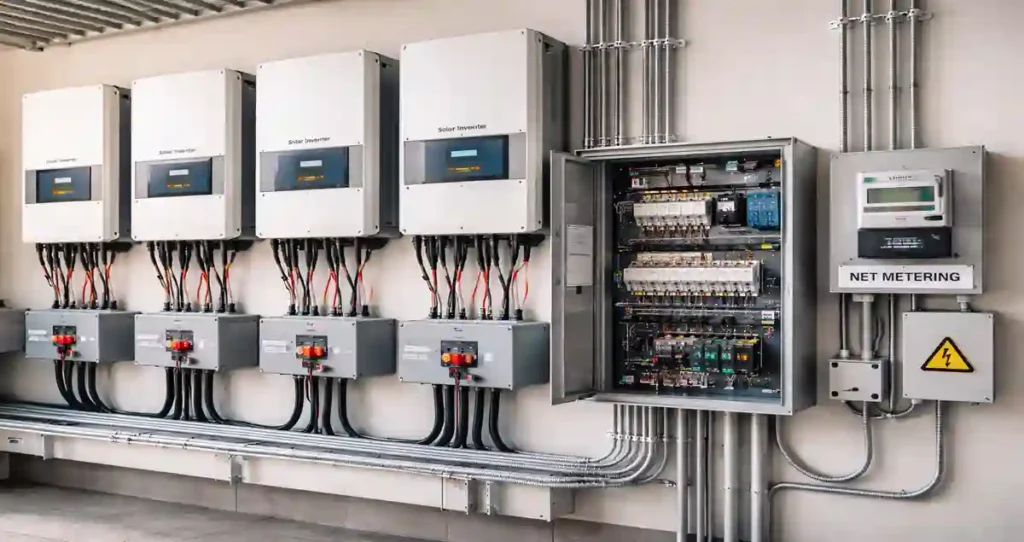
This is where commercial solar engineering separates most clearly from residential. A three-phase electrical connection is not simply a bigger version of a single-phase residential connection — it has distinct protection requirements, harmonic considerations, and utility coordination obligations governed by IEEE 1547-2018 and your utility’s specific Interconnection Application Standards (IAS).
Three-Phase System Fundamentals
Commercial facilities in the US are served at either 208V three-phase (wye configuration, common in smaller commercial buildings) or 480V three-phase (delta or wye, common in industrial and larger commercial facilities). The solar system’s inverter must match the service voltage. Most commercial solar inverters are available in both 208V and 480V configurations, with 480V preferred above 100 kW for efficiency and reduced conductor sizing.
| Parameter | 208V Three-Phase | 480V Three-Phase | Engineering Implication |
| Service type | Wye (Y), 4-wire + ground | Delta or Wye, 3 or 4-wire + ground | Must match inverter configuration exactly |
| Conductor sizing | Higher current for the same kW | Lower current — more cost-efficient | 480V preferred above 100 kW for BOS cost savings |
| Inverter options | Limited to above 250 kW | Full range to MW-scale | The system size ceiling is lower at 208V |
| Transformer requirement | Often not required | May require a step-up transformer | Add $8,000–$25,000 to the project cost if needed |
| Protection relay complexity | Moderate | Higher utility often requires directional protection | IEEE 1547-2018 Section 7 compliance required |
Protection and Relay Requirements
IEEE 1547-2018 is the governing standard for interconnection of distributed energy resources — including commercial solar — to the grid. It replaced the previous 2003 version and significantly expanded the requirements for voltage and frequency ride-through, reactive power capability, and communications.
For commercial solar systems above 25 kW, your utility will typically require:
- Anti-islanding protection — verified and documented, not just assumed from inverter spec
- Overvoltage and undervoltage trip settings per IEEE 1547-2018 Table 1
- Over-frequency and under-frequency trip settings per IEEE 1547-2018 Table 2
- Voltage ride-through capability for systems above 500 kW (mandatory) and often required above 200 kW
- Reactive power capability (power factor control) for systems above 500 kW
- Communication interface for systems above 1 MW — SCADA or smart inverter communications protocol
For systems above 500 kW, most US utilities require a Protection and Controls (P&C) study as part of the interconnection application — an engineering study that models your system’s impact on the distribution feeder and specifies required protection relay settings. This study is performed by a licensed PE and takes 4 to 12 weeks, depending on the utility workload.
Service Panel and Main Switchgear Modifications
Unlike residential solar, where a breaker-back-fed connection to the main panel is standard, commercial solar typically connects to the main switchgear bus or a dedicated solar point of interconnection (POI) section. The NEC 705.12 supply-side connection method is more commonly used in commercial applications — connecting upstream of the main overcurrent device rather than back-feeding through a breaker.
A supply-side connection requires a dedicated disconnect switch (NEC 690.13), typically a 600V-class molded case circuit breaker or fused disconnect installed between the inverter and the point of common coupling. This disconnect must be lockable and accessible to utility personnel.
Engineer’s Note: For systems above 100 kW, specify a revenue-grade production meter at the solar POI in addition to the utility’s bidirectional meter at the service entrance. This gives you independent verification of system production and is essential for SREC documentation, PPA performance reporting, or any future system performance disputes.
5. Permits, Utility Coordination, and Commissioning
The permitting and interconnection process for commercial solar is more complex than residential in every dimension — more agencies, more documentation, more engineering sign-off requirements, and significantly longer timelines. Understanding this process in advance is the difference between a project that completes on schedule and one that loses months to administrative back-and-forth.
The Commercial Permitting Stack
| Permit / Approval | Issuing Authority | Documentation Required | Typical Timeline |
| Building permit | Local AHJ (city/county) | Architectural/structural drawings, PE-stamped if required | 2–8 weeks |
| Electrical permit | Local AHJ (electrical division) | Single-line diagram, panel schedules, and NEC compliance documentation | 2–6 weeks |
| Zoning/land use | Local planning dept. | Site plan, setback documentation, height clearances | 2–12 weeks (varies widely) |
| Utility interconnection application (Level 1/2) | Distribution utility | System specs, IEEE 1547 compliance, PE-stamped single-line | 4–16 weeks |
| Utility P&C study (>500 kW) | Utility engineering dept. | System model, inverter specs, protection relay settings | 8–20 weeks |
| State PUC approval (some states, >1 MW) | State Public Utility Commission | Full interconnection study, environmental review | 12–52 weeks |
| Environmental review (ground mount, >1 MW) | State environmental agency | Site assessment, habitat review, stormwater plan | 12–52 weeks (if triggered) |
The critical path for most commercial solar projects is the utility interconnection queue, not the physical installation. In congested utility territories — parts of California, New York, and New England — interconnection queues can add 6 to 18 months to a project timeline even for systems well under 1 MW. Any commercial solar project manager who does not submit the interconnection application on day one of the project is adding preventable schedule risk.
Utility Coordination: What Actually Happens
The utility interconnection process follows a defined sequence under FERC Order 2023 (for systems connecting to transmission) and state-level distribution interconnection tariffs (for most commercial rooftop systems). For distribution-connected systems under 5 MW, the process typically involves:
- Pre-application meeting: Optional but highly recommended for systems above 200 kW. Gives you early visibility on upgrade requirements and queue position.
- Interconnection application submission: Includes system specs, single-line diagram, IEEE 1547 compliance documentation, and application fee ($500 to $5,000 depending on utility and system size).
- Completeness review: Utility confirms the application package is complete. Incomplete applications restart the clock — a common delay source.
- Technical review/feasibility study: Utility evaluates system impact on distribution feeder voltage, fault current levels, and protection coordination.
- Interconnection agreement: Legal agreement specifying operating conditions, metering requirements, and utility rights. Must be executed before energization.
- Permission to Operate (PTO): Final utility authorization to energize the system after construction inspection.
Commercial Commissioning Protocol for Commercial Solar Panel Installation
Commercial commissioning is significantly more involved than residential. A proper commercial commissioning sequence includes:
- Pre-commissioning checklist: torque verification on all electrical connections, insulation resistance testing on DC strings (documented IR test results), continuity testing on AC wiring
- Inverter startup sequence per manufacturer commissioning guide — not improvised
- Protection relay testing: verification of all trip setpoints per IEEE 1547-2018 and utility-specified settings
- Anti-islanding test: formal test per UL 1741 SA or IEEE 1547.1 — documented and submitted to the utility
- Revenue meter accuracy verification: check production meter against reference standard
- SCADA/monitoring system verification: all data points live, alarms functional, historical data logging confirmed
- Thermal imaging of all electrical connections under load — infrared scan of combiner boxes, inverter DC inputs, AC disconnect, and switchgear connection point
- Performance ratio test: compare measured AC output against expected output per irradiance and temperature conditions
- As-built drawing package: final single-line, panel schedules, equipment cutsheets, test reports — delivered to owner and AHJ
Field Note: The thermal imaging step is the one most commonly skipped on commercial installations to save time. I have found hot connections on new commercial installations — not failed connections, but connections with 8 to 12°C temperature rise above ambient that would have developed into arc fault conditions within 2 to 3 years. An infrared camera costs $400 to rent for a day. An arc fault in a roof-mounted combiner box costs orders of magnitude more to remediate, and that is before the insurance and liability implications.
6. Commercial Solar Installation Cost Breakdown
Commercial solar panel installation cost ranges from $1.40 to $3.80/watt, depending on system size, roof conditions, and utility territory. For the complete 2026 breakdown — $/watt by system size, hidden change orders, ITC + MACRS incentive stack, and real ROI scenarios — see the full Commercial Solar Panel Installation Cost guide.”
Frequently Asked Questions
How is commercial solar panel installation different from residential?
Commercial solar differs from residential in six key areas: system voltage (3-phase vs. single-phase), structural loading complexity (commercial roofs often have less margin), inverter architecture (central inverters and string inverters at larger scale), utility interconnection requirements (IEEE 1547-2018 compliance, protection relay coordination), permitting scope (multiple agencies plus utility engineering review), and financial structure (ITC plus MACRS depreciation creates substantially better first-year economics for businesses than for homeowners).
Do I need a structural engineer before installing commercial solar?
Yes, without exception. Every commercial rooftop solar installation requires a structural analysis before design is finalized. Adding solar creates a permanent new dead load on a structure designed without it. Skipping this step is not a shortcut — it is a liability that surfaces either during permitting (the AHJ will require it anyway) or worse, after installation, when a structural problem is discovered.
How long does a commercial solar panel installation take from contract to energization?
For a typical 100 to 500 kW commercial rooftop system, the total timeline from signed contract to Permission to Operate is 4 to 12 months. Physical installation typically takes 2 to 6 weeks. The rest of the timeline is consumed by permitting (4 to 8 weeks), utility interconnection review (6 to 16 weeks), and construction inspection. Projects above 500 kW that trigger a utility P&C study can extend to 12 to 24 months. Submitting the utility interconnection application on day one of the project is the single most impactful schedule action a project manager can take.
What is the ROI for a commercial solar panel installation?
Commercial solar ROI depends heavily on the facility’s electricity tariff structure — particularly whether demand charges are addressed. For a well-designed commercial system in a high-rate state with favorable net metering, combining the 30% ITC and MACRS depreciation, IRRs of 15 to 25% are achievable for profitable businesses. Simple payback periods of 4 to 7 years are common in California, New York, Massachusetts, and New Jersey. Lower electricity rate states typically see 7 to 12-year paybacks.
Does commercial solar reduce demand charges?
Solar alone reduces demand charges only if it consistently covers your peak demand period — which requires your peak to coincide with peak solar production. For facilities whose peak demand occurs in the morning, evening, or during cloudy weather, solar alone will not reduce demand charges. Battery storage paired with intelligent dispatch software is required to reliably reduce demand charges. This is why demand charge reduction cannot be included in a solar-only financial analysis without a careful review of the facility’s 15-minute interval demand data.
What is C-PACE financing for commercial solar?
Commercial Property Assessed Clean Energy (C-PACE) financing allows commercial property owners to finance solar installations through the property tax assessment mechanism. The loan is repaid through property tax payments over 10 to 30 years, is non-recourse to the property owner personally, and transfers with the property at sale. It is available in 29 states plus Washington DC as of 2026. For building owners who want to install solar without deploying capital or taking on personal liability, C-PACE is often the most financially efficient path.
Final Thoughts: Commercial Solar Is an Engineering Project First
The commercial solar installations I have seen perform best over the long term share one characteristic: they were approached as engineering projects from the first conversation, not as sales transactions that engineering was brought into afterward.
That means the structural analysis happens before system design is finalized. The utility interconnection application is submitted before equipment is procured. The P&C study is factored into the project schedule, not treated as a surprise. The commissioning protocol includes protection relay testing and thermal imaging, not just a power-on check. And the financial model accounts for demand charges and the full incentive stack — ITC plus MACRS plus any applicable state programs — not just the 30% tax credit in isolation.
When these things are done right, a commercial solar installation is one of the most defensible capital investments a facility owner can make. Predictable operating cost for 25 years, significant Year 1 tax benefit, and a technology with a 40-year proven track record in commercial applications.
Get the engineering right, and the economics follow.
Related guides on SolarVisionAI.com
Solar Panel Installation: Complete Engineering Guide
Solar Power System : Types, Cost, ROI & AI Optimization
1 thought on “Commercial Solar Panel Installation: Engineering Guide 2026 (Costs, Design & ROI)”