
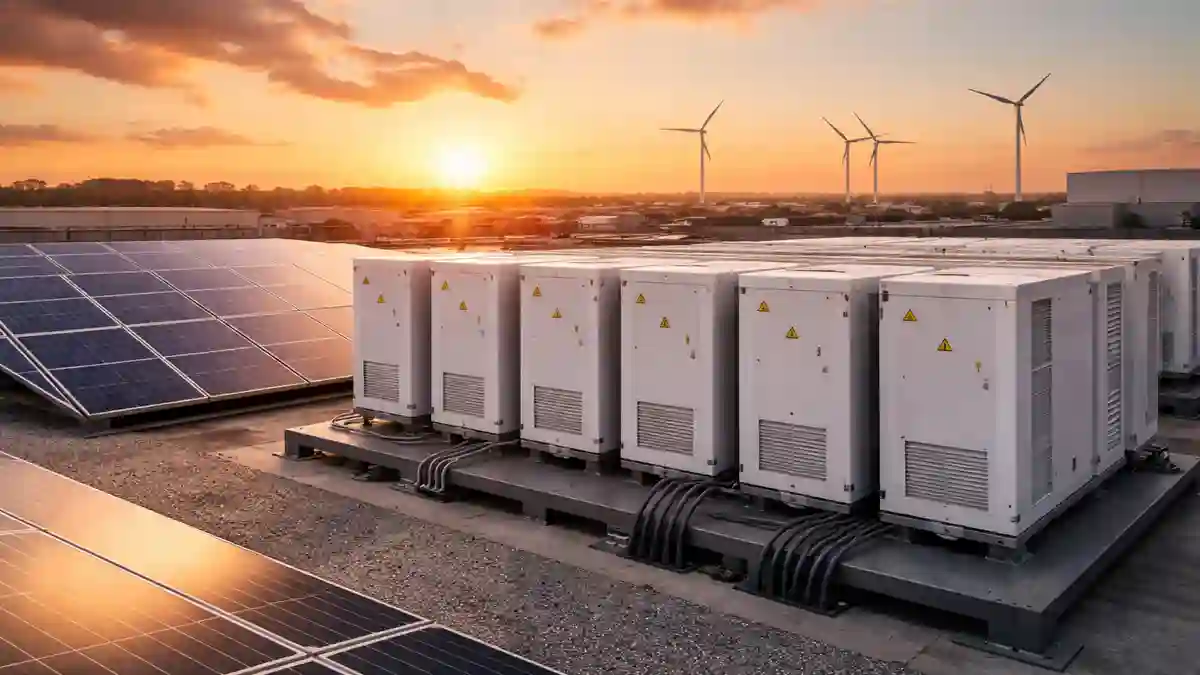
Engineer’s guide to commercial solar battery installation and BESS: demand charge reduction, LFP vs Na-Ion, NFPA 855:2026 HMA requirements, costs, and the full ITC + REAP incentive stack.
A commercial solar system that generates power only when the sun is shining is a good energy asset. A commercial solar system paired with a Battery Energy Storage System (BESS) that dispatches energy when electricity prices peak, absorbs excess generation rather than exporting at avoided-cost rates, and provides backup power during grid outages — that is a different category of asset entirely.
The case for commercial BESS paired with solar has strengthened significantly in the last three years. Battery costs have declined. Utility rate structures have become more complex, with demand charges that solar alone cannot address. Grid reliability has become a genuine business continuity concern in more markets. And the ITC, which covers BESS charged by solar panels, creates a financial structure where storage adds less net cost than its sticker price suggests.
This guide covers the engineering, economics, and installation requirements for commercial solar battery storage systems — what you need, how a BESS integrates with an existing or new solar installation, and where the real financial value is.
1. Why commercial solar battery installation and Solar Are Different Problems
The most common misunderstanding about commercial solar battery storage is that a BESS is simply an extension of the solar system. It is not. Solar generation and BESS dispatch are governed by different physics, different electrical systems, and different business objectives.
Solar generation is an energy resource — it produces kilowatt-hours when irradiance conditions allow. A Battery Energy Storage System is a power and energy management tool — it moves kilowatt-hours in time, from when they are generated to when they are most valuable. Connecting these two capabilities into a coherent commercial solar-plus-storage system requires design decisions that go well beyond ‘add batteries to the solar quote.’
2. The Three Commercial Solar Battery Installation Use Cases — and Which One Is Yours
Use Case 1: Demand Charge Reduction
This is the primary financial driver for commercial BESS installations in most US markets. Commercial utility tariffs include a demand charge — a fee based on your peak 15-minute power draw in a billing period — that typically accounts for 30 to 50% of a commercial electricity bill. Solar alone reduces demand charges only if your peak demand consistently occurs during peak solar production, which is rare for most commercial facility types.
A BESS paired with an intelligent energy management system (EMS) can reliably reduce demand charges by monitoring real-time load, predicting demand peaks, and discharging the battery to suppress the peak before it registers on the utility meter. In high-demand-charge markets, demand charge reduction alone can produce a 3 to 6-year simple payback on the BESS installation.
Engineer’s Note: Demand charge reduction only works if the BESS’s EMS has access to your facility’s real-time load data — typically from a submetering system or smart meter. A battery energy storage system installed without submetering or real-time load monitoring cannot dispatch intelligently for demand reduction. This integration is not optional; it is the entire mechanism of financial value.
Use Case 2: Time-of-Use Arbitrage and Export Optimization
In markets with time-of-use (TOU) electricity rates, commercial BESS can shift solar generation from low-value periods (midday, when solar generation peaks and TOU rates may be low) to high-value periods (late afternoon and evening, when TOU rates peak and solar generation has declined). The financial benefit depends on the spread between on-peak and off-peak TOU rates — larger spreads produce more arbitrage value.
In California’s commercial TOU tariffs, for example, peak rates in summer can reach $0.35 to $0.45/kWh versus off-peak rates of $0.08 to $0.12/kWh. A BESS that captures 200 kWh of midday solar generation and dispatches it during the 4pm to 9pm peak window generates meaningful incremental revenue beyond what a solar-only system would produce.
Use Case 3: Backup Power and Resilience
Commercial BESS sized for backup power serves a different objective than demand management or arbitrage. Backup sizing is driven by critical load requirements — which systems must stay operational during a grid outage and for how long. This use case is financially justified primarily by avoided downtime cost and business continuity value rather than energy savings, and it requires careful design to ensure the BESS can island from the grid and supply critical loads independently.
Backup power adds significant design complexity compared to grid-interactive-only BESS: it requires an automatic transfer switch (ATS) or a static transfer switch (STS), a clearly defined critical load panel separate from non-critical loads, inverter capability for off-grid operation, and coordination with the utility interconnection agreement on islanding conditions.
3. Commercial Solar Battery Installation and BESS Sizing
| Sizing Parameter | For Demand Reduction | For TOU Arbitrage | For Backup Power |
| Energy capacity (kWh) | 1–2× the kW of demand reduction target × demand event duration (typically 30–60 min) | Size to capture excess midday solar generation; typically 50–150% of solar system daily peak excess kWh | Total critical load (kW) × required backup duration (hours) ÷ BESS round-trip efficiency |
| Power rating (kW) | Equal to or greater than demand reduction target — must suppress peak fully | Matched to inverter AC output; typically 25–50% of solar system kW rating | Equal to peak critical load — must supply all critical loads simultaneously |
| Typical commercial range | 250–1,000 kWh; 100–500 kW discharge | 150–500 kWh; 50–200 kW | 100–500 kWh; 50–200 kW (depends on critical loads) |
| Key design constraint | Depth of discharge limit — commercial BESS typically operate between 20–90% SOC | Round-trip efficiency (typically 85–92%) affects arbitrage economics | Cold-start capability and inverter off-grid operating range |
4. Commercial Solar Battery Installation and BESS Technologies
2026 UPDATE: NFPA 855: 2026 Edition now requires a formal Hazard Mitigation Analysis (HMA) for nearly all commercial BESS projects — see Field Note below.
| Technology | Chemistry | Cycle Life | Round-Trip Efficiency | Best Commercial Use | 2026 Installed Cost |
| Lithium Iron Phosphate (LFP) | LiFePO4 | 3,000–6,000 cycles at 80% DoD | 92–96% | Demand reduction, TOU arbitrage, backup — all BESS use cases. Industry dominant. | $700–$950/kWh |
| Nickel Manganese Cobalt (NMC) | Li-NMC | 1,500–3,000 cycles at 80% DoD | 90–94% | High energy density applications; less common in new commercial BESS installs due to thermal management cost | $750–$1,000/kWh |
| Flow Battery (Vanadium VRFB) | Vanadium | 10,000+ cycles; no capacity degradation | 65–75% | Long-duration BESS (4–8 hours); utility-scale and large industrial solar applications | $900–$1,500/kWh |
| Lead-Carbon / Advanced Lead-Acid | Pb-C | 1,000–2,500 cycles | 70–80% | Low-cost backup BESS; limited by weight and cycle life vs. LFP | $400–$600/kWh |
| ★ Sodium-Ion (Na-Ion) — NEW 2026 | Na-Ion | 2,000–4,000 cycles (projected) | 85–92% (emerging) | Large-scale, cost-sensitive stationary BESS where energy density is less critical than LFP. 2026 Status: Entering commercial pilot projects in the US — not yet mainstream for commercial rooftop BESS. | $550–$750/kWh (projected) |
LFP remains the dominant technology for new commercial solar battery installation and BESS in 2026. Its combination of long cycle life, high round-trip efficiency, excellent thermal stability, and competitive installed cost makes it the correct specification for virtually all commercial applications. NMC batteries retain some market share in applications where energy density is at a premium. Still, thermal management requirements have made them less preferred for commercial BESS installations where safety and simplicity are priorities.
Sodium-Ion BESS is worth monitoring. Several manufacturers — including CATL and HiNa — have entered the commercial stationary storage market with Na-Ion systems in 2025–2026. For large, cost-sensitive BESS applications where the lower energy density of Na-Ion is acceptable (ground-mounted; warehouse floor space is not a constraint), Na-Ion may offer a meaningful cost advantage over LFP within 12 to 24 months as production scales. For most commercial rooftop BESS projects in 2026, LFP remains the correct specification.
Field Note: NFPA 855: 2026 now requires a formal Hazard Mitigation Analysis (HMA) for nearly all commercial BESS installations regardless of size. The HMA must be directed by a licensed PE and cover thermal runaway propagation and hazardous gas management. Complete it before procurement begins. Confirm local AHJ adoption of the 2026 edition — timelines vary by jurisdiction.
5. Integrating BESS with an Existing Commercial Solar Power System
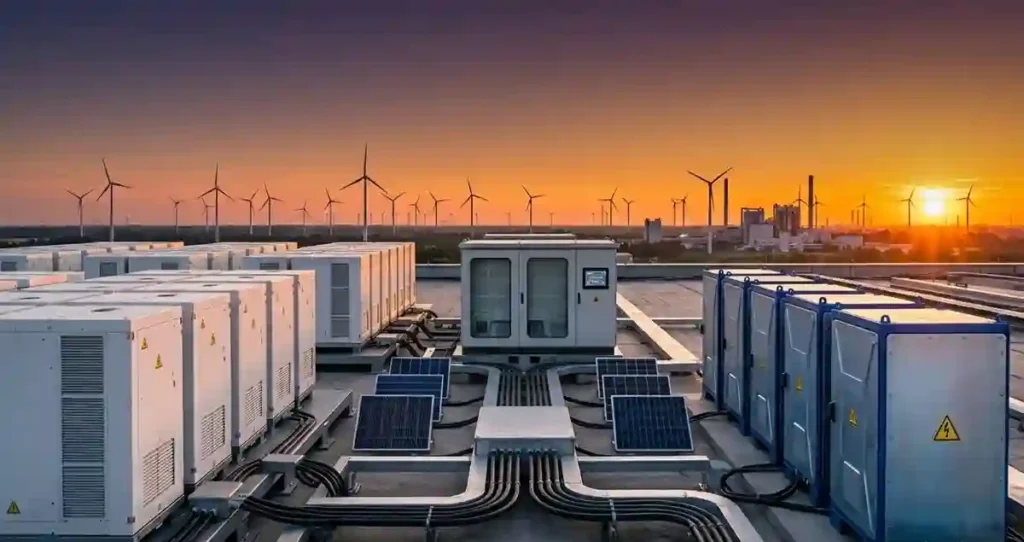
Retrofitting a BESS to an existing commercial solar installation is technically feasible but requires careful compatibility assessment. The key integration questions for a commercial solar-plus-storage retrofit:
- Inverter compatibility: AC-coupled BESS systems (the most common retrofit approach) use a separate battery inverter and connect to the AC side of the existing solar system. This approach works with any existing solar inverter architecture. DC-coupled BESS systems connect directly to the solar array’s DC bus and require either a hybrid inverter replacement or a DC-coupled charge controller — more efficient but more disruptive to install.
- Metering and monitoring integration: Adding a BESS changes the metering configuration. Your utility interconnection agreement and net metering tariff may need to be updated to reflect the addition of storage. Some utilities require notification or a supplemental interconnection application for BESS retrofits — verify before installation begins.
- Energy management system integration: The BESS’s EMS needs to communicate with the solar system’s monitoring platform to optimize combined dispatch. In AC-coupled retrofits, this typically requires an additional system controller layer (from the BESS manufacturer, such as Tesla Energy Gateway, SMA Energy Meter, or Generac PWRcell) that sees both solar production and facility load data simultaneously.
- Switchgear and interconnection modifications: Adding a BESS changes the fault current contribution at your switchgear. For systems above 100 kW of BESS capacity, have your PE review the existing switchgear fault current ratings to confirm they remain adequate with storage added.
6. Commercial Solar Battery Installation and BESS Incentives in 2026
⟳ 2026 UPDATE: REAP grant maximum is now 50% (up from 25%) for IRA-eligible rural and energy-transition zone projects — updated figures reflected below.
| Incentive | Value in 2026 | Who Qualifies | Key Condition |
| Federal ITC (Investment Tax Credit) | 30% of installed BESS cost | Any US business with federal tax liability | BESS must be charged by on-site solar (functionally interdependent). System operational in the tax year claimed. |
| Bonus Depreciation (MACRS) | 60% first-year bonus + 5-year MACRS on remainder | Any US business with tax liability | BESS qualifies as 5-year MACRS property — same as solar. Significant Year 1 tax shield on combined solar-plus-BESS project cost. |
| USDA REAP Grant ★ UPDATED | Up to 50% of project cost (IRA-enhanced rate for 2026) | Rural small businesses and agricultural producers in eligible zones | Under IRA provisions continuing through 2026, projects in rural or energy-transition zones now routinely qualify for the 50% tier (previously 25% was the standard). Competitive; application required; funding is limited and first-come-first-served. |
| State commercial BESS incentives | Varies — $0 to $100K+ | Varies by state | Several states (CA, NY, MA, NJ, IL) have dedicated commercial BESS incentive programs separate from solar incentives. Check DSIRE database. |
| Utility demand response / BESS incentives | $50–$500/kW of dispatchable capacity | Commercial customers in participating utility programs | Many utilities now offer standalone BESS incentives for demand response enrollment — stackable with ITC. |
| C-PACE financing | 100% project financing; property-assessed repayment | Commercial property owners in C-PACE states (29 states + DC as of 2026) | Covers BESS as part of a qualifying energy project. No personal guarantee. Loan transfers with property at sale. |
The REAP update is material for rural commercial operators. Under IRA provisions continuing through 2026, the 50% grant tier is now the standard target for qualifying projects — not the ceiling. Combined with the 30% ITC and 60% bonus depreciation, a rural agricultural or small business BESS project in an eligible zone can recover 65 to 75% of gross installed cost in Year 1 between grants and tax benefits. That fundamentally changes the financial case for commercial BESS in rural markets.
Engineer’s Note: For ITC qualification on an AC-coupled BESS retrofit, document the solar charging percentage explicitly in your monitoring system. The IRS position is that the BESS must be charged predominantly from solar — typically interpreted as 75% or more of annual charge cycles sourced from the on-site PV system. Your BESS EMS should have a reporting function that produces this data. Set it up at commissioning; do not try to reconstruct it at tax time.
7. The Commercial Solar-Plus-BESS Financial Case: A Worked Example
Facility: 150,000 sq ft distribution warehouse. Current electricity cost: $18,000/month average ($8,200 energy charges + $9,800 demand charges). Located in a state with moderate TOU rates. Not eligible for REAP (urban market — non-REAP scenario shown; REAP scenario shown separately).
Proposed system: 400 kW solar + 500 kWh / 250 kW LFP BESS.
| Item | Standard Commercial (No REAP) | Rural / REAP-Eligible Scenario |
| Gross installed cost (solar + BESS) | $1,420,000 | $1,420,000 |
| Federal ITC (30%) | −$426,000 | −$426,000 |
| USDA REAP Grant (0% / 50%) | −$0 | −$710,000 |
| Year 1 MACRS bonus depreciation (60% × 21%) | −$178,920 | −$89,460 (applied to post-REAP depreciable basis) |
| Net effective cost after Year 1 tax benefits | $815,080 | $194,540 |
| Annual solar energy savings (400 kW) | $52,000/yr | $52,000/yr |
| Annual demand charge reduction (BESS dispatch) | $58,000/yr | $58,000/yr |
| Total annual savings | $110,000/yr | $110,000/yr |
| Simple payback | 7.4 years | 1.8 years |
| 25-year IRR (2.5% annual rate escalation) | ~16% | ~55%+ |
The REAP column is not a hypothetical — it reflects the actual financial structure available to qualifying rural commercial and agricultural facilities under IRA-enhanced REAP funding in 2026. A 1.8-year simple payback on a commercial solar-plus-BESS project is not a rounding error; it represents a category shift in the investment case for storage in rural markets.
Even in the standard commercial scenario, the combination of 30% ITC and MACRS means that $604,920 of the $1,420,000 gross investment is recovered in Year 1 tax benefits alone — before a single month of energy savings is counted.
Field Note: The demand charge reduction figure of $58,000/yr in this example assumes intelligent BESS dispatch with real-time load submetering. If the BESS is installed without submetering and relies on time-based scheduling rather than load-responsive dispatch, demand charge savings will be materially lower — commonly 30 to 50% of the optimised figure. Submetering is not a nice-to-have in a commercial BESS installation; it is the difference between the modeled financial case and the actual financial outcome.
The solar system design and electrical integration requirements for this type of commercial solar-plus-BESS installation — including three-phase electrical connection, utility interconnection coordination, and commissioning protocols — are covered in the Commercial Solar Panel Installation Engineering Guide on SolarVisionAI. The full BESS fundamentals — chemistry, sizing principles, and system architecture — are covered in the BESS: Battery Energy Storage System Guide. The ongoing O&M framework for keeping both the solar and BESS systems performing at their modeled yield is covered in the Commercial Solar Maintenance guide.
Frequently Asked Questions About Commercial Solar BESS
What is the difference between a commercial BESS and a residential battery backup?
A commercial Battery Energy Storage System (BESS) operates at a fundamentally different scale and under different regulatory requirements than residential storage. Commercial BESS installations typically operate at 480V three-phase, require IEEE 1547-2018 compliant protection relay coordination with the utility, and as of the NFPA 855: 2026 edition, require a formal Hazard Mitigation Analysis directed by a licensed PE. Residential batteries (Tesla Powerwall, Enphase IQ Battery) are pre-engineered consumer products installed under a simplified permitting process. The engineering rigor, utility coordination, and fire code compliance requirements are categorically different.
Does a commercial BESS always require a PE-stamped HMA in 2026?
Under the NFPA 855: 2026 edition, a Hazard Mitigation Analysis is now baseline for nearly all commercial BESS projects regardless of size. The HMA must be directed by a Registered Design Professional (PE) and must evaluate thermal runaway propagation and hazardous gas management for the specific installation environment. Local AHJ adoption of the 2026 edition varies by jurisdiction — verify with your AHJ whether the 2026 or 2023 edition governs your project, and plan for HMA requirements in either case above 50 kWh.
Can I add a BESS to my existing commercial solar system?
Yes, with the compatibility assessment described in Section 5. AC-coupled BESS systems can be retrofitted to any existing solar inverter architecture. The key requirements are: PE review of fault current impact on existing switchgear, utility notification or supplemental interconnection application (varies by utility), NFPA 855: 2026 HMA for the specific battery placement, and EMS integration with real-time load submetering if demand charge reduction is a project objective.
What BESS technology should I specify for a commercial project in 2026?
LFP (Lithium Iron Phosphate) for virtually all commercial applications. The combination of 3,000 to 6,000 cycle life, 92 to 96% round-trip efficiency, superior thermal stability, and $700 to $950/kWh installed cost makes LFP the correct default specification. Sodium-Ion BESS is entering the commercial pilot stage and may offer cost advantages for large-scale, cost-sensitive stationary storage applications within the next 12 to 24 months, but is not yet proven at commercial scale for rooftop installations. NMC batteries are appropriate only where energy density is the overriding constraint.