
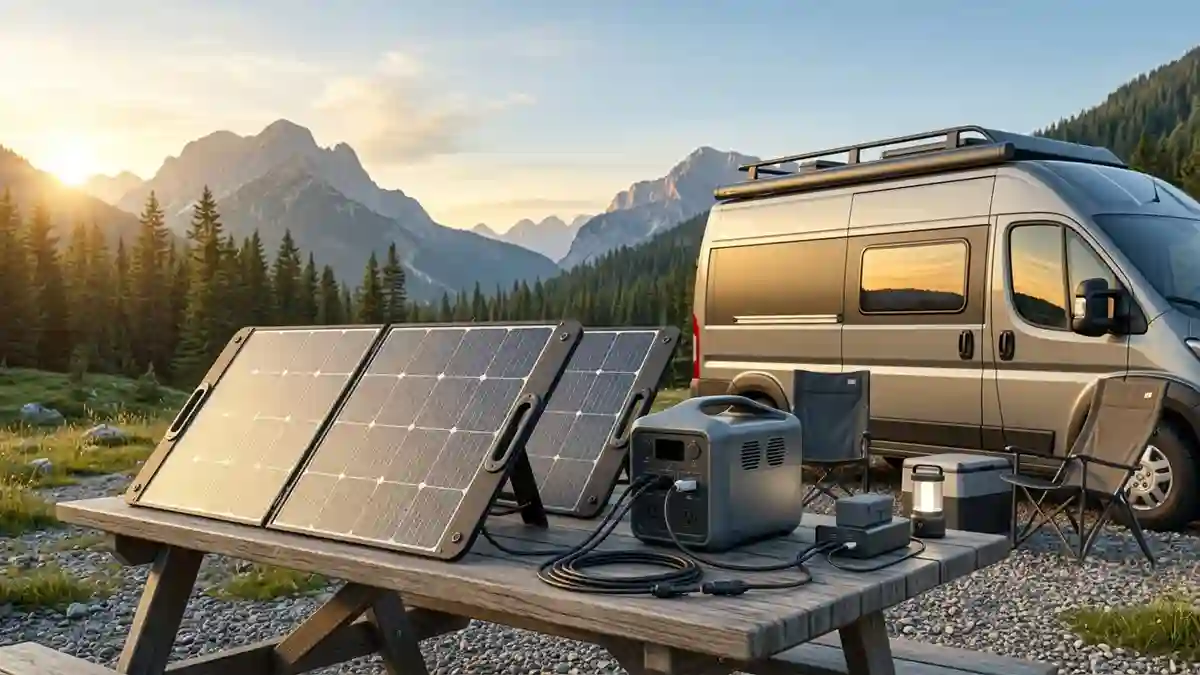
What actually matters when buying portable solar panels — real wattage, foldability, and durability tested by a PEC engineer.
Portable solar panel marketing is some of the most inflated in the entire industry — wattage claims that don’t survive a single cloudy afternoon, “unbreakable” panels that crack on the second fold. This guide strips the spec sheet down to what actually determines whether a portable panel is worth buying, based on the units I’ve personally tested and the service calls I’ve fielded on other people’s.
I want to be upfront that this is a category I genuinely like recommending when it’s the right fit — there’s nothing wrong with portable solar as a product class. The problem is almost entirely in how it’s marketed and how buyers size their systems, not in the underlying technology itself. Get those two things right and a portable panel will do exactly what you need it to do.
This guide is part of our Types of Solar Panels hub.
Quick Facts: Portable Solar Panels
| Feature | Details |
|---|---|
| Typical Efficiency | 10–18% |
| Typical Power Output | 50W–400W |
| Lifespan | 10–15 Years |
| Best For | Camping, RVs, Emergency Backup |
| Weight | 2–15 kg |
| Foldable | Yes |
| Battery Storage | Recommended |
| Overall Recommendation | Excellent for Mobile Power Applications |
What Makes a Panel “Portable”
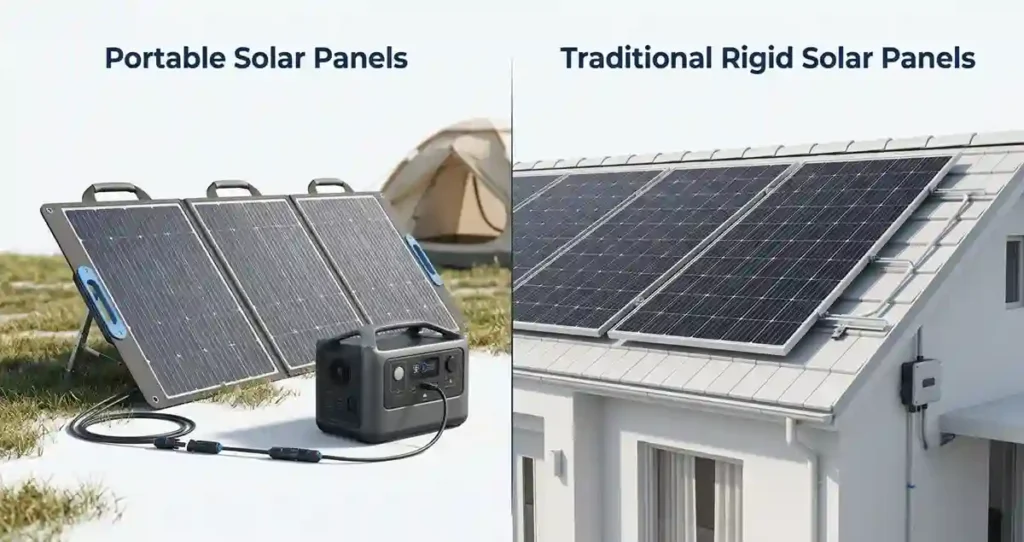
Portable panels prioritize weight, foldability, and setup speed over maximum efficiency. Most use monocrystalline or thin-film cells mounted on a flexible or hinged rigid backing, with integrated kickstands and a carrying case. They typically run 10–18% efficiency and 50W–200W per panel, often paired in foldable arrays for higher combined output.
Engineer’s Note: The single biggest gap between marketing and reality in this category is rated wattage under real sun versus rated wattage under lab test conditions (STC). A “200W” portable panel commonly delivers 120–150W in typical field use. Budget your power needs around real output, not the number on the box.
What Actually Matters When Buying
| Specification | Why It Matters | What to Look For | Practical Difference | Industry Reference |
|---|---|---|---|---|
| Real-World Wattage | Laboratory ratings rarely match actual outdoor performance. | Look for independent field test results rather than relying solely on manufacturer claims. | Most portable panels deliver 70–80% of their STC-rated output under typical outdoor conditions. | NREL, PV Magazine |
| Fold Cycle Durability | Determines long-term reliability with repeated folding and transport. | Choose models rated for 10,000+ fold cycles if used frequently. | Better hinges and fabrics significantly extend service life. | Manufacturer Specifications |
| IP Rating | Indicates resistance to dust and water ingress. | IP65 or higher is recommended for outdoor and camping use. | Higher IP ratings improve reliability in rain, dust, and harsh environments. | IEC 60529 |
| Connector Type | Determines compatibility with batteries, charge controllers, and power stations. | Confirm MC4 compatibility or verify proprietary connectors before purchase. | Standard connectors simplify future expansion and equipment compatibility. | Industry Best Practice |
| Weight per Watt | Affects portability and ease of transport. | Around 10 g/W or less is considered lightweight for backpacking and travel. | Lower weight improves mobility without significantly reducing usability. | Manufacturer Specifications |
Engineering Assessment
| Feature | Assessment |
|---|---|
| Portability | Excellent |
| Ease of Setup | Excellent |
| Durability | Good |
| Efficiency | Moderate |
| Expandability | Very Good |
| Weather Resistance | Good |
| Long-Term Value | Good |
| Overall Recommendation | Best suited for mobile, temporary, and emergency power applications |
Advantages and Disadvantages
| Advantages | Disadvantages |
| Foldable and lightweight — genuinely portable in the field | Real-world wattage often well below the rated STC number |
| No permanent mounting or roof penetration required | Hinges, zippers, and connectors are common failure points |
| Wide product range across price points and use cases | Shorter lifespan than a fixed rooftop installation |
| Good fit for emergency backup and remote power needs | Lower efficiency than standard rigid panels of the same footprint |
Real-World Applications
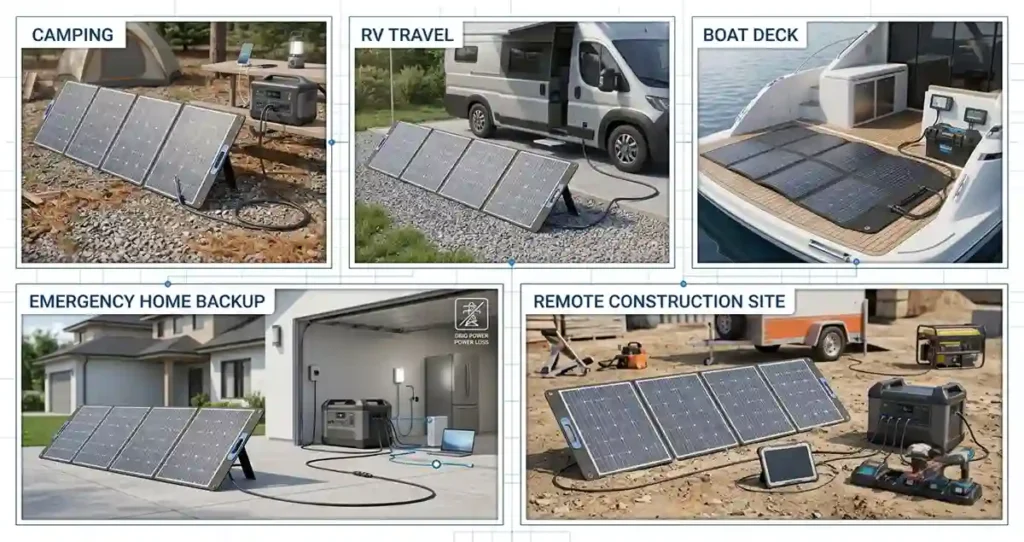
The most common request I get in this category is from clients setting up a remote agricultural water pump — a portable panel paired with a small controller and pump, moved between fields as needed rather than permanently installed. That’s genuinely the right use case: nobody wants to trench conduit to a field that gets irrigated on a rotation. See Solar Water Pump Guide for the pairing details.
The second most common is off-grid emergency backup — a homeowner wanting the ability to keep a refrigerator or medical device running during an outage without committing to a full rooftop system. For that use case, see Off-Grid Solar System Guide. And of course, there’s straightforward RV and vehicle charging, where the panel supplements rather than replaces the vehicle’s main power source — see Solar Panel Mount Brackets for RV, Polo & Motorhome for the mounting side of that specifically.
I’ve also had a handful of clients use portable panels for construction site power — running small tools or charging equipment at a site that doesn’t yet have utility power connected. It’s a short-term, temporary-use case that plays directly to portable panels’ strengths: no permitting, no permanent installation, pack it up and move it to the next site when the job’s done.
Durability Expectations and Common Failure Points
Based on the units I’ve serviced, the panel’s actual solar cells are rarely the first thing to fail — it’s almost always the mechanical and connective components. Fold hinges wear out with repeated use, especially on cheaper units where the hinge is a simple fabric fold rather than a reinforced mechanism. Zippers on the carrying case fail. Connectors get bent or corroded from repeated field use in dust or moisture.
If you’re buying for frequent, serious field use rather than occasional weekend charging, I’d treat the mechanical build quality as equally important to the electrical spec sheet. A panel with slightly lower rated wattage but a genuinely rugged hinge and connector assembly will outlast a higher-wattage unit with flimsy hardware in almost every real-world scenario I’ve observed.
Where It Doesn’t Make Sense
Any application where the panel will stay in one place permanently. If you’re not folding, carrying, or relocating the panel regularly, a standard rigid monocrystalline panel will always deliver more watts per dollar and last longer. See Monocrystalline Solar Panels for the fixed-installation alternative.
Field Note: I’ve had more service calls about failed portable panel hinges and connectors than about failed cells. If you’re buying for frequent field use, prioritize build quality on the moving parts — the electronics inside are rarely the weak point in my experience.
Sizing Your Portable System Correctly
The most common sizing mistake I see is buyers working backward from a single panel’s wattage rather than forward from their actual power need. If you need to run a 60W refrigeration unit for eight hours a day, you need roughly 480Wh of daily generation with margin for cloudy days and system losses — which, given the real-world derating discussed above, likely means 200–250W of rated panel capacity rather than the 150W the naive calculation would suggest. Always size from your load requirement backward, factoring in real-world derating, rather than from the panel wattage forward.
Battery capacity matters just as much as panel wattage in a portable setup, since the panel only generates during daylight hours and most use cases need power around the clock. Pairing an undersized battery with an appropriately-sized panel is a common and avoidable mistake — the panel can only charge as fast as the battery can accept, and an undersized battery leaves usable generation capacity on the table every single day.
Common Misconceptions Worth Clearing Up
A lot of buyers assume a higher-wattage portable panel is simply a strictly better version of a lower-wattage one. That’s not always true once you factor in weight, pack size, and price — a 100W panel that’s genuinely rugged and accurately rated can outperform a 200W panel on paper that derates heavily in the field and falls apart after a season of use. Compare on delivered watt-hours per day in your actual use conditions, not headline wattage.
The other misconception is that a portable panel and a portable power station are the same purchase decision. They’re not — the panel generates, the power station stores and outputs. Buying a great panel paired with an undersized or incompatible power station is one of the most common and avoidable mistakes I see people make when putting together their first off-grid kit.
Buying Checklist
- Confirm real-world tested wattage from independent reviews, not just the manufacturer’s STC rating
- Check IP rating matches your actual use environment, not just a generic outdoor rating
- Confirm connector compatibility with your power station or charge controller — see Solar Charge Controller Guide
- If building your own kit rather than buying pre-assembled, see 7 Steps to Build DIY Solar Panel Kits
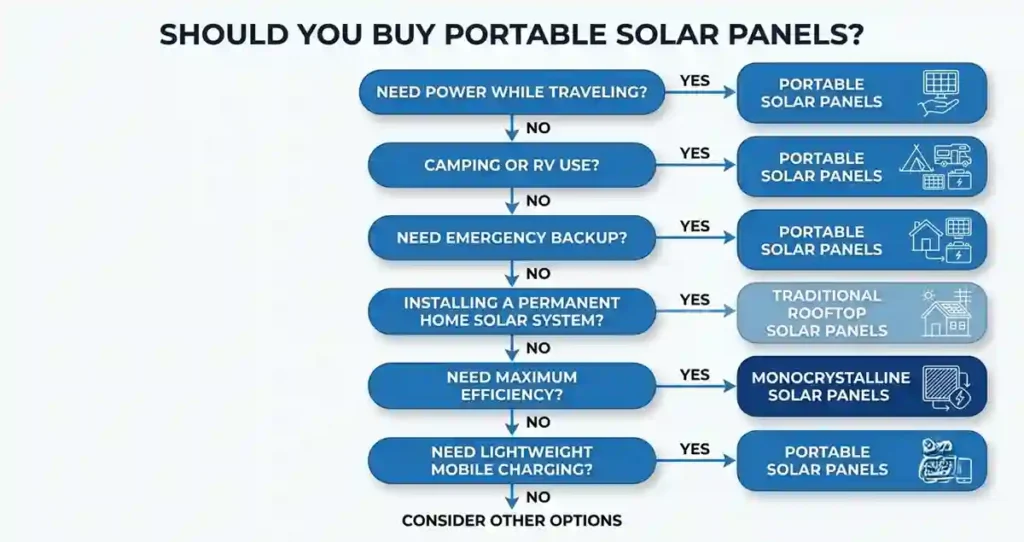
Who Should Buy Portable Solar Panels?
Portable solar panels are an excellent choice for:
- Campers and outdoor enthusiasts
- RV and motorhome owners
- Van life travelers
- Emergency preparedness kits
- Remote agricultural applications
- Construction sites without utility power
- Boat owners and marine applications
- Off-grid battery charging systems
Who Should Avoid Portable Solar Panels?
Portable solar panels are generally not the best choice for:
- Permanent residential solar installations
- Large commercial buildings
- Utility-scale solar projects
- High-energy households
- Customers seeking the lowest cost per watt
- Long-term fixed rooftop systems
- Industrial facilities with continuous high loads
Final Engineering Verdict
Engineering Verdict: Portable solar panels are one of the most practical renewable energy solutions for mobile and temporary solar power applications. Their value comes from flexibility, convenience, and ease of deployment rather than maximum efficiency. If your goal is camping, RV travel, emergency backup, or off-grid mobility, portable solar panels can be an excellent investment. For permanent installations, however, conventional rigid monocrystalline panels remain the better long-term solution due to their higher efficiency, lower cost per watt, and superior lifespan.
The pattern I see most often with happy portable solar owners is that they under-bought initially, learned their real-world usage, and upgraded once with better information rather than guessing big from the start. There’s no shame in starting small — a modest panel and battery combination you can expand later is usually a better first purchase than an expensive kit sized for a use case you haven’t actually tested yet. Talk to your installer or retailer about return policies before buying, since the biggest sizing mistakes only reveal themselves after a week or two of actual field use, not in the showroom.
Frequently Asked Questions
How long do portable solar panels last?
Typically 10–15 years with proper care, though hinges and connectors — not the solar cells themselves — are the most common failure point with frequent field use.
Can portable solar panels get wet?
Most quality portable panels carry an IP65 rating or higher, suitable for outdoor and light rain exposure. Always check the specific IP rating before marine or heavy-weather use.
What size portable solar panel do I need?
Size from your daily power need backward, not from panel wattage forward. A 60W refrigerator running 8 hours needs roughly 480Wh of daily generation — factoring in real-world derating, that is typically a 200–250W rated panel, not the 150W a naive calculation suggests.
Are portable solar panels worth the higher cost per watt?
For mobile or temporary use — camping, RV, emergency backup — yes. For any permanent installation, a standard rigid panel delivers more watts per dollar and lasts far longer.
References
Module safety and durability claims in this guide follow IEC 61730 (photovoltaic module safety qualification) and IEC 61215 (design qualification and type approval) — the same baseline certification standards that apply to portable and folding panel products, not just fixed installations.
Related guides on SolarVisionAI.com
- Solar Fence Post Lights: Cap Sizes, Types & Install Guide
- Solar Charge Controller: The Complete Guide
- MC4 Connectors: Solar Safety & Installation Guide
- Solar Panel Types, Efficiency & Benefits
- Solar Water Pump Guide
- Commercial Solar Panel Installation: Engineering Guide
- Solar Fence Post Lights: Cap Sizes, Types & Install Guide — solarvisionai.com/solar-fence-post-lights/
- BESS — Battery Energy Storage System Guide — solarvisionai.com/bess-battery-energy-storage-system-guide/
- Commercial Solar Panel Installation — solarvisionai.com/commercial-solar-panel-installation/