
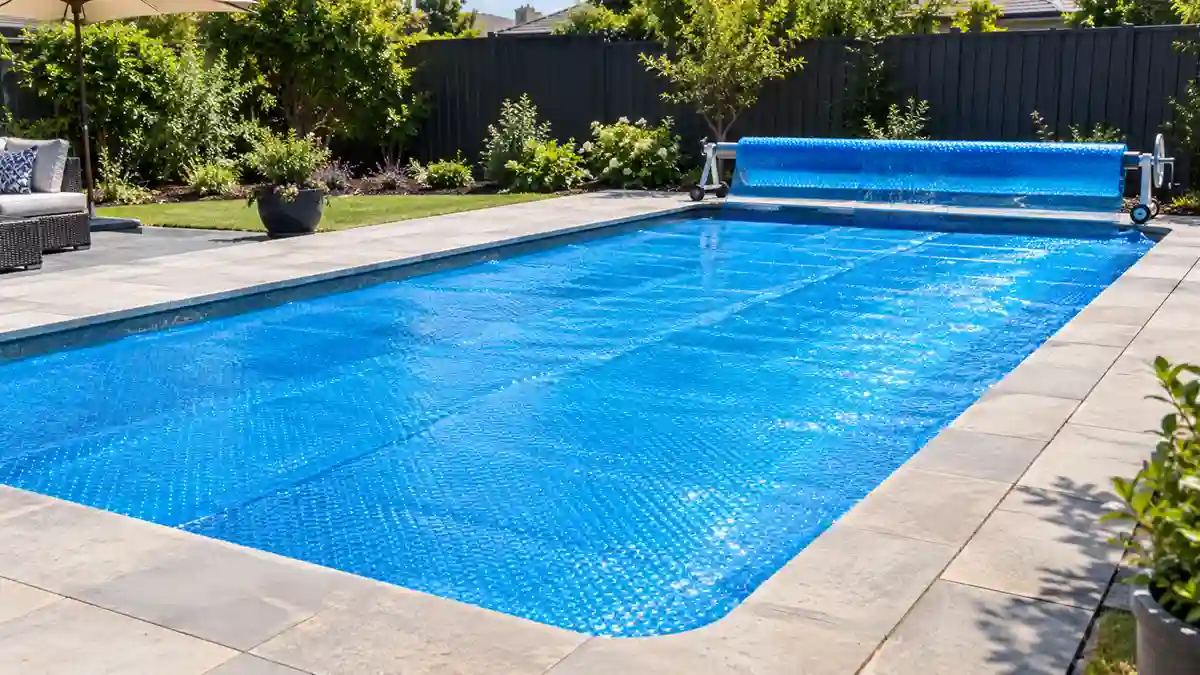
Solar blanket reels make pool covers easier to handle. Learn about reel types, solar blanket covers, heat retention, and reducing pool water evaporation.
A swimming pool can absorb plenty of sunlight and still lose heat overnight. Wind, evaporation, cool air, and changing weather conditions all affect how much warmth the water retains. A solar blanket can help manage these losses, but the blanket and the reel that stores it perform two different functions.
As a solar engineer, I evaluate equipment by identifying its purpose, operating conditions, and performance losses. The same principle applies to pool covers. A solar blanket helps retain heat and can contribute to warming the water, while a reel makes the cover easier to handle and store.
If you are considering a solar pool blanket or a powered reel, understanding the difference will help you choose equipment that suits your pool and your heating requirements.
Do Solar Blanket Covers Actually Heat Water?
Yes. A solar pool blanket can help warm swimming pool water by allowing sunlight to reach the water while reducing heat loss from the surface. However, the amount of warming depends on sunlight exposure, ambient temperature, wind, pool size, cover design, and how consistently the blanket is used.
Most solar pool blankets are made from flexible plastic with air-filled bubbles. The cover floats on the water, helping reduce evaporation while allowing solar energy to contribute to heating.
There are two important effects to understand:
- Solar heat gain: Sunlight reaches the pool water and adds thermal energy.
- Heat retention: The cover reduces evaporation and slows heat loss when the pool is not in use.
The second effect is particularly important. Even when a pool receives strong sunlight during the day, it can lose considerable heat after sunset. Covering the pool helps preserve more of the energy already stored in the water.
The US Environmental Protection Agency explains that pool covers can reduce evaporation and help retain water heat when used consistently and appropriately. The actual results depend on the cover and operating conditions. Read the EPA’s pool water efficiency guidance.
A solar blanket is therefore a useful heat-management tool, but it should not be confused with a dedicated solar thermal pool heating system.
How Does a Solar Pool Cover Work?
A solar pool cover works through a combination of sunlight transmission, insulation, and evaporation control.
1. Sunlight warms the pool
Solar radiation passes through a suitable translucent cover and is absorbed by the water and pool surfaces. The resulting temperature increase depends on the amount of sunlight available, the water volume, the pool’s exposed surface area, and environmental conditions.
A larger pool generally requires more energy to achieve the same temperature increase as a smaller pool, assuming other conditions are similar.
2. The cover reduces evaporation
When water evaporates, it carries heat away from the pool. A floating solar blanket acts as a barrier between the water and surrounding air, reducing this loss.
This is one of the main reasons a covered pool can retain more warmth, particularly overnight or during cooler weather.
3. The cover slows heat loss
The air trapped inside the blanket’s bubbles provides some insulation, helping reduce heat transfer at the water surface. The cover does not eliminate heat loss, but it can slow it considerably.
Wind, air temperature, humidity, water temperature, and the time spent uncovered all influence the final result.
For a broader explanation of blanket applications beyond swimming pools, read our guide to solar blankets, their types, uses, and how they work.
Types of Solar Blanket Covers and Reels
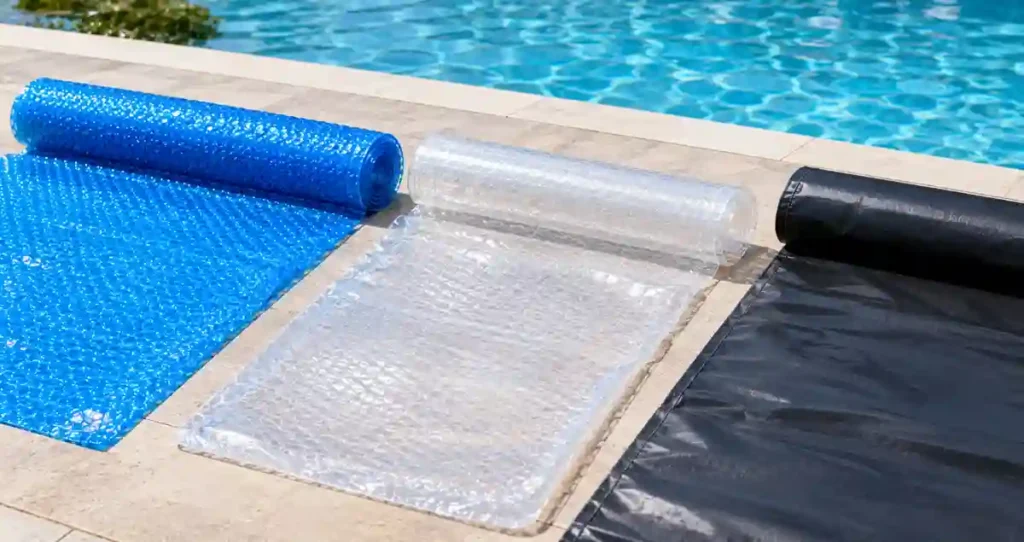
Solar pool covers and reels are available in several designs. The right choice depends on the pool’s dimensions, the required heat retention, the local climate, and how easily you want to cover and uncover the water.
It helps to separate the two categories: cover types determine how the pool is protected, while reel types determine how the cover is operated.
1. Bubble-Style Solar Pool Blankets
Bubble-style solar blankets are among the most common options for residential swimming pools. They consist of flexible plastic with air-filled bubbles that float on the water’s surface.
The cover allows sunlight to reach the water while helping reduce evaporation and heat loss. Products are available in different thicknesses, colors, sizes, and material specifications.
Best for: Homeowners who want a practical way to retain pool heat and reduce water evaporation.
When comparing products, check durability, UV resistance, coverage, warranty, and compatibility with the pool’s shape.
2. Clear and Translucent Solar Pool Covers
Clear or translucent covers allow sunlight to pass through to the water. Depending on their construction, they can support daytime solar heat gain while reducing evaporation when the pool is covered.
Their performance depends on light transmission, material construction, pool conditions, and overnight heat loss. A clear cover is not automatically more effective than every blue or opaque alternative.
Best for: Pool owners who want to balance sunlight transmission with heat retention.
Compare manufacturer specifications rather than selecting a cover based on color alone.
3. Dark or Opaque Pool Covers
Dark and opaque covers limit the amount of sunlight passing directly through the material. Some are designed primarily for heat retention or seasonal protection rather than maximizing direct solar heat gain.
Their thermal behavior depends on the material and construction. A dark surface may absorb solar energy, but that does not mean all the absorbed energy will transfer efficiently to the pool water.
Best for: Owners prioritizing coverage and heat retention, provided the selected cover is designed for their application.
Check whether the product is specifically marketed as a solar heating cover, a thermal cover, or a seasonal pool cover. These products may serve different purposes.
4. Manual Solar Blanket Reels
A manual reel uses a hand crank to roll the pool blanket onto a tube. It makes it easier to remove the cover before swimming and return it to the pool afterward.
Manual reels come in different widths and mounting arrangements. Before buying one, confirm that it can accommodate the cover’s dimensions and weight.
Best for: Smaller pools, straightforward pool layouts, and homeowners who are comfortable operating the reel by hand.
5. Portable and Removable Reels
Portable reels can be moved or repositioned when the cover is not in use. Depending on the design, they may use wheels or a lightweight support frame.
They can be useful when a permanent mounting arrangement is unsuitable or when the pool area needs to remain accessible.
Best for: Pools where flexible positioning and convenient storage are important.
6. Powered Solar Blanket Reels
Powered reels use a motor to roll up the cover, reducing the physical effort required. Some systems offer remote operation, while others use a dedicated control.
A powered reel improves convenience rather than directly increasing the pool’s temperature. Its main benefit is making the cover easier to operate, particularly when the blanket is large or frequent handling is required.
Best for: Larger pools, frequent cover operation, and homeowners who want to minimize manual effort.
Which Type Should You Choose?
For most residential pools, start by selecting a cover that suits the pool’s dimensions, local conditions, and heat-retention requirements. Then decide whether a manual, portable, or powered reel will make regular use easier.
Remember that the cover and reel serve different purposes: the cover helps manage heat loss, while the reel makes handling and storage more convenient.
What Does a Solar Blanket Reel Actually Do?
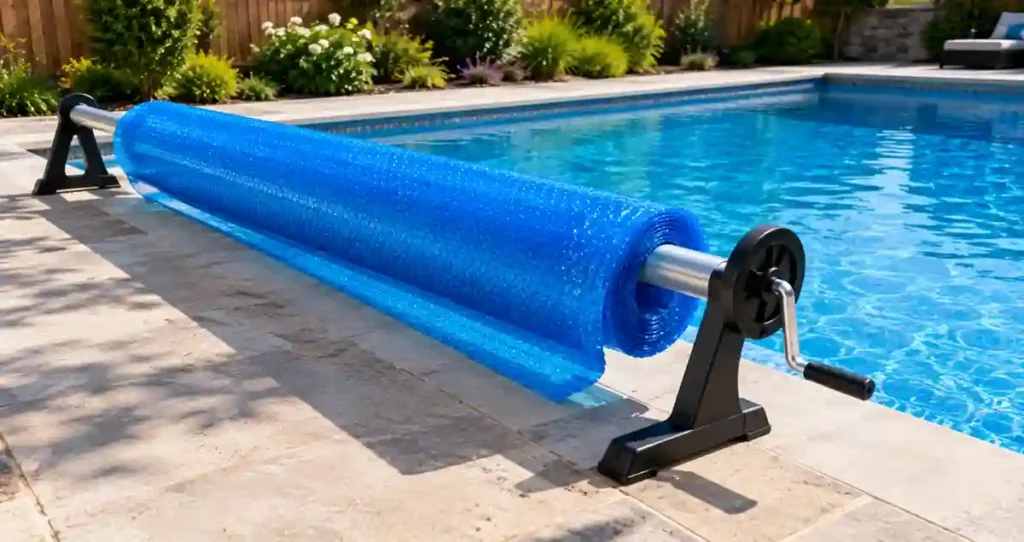
A solar blanket reel is a mechanical system used to roll a pool cover onto a tube and unroll it across the water when needed.
The reel does not directly heat the water. Its primary purpose is to make handling the blanket easier, reducing the effort involved in covering and uncovering the pool.
This matters because a pool cover provides its intended benefits only while it is being used correctly. If a large or awkward blanket is difficult to handle, an owner may leave it off the pool more often than intended.
A suitable reel can make daily operation more convenient.
Before selecting one, check:
- Pool dimensions: The reel must accommodate the blanket’s width and length.
- Cover weight: Confirm that the tube and support frame can handle the selected blanket.
- Pool layout: Steps, coping, walls, and other obstacles may affect positioning.
- Storage space: Make sure the rolled cover will not obstruct access.
- Power requirements: Verify the manufacturer’s instructions for a motorized system.
- Durability: Outdoor equipment must withstand moisture, sunlight, and local environmental conditions.
A reel is not essential for every pool. Its value depends on how much easier it makes regular cover use.
How Much Heat Can a Solar Blanket Retain?
There is no single temperature increase that applies to every swimming pool. A blanket used on a sunny, sheltered pool may deliver a different result from one used in a windy location with cool nights.
Several factors influence performance.
Sunlight exposure: More available solar radiation generally creates greater potential for daytime warming.
Pool size and depth: The volume of water determines how much energy is needed to raise its temperature.
Wind: Wind increases heat loss from an uncovered pool and can reduce the benefit of leaving the water exposed.
Nighttime temperature: Cool nights can remove some of the heat gained during the day.
Cover fit: Gaps and uncovered sections leave water exposed to evaporation.
Usage pattern: Frequent swimming and leaving the cover off for extended periods can reduce heat retention.
The EPA notes that solar bubble covers can substantially reduce evaporation, with effectiveness varying according to pool shape and coverage. However, evaporation reduction is not the same as a guaranteed increase in water temperature. EPA technical reference on pool covers.
A solar blanket should therefore be viewed as a way to improve passive solar heating and reduce heat loss, not as a guarantee of a specific water temperature.
If a target temperature must be maintained regardless of weather, a dedicated pool heating system may still be necessary.
Are Solar Blanket Reels Worth the Cost?
A reel can be worthwhile when it makes the pool cover substantially easier to use. The decision depends on pool size, frequency of use, physical effort, and equipment cost.
A manual reel may be sufficient when the cover is relatively easy to handle and the pool layout provides suitable space for storage.
A powered reel may be more practical when the blanket is large, daily handling is inconvenient, or the owner wants to reduce manual effort.
Before investing, consider the following:
- Pool dimensions: Confirm that the reel can accommodate the blanket’s length and width.
- Pool shape: Rectangular pools are generally easier to accommodate, although suitable arrangements depend on the product.
- Storage space: Check whether the reel can sit beside the pool without obstructing access.
- Mounting and clearance: Account for steps, diving boards, coping, walls, and other obstacles.
- Power requirements: For a motorized reel, verify the manufacturer’s specified power arrangement and installation instructions.
- Maintenance and durability: Outdoor equipment must withstand moisture, sunlight, and regular use.
A reel is a convenience investment. The blanket itself provides the primary heat-retention benefit, while the reel can make it easier to use the cover consistently.
Do Solar Pool Covers Replace Pool Heaters?
Not necessarily.
A solar blanket can reduce heat loss and make better use of available sunlight, but it is not equivalent to a dedicated solar pool heating system.
A blanket mainly acts at the water surface. A solar thermal heating system uses collectors to capture solar energy and transfer heat to circulating pool water.
These technologies can complement each other. A solar pool heating system can warm the water during suitable sunlight conditions, while a cover helps retain some of that heat when the pool is not in use.
The appropriate choice depends on the required swimming temperature, local climate, pool usage, and available installation space.
If your objective is to heat a pool more consistently, evaluate the expected heat demand and available heating options rather than relying on a cover alone.
Safety and Maintenance Considerations
A solar bubble blanket should not be treated as a safety cover. It is not designed to support a person’s weight or prevent a child or animal from entering the water.
If pool access protection is required, choose a properly rated safety cover or another suitable barrier in accordance with local requirements. A solar blanket and a safety cover serve different purposes.
Regular maintenance also helps preserve performance:
- Remove leaves and debris before rolling up the blanket.
- Follow the manufacturer’s instructions for cleaning and storage.
- Avoid dragging the cover across abrasive surfaces.
- Inspect the material for tears, deterioration, or damaged sections.
- Use the reel according to its operating and installation instructions.
- Keep children away from the reel and its moving components.
Follow the cover manufacturer’s guidance regarding chemical levels, water treatment, and storage. Remove the cover as required for safe swimming and appropriate pool maintenance.
Final Verdict: Should You Buy a Solar Blanket or a Reel?
If your primary goal is to retain pool heat and reduce evaporation, the solar blanket is the essential component. A reel is an optional accessory that makes covering and uncovering the pool easier.
For a homeowner who already has a suitable blanket but finds it difficult to handle, a manual or powered reel may improve convenience. For someone buying a complete setup, the sensible approach is to select a compatible cover first and then determine whether a reel is justified by the pool’s dimensions and usage.
From an engineering perspective, the best solution is not necessarily the most expensive one. It is the arrangement that meets the pool’s heating requirements, reduces avoidable losses, and remains practical enough to use consistently.
Frequently Asked Questions
Does a solar blanket heat a swimming pool at night?
A solar blanket does not generate meaningful solar heat without sunlight. At night, its main benefit is helping the pool retain heat by reducing evaporation and slowing heat loss.
Does a solar blanket reel make the water warmer?
No. The reel stores and deploys the blanket. Any heating or heat-retention benefit comes from the cover itself, not the reel.
Is a powered solar blanket reel better than a manual one?
A powered reel reduces manual effort, which may be valuable for large covers or frequent use. A manual reel may be sufficient for a smaller pool or a setup that is easy to operate. The better option depends on convenience, compatibility, and budget.
Can I leave a solar pool blanket on all day?
Follow the cover manufacturer’s instructions and consider pool use, water treatment, and local conditions. A cover can help retain heat and reduce evaporation while the pool is not in use. Remove it before swimming.
Is a solar pool blanket a safety cover?
No. A typical bubble-style solar blanket is designed for heat retention and evaporation control, not to support a person or prevent accidental entry into the pool. Use a properly rated safety cover where required.
Should I buy the cover or the reel first?
Choose the cover according to the pool’s dimensions and heating needs. Then select a compatible reel if it will make regular covering and storage easier.
Related Guides
- 24V 200Ah LiFePO4 Battery: Specs, Uses & Buying Guide
- LiFePO4 vs Lithium-Ion: Which Battery Should You Buy?
- LiFePO4 Battery: How It Works, Specs & Buying Guide
- LiFePO4 Batteries for Solar: How to Choose & Size Right
- 48V 200Ah LiFePO4 Battery: Specs, Sizing & Home Storage Guide
- LiFePO4 Battery Charger: Voltage, Amps & Settings
- Solar Panel Repair Guide: Diagnose Problems, Costs & Fixes
- IRS Form 5695 for 2025: Solar Tax Credit Guide
Related guides on SolarVisionAI.com
- Monocrystalline Solar Panels 2026: Still Worth It or Hype
- Polycrystalline Solar Panels: Worth Buying in 2026?
- Thin-film Solar Panels: When They Beat Silicon (2026)
- BIPV Solar Panels: Building-Integrated PV Complete Guide
- Portable Solar Panels: Engineer’s Buyer’s Guide 2026
- CPV Solar Panels: Concentrated Photovoltaic Explained
- Skin Solar Panel: What “Solar Skin” Actually Means
- Solar Fence Post Lights: Cap Sizes, Types & Install Guide
- Bifacial Solar Panels in 2026: How to Boost Energy Output
- Solar Charge Controller: The Complete Guide
- MC4 Connectors: Solar Safety & Installation Guide
- Solar Panel Types, Efficiency & Benefits
- Solar Water Pump Guide
- BESS — Battery Energy Storage System Guide
- Commercial Solar Panel Installation
- Solar Refrigerator & DC Fridge — Complete 2026 Guide
- Bifacial Solar Panel Albedo Effect Guide
- TOPCon: Why TOPCon Solar Panel is a Proven Smart Investment in 2026
- HJT: Why Heterojunction Is the Hot Climate Champion
- PERC: PERC Solar Panel: Still Relevant or Already Outdated?
- Perovskite: Perovskite Solar Panels: The 2026 Reality Check
- N-Type vs P-Type: N-Type vs P-Type Solar Panels: Honest Comparison
- ABC: ABC (all back contact) Solar Panel: Back Contact Technology Explained
- IBC: IBC Solar Panels: Interdigitated Back Contact Guide
- Tandem: Tandem Solar Panels: Are Stacked Cells Ready for Rooftops?