
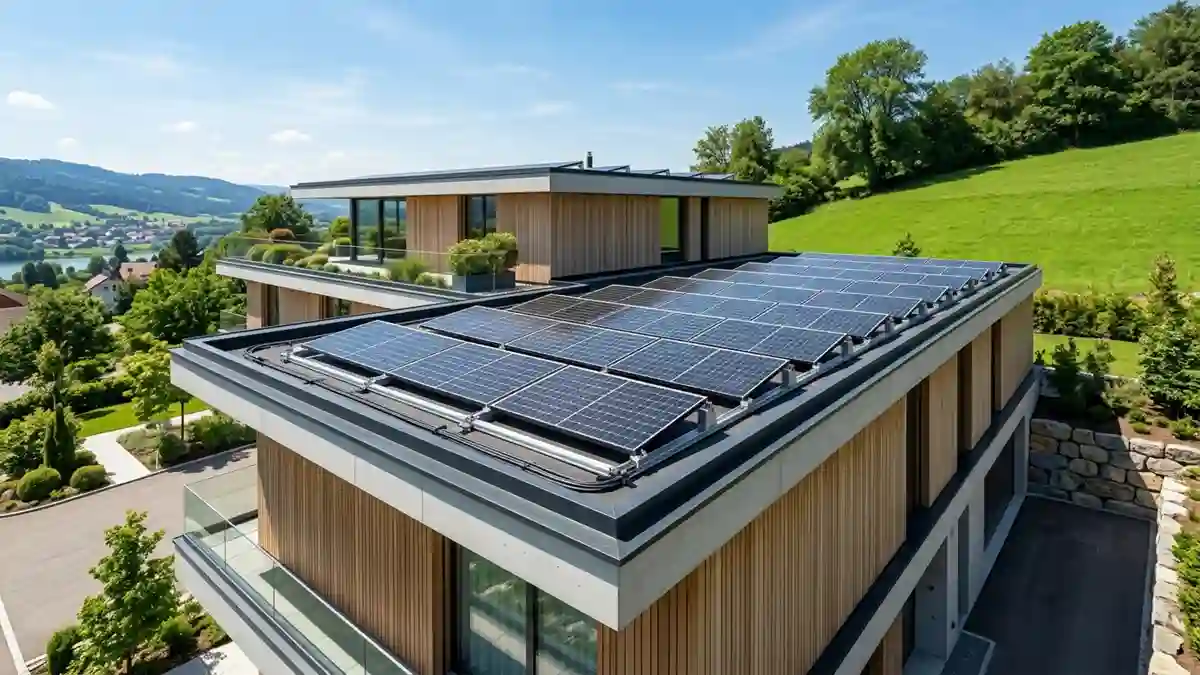
Perovskite Solar Panels: real efficiency numbers, durability concerns, and when this emerging technology becomes buyable — explained by a registered engineer.
Perovskite is the technology I get the most excited questions about and the technology I recommend least often for an actual purchase in 2026 — and both of those things are true for good reason. It genuinely represents the most significant jump in silicon-adjacent solar panel efficiency in years. It’s also not yet something I’d put on a client’s roof as a standalone durable product, and being honest about that gap between research promise and installable reality is the whole point of this guide.
This guide is part of our Technology cluster. It connects directly to our coverage of Tandem Solar Panels, since perovskite’s most commercially promising form right now is as a tandem layer stacked atop standard silicon.
Quick Facts: Perovskite Solar Panels
| Feature | Details |
|---|---|
| Technology | Perovskite Thin-Film Photovoltaics |
| Typical Commercial Status | Emerging Technology |
| Laboratory Efficiency | Over 30% (Tandem Research) |
| Expected Lifespan | Currently Shorter Than Silicon Panels |
| Best For | Next-Generation High-Efficiency Solar Systems |
| Primary Advantage | Exceptional Efficiency Potential |
| Main Limitation | Long-Term Stability and Commercial Scalability |
| Commercial Availability | Limited |
What Makes Perovskite Solar Panels Different
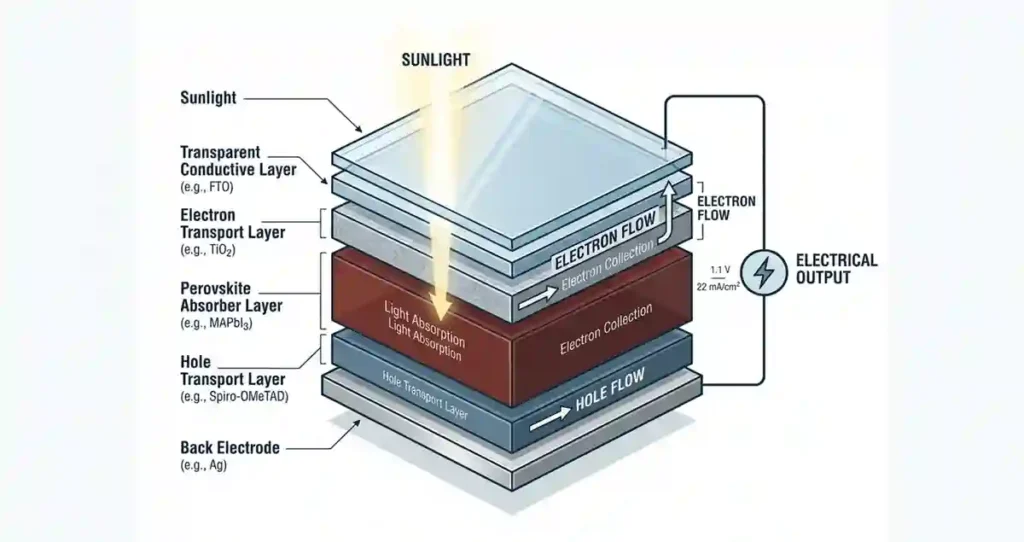
Perovskite refers to a class of crystal-structured compounds that can be manufactured into thin-film solar cells at a fraction of the temperature and energy cost of crystalline silicon. On their own, perovskite cells have achieved lab efficiencies rivaling silicon. Stacked as a top layer on a silicon cell — a perovskite-silicon tandem — the two materials capture different parts of the light spectrum, pushing combined efficiency well beyond what either technology achieves alone.
Engineer’s Note: The efficiency numbers you’ll see reported for perovskite tandem cells are genuinely remarkable, and I don’t want to undersell that. But lab efficiency and 25-year field reliability are two completely different engineering questions, and right now the industry has excellent answers to the first and still-developing answers to the second.
Efficiency and the Durability Question
| Metric | Perovskite-Silicon Tandem | Standard Monocrystalline | Industry Reference |
| Lab efficiency (record) | 33%+ | 26.7% (single junction) | NREL |
| Commercially deployed efficiency | Limited early products | 18% – 22%, standard | Fraunhofer ISE |
| Demonstrated field lifespan | Still being established | 25-30 years, well proven | Fraunhofer ISE |
| Moisture/heat sensitivity | Historically higher, improving | Low, mature encapsulation | PV Magazine |
Engineering Assessment
| Feature | Rating | Engineering Assessment |
|---|---|---|
| Efficiency Potential | ★★★★★ | Among the highest photovoltaic efficiencies achieved in laboratory research. |
| Manufacturing Cost | ★★★★☆ | Thin-film production has the potential to reduce manufacturing costs as commercialization expands. |
| Commercial Readiness | ★★☆☆☆ | Large-scale commercial deployment remains limited. |
| Durability | ★★☆☆☆ | Long-term resistance to moisture, heat, and UV exposure is still improving. |
| Future Potential | ★★★★★ | Widely regarded as one of the most promising next-generation solar technologies. |
| Overall Recommendation | ★★★★☆ | Excellent future technology, but silicon-based panels remain the preferred commercial option today. |
Advantages and Disadvantages
| Advantages | Disadvantages |
| Highest efficiency ceiling of any near-term silicon-adjacent technology | Field lifespan not yet proven at the 25-year timescale of silicon |
| Lower manufacturing energy and temperature requirements than silicon | Historical sensitivity to moisture and heat still being engineered out |
| Tandem format adds efficiency without replacing silicon manufacturing | Limited commercial availability — mostly early-stage product lines |
| Rapid year-over-year efficiency improvement in lab settings | Warranty terms from manufacturers remain shorter and more conservative |
Real-World Applications

Right now, honestly, the real-world application is mostly “watch and wait” for the overwhelming majority of US buyers I talk to, where utility incentive structures and net metering rules already make proven technology the lower-risk financial choice. I’ve fielded genuine interest from clients who read about perovskite online and want it on their next installation, and my consistent advice has been to hold off until the specific product they’re considering has at least a few years of independently verified field performance data, not just lab efficiency claims from the manufacturer.
The one context where I’ve discussed perovskite seriously with a client was a research-oriented installation where the owner explicitly wanted to be an early adopter and understood the durability trade-off going in — treating the system as a technology showcase rather than a purely economic decision. That’s a legitimate reason to consider it today. Optimizing for lowest lifetime cost per watt is not, yet.
Field Note: I tell every curious client the same thing: perovskite tandem panels will very likely be a mainstream, excellent choice within the next several years, but ‘very likely soon’ and ‘proven today’ are different engineering standards, and I won’t recommend a client bet a 25-year investment on the former.
Where It Doesn’t Make Sense Yet
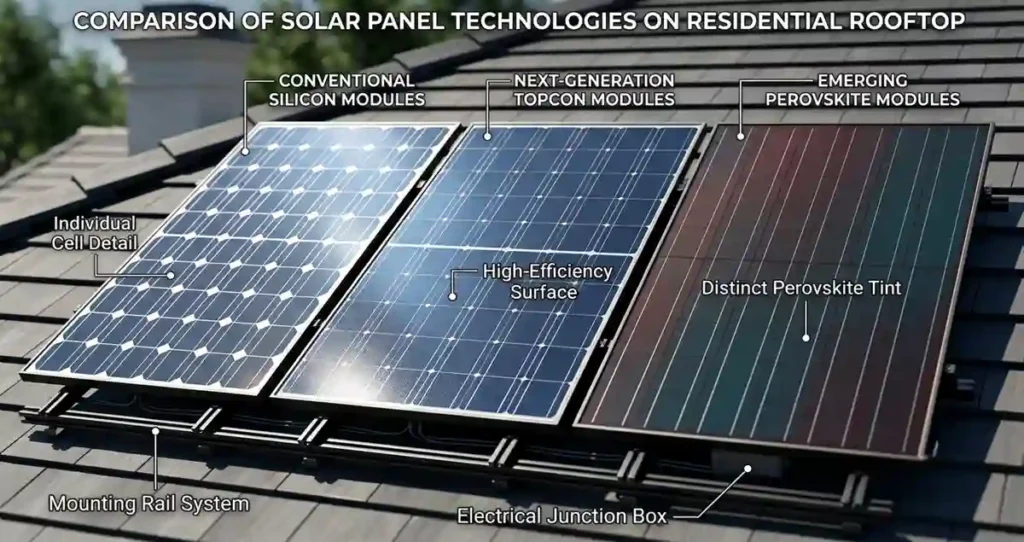
Any installation where you need a firm 25-year performance guarantee backed by a long manufacturer track record. That describes the overwhelming majority of residential and commercial solar purchases, which is exactly why I still default to monocrystalline or TOPCon for nearly every client today, regardless of how compelling perovskite’s lab numbers look.
Common Misconceptions Worth Clearing Up
People sometimes assume perovskite is going to replace silicon entirely. The more likely near-term outcome, based on where manufacturing investment is actually going, is perovskite-silicon tandems — perovskite as a complementary top layer, not silicon’s replacement. Pure perovskite modules face durability challenges that tandem designs partially sidestep by keeping silicon as the proven base layer.
A second misconception worth addressing: some clients assume every headline about a new efficiency record means that specific product is close to commercial availability. Research efficiency records are almost always achieved on small lab cells under controlled conditions, not full-size commercial modules facing real-world weather and manufacturing tolerances. The gap between a record-setting lab cell and a warranty-backed commercial product can span several years, and treating every announcement as an imminent product launch leads to unrealistic expectations.
Standards & Certifications
| Standard | Why It Matters |
|---|---|
| IEC 61215 | Mechanical durability and long-term performance testing |
| IEC 61730 | Electrical safety and fire protection |
| IEC TS 62804 | Potential Induced Degradation (PID) evaluation where applicable |
| UL 61730 | North American electrical safety certification |
| ISO 9001 | Manufacturing quality management systems |
Buying Checklist
Before investing in Perovskite solar panels, consider the following:
✔ Verify whether the product is a laboratory prototype, pilot project, or commercially available module.
✔ Compare long-term degradation data instead of focusing only on laboratory efficiency records.
✔ Review independent testing from trusted organizations such as NREL or Fraunhofer ISE.
✔ Confirm the manufacturer’s moisture, heat, and UV protection technology.
✔ Check warranty coverage carefully, as field experience remains limited compared to silicon technologies.
✔ Compare total system cost with mature technologies such as TOPCon, HJT, and PERC.
✔ Verify compatibility with your inverter, mounting system, and local electrical codes.
✔ Confirm compliance with applicable IEC safety and performance standards.
Who Should Buy Perovskite Solar Panels?
Perovskite solar panels are currently best suited for:
• Universities and research institutions
• Demonstration and pilot solar projects
• Companies developing next-generation photovoltaic technologies
• Organizations evaluating tandem solar cells
• Technology enthusiasts following emerging renewable energy innovations
• Future-focused commercial developers
• Manufacturers participating in photovoltaic research and development
Who Should Avoid Perovskite Solar Panels?
Perovskite solar panels may not currently be the best choice for:
• Residential homeowners seeking proven long-term reliability
• Commercial rooftop installations requiring decades of field-tested performance
• Utility-scale solar farms prioritizing bankable technologies
• Buyers expecting immediate product availability
• Projects with strict long-term warranty requirements
• Budget-conscious installations seeking mature technologies
• Customers requiring maximum durability in harsh outdoor environments today
What To Watch For
- Independently verified field data (not just manufacturer lab claims) covering 3+ years of outdoor exposure
- Warranty length — a manufacturer offering a 25-year warranty on perovskite tandem products is a meaningful confidence signal
- Whether the product is a true tandem (perovskite layered on silicon) or a standalone perovskite module — durability profiles differ significantly
For the tandem cell architecture underpinning most near-term perovskite commercialization, see our Tandem Solar Panels guide. For where perovskite fits against every other emerging cell technology, see our N-Type vs P-Type Solar Panels guide.
For US buyers specifically, it’s worth noting that most state and federal solar incentive programs are structured around proven, certified technology with established warranty terms — early-stage perovskite products may not yet qualify for the same incentive treatment as mainstream silicon panels in every jurisdiction, which is another practical reason to treat this as a technology to watch rather than a purchase to make today.
Setting Realistic Expectations With Clients
When a client brings me a perovskite product they found online, the conversation usually starts with a simple question: what does the warranty actually say? A manufacturer confident in 25-year field durability will put that confidence in writing. Short or heavily qualified warranty language is a far more reliable signal of true product maturity than any lab efficiency number in the marketing materials, and I always tell clients to read that section of the datasheet before anything else.
I keep a running mental list of perovskite and tandem products I’m tracking, specifically watching for the point where independent, multi-year field verification starts appearing in the technical literature rather than just manufacturer press releases. That’s the signal I’m personally waiting for before recommending this technology as a primary choice rather than a closely-watched emerging option.
Engineering Reality Check
| Marketing Claim | Engineering Reality |
|---|---|
| “Perovskite solar panels are replacing silicon.” | Perovskite technology has demonstrated remarkable laboratory efficiencies, but silicon technologies such as TOPCon and HJT remain the commercial standard because of their proven durability, large-scale manufacturing, and decades of real-world operating experience. |
Frequently Asked Questions
What are Perovskite solar panels?
Perovskite solar panels are photovoltaic devices that use perovskite-structured semiconductor materials to convert sunlight into electricity. They are considered one of the most promising next-generation solar technologies due to their exceptional efficiency potential.
How do Perovskite solar panels work?
Perovskite materials absorb sunlight and generate electrical charge carriers that are collected through conductive layers to produce electricity, similar to conventional photovoltaic cells but with different semiconductor materials.
Are Perovskite solar panels commercially available?
Commercial availability remains limited. Most Perovskite solar technologies are currently in pilot production, demonstration projects, or early commercial deployment.
Why are Perovskite solar panels so efficient?
Their crystal structure allows excellent light absorption and efficient charge transport, enabling laboratory efficiencies exceeding 30% in tandem cell configurations.
What is the biggest challenge facing Perovskite solar panels?
The primary challenge is improving long-term stability against moisture, heat, oxygen, and ultraviolet exposure while maintaining high efficiency over decades of operation.
How long do Perovskite solar panels last?
Current commercial expectations are lower than those of conventional silicon panels, although durability continues to improve as manufacturers develop better encapsulation and protective materials.
Are perovskite solar panels better than TOPCon?
Not yet for most commercial projects. TOPCon panels currently offer greater long-term reliability, while Perovskite technology offers higher future efficiency potential.
Can Perovskite be combined with silicon?
Yes. Tandem Perovskite-Silicon solar cells combine both technologies to achieve significantly higher efficiencies than either technology alone.
Are Perovskite solar panels safe?
Commercial products are designed to meet electrical safety standards, although ongoing research continues to improve environmental stability and material safety.
When will Perovskite solar panels become mainstream?
Industry experts expect broader commercialization over the coming years as durability, manufacturing scale, and certification standards continue to mature.
References
The single piece of advice I’d want every US reader to leave this guide with: perovskite’s promise is real, and so is the discipline required to wait for it to mature properly. Being an informed, patient buyer here will serve you far better over a 25-year system life than being an early adopter of a technology still finding its footing.
Record efficiency figures for perovskite and perovskite-tandem cells are drawn from NREL’s Best Research-Cell Efficiency Chart. Durability and field performance context references Fraunhofer ISE’s Photovoltaics Report and ongoing coverage from PV Magazine’s perovskite reporting
Related guides on SolarVisionAI.com
- Monocrystalline Solar Panels 2026: Still Worth It or Hype
- Polycrystalline Solar Panels: Worth Buying in 2026?
- Thin-film Solar Panels: When They Beat Silicon (2026)
- BIPV Solar Panels: Building-Integrated PV Complete Guide
- Portable Solar Panels: Engineer’s Buyer’s Guide 2026
- CPV Solar Panels: Concentrated Photovoltaic Explained
- Skin Solar Panel: What “Solar Skin” Actually Means
- Solar Fence Post Lights: Cap Sizes, Types & Install Guide
- Solar Charge Controller: The Complete Guide
- MC4 Connectors: Solar Safety & Installation Guide
- Solar Panel Types, Efficiency & Benefits
- Solar Water Pump Guide
- Commercial Solar Panel Installation: Engineering Guide
- Solar Fence Post Lights: Cap Sizes, Types & Install Guide
- BESS — Battery Energy Storage System Guide
- Commercial Solar Panel Installation
2 thoughts on “Perovskite Solar Panels: The 2026 Reality Check”