
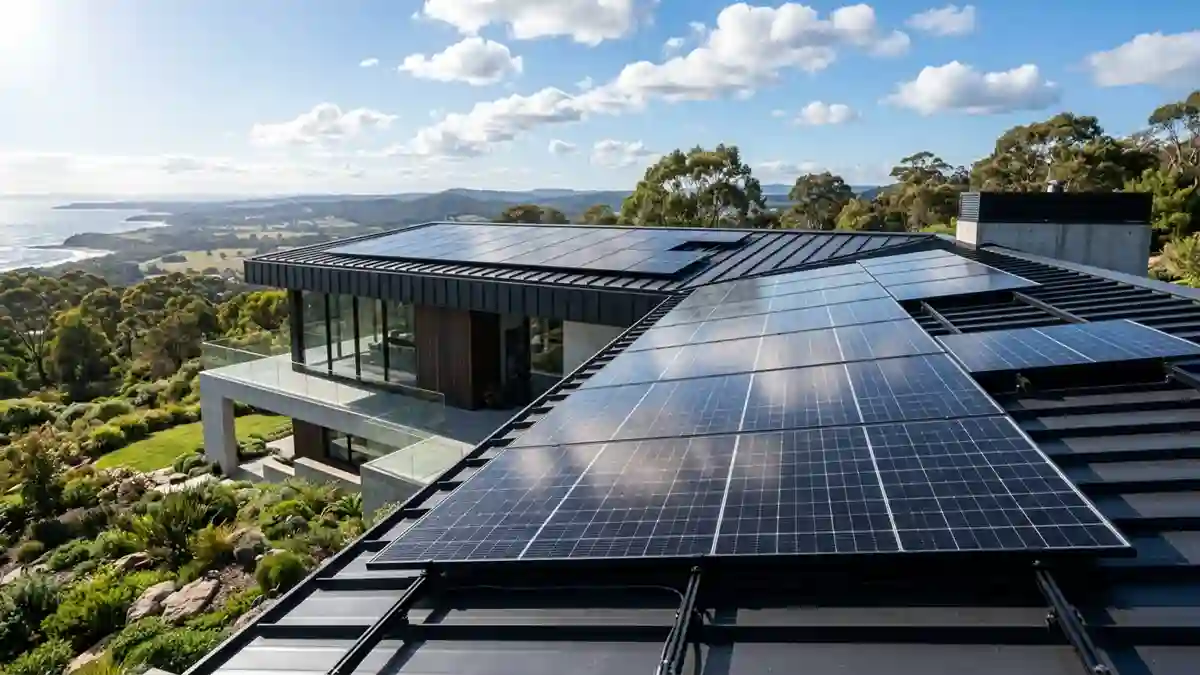
Tandem solar panels technology explained — how stacking cell layers boosts efficiency, and whether it’s ready for real rooftops in 2026
Tandem cells are the architecture underpinning most of the genuinely exciting efficiency headlines in solar panels research right now, and understanding the concept clarifies why perovskite, CPV, and next-generation silicon research all keep converging on the same basic idea: no single material captures the whole solar spectrum efficiently, so stack two materials that each specialize in a different part of it.
This guide is part of our Technology cluster, and connects directly to our Perovskite Solar Panels guide, since perovskite-silicon tandems are the most commercially advanced form of this technology today, and to our CPV Solar Panels guide, which uses multi-junction tandem cells at the extreme end of the concept.
Quick Facts: Tandem Solar Panels
| Feature | Details |
|---|---|
| Technology | Multi-junction Tandem Solar Cells |
| Typical Efficiency | 28–35% (commercially emerging) |
| Laboratory Efficiency | Over 34% |
| Expected Lifespan | 20–30 Years (improving) |
| Best For | High-efficiency rooftops, BIPV, space-constrained systems |
| Primary Advantage | Extremely high efficiency |
| Main Limitation | High manufacturing cost and limited commercialization |
| Typical Warranty | Manufacturer dependent |
How Tandem Cells Work
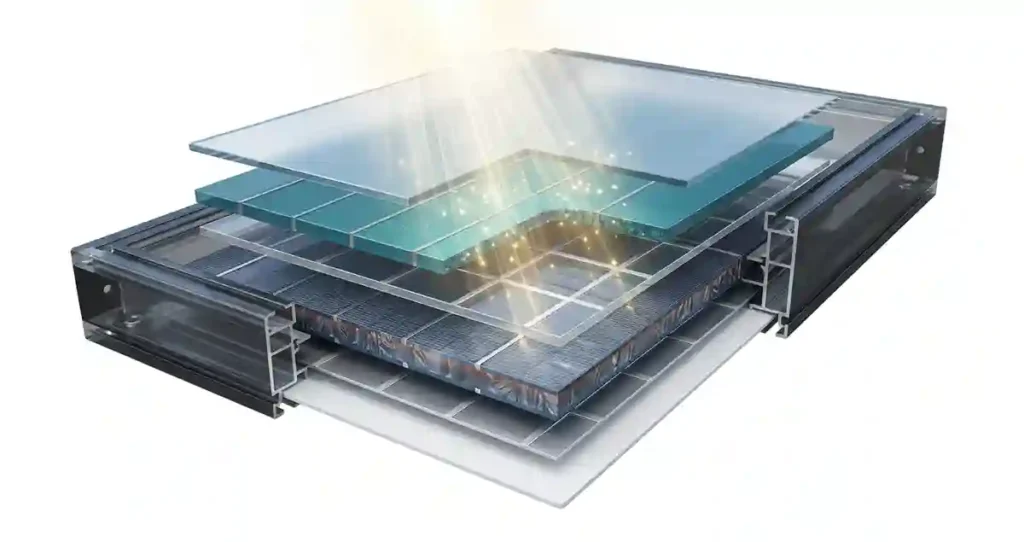
Sunlight contains a broad spectrum of wavelengths, and any single semiconductor material is only efficient at converting a portion of that spectrum — the rest either passes through unconverted or is lost as heat. Tandem design stacks two (or more) semiconductor layers with different spectral sensitivities, so the top layer captures the wavelengths it’s best suited for and lets the remaining light pass through to a bottom layer tuned to a different part of the spectrum. The combined efficiency of the stack exceeds what either material could achieve alone.
Engineer’s Note: The most common tandem configuration people ask me about is perovskite-on-silicon: a perovskite top layer captures higher-energy shorter wavelengths, while the silicon base layer — already well-understood and manufacturable at scale — captures the longer wavelengths perovskite doesn’t use efficiently. It’s a genuinely elegant division of labor between an established material and an emerging one.
Technical Specifications
| Specification | Typical Value | Why It Matters |
|---|---|---|
| Cell Architecture | Perovskite-Silicon Tandem | Higher photon utilization |
| Commercial Efficiency | 28–35% | Higher energy density |
| Laboratory Efficiency | >34% | Future performance potential |
| Temperature Coefficient | ~−0.30 to −0.35%/°C | Better hot-climate performance |
| Annual Degradation | Still under evaluation | Long-term reliability |
| Certifications | IEC 61215, IEC 61730 (future commercial products) | Safety & durability |
Efficiency Potential and Current Reality
| Metric | Tandem (Perovskite-Silicon) | Standard Single-Junction Silicon | Industry Reference |
| Lab efficiency (record) | 33%+ | 26.7% | NREL |
| Commercial availability | Very limited, early stage | Fully mature, mainstream | Fraunhofer ISE |
| Field durability data | Still being established | 25-30 years, well proven | Fraunhofer ISE |
| Manufacturing complexity | High — two-layer precision deposition | Lower — single-material process | PV Magazine |
Engineering Assessment
| Feature | Rating | Engineering Assessment |
|---|---|---|
| Efficiency | ★★★★★ | Highest efficiency among emerging commercial technologies. |
| Reliability | ★★★★☆ | Rapidly improving but long-term field data is limited. |
| Heat Performance | ★★★★★ | Excellent due to advanced cell architecture. |
| Innovation | ★★★★★ | Represents the future direction of photovoltaic technology. |
| Cost | ★★☆☆☆ | Currently expensive because manufacturing is still scaling. |
| Long-Term Value | ★★★★★ | Exceptional long-term potential as commercialization expands. |
| Overall Recommendation | ★★★★★ | One of the most promising next-generation solar technologies. |
Advantages and Disadvantages
| Advantages | Disadvantages |
| Highest efficiency ceiling of any near-term commercially viable technology | Field durability not yet proven at silicon’s 25-year benchmark |
| Builds on proven silicon manufacturing rather than replacing it entirely | Manufacturing complexity of precision multi-layer deposition is significant |
| Rapid efficiency gains year over year as the technology matures | Very limited commercial product availability as of 2026 |
| Clear technical pathway to surpassing silicon’s theoretical efficiency limit | Warranty terms remain conservative given limited field history |
Real-World Applications

As with perovskite generally, tandem technology today is mostly a “watch closely, don’t bet your whole project on it yet” conversation with clients. The one meaningful exception in my experience has been utility-scale developers in the US market running long-horizon planning models who want to understand where the technology roadmap is heading, even if they’re not purchasing tandem panels for their current project — that forward-looking context genuinely helps with long-term site and infrastructure planning.
I’ve also discussed tandem technology with clients purely from an educational angle — people who read about record efficiency announcements and want to understand what’s actually happening, separate from whether it changes their immediate buying decision. That’s a completely reasonable reason to want a clear explanation, even without an imminent purchase attached to it.
Field Note: I try to give every client the same honest framing: tandem technology’s trajectory looks genuinely excellent, and it’s very likely to become a mainstream, proven choice within a handful of years. That’s different from saying it’s the right choice for a system going up on a rooftop this year, where a 25-year track record matters more than a promising research trajectory.
Where Tandem Solar Panels Make the Most Sense
| Installation Scenario | Recommendation | Engineering Assessment |
|---|---|---|
| Premium Residential Homes | ★★★★★ | Excellent for maximizing energy density. |
| Commercial Buildings | ★★★★☆ | Suitable where premium efficiency is justified. |
| Utility-Scale Projects | ★★★☆☆ | Commercial deployment is still emerging. |
| Building Integrated PV | ★★★★★ | One of the strongest future applications. |
| Electric Vehicles | ★★★★★ | Lightweight high-efficiency technology. |
| Space Applications | ★★★★★ | Outstanding due to maximum efficiency. |
Where It Doesn’t Make Sense Yet
Any installation prioritizing a long, proven warranty and manufacturer track record — which is the right priority for the overwhelming majority of residential and commercial solar purchases today. Tandem technology hasn’t yet accumulated the multi-decade field history that makes silicon-only panels the safe, boring, reliable default.
Common Misconceptions Worth Clearing Up
Explain:
- Tandem ≠ Perovskite only
- Not all tandem cells are commercially available
- Highest efficiency doesn’t always mean lowest cost
- Tandem panels are not yet replacing silicon everywhere
- Laboratory efficiency ≠ field efficiency
Common Misconceptions Worth Clearing Up
People sometimes conflate “tandem” with “perovskite” as if they’re the same thing. Tandem is the architectural concept — stacking materials with complementary spectral sensitivity. Perovskite-silicon is currently the most commercially advanced tandem pairing, but CPV’s multi-junction cells are also a form of tandem design, using different material combinations optimized for concentrated sunlight rather than standard flat-panel use.
Standards & Certifications
| Standard | Why It Matters |
|---|---|
| IEC 61215 | Long-term durability |
| IEC 61730 | Electrical safety |
| UL 61730 | North American certification |
| IEC TS 63126 | Performance evaluation |
| ISO 9001 | Manufacturing quality |
Buying Checklist
- Verify whether the panel uses a true perovskite-silicon tandem architecture.
- Review independently verified efficiency rather than laboratory claims.
- Confirm IEC safety and durability certifications where available.
- Compare the cost premium against TOPCon, HJT, and IBC alternatives.
- Check the manufacturer’s warranty and degradation projections.
- Ensure compatibility with your inverter and mounting system.
- Evaluate long-term manufacturer support before purchasing.
- Compare real-world performance data, not just prototype announcements.
What To Watch For
- Independently verified multi-year field data, not just announced lab efficiency records
- Manufacturer warranty length as a proxy for confidence in long-term durability
- Whether a specific tandem product has passed standard IEC certification testing for commercial deployment
For the specific material driving most near-term tandem commercialization, see our Perovskite Solar Panels guide. For tandem architecture taken to its most extreme, high-concentration form, see our CPV Solar Panels guide.
For US-based utility-scale developers specifically, I’d frame tandem technology as a genuine planning consideration for projects still several years out from construction, particularly where land acquisition and interconnection studies already extend multi-year timelines. By the time those projects reach equipment procurement, tandem products may have matured enough to be a real line item in the technology comparison, rather than a footnote.
Who Should Buy Tandem Solar Panels?
Recommended for:
- Early adopters of advanced solar technology
- Premium residential homeowners
- Commercial buildings maximizing roof output
- Building-integrated photovoltaic (BIPV) projects
- Electric vehicle charging installations
- High-performance research facilities
- Space-constrained rooftops
- Buyers prioritizing maximum efficiency
Who Should Avoid Tandem Solar Panels?
Less suitable for:
- Budget-conscious homeowners
- Projects focused on the lowest upfront cost
- Large installations where conventional panels are sufficient
- Buyers seeking long-established field performance
- Regions where tandem products are not commercially available
- Temporary solar installations
- Off-grid projects with tight budgets
- Users requiring immediate product availability
Engineering Reality Check
| Marketing Claim | Engineering Reality |
|---|---|
| “Tandem panels will replace every other solar technology immediately.” | Tandem technology is extremely promising, but widespread commercial adoption will take time as manufacturing scales and costs decrease. |
Sizing the Decision Around Long-Term Value
Clients often ask me to boil tandem technology down to a single number — how many extra years until it’s the obvious mainstream choice. I don’t think that question has a clean answer yet, because the honest driver isn’t a calendar date, it’s accumulated field data crossing a credibility threshold that manufacturers, insurers, and installers all trust. Once that threshold is crossed, warranty terms will lengthen, pricing will fall, and the calculus shifts quickly. Until then, the smartest move for most clients is exactly what I recommend: build your current system on proven technology, and revisit tandem seriously the next time you’re planning a system, likely with a much clearer picture in hand.
I also encourage clients not to view choosing proven silicon today as somehow settling for less. A well-specified monocrystalline or TOPCon system installed now will still be generating reliable power throughout tandem’s maturation period, and by the time replacement or expansion conversations come up, the newer technology will be a genuinely evaluated option rather than a leap of faith.
Frequently Asked Questions
Are tandem solar panels worth buying in 2026?
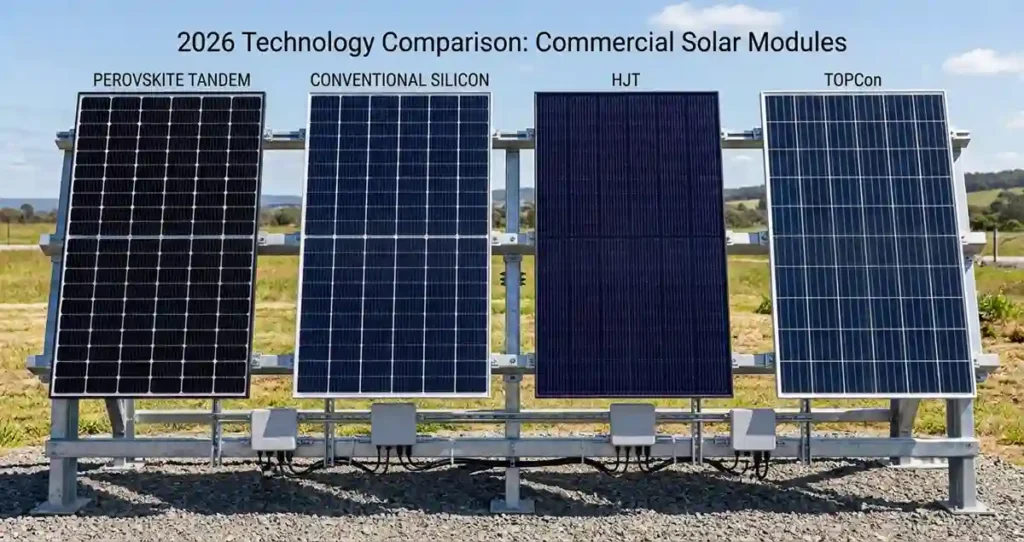
For most homeowners, tandem solar panels are still considered an emerging technology rather than a mainstream option. They offer exceptional efficiency and long-term potential, but limited commercial availability and higher costs mean TOPCon and HJT panels remain the more practical choice for most installations in 2026.
How efficient are tandem solar panels?
Commercial tandem solar panels typically achieve efficiencies of around 28% to 35%, while laboratory prototypes have already exceeded 34%. Their multi-junction design allows them to convert a broader portion of the solar spectrum than conventional silicon panels.
What is a tandem solar panel?
A tandem solar panel combines two or more photovoltaic materials, most commonly a perovskite top cell and a silicon bottom cell, to capture different wavelengths of sunlight. This layered architecture significantly improves energy conversion efficiency compared to traditional single-junction solar cells.
Are tandem panels better than TOPCon?
Tandem solar panels have the potential to outperform TOPCon in efficiency because they use multiple photovoltaic layers to harvest more sunlight. However, TOPCon panels are currently more mature, widely available, and offer proven long-term reliability for commercial installations.
Are tandem panels better than HJT?
Tandem panels are expected to surpass HJT in efficiency once commercial production becomes widespread. At present, HJT technology remains the more established and readily available premium option with extensive real-world performance data.
Can tandem panels be used with lithium batteries?
Yes. Tandem solar panels are fully compatible with lithium battery systems. Battery compatibility depends on the inverter, charge controller, and overall system design rather than the photovoltaic cell technology itself.
Are tandem solar panels compatible with net metering?
Yes. Tandem solar panels can be used in net-metered systems as long as the installation complies with local utility regulations, inverter certification requirements, and applicable electrical codes.
Do tandem solar panels perform well in hot climates?
Yes. Tandem solar panels are designed to perform efficiently across a wide range of temperatures. Many tandem architectures demonstrate lower temperature losses than conventional silicon technologies, making them promising for hot-climate installations.
What certifications should tandem solar panels have?
Commercial tandem solar panels should comply with internationally recognized standards such as IEC 61215 for long-term durability, IEC 61730 for electrical safety, and UL 61730 for North American installations. Buyers should also verify manufacturer warranties and independent third-party certifications.
When will tandem solar panels become widely available?
Tandem solar technology is rapidly moving from research laboratories into commercial production. Industry experts expect broader market adoption during the second half of this decade as manufacturing scales up, production costs decline, and long-term reliability continues to improve.
References
My closing advice to any US client asking about tandem technology today is the same one I give about most emerging solar tech: stay informed, don’t stay idle. Get your current system built on proven, well-warrantied technology now, and treat tandem as a genuine consideration for your next major solar decision rather than something to wait indefinitely for.
Record efficiency figures for tandem cell architectures are drawn from NREL’s Best Research-Cell Efficiency Chart. Field durability and manufacturing context references Fraunhofer ISE’s Photovoltaics Report and ongoing coverage from PV Magazine.
Related guides on SolarVisionAI.com
- Monocrystalline Solar Panels 2026: Still Worth It or Hype
- Polycrystalline Solar Panels: Worth Buying in 2026?
- Thin-film Solar Panels: When They Beat Silicon (2026)
- BIPV Solar Panels: Building-Integrated PV Complete Guide
- Portable Solar Panels: Engineer’s Buyer’s Guide 2026
- CPV Solar Panels: Concentrated Photovoltaic Explained
- Skin Solar Panel: What “Solar Skin” Actually Means
- Solar Fence Post Lights: Cap Sizes, Types & Install Guide
- Solar Charge Controller: The Complete Guide
- MC4 Connectors: Solar Safety & Installation Guide
- Solar Panel Types, Efficiency & Benefits
- Solar Water Pump Guide
- Commercial Solar Panel Installation: Engineering Guide
- Solar Fence Post Lights: Cap Sizes, Types & Install Guide
- BESS — Battery Energy Storage System Guide
- Commercial Solar Panel Installation