
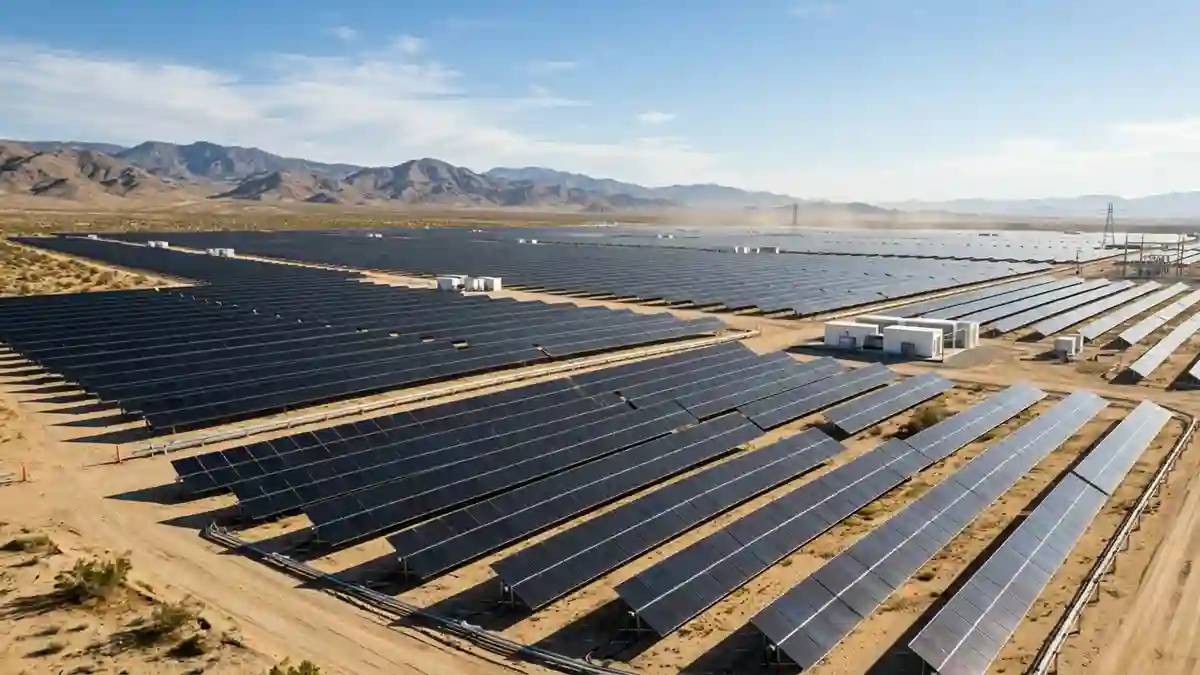
Thin-film solar panels efficiency, cost, and the specific situations where they outperform crystalline silicon — an engineer explained.
Thin-film solar panels are often dismissed the moment buyers see their 10–12% efficiency compared to 18–22% for monocrystalline solar panels. But that’s the wrong comparison. Thin-film solar panels aren’t built for space-constrained residential rooftops—they’re designed for utility-scale projects, lightweight structures, and flexible applications where crystalline silicon panels simply can’t compete.
This guide is part of our Types of Solar Panels hub — see that page for how thin-film compares against every other panel category at a glance.
How Thin-Film Solar Panels Are Actually Built
Rather than wafer-cut silicon cells, thin-film panels deposit a semiconductor layer — usually cadmium telluride (CdTe), amorphous silicon (a-Si), or CIGS (copper indium gallium selenide) — directly onto a substrate of glass, plastic, or metal. This uses a fraction of the raw material that crystalline silicon requires, which is the entire reason thin-film scales cheaply at large volumes.
Engineer’s Note: People often assume “thin-film” means one product. It doesn’t — CdTe, a-Si, and CIGS behave differently in temperature tolerance, degradation, and cost. If a supplier says “thin-film” without specifying which, ask. It changes the spec sheet significantly, and I’ve seen buyers get burned assuming all three perform identically. A five-minute question to the supplier can save a lot of disappointment two years down the line.
Efficiency and Real Performance Numbers
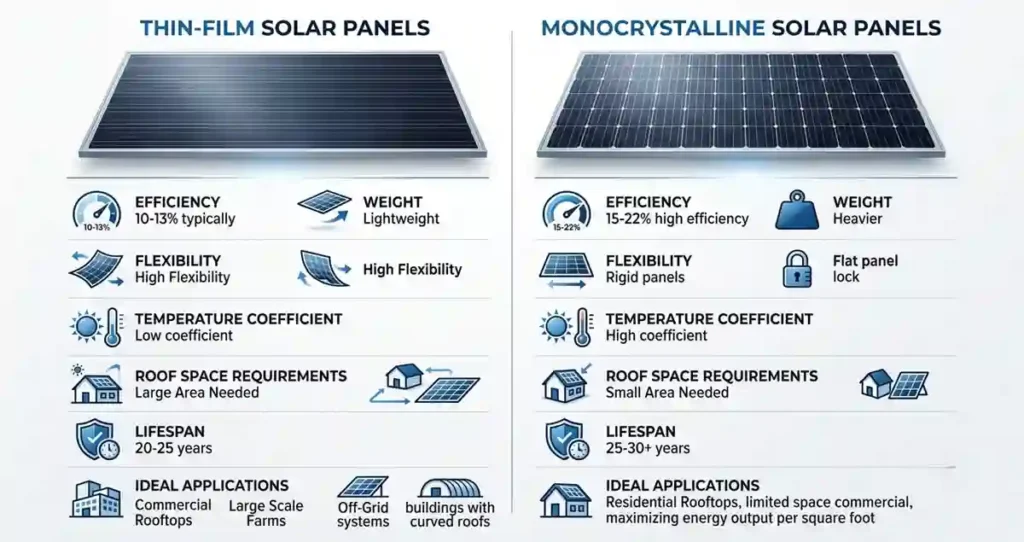
| Metric | Thin-Film Solar panels | Monocrystalline | Practical Difference | Industry Reference |
|---|---|---|---|---|
| Typical Module Efficiency | 10–12% | 18–22% | Monocrystalline produces nearly twice the power per square meter. | NREL, Fraunhofer ISE |
| Temperature Coefficient | ~−0.25%/°C | ~−0.35%/°C | Thin-film generally loses less output under high operating temperatures. | NREL |
| Module Weight | Significantly Lower | Higher | Better suited for lightweight roofs and specialty installations. | Manufacturer Specifications |
| Flexibility | Available | Rigid Only | Thin-film supports curved and non-standard mounting surfaces. | PV Magazine |
| Roof Space for 5 kW | ~50 m² | ~27 m² | Thin-film requires substantially more installation area. | Typical Commercial Modules |
| Certification | IEC Certified | IEC Certified | Both technologies should comply with international durability and safety standards. | IEC 61215 & IEC 61730 |
The temperature coefficient advantage is the detail most buyers miss entirely: in extreme heat, thin-film’s efficiency gap narrows because it degrades less per degree than crystalline silicon does. That’s a meaningful part of why utility farms in very hot, high-irradiance regions occasionally choose thin-film despite the raw efficiency deficit.
Types of Thin-Film Solar Panels
Thin-film solar panels are not a single technology but a family of photovoltaic technologies that use ultra-thin semiconductor layers instead of traditional crystalline silicon wafers. The three main types are Cadmium Telluride (CdTe), Copper Indium Gallium Selenide (CIGS), and Amorphous Silicon (a-Si), each designed for different applications and performance requirements.
- Cadmium Telluride (CdTe): The most widely deployed thin-film technology, CdTe solar panels are commonly used in utility-scale solar farms due to their competitive manufacturing costs, strong performance in hot climates, and excellent energy yield under high solar irradiance.
- Copper Indium Gallium Selenide (CIGS): CIGS panels generally offer the highest efficiency among thin-film technologies and are available in both rigid and flexible formats. Their lightweight construction and flexibility make them ideal for curved roofs, portable solar systems, building-integrated photovoltaics (BIPV), and other specialty applications.
- Amorphous Silicon (a-Si): Amorphous silicon panels have the lowest efficiency of the three technologies but perform well under low-light conditions. They are most commonly used in small electronic devices, portable chargers, calculators, and low-power applications rather than large residential or commercial solar installations.
From an engineering perspective, no single thin-film technology is universally superior. The best choice depends on the project’s objectives, available installation space, structural requirements, operating temperature, and budget. While CdTe dominates utility-scale power generation, CIGS excels where flexibility and lightweight construction are required, and a-Si remains a practical solution for small-scale, low-power devices.
Engineering Assessment
| Feature | Engineering Assessment |
|---|---|
| Cost | Excellent for utility-scale projects |
| Residential Suitability | Limited |
| Temperature Performance | Excellent |
| Structural Weight | Outstanding |
| Flexibility | Outstanding |
| Efficiency | Moderate |
| Overall Recommendation | Best suited for specialized engineering applications rather than typical residential rooftops. |
Advantages and Disadvantages
| Advantages | Disadvantages |
| Lightweight — usable on roofs unable to bear rigid panel load | Lowest efficiency category on the mainstream market |
| Better temperature coefficient in extreme heat | Requires roughly double the area for equal output |
| Some formats are genuinely flexible | Historically, faster degradation in the first few years |
| Lower embodied manufacturing energy | Limited residential product availability and warranty depth |
Real-World Applications
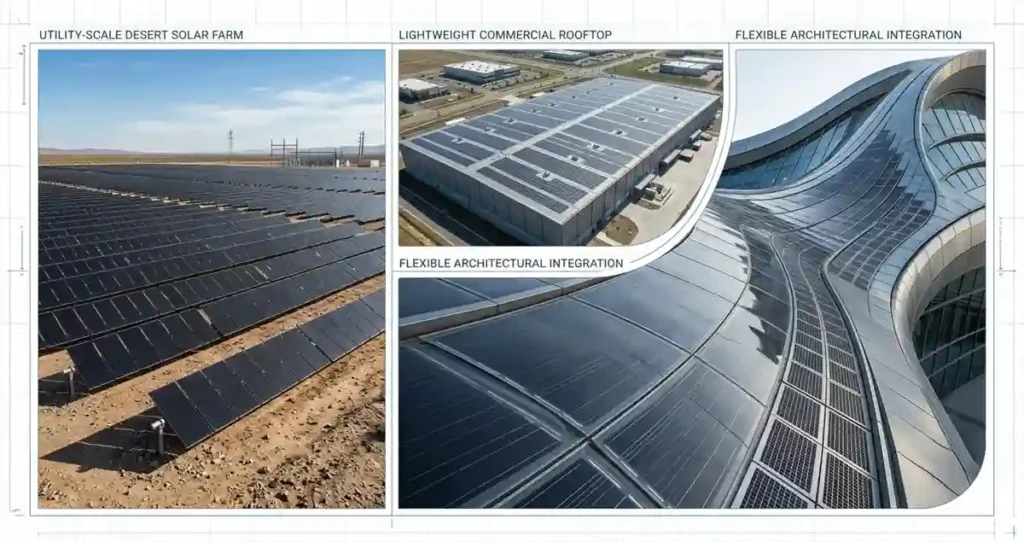
The two utility-scale projects I’ve been involved in specifying thin-film for both shared the same profile: desert-adjacent sites with land costing nothing per additional panel row, effectively, paired with summer ambient temperatures regularly above 45°C. In both cases, the better temperature coefficient measurably offset part of the efficiency deficit across peak summer months, and the land was simply not a constraint worth optimizing against.
The other place I’ve used thin-film is inside flexible/portable products, where its base chemistry underpins the Skin-Type Flexible panels category — a boat owner needing a curved-deck installation, or a specialty application where a rigid frame simply won’t physically fit. That’s a fundamentally different buying decision from a utility farm, but it’s the same underlying technology doing the work.
I’ve also seen thin-film specified for warehouse rooftops where the structural engineer flagged that the existing roof deck couldn’t bear the additional dead load of standard framed glass panels without reinforcement. In that scenario, the thin film’s lower weight per square meter solved a structural problem that no amount of efficiency from a heavier panel could have solved — the building couldn’t carry more weight, full stop, and that constraint overrode every other consideration in the selection process.
Who Should Buy Thin-Film Solar Panels?
- Utility-scale solar farms
- Desert installations
- Lightweight commercial roofs
- Curved architectural surfaces
- Mobile and portable solar systems
- Specialty engineering projects
Who Should Avoid Thin-Film Solar Panels?
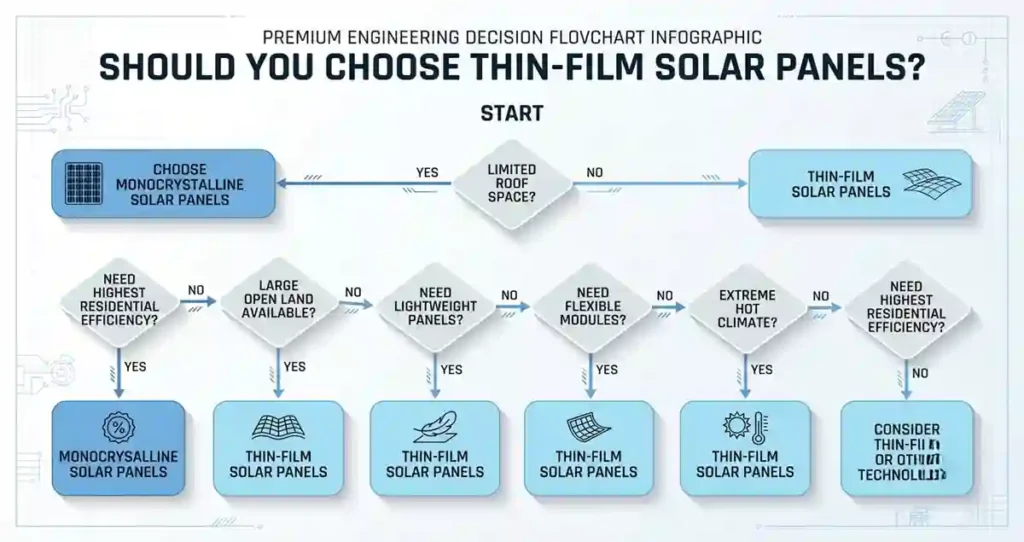
- Homes with limited roof space
- Urban residential rooftops
- High-efficiency residential systems
- Small commercial buildings
- Projects where land is expensive
- Installations prioritizing maximum power density
Installation and Lifespan Considerations
Thin-film’s lower weight simplifies racking design and can reduce structural reinforcement costs on marginal roofs, but it doesn’t simplify electrical design — string sizing and voltage calculations still need to account for the lower per-panel wattage, which typically means more panels and more connections to reach the same system size compared to monocrystalline. That translates to more junction boxes, more MC4 connections, and more potential failure points across the array, even though each component is doing less work.
On lifespan, plan conservatively. Where monocrystalline commonly carries 25-year performance warranties, thin-film manufacturers are often more conservative, and the degradation curve in the first few years tends to be steeper before leveling off — a pattern known in the industry as light-induced degradation for some thin-film chemistries. Ask for the manufacturer’s year-by-year degradation curve specifically, not just the headline 25-year number, before committing to a large installation.
Where It Doesn’t Make Sense
Residential rooftops with any space constraint at all. The larger footprint required for equivalent output usually makes thin-film a worse total-cost choice once installation labor and racking are factored in, compared to monocrystalline or TOPCon. See Monocrystalline Solar Panels for the space-constrained alternative.
Field Note: Every thin-film install I’ve specified in the last two years has been utility-scale or a specialty flexible application. I haven’t recommended it for a standard residential rooftop once — the math just doesn’t favor it there anymore, and I don’t expect that to change soon given how cheap monocrystalline has become.
A Real Cost Comparison Worked Example
On a 2MW utility-scale project I reviewed, thin-film’s roughly 10% lower cost per watt against crystalline silicon was substantial in absolute dollar terms — but the array needed close to double the land area to hit the same nameplate capacity, and land acquisition and civil works (fencing, access roads, grading) at that scale isn’t free. Once land and balance-of-system costs were fully accounted for, the total installed cost per watt was close to parity between thin-film and monocrystalline at that specific site, and monocrystalline won on total lifetime output due to its better degradation profile.
The calculus only tips back toward thin-film when land is genuinely free or near-free relative to the project — leased desert land at low per-acre rates, for instance — or when the operating temperature is high enough that thin-film’s better temperature coefficient meaningfully closes the annual output gap. Neither condition is common outside specific utility-scale contexts, which is exactly why I don’t recommend this technology for the vast majority of readers comparing panel types for a home or business.
Common Misconceptions Worth Clearing Up
The biggest misconception I run into is buyers assuming thin-film is inherently the “green” or “eco-friendly” choice because it uses less raw material per panel. Manufacturing energy intensity per panel is lower; that part is true, but manufacturing energy per watt of lifetime generation tells a different story once you factor in the larger array size and generally shorter service life needed to match crystalline silicon’s output. It isn’t a clear-cut environmental win either way, and I’d encourage skepticism toward marketing that leans hard on that angle without showing the full lifecycle numbers.
The second misconception is that all thin-film panels perform the same in shade. Some CdTe and CIGS formats do tolerate partial shading better than crystalline silicon because of how their cells are structured, but this varies meaningfully between manufacturers and isn’t a universal property of “thin-film” as a category. If shade tolerance is part of your decision, ask for the specific manufacturer’s shading performance data rather than relying on general claims about the technology class.
Buying Checklist If You Choose Thin-Film
- Confirm which chemistry (CdTe, a-Si, or CIGS) is used — they behave quite differently in the field and are not interchangeable
- Verify manufacturer certification against recognized international standards
- Check degradation rate specifically — thin-film historically degrades faster than crystalline in the first few years
- Confirm the panel’s IP rating if it will be exposed to moisture
If there’s one closing thought I’d leave you with on thin-film, it’s this: don’t let the low headline efficiency number decide for you, and don’t let a salesperson’s sustainability pitch make it for you either. Work out the actual footprint and total installed cost for your specific site, compare it honestly against monocrystalline for that same site, and let the numbers for your project — not the technology’s reputation either way — make the call.
Frequently Asked Questions (FAQs)
Are Thin-Film Solar Panels Worth Buying in 2026?
Yes, but only for the right applications. Thin-film solar panels remain an excellent choice for utility-scale projects, lightweight rooftops, curved surfaces, and high-temperature environments. For most residential rooftops with limited space, modern monocrystalline panels generally provide better overall value due to their higher efficiency.
Why Are Thin-Film Solar Panels Less Efficient Than Monocrystalline Panels?
Thin-film solar panels use extremely thin semiconductor layers instead of crystalline silicon wafers. While this reduces manufacturing costs and weight, it also results in lower energy conversion efficiency—typically 10–12% compared to 18–22% for monocrystalline panels.
Which Thin-Film Technology Is Best: CdTe, CIGS, or Amorphous Silicon?
There is no universal “best” technology. Cadmium Telluride (CdTe) is widely used in utility-scale solar farms due to its excellent performance in hot climates. CIGS (Copper Indium Gallium Selenide) offers higher efficiency and flexibility for specialized applications, while Amorphous Silicon (a-Si) is commonly used in small electronics and low-power devices.
Do Thin-Film Solar Panels Perform Better in Hot Climates?
Yes. Thin-film solar panels generally have a better temperature coefficient than crystalline silicon panels, meaning they lose less power as temperatures increase. This makes them particularly suitable for hot regions and utility-scale installations in desert environments.
Can Thin-Film Solar Panels Be Installed on Curved Roofs?
Yes. Certain thin-film technologies, particularly flexible CIGS modules, can conform to curved roofs, vehicle roofs, boats, and other unconventional surfaces where rigid glass panels cannot be installed.
How Long Do Thin-Film Solar Panels Last?
Most quality thin-film solar panels have an expected lifespan of 20–30 years, depending on the technology, manufacturer, and operating conditions. Always review the product warranty and annual degradation rate before purchasing.
Are Thin-Film Solar Panels Suitable for Residential Homes?
In most cases, no. Because thin-film panels require significantly more installation area to produce the same power output, they are generally less practical for residential rooftops where space is limited. Monocrystalline panels remain the preferred option for most homes.
Are Thin-Film Solar Panels Recyclable?
Yes. Many thin-film solar panels can be recycled, although recycling methods vary depending on the semiconductor material used. Several manufacturers also operate dedicated recycling programs to recover valuable materials and reduce environmental impact.
What Certifications Should Thin-Film Solar Panels Have?
Look for internationally recognized certifications such as IEC 61215 for design qualification and performance testing, IEC 61730 for electrical safety, and additional certifications required by your local market. These standards help ensure long-term reliability and safe operation.
Can Thin-Film Solar Panels Be Used with Battery Storage Systems?
Yes. Thin-film solar panels are fully compatible with battery storage systems. Compatibility depends on the inverter, charge controller, and overall system design rather than the type of solar panel technology itself.
Related guides on SolarVisionAI.com
- Solar Fence Post Lights: Cap Sizes, Types & Install Guide
- Solar Charge Controller: The Complete Guide
- MC4 Connectors: Solar Safety & Installation Guide
- Solar Panel Types, Efficiency & Benefits
- Solar Water Pump Guide
- Commercial Solar Panel Installation: Engineering Guide
- Solar Fence Post Lights: Cap Sizes, Types & Install Guide
- BESS — Battery Energy Storage System Guide
- Commercial Solar Panel Installation