
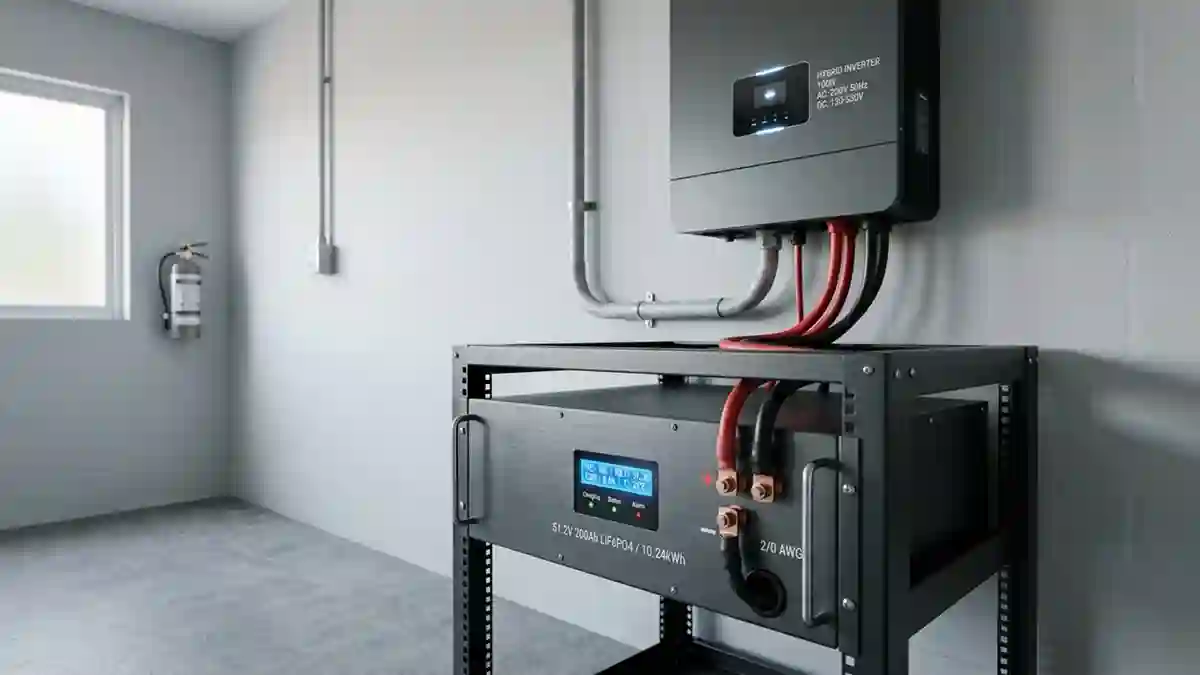
48V 200Ah LiFePO4 Battery: Specs, sizing, runtime, inverter compatibility, cost per kWh, and red flags to check before buying.
The 48V 200Ah LiFePO4 battery — also sold as the 51.2V 200Ah battery — has become the standard building block for home battery energy storage. Both names describe the same product: “48V” is the traditional label carried over from lead-acid systems, while 51.2V is the battery’s actual nominal voltage. It is large enough to run essential loads through an evening or a short outage, and modular enough that a second or third unit can be added later.
You’ll also see it sold under other names: “powerwall-style,” “server rack battery,” and “ESS battery.” They all describe the same product category.
Engineer’s Note: In the past few years, the 48V/51.2V 200Ah format has become close to a de facto standard for residential solar storage. Most hybrid inverter manufacturers now design their 48V input range specifically around this battery class, which is why it’s the size you’ll see recommended most often for home systems.
This guide explains what the numbers mean, how to check whether a specific unit is genuine, how long it can run your loads, and what to confirm before connecting one to an inverter.
Quick answer: A 51.2 V 200 Ah LiFePO4 battery stores 10.24 kWh (51.2 V x 200 Ah). Most units deliver 9 to 10 kWh of usable energy, use 16 cells in series, and are sold as server-rack or wall-mounted modules for 48 V hybrid inverters. Before buying, check the continuous discharge rating (often 100 to 200 A), the communication protocol your inverter supports, and the safety certifications (UL 1973, IEC 62619, UN 38.3).
1. What “51.2 V 200 Ah” Means
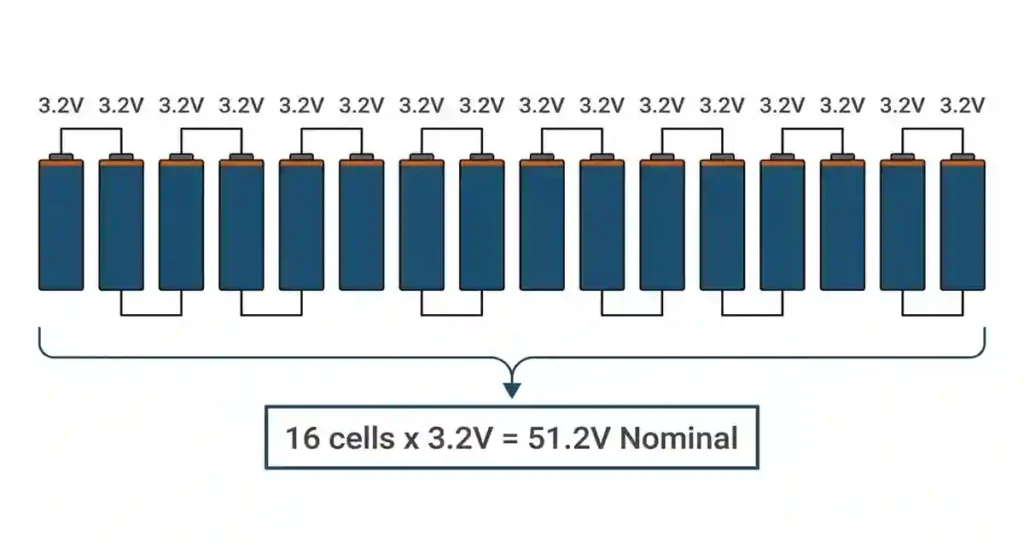
Each LiFePO4 cell has a nominal voltage of 3.2 V. Sixteen cells in series give 16 x 3.2 = 51.2 V. The “200 Ah” is the capacity of each cell, since series connections add voltage but not capacity. Multiply the two and you get the stored energy: 51.2 V x 200 Ah = 10,240 Wh, or 10.24 kWh.
You will also see these batteries called “48 V”. That name comes from lead-acid systems, where 48 V is the traditional label for a 24-cell bank. A 51.2 V LiFePO4 battery works with inverters designed for 48 V systems, but the inverter’s DC input range must cover the battery’s full operating range of roughly 44 V (empty) to 58 V (full).
48V 200Ah or 51.2V 200Ah Same Battery, Two Names
A “48V 200Ah” battery and a “51.2V 200Ah” battery are the same product. LiFePO4 packs in this class use 16 cells in series (16S), and 16 cells x 3.2 V nominal = 51.2 V — the battery’s true nominal voltage. “48V” is the rounded label carried over from lead-acid systems, where it stuck as the standard name for this voltage class. Manufacturers use both names interchangeably for identical hardware, so don’t expect a different battery, or different specs, based on which label a listing uses.
Watch Out for True 15S vs 16S Packs
Not every battery sold as “48V 200Ah” is actually the 16S (51.2V) pack described above. A small number of budget or off-grid brands build 15S packs instead:
| Configuration | Math | Nominal voltage | Energy |
|---|---|---|---|
| 15S (non-standard) | 15 cells x 3.2V | 48.0 V | 9.6 kWh |
| 16S (industry standard) | 16 cells x 3.2V | 51.2 V | 10.24 kWh |
A true 15S pack is not simply “the same battery with a rounder label” — it has one fewer cell, and therefore about 6% less energy than a genuine 51.2V 16S pack, even though both may be marketed as “48V 200Ah.”
Engineer’s Note: Don’t assume “48V” automatically means 16S. Check the datasheet’s actual nominal voltage. If it lists 48.0V rather than 51.2V, or the fully-charged resting voltage doesn’t reach roughly 54–58V, you’re likely looking at a 15S pack — not a rounded label for the same 16S battery, but a genuinely smaller one.
2. Specifications to Check Before You Buy
| Specification | Typical value | Why it matters |
| Nominal voltage | 51.2 V (16S) | Must sit inside the inverter’s DC input range |
| Capacity / energy | 200 Ah / 10.24 kWh | Usable energy is lower, typically 90 to 100% of this |
| Continuous discharge | 100 to 200 A (about 5 to 10 kW) | Sets the maximum load one unit can carry |
| Charge current | Often 100 A or less | Limits how fast solar can refill the battery |
| Cycle life | 3,000 to 6,000+ cycles | Ask for the depth of discharge and temperature it was tested at |
| Communication | CAN bus or RS485 | The inverter must support the battery’s protocol |
| Parallel capacity | Often up to 15 or 16 units | Determines how far you can expand |
| Certifications | UL 1973, UL 9540A, IEC 62619, UN 38.3 | Independent evidence of safety testing |
| Weight | About 70 to 110 kg (varies) | A weight far below this range is a warning sign |
| Warranty | 5 to 10 years, with a throughput or cycle limit | Read the end-of-life capacity and conditions |
All values are typical ranges. Manufacturers vary, so use the product datasheet as the source of truth.
3. How Much Can a 48V 200Ah LiFePO4 Battery Power?
Runtime is usable energy divided by load. Assume about 9 kWh usable, and about 91% inverter efficiency, which leaves roughly 8.2 kWh available on the AC side.
| Load | Power | Approximate runtime |
| Fridge, lights, router, phone chargers | 500 W | About 16 hours |
| Add a TV, laptop and small fan | 1,000 W | About 8 hours |
| Add a microwave or well pump running | 3,000 W | About 2.7 hours |
Real runtime is affected by how often large loads cycle on and off, so treat these as planning numbers. To calculate your own, our solar battery size calculator handles the arithmetic.
4. Power vs Energy: Why the Discharge Rating Matters
Capacity tells you how long the battery can run. The discharge rating tells you how hard it can work. These are different limits, and buyers often check only the first.
At 51.2 V, a 5 kW inverter draws about 100 A from the battery at full load, and more once inverter losses are included. A battery rated for 100 A continuous is therefore already at its limit. Two batteries in parallel share the current and cut the load on each. If you plan a large inverter, size the battery count for power first and energy second.
Engineer’s Note: Check the peak rating and the continuous rating separately. A unit advertised as “200 A” may only hold that for a few seconds. The continuous figure is the one that decides whether your inverter runs smoothly.
5. Inverter Compatibility and Communication
Modern lithium batteries talk to the inverter through CAN bus or RS485. This closed-loop connection lets the inverter read the battery’s state of charge and obey its charge and discharge limits. Without it, the inverter relies on voltage settings alone, which is less accurate on LiFePO4 because its voltage curve is so flat.
- Check the inverter manufacturer’s approved-battery list before you buy, not after.
- Confirm the protocol setting on both devices. A mismatch is the most common reason a new battery does not communicate.
- Confirm the inverter’s DC input range covers 44 to 58 V and that its maximum charge current suits the battery.
If you are still choosing an inverter, read our hybrid inverter guide and use the inverter size calculator to match power to your loads. For the broader picture of how batteries fit into a home or commercial installation, see our battery energy storage system guide.
6. Rack-Mount vs Wall-Mount Installation
Rack-mount modules slide into a standard 19-inch cabinet, making expansion neat and keeping cable runs short. They need floor space and a stable base. Wall-mount units save floor space but are heavy, so the wall must be able to carry the weight and the fixings must be rated for it.
With either format, follow these basics:
- Use a DC-rated breaker or fuse between the battery and inverter, sized to the manufacturer’s specification.
- Use identical batteries when adding units in parallel, and keep cable lengths equal so current shares evenly.
- Torque every terminal to the manufacturer’s figure and re-check after the first few weeks.
- Keep the battery in the temperature range on the datasheet, typically 0 to 45°C for charging.
7. Codes, Safety Standards and Siting
Home battery systems are covered by electrical and fire codes, including NEC Article 706 for energy storage systems and NFPA 855 for installation. Codes in many jurisdictions limit the size of an individual battery system and where it may be installed, so a 10 kWh unit may be allowed in a garage but not in a bedroom closet. Check with your local authority before deciding where it goes.
UL 1973 covers stationary batteries, UL 9540 covers complete energy storage systems, and UL 9540A is a test method for how fire spreads. A product that lists none of these is harder to insure and harder to permit.
8. Cost and Value: How to Compare Batteries
Price per kWh is a starting point, not the answer. Compare price per usable kWh, then compare how many kWh the battery will deliver over its warranted life.
| Example (illustrative prices) | Battery A | Battery B | Notes |
| Price | $3,000 | $2,500 | Assumed for illustration |
| Usable energy | 9.2 kWh | 8.2 kWh | 90% and 80% usable |
| Price per usable kWh | $326 | $305 | B looks cheaper |
| Warranted cycles | 6,000 | 3,000 | From the warranty |
| Lifetime energy | 55,200 kWh | 24,600 kWh | Usable kWh x cycles |
| Cost per kWh delivered | About $0.054 | About $0.102 | A is nearly half |
The gap only holds if the warranty terms are met, so read the conditions on temperature and depth of discharge. In California, the financial value of storage also depends on your utility’s time-of-use rates, which our NEM 3.0 guide explains.
9. Red Flags When Buying
- No datasheet, or one without cell details. The cell manufacturer and model should be stated.
- Weight too low. Cells alone for 10.24 kWh weigh about 64 kg even at a generous 160 Wh/kg, so a pack listed at 40 kg cannot contain 200 Ah of LiFePO4 cells.
- Only a peak discharge rating. No continuous figure means no clear limit.
- No listed certifications, or certifications with no certificate number.
- No communication protocol for your inverter. You may end up unable to use the battery in closed-loop mode.
- A warranty with no throughput or end-of-life capacity stated.
10. C-Rating for a 48V 200Ah LiFePO4 Battery
The “C-rate” describes how fast a battery is charged or discharged, relative to its capacity. For a 200Ah battery, 1C equals 200 A — the current required to charge or discharge the full capacity in one hour.
| C-rate | Current | Time to fully charge/discharge | Power at 51.2V |
|---|---|---|---|
| 0.2C | 40 A | About 5 hours | ~2 kW |
| 0.5C | 100 A | About 2 hours | ~5 kW |
| 1C | 200 A | About 1 hour | ~10 kW |
Engineer’s Note: Most 48V 200Ah LiFePO4 batteries are rated 0.5C to 1C continuous (100–200 A), but 1C is usually the ceiling, not the daily target. In the field, 0.4C to 0.8C (80–160 A) is the practical sweet spot — low heat, rarely trips the BMS, even under peak evening loads. Save anything near 1C for short surges, not continuous draw. Always check the datasheet’s continuous rating, not the peak rating, before sizing an inverter.
Why this matters for sizing: A 10 kW hybrid inverter running at full load draws close to 200 A from a 51.2V battery — right at the 1C ceiling for many units. If your inverter regularly hits that load (not just briefly during startup), confirm the battery’s continuous rating actually supports 1C, or plan on two batteries in parallel to split the current and keep each unit comfortably under its limit.
Frequently Asked Questions
Is a 51.2 V battery the same as a 48 V battery?
In practice, yes. “48 V” is the traditional label and 51.2 V is the actual nominal voltage of a 16-cell LiFePO4 pack. Check that your inverter accepts the full 44 to 58 V range.
How many kWh is a 51.2 V 200 Ah battery?
10.24 kWh nominal. Usable energy is typically 9 to 10 kWh, depending on the depth-of-discharge limit the manufacturer allows.
How many 51.2 V 200 Ah batteries do I need for my house?
It depends on your daily energy use and whether you want to back up the whole house or only essential loads. Divide the energy you want to store by about 9 kWh to get a starting count, then check the power rating against your inverter.
Can I add more batteries later?
Usually yes, if you use the same model and the manufacturer supports parallel connection. Check the maximum number of units and whether older and newer units can be mixed.
Can a 51.2 V 200 Ah battery run a whole house?
It can run essential loads for hours, but a whole house with air conditioning or electric cooking may need more than one unit and a larger inverter.
Why do some listings say 48V and others say 51.2V?
There’s no technical difference — it comes down to manufacturer or retailer preference. Some use the rounded industry-standard name, others use the precise nominal voltage.
Does the inverter care if the battery is labeled 48V or 51.2V?
No. What matters is that the inverter’s DC input range covers the battery’s real operating voltage, roughly 44 V (empty) to 58 V (full), regardless of which label is on the box.
If a “48V” battery doesn’t measure close to 51.2V, is something wrong?
Yes, that’s worth investigating. A standard 16S LiFePO4 pack should rest close to 51.2 V. A significant deviation suggests a different cell count or configuration, and you should check the datasheet before buying.
Should I search for “48V” or “51.2V” when comparing products?
Search both. Listings split fairly evenly between the two names, so using only one term may cause you to miss otherwise identical products.
Related guides on SolarVisionAI.com
- Monocrystalline Solar Panels 2026: Still Worth It or Hype
- Polycrystalline Solar Panels: Worth Buying in 2026?
- Thin-film Solar Panels: When They Beat Silicon (2026)
- BIPV Solar Panels: Building-Integrated PV Complete Guide
- Portable Solar Panels: Engineer’s Buyer’s Guide 2026
- CPV Solar Panels: Concentrated Photovoltaic Explained
- Skin Solar Panel: What “Solar Skin” Actually Means
- Solar Fence Post Lights: Cap Sizes, Types & Install Guide
- Bifacial Solar Panels in 2026: How to Boost Energy Output
- Solar Charge Controller: The Complete Guide
- MC4 Connectors: Solar Safety & Installation Guide
- Solar Panel Types, Efficiency & Benefits
- Solar Water Pump Guide
- BESS — Battery Energy Storage System Guide
- Commercial Solar Panel Installation
- Solar Refrigerator & DC Fridge — Complete 2026 Guide
- Bifacial Solar Panel Albedo Effect Guide
- TOPCon: Why TOPCon Solar Panel is a Proven Smart Investment in 2026
- HJT: Why Heterojunction Is the Hot Climate Champion
- PERC: PERC Solar Panel: Still Relevant or Already Outdated?
- Perovskite: Perovskite Solar Panels: The 2026 Reality Check
- N-Type vs P-Type: N-Type vs P-Type Solar Panels: Honest Comparison
- ABC: ABC (all back contact) Solar Panel: Back Contact Technology Explained
- IBC: IBC Solar Panels: Interdigitated Back Contact Guide
- Tandem: Tandem Solar Panels: Are Stacked Cells Ready for Rooftops?