
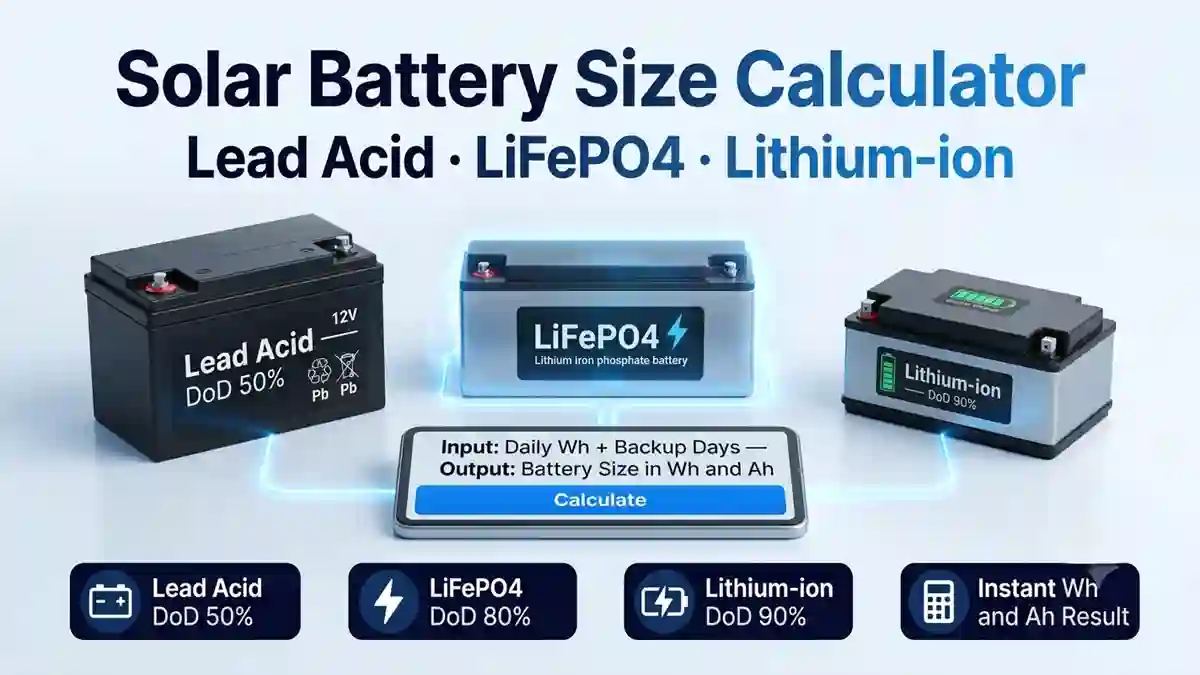
Free Solar Battery Size Calculator — Find the exact battery capacity in Wh and Ah for your system. Supports Lead Acid, LiFePO4, and Lithium-ion batteries for solar, off-grid, and backup power.
Please enter valid values greater than zero.
Use our free Solar Batteries Size Calculator to determine the exact battery capacity you need for your solar system, off-grid installation, or backup power setup. Enter your daily energy consumption, backup days, battery type, and system voltage to get instant results in both Wh and Ah.
1. Why Battery Sizing Matters
Undersizing a battery bank is one of the most common and costly mistakes in solar system design. A battery bank that is too small will be regularly deep discharged beyond its rated limit, dramatically shortening its lifespan and increasing your cost per cycle. A battery bank that is too large wastes capital and may never reach a full state of charge in low-sunlight conditions, which causes sulfation in lead acid batteries and accelerated degradation in lithium cells.
Correct battery sizing balances your daily energy demand, your required days of autonomy, your battery chemistry’s depth of discharge limit, and your system’s real-world efficiency losses. This calculator performs all four steps simultaneously and adds a 25% safety overhead to give you a practical, engineering-grade recommendation.
Engineer’s Note: Battery capacity is specified by manufacturers at a standard discharge rate, typically C10 or C20 (full discharge over 10 or 20 hours). If your load discharges the battery faster than this rated rate, the usable capacity is lower than the nameplate value. For high-current loads like inverters powering large appliances, always verify the battery’s capacity at the actual discharge rate, not just the C20 nameplate figure.
2. The Battery Sizing Formula
Battery Capacity (Wh) = Daily Energy (Wh) × Backup Days ÷ Depth of Discharge ÷ System Efficiency
To convert Wh to Ah: Ah = Wh ÷ System Voltage
Example: Daily energy use: 1500 Wh | Backup: 2 days | LiFePO4 DoD: 80% | Efficiency: 90%
Calculation: 1500 × 2 ÷ 0.80 ÷ 0.90 = 4,167 Wh required
At 48V: 4167 ÷ 48 = 86.8 Ah — round up to 100 Ah for the recommended standard battery size
Engineer’s Note: Always round up to the next standard battery capacity available in the market. Standard sizes are typically 50Ah, 100Ah, 150Ah, 200Ah, and 300Ah. Never round down when sizing a battery bank — the safety margin you lose cannot be recovered once the system is installed and the batteries are cycling daily.
3. Understanding Depth of Discharge (DoD)
Depth of Discharge (DoD) is the percentage of a battery’s total capacity that can be safely used before recharging. Discharging a battery beyond its rated DoD does not mean it stops working immediately — it means each over-discharge event permanently reduces the battery’s total cycle life and usable capacity.
Lead Acid Batteries — DoD 50%
Lead acid batteries, including AGM and gel types, should never be discharged below 50% of their rated capacity. Regular discharges to 80% or deeper will reduce a 500-cycle battery to fewer than 200 usable cycles. In solar applications, lead acid is the lowest upfront cost option but has the highest long-term cost per cycle.
LiFePO4 Batteries — DoD 80%
Lithium Iron Phosphate (LiFePO4) is the recommended battery chemistry for solar energy storage in 2026. With a DoD of 80%, LiFePO4 delivers 3,000 to 5,000 full cycles at rated capacity — roughly 10 to 15 years of daily cycling. It requires no maintenance, tolerates partial states of charge, and performs reliably in high ambient temperatures common in solar installations across South Asia and the Middle East.
Lithium-ion Batteries — DoD 90%
Standard lithium-ion cells used in some residential battery systems allow up to 90% DoD, delivering very high energy density per kilogram. However, lithium-ion chemistry is more sensitive to temperature extremes and requires a high-quality Battery Management System (BMS) to prevent thermal runaway. LiFePO4 is generally safer for outdoor and off-grid solar installations.
Engineer’s Note: In hot climates above 35°C, all battery types lose usable capacity. LiFePO4 capacity drops approximately 5-10% at 40°C compared to the 25°C rated capacity. Lead acid loses up to 20% at the same temperature. If your battery installation is in a non-air-conditioned enclosure in a hot climate, add a 10-15% overhead to your calculated capacity to account for thermal derating.
4. System Voltage Selection
The system voltage (12V, 24V, or 48V) determines the ampere-hour (Ah) rating of your battery bank. Higher voltage systems carry the same energy at lower current, which allows smaller cable sizes and reduces resistive losses. For any system above 500Wh daily consumption, a 24V or 48V system is strongly recommended over 12V.
- 12V Systems: Suitable for small off-grid setups under 500Wh per day. Common in RVs, caravans, small cabins, and solar garden lighting systems.
- 24V Systems: Recommended for medium off-grid homes and solar pump systems from 500Wh to 3,000Wh per day. Good balance of cost and efficiency.
- 48V Systems: Required for systems above 3,000Wh per day. All modern hybrid inverters and large solar installations operate at 48V. Lowest cable losses and highest system efficiency.
Engineer’s Note: Cable losses in DC systems increase as the square of the current. Doubling the voltage halves the current, which reduces cable losses by 75%. A 48V system loses four times less energy in its DC cables than an equivalent 12V system carrying the same power. For any installation with cable runs longer than 3 meters between battery and inverter, 48V is the engineering-correct choice.
5. Practical Sizing Examples
Small Off-Grid Cabin — 12V LiFePO4
Daily load: 300Wh | Backup: 2 days | LiFePO4 DoD: 80% | Efficiency: 90%
Required: 300 × 2 ÷ 0.80 ÷ 0.90 = 833 Wh | At 12V: 69.4 Ah — use 100Ah LiFePO4
Family Home — 48V LiFePO4
Daily load: 3,000Wh | Backup: 2 days | LiFePO4 DoD: 80% | Efficiency: 90%
Required: 3000 × 2 ÷ 0.80 ÷ 0.90 = 8,333 Wh | At 48V: 173.6 Ah — use 200Ah LiFePO4 at 48V
Agricultural Solar Pump — 48V Lead Acid
Daily load: 2,000Wh | Backup: 1 day | Lead Acid DoD: 50% | Efficiency: 85%
Required: 2000 × 1 ÷ 0.50 ÷ 0.85 = 4,706 Wh | At 48V: 98 Ah — use 150Ah Lead Acid at 48V (with safety margin)
Solar Street Light — 24V LiFePO4
Daily load: 150Wh | Backup: 3 cloudy days | LiFePO4 DoD: 80% | Efficiency: 90%
Required: 150 × 3 ÷ 0.80 ÷ 0.90 = 625 Wh | At 24V: 26 Ah — use 50Ah LiFePO4 at 24V
Engineer’s Note: For solar street lights and remote monitoring systems, always size for a minimum of 3 cloudy days of autonomy. In monsoon regions like South Asia and tropical areas, consecutive cloudy days of 5 or more are not uncommon. Critical loads such as medical refrigeration or water pumps serving a community should be sized for 5 days of autonomy minimum to ensure reliable operation through extended low-sunlight periods.
6. Quick Reference Battery Sizing Table
| Daily Energy | Backup Days | Battery Type | System Voltage | Required Wh | Required Ah |
| 300 Wh | 1 Day | LiFePO4 (80%) | 12V | 417 Wh | 35 Ah |
| 500 Wh | 2 Days | LiFePO4 (80%) | 24V | 1,389 Wh | 58 Ah |
| 1,000 Wh | 2 Days | LiFePO4 (80%) | 48V | 2,778 Wh | 58 Ah |
| 1,500 Wh | 2 Days | Lead Acid (50%) | 48V | 6,667 Wh | 139 Ah |
| 2,000 Wh | 3 Days | LiFePO4 (80%) | 48V | 8,333 Wh | 174 Ah |
| 3,000 Wh | 2 Days | LiFePO4 (80%) | 48V | 8,333 Wh | 174 Ah |
| 5,000 Wh | 2 Days | LiFePO4 (80%) | 48V | 13,889 Wh | 289 Ah |
| 10,000 Wh | 3 Days | LiFePO4 (80%) | 48V | 41,667 Wh | 868 Ah |
7. Common Battery Sizing Mistakes
- Ignoring Efficiency Losses: Inverters, wiring, and charge controllers all consume energy. A system with 85% efficiency requires 18% more battery capacity than a perfect system. Always include efficiency in your sizing calculation.
- Using 12V for Large Systems: A 3,000Wh load at 12V requires 250Ah of battery and draws over 100 amps DC. This demands very heavy cables and causes significant losses. Move to 48V for any system above 1,000Wh.
- Not Accounting for Temperature: Battery capacity drops in cold weather (below 10°C) and in extreme heat (above 40°C). If your installation is in an unconditioned outdoor enclosure, add 15-20% to your calculated capacity.
- Mixing Old and New Batteries: Never add new batteries to an existing bank that has more than 6 months of cycling history. New cells will charge faster and discharge faster than aged cells, creating imbalance that degrades all batteries in the bank.
- No Safety Overhead: A battery sized exactly to minimum requirements leaves no room for aging, temperature effects, or load increases. Always add a minimum 25% overhead to your calculated minimum capacity.
Engineer’s Note: Battery bank wiring configuration matters as much as capacity sizing. Batteries connected in series increase voltage while keeping Ah constant. Batteries in parallel increase Ah while keeping voltage constant. For large battery banks, a combination of series and parallel connections is used. All parallel strings must use identical batteries of the same age, chemistry, and state of charge. Mixing different batteries in parallel is one of the fastest ways to destroy an expensive battery bank.
8. Frequently Asked Questions
How do I calculate my daily energy consumption in Wh?
List every electrical device in your system and multiply its watt rating by the number of hours it runs per day. Add up all the results to get total daily Wh. For example: a 60W fan running 8 hours = 480Wh, a 20W LED running 5 hours = 100Wh, a 500W pump running 1 hour = 500Wh. Total = 1,080Wh per day.
Which battery is best for solar in 2026?
LiFePO4 (Lithium Iron Phosphate) is the recommended choice for solar storage in 2026. It offers 3,000 to 5,000 cycles at 80% DoD, requires zero maintenance, handles high ambient temperatures better than other lithium chemistries, and has an excellent safety record with no thermal runaway risk under normal operating conditions.
How many days of autonomy should I design for?
For non-critical residential systems, 2 days is the standard. For critical loads such as medical equipment, water supply, or telecommunications, design for 3 to 5 days. In regions with extended monsoon or cloudy seasons, 3 days minimum is recommended even for residential systems.
What is the difference between Wh and Ah in batteries?
Wh (Watt-hours) measures the total energy a battery can store or deliver, independent of voltage. Ah (Ampere-hours) measures the charge capacity at a specific voltage. To convert: Wh = Ah × Voltage. A 100Ah battery at 48V stores 4,800Wh. The same 100Ah rating at 12V stores only 1,200Wh. Always use Wh for energy comparisons between batteries of different voltages.
Can I use this calculator for home battery backup without solar panels?
Yes. This calculator sizes the battery bank based on your energy consumption andbackup requirements. It applies equally to grid-tied battery backup systems, off-grid solar systems, and hybrid solar plus grid systems. The solar panel sizing is a separate calculation based on your daily energy demand and local peak sun hours.
Engineer’s Note: For grid-tied battery backup systems, size the battery for the loads you want to keep running during a grid outage, not for your entire home consumption. Identify your critical loads (refrigerator, lights, phone charging, medical equipment, water pump) and size only for those. This approach typically reduces battery cost by 50-70% compared to sizing for whole-home backup while still covering the loads that actually matter during an outage.
Also, Check Our Related Calculators
- Watt-Hours to Watts Calculator
- Watts to Watt-Hours Calculator
- kWh to kW Calculator
- kW to HP Calculator
- Amps to Watts Calculator
- Solar Panel Size Calculator
- mAh to Wh Calculator
- Solar ROI Calculator
- Inverter Size Calculator
- Watts to Amps Calculator
- Volts to Watts Calculator
Related guides on SolarVisionAI.com
Solar Fence Post Lights: Cap Sizes, Types & Install Guide
Solar Charge Controller: The Complete Guide
MC4 Connectors: Solar Safety & Installation Guide
Solar Panel Types, Efficiency & Benefits
Commercial Solar Panel Installation: Engineering Guide
Commercial Solar Panel Installation — solarvisionai.com/commercial-solar-panel-installation/