
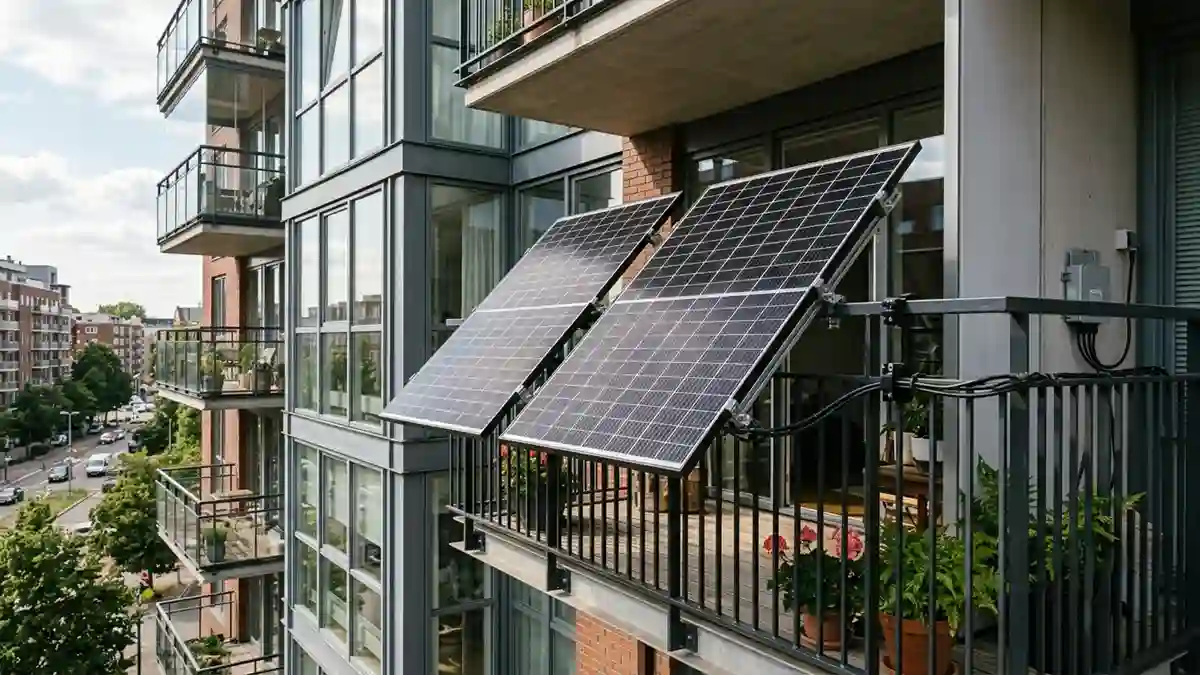
Balcony solar mounting system engineering — railing clamp design, UL 3700 plug-in standard, wind load on balconies, and the 2026 state-by-state legalization map for US renters
Every mounting system covered elsewhere on SolarVisionAI assumes the installer owns the structure they are attaching to — a roof, a wall, a parcel of land. Balcony solar mounting systems exist for the opposite situation: a renter or apartment owner who wants solar panel generation but has no roof, no land, and a lease agreement that prohibits permanent structural modification. The entire engineering and regulatory framework for this mounting type is built around one constraint — the system must be removable, low-impact, and safe enough that a non-licensed person can plug it directly into a wall outlet.
This is a genuinely new category in US residential solar. Plug-in solar — sometimes called balcony solar or guerrilla solar — has been common in Germany for years, where over 500,000 systems are installed. The US market is catching up fast: UL released the first dedicated safety standard for these systems, UL 3700, in 2026, and at least 24 states are actively considering legislation to legalize plug-in solar for renters and condo owners.
This guide covers the mounting engineering specific to balcony solar — railing clamp design, wind load on elevated structures, and the regulatory landscape that determines where these systems are currently legal. For the broader bracket and clamp hardware specification that underpins small-scale mounting systems, see the Solar Panel Mounting Brackets guide. For the complete mounting system taxonomy, see the Solar Mounting Systems hub.
1. What a Balcony Solar Mounting System Is
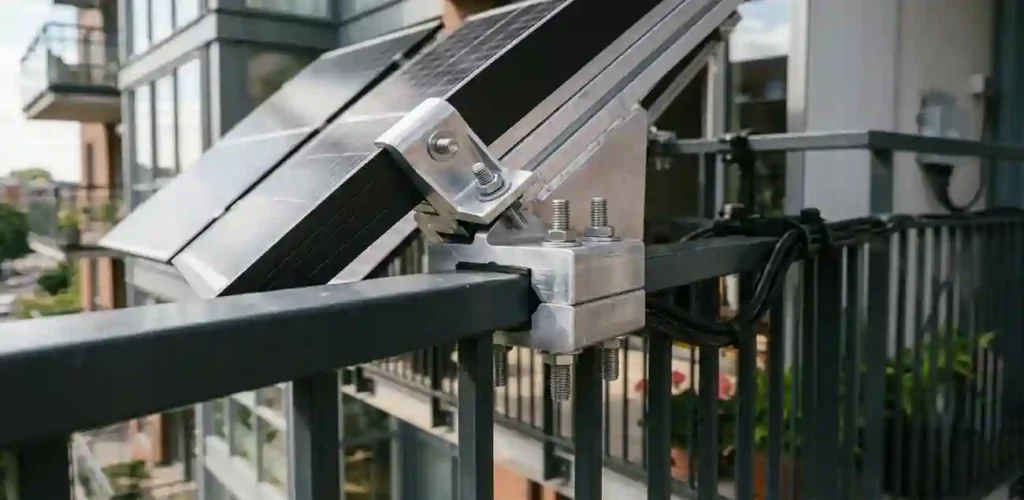
A balcony solar mounting system supports one to four solar panels (typically 400 to 1,600 watts total) on a balcony railing, parapet, or freestanding frame, connected to a household electrical circuit through a standard plug — most commonly a NEMA 5-15 outlet — rather than through a hardwired utility interconnection. The system is designed to be installed and removed without tools by the resident, without permanent modification to the building’s structure.
This is fundamentally different from every other mounting system on this site in one critical way: the structural anchor is not engineered building infrastructure. A balcony railing was designed to resist a person leaning against it — not necessarily the wind load of a 1.6 kW solar array. The mounting engineering for balcony solar must work within this constraint rather than specify a structural anchor to suit the load, which is the reverse of every other mounting engineering problem covered on this site.
Balcony Solar Mounting System vs Rooftop Solar
| Feature | Balcony Solar | Rooftop Solar |
|---|---|---|
| Installation | Removable | Permanent |
| Best for | Renters/apartments | Home owners |
| Structural attachment | Railing/frame | Roof structure |
| System size | Small | Larger |
| Approval | Lease + local rules | Utility/building permits |
2. Balcony Solar Mounting — Bracket and Clamp Types
Railing Clamp Mount
The most common balcony solar mounting method — a clamp bracket that grips the horizontal or vertical members of an existing balcony railing without drilling or permanent fasteners. Railing clamps typically use a threaded clamp mechanism similar to a pipe clamp, tightened by hand or with a basic hand tool, distributing the clamping force across the railing member without point-loading or deforming it.
Railing clamp capacity depends entirely on the railing’s own structural adequacy — a clamp cannot exceed the load capacity of the railing it grips. Most US balcony railings are designed for a 50 lb/linear foot horizontal load per IBC guardrail requirements, which provides adequate margin for the wind load of a properly mounted small solar array, but this margin should be verified for the specific railing type rather than assumed.
Freestanding Frame (Self-Ballasted)
For balconies where railing attachment is not desired or not structurally appropriate — glass railings, decorative railings not rated for additional load, or balconies where the lease prohibits any railing attachment — a freestanding frame rests on the balcony floor surface, held in position by its own weight or supplemental ballast (sandbags, water-filled ballast tubes, or concrete pavers).
Freestanding frames eliminate any structural dependency on the railing but require sufficient floor space and impose the full wind load directly onto the balcony floor slab through the frame feet — which must be evaluated against the point load capacity of the balcony deck, particularly on older buildings or lightweight balcony construction.
Vertical Wall-Lean System
A simplified mounting approach where the panel frame leans against the balcony’s exterior wall at a fixed angle, held in position by its own weight and a low-profile foot bracket. This method requires the least hardware and the simplest installation, but provides the least wind resistance and is generally limited to single-panel systems in low-wind-exposure locations (lower floors, wind-sheltered building orientations).
3. Wind Load Engineering for Balcony Solar
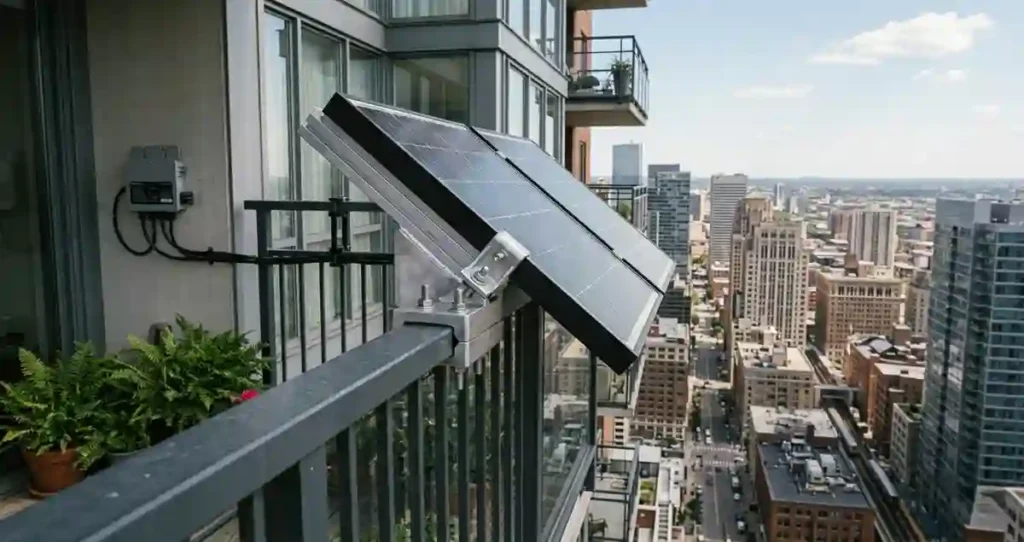
Wind load on a balcony-mounted solar array is governed by the same ASCE 7-22 principles as any other solar mounting system, but the application is complicated by the balcony’s position on the building — typically several stories above grade, where wind speed is higher than at ground level due to the atmospheric boundary layer effect, and where the balcony itself can create local wind acceleration or turbulence depending on building geometry.
| Mounting Type | Typical Wind Resistance Capacity | Building Height Limitation | Key Engineering Constraint |
| Railing clamp (single panel, low tilt) | Moderate — 60-80 mph design wind speed typical | Best below 6 stories without supplemental engineering | Railing’s own structural rating governs maximum panel size |
| Railing clamp (multi-panel array) | Lower margin — requires railing capacity verification | Best below 4 stories — verify railing rating above this | Cumulative wind load across multiple panels approaches railing limits faster |
| Freestanding ballasted frame | Higher — ballast weight scales to required resistance | Any height — ballast can be increased for higher wind exposure | Floor point-load capacity of balcony deck becomes limiting factor |
| Vertical wall-lean | Lowest — minimal mechanical resistance | Best below 3 stories or wind-sheltered locations only | Most vulnerable configuration — least suited to high-wind or high-rise locations |
Engineer’s Note: I do not recommend balcony solar installations above the 6th floor of a building without a specific structural engineering evaluation of both the railing capacity and the local wind exposure at that elevation. Wind speed increases measurably with height — a balcony on the 15th floor of a building experiences meaningfully higher wind loads than an identical balcony at street level, even in the same overall design wind speed zone. Manufacturers’ generic wind ratings are typically based on low-rise testing and should not be assumed to apply at high elevations without verification.
4. UL 3700 — The New US Safety Standard
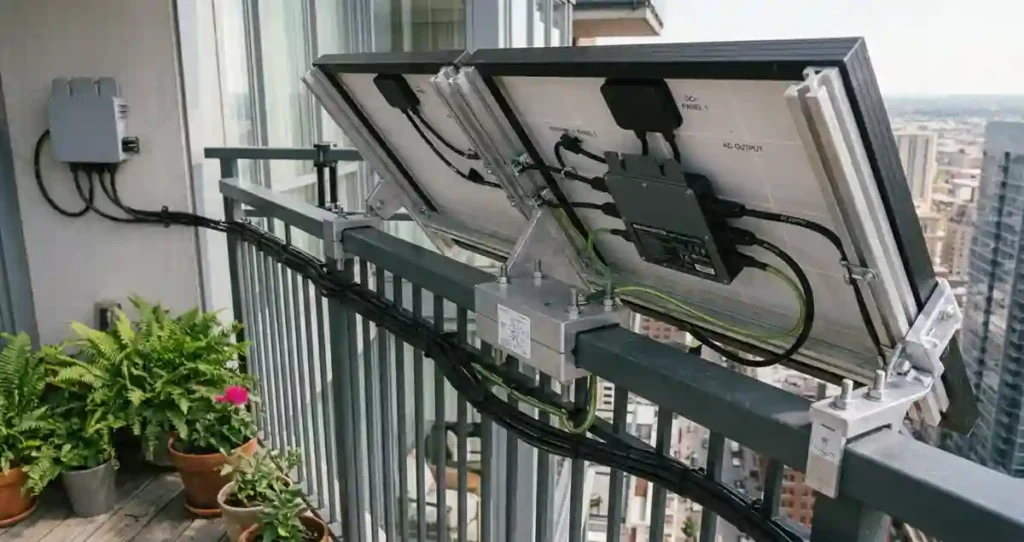
UL 3700, Outline of Investigation for Photovoltaic Microgrid Inverter and Distributed Energy Resource Disconnect Switches for Plug-In Solar Energy Systems, became active in January 2026 as the first dedicated US safety standard for plug-in solar systems. The standard addresses the electrical safety requirements specific to plug-in solar — automatic disconnection if the plug is removed while energized, compliance with circuit ampacity limits so the solar power system cannot overload an existing household circuit, and anti-islanding protection consistent with grid-tied inverter safety requirements.
UL 3700 certification is becoming the baseline requirement that state legislation is being written around — several of the 24+ states currently considering plug-in solar legalization are drafting bills that specifically require UL 3700 (or equivalent) certification as a condition of legal residential use. For a balcony solar mounting system, this means the inverter and disconnect components of the system — not the mounting hardware itself — must carry UL 3700 listing for the installation to be both safe and, in jurisdictions adopting this requirement, legal.
5. State-by-State Legal Status — What to Verify Before Installation
The legal status of plug-in balcony solar varies significantly by state, and in many cases by local jurisdiction and individual lease or condo association rules within a state that otherwise permits it. Before specifying or installing a balcony solar mounting system in the US, verify:
- State-level legislation status: whether the state has enacted specific legislation legalizing plug-in solar, has legislation pending, or has no specific provision (which typically defaults to requiring standard utility interconnection rules that plug-in systems do not meet)
- Utility interconnection policy: even in states without specific plug-in solar legislation, some utilities have adopted interconnection policies that accommodate small plug-in systems under a simplified or exempted process
- Local building and electrical code adoption: local jurisdictions may have adopted NEC provisions or local amendments that affect plug-in solar legality independent of state legislation
- Lease or HOA/condo association restrictions: even where state law permits plug-in solar, individual lease agreements and condo association rules may prohibit balcony modifications including solar — this is a contractual restriction independent of legal permission
- Renters’ right to install provisions: a small number of states have or are considering ‘right to solar’ provisions specifically protecting renters’ ability to install plug-in solar despite lease restrictions, similar to existing satellite dish protection laws
Field Note: I recommend every client considering balcony solar in the US treat this as a three-part verification before purchase — state law, utility policy, and lease/HOA terms — because all three must align for the installation to be both legal and uncontested. I have seen installations that were technically legal under state law but resulted in lease violations and removal demands from property management because the lease language predated the state legislation and had not been updated. Verify all three independently; do not assume state legalization automatically overrides existing lease terms.
6. Balcony Solar Mounting — Installation Best Practices
- Panel selection: Lightweight panels (typically under 25 lbs each) reduce the load on railing clamps and freestanding frames. Flexible or semi-flexible panels are sometimes used for the lowest weight, though rigid panels generally offer better long-term durability and higher efficiency.
- Clamp torque: Railing clamps should be torqued to the manufacturer’s specification — typically hand-tight plus a quarter turn with a wrench for most consumer railing clamp systems. Over-tightening can deform aluminum or vinyl railing material; under-tightening allows the clamp to slip under wind load.
- Cable routing: The power cable from the panel to the inverter to the wall outlet should be routed to avoid trip hazards, kept clear of door swing paths, and protected from abrasion at any point where it passes over a railing edge or sharp surface.
- Inverter location: Microinverters mounted on plug-in systems should be positioned for ventilation — not enclosed in a way that traps heat — and protected from direct rain exposure even though most are rated for outdoor use.
- Seasonal removal consideration: In regions with significant winter storm wind events, evaluate whether seasonal removal of the array during the highest-risk months is a more practical risk management approach than permanent installation rated for the worst-case design wind speed.
For broader context on small-scale solar mounting hardware — including the bracket and fastener specifications that inform balcony clamp design — see the Solar Panel Mounting Brackets guide. For wall-surface mounting alternatives where balcony access is not available, see the Wall Mounted Solar Panels guide
Frequently Asked Questions
What is a balcony solar mounting system?
A balcony solar mounting system is a removable structure that allows solar panels to be installed on apartment balconies, railings, or freestanding frames without permanent building modification.
Can renters install a balcony solar system?
Yes, in some locations, renters can install balcony solar systems, but they must check local regulations, utility requirements, and lease agreements before installation.
How many solar panels can be installed on a balcony?
Most balcony solar systems support one to four panels depending on available space, railing strength, wind exposure, and local requirements.
Are balcony solar panels safe in high winds?
Safety depends on correct mounting design, wind load evaluation, railing strength, and installation height. High-rise balconies require additional engineering consideration.
Do balcony solar systems need permission?
Permission requirements vary. Users should verify state rules, utility policies, building management rules, and lease restrictions.
What is UL 3700 for balcony solar?
UL 3700 is a safety standard related to plug-in solar systems, addressing electrical safety features such as disconnect protection and circuit safety.
Can balcony solar damage the railing?
Improper installation can damage railings. The mounting system must distribute loads correctly and stay within the railing’s structural capacity.
What is the maximum solar panel power allowed for a balcony solar system?
The maximum solar panel power allowed for a balcony solar system depends on local regulations, utility rules, building policies, and the electrical capacity of the system. In many regions, plug-in balcony solar systems are commonly limited to around 600W to 800W AC output, while the total solar panel capacity may be higher depending on inverter specifications and local requirements. Always verify the permitted limit before installation.
Related guides on SolarVisionAI.com
Dual Axis Solar Tracking System: Complete Engineer’s Guide
Solar Panel Installation: Complete Engineering Guide (2026)
Solar Panel Installation Cost: The Complete 2026 Breakdown
Commercial Solar Panel Installation: Engineering Guide 2026
When Is the Best Time to Install Solar Panels?
Solar Power System in 2026: Types, Cost, ROI & AI Optimization