
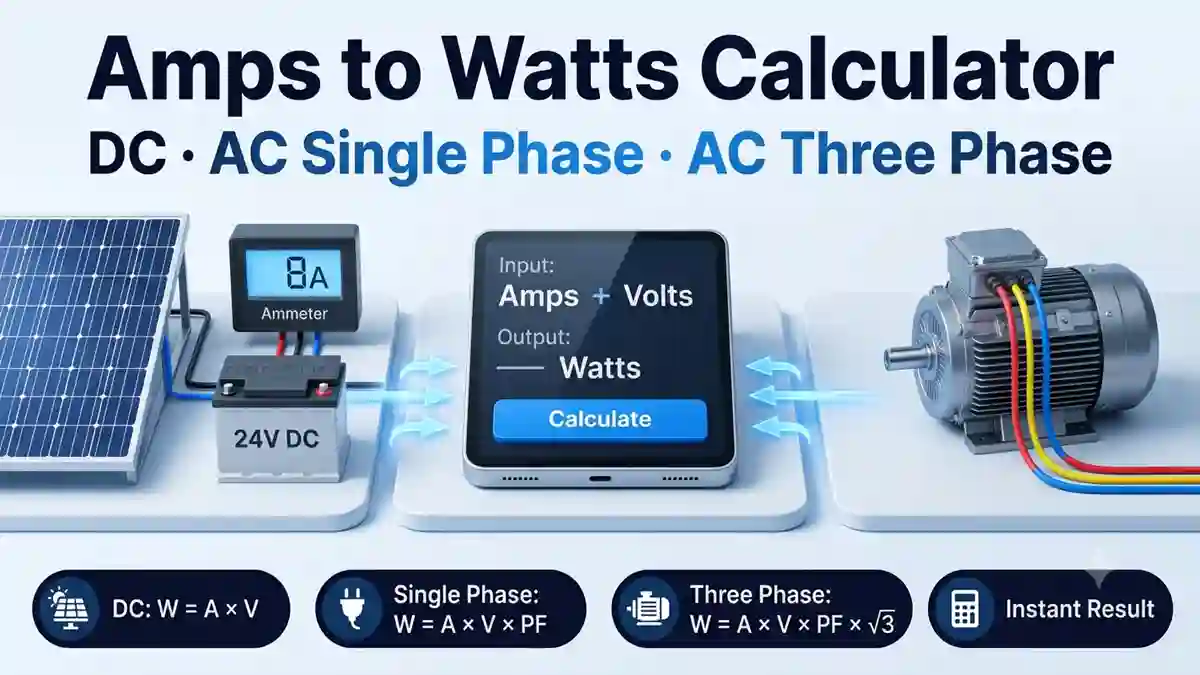
Free Amps to Watts Calculator — Convert A to W instantly for DC, AC Single Phase, and AC Three Phase. Perfect for solar panels, motors, home appliances, and electrical systems.
Please enter valid values greater than zero.
Formula: W = A × V
Use our free Amps to Watts Calculator to instantly convert electrical current to power for DC circuits, AC Single Phase, and AC Three Phase systems. Whether you are sizing a solar panel array, calculating motor load, or checking your home appliance power consumption, this tool delivers fast and accurate results.
1. What Is the Difference Between Amps and Watts?
Amps (A) measure the flow of electrical current — how many electrons are moving through a conductor per second. Watts (W) measure electrical power — the rate at which energy is being consumed or produced. Knowing both values is essential for correctly sizing cables, circuit breakers, inverters, solar panels, and battery storage systems.
You cannot size an electrical system using amps alone or watts alone. Both values work together. A device drawing 10 amps on a 12V battery system consumes 120 watts — a very different load from the same 10 amps on a 240V supply, which would be 2400 watts.
Engineer’s Note: Never assume that two devices with the same amp rating consume the same power. The voltage always determines the actual power. This is one of the most common sizing errors in DIY solar and off-grid electrical installations. Always confirm the voltage before converting amps to watts.
2. The Conversion Formulas
DC Circuit — Direct Current
Formula: Watts (W) = Amps (A) × Volts (V)
Example: A solar panel producing 8A at 24V generates: 8 × 24 = 192 Watts
AC Single Phase — Alternating Current
Formula: Watts (W) = Amps (A) × Volts (V) × Power Factor (PF)
Example: A 10A air conditioner on 230V with PF 0.85: 10 × 230 × 0.85 = 1955 Watts
AC Three Phase — Alternating Current
Formula: Watts (W) = Amps (A) × Volts (V) × PF × √3 (1.732)
Example: A 15A three-phase motor on 400V with PF 0.8: 15 × 400 × 0.8 × 1.732 = 8313.6 Watts (8.31 kW)
Engineer’s Note: Power Factor (PF) represents how efficiently a device converts electrical power into useful work. Resistive loads like heaters and incandescent bulbs have PF = 1.0. Most motors, air conditioners, and inverters have PF between 0.7 and 0.95. Always use the actual PF from the device nameplate when calculating real power. Using PF = 1.0 for inductive loads will significantly undersize your protection and supply equipment.
3. What Is Power Factor and Why Does It Matter?
Power Factor is a value between 0 and 1 that describes how much of the apparent power (VA) drawn from the supply is actually converted into real working power (Watts). A low power factor means a device draws more current from the supply than it actually needs to do its job, wasting energy in the process.
In solar power systems and off-grid installations, a low power factor forces you to oversize your inverter, wiring, and battery bank to handle the higher current draw. This directly increases system cost. Understanding and accounting for power factor is essential when sizing any AC-powered solar system.
- PF = 1.0: Resistive loads — electric heaters, incandescent bulbs, kettle, iron
- PF = 0.8 to 0.95: Motors, pumps, air conditioners, refrigerators
- PF = 0.6 to 0.8: Old fluorescent lights, some older industrial equipment
- PF = 0.95 to 0.99: Modern inverters, LED drivers, switched-mode power supplies
Engineer’s Note: In three-phase systems, a poor power factor multiplied by the √3 factor compounds the current demand significantly. On a large solar-powered industrial installation, correcting the power factor from 0.7 to 0.95 can reduce your required inverter capacity by over 25%. Always include power factor correction capacitors in large AC motor installations connected to solar inverters.
4. Practical Applications
Solar Panel Output Calculation (DC)
Solar panels produce DC power. To calculate the watt output from a panel’s rated current and voltage, use the DC formula. A 10A solar panel operating at 36V produces 360 Watts at peak output. In practice, derate this by 20-25% for temperature losses, soiling, and wiring losses to get the actual usable output.
Engineer’s Note: Solar panel datasheets give STC (Standard Test Conditions) ratings at 25°C and 1000 W/m² irradiance. Real-world output is always lower. In hot climates like Pakistan and the Middle East, panel output can drop by 15-20% on peak summer days due to temperature derating. Always design for real-world output, not STC nameplate values.
Battery Bank Discharge (DC)
When calculating how much current a load draws from a battery bank, use the DC formula in reverse. A 500W inverter load at 48V draws: 500 ÷ 48 = 10.4 Amps from the battery. This figure is essential for sizing battery cables, fuses, and charge controllers correctly.
Home Appliance Load Calculation (AC Single Phase)
Most home appliances run on single-phase AC supply. When the watt rating is not shown on the label but the amp rating and voltage are, use the AC single-phase formula with an appropriate power factor to estimate the real power draw. This is particularly useful when calculating total home load for solar system sizing.
Industrial Motor Load (AC Three Phase)
Three-phase motors are common in agricultural pump systems, industrial workshops, and commercial buildings. Converting three-phase amp readings to watts is essential when sizing solar inverters, VFDs (Variable Frequency Drives), and protection equipment for solar-powered motor systems.
Engineer’s Note: When using a clamp meter to measure current on a three-phase motor, always measure all three phases and use the average value if they differ. An imbalance of more than 2% between phases indicates a fault condition that can damage the motor. Never size a solar inverter for a three-phase motor based on nameplate HP alone — always measure the actual running current under full load conditions.
Solar Pump System Sizing
Solar water pump systems require careful amps-to-watts conversion at every stage. The solar panel array must generate enough watts to power the pump motor. The pump motor draws amps from the inverter, and the inverter draws amps from the battery bank. Each conversion step involves a different voltage level, and each must be calculated correctly to avoid undersizing.
5. Quick Reference Conversion Table
| Current (A) | Voltage (V) | Power Factor | Circuit Type | Power (W) |
| 1 A | 12 V | 1.0 (DC) | DC | 12 W |
| 5 A | 24 V | 1.0 (DC) | DC | 120 W |
| 10 A | 48 V | 1.0 (DC) | DC | 480 W |
| 8 A | 230 V | 0.85 | AC Single Phase | 1,564 W |
| 15 A | 230 V | 0.90 | AC Single Phase | 3,105 W |
| 10 A | 400 V | 0.80 | AC Three Phase | 5,542 W |
| 20 A | 400 V | 0.85 | AC Three Phase | 11,778 W |
| 30 A | 415 V | 0.90 | AC Three Phase | 19,399 W |
6. Common Mistakes When Converting Amps to Watts
- Ignoring Power Factor: Using W = A × V for AC loads without applying PF gives apparent power (VA), not real power (Watts). This overstates actual power consumption.
- Wrong Voltage: Using 12V when the system runs at 24V or 48V doubles or quadruples the error. Always confirm the actual system voltage.
- Using STC Panel Ratings: Solar panel current ratings are at STC. Real-world current is 10-25% lower. Never size a system on nameplate values alone.
- Forgetting Inverter Efficiency: An inverter drawing 10A at 48V DC does not deliver 480W of AC output. At 90% efficiency, it delivers 432W. Always account for conversion losses.
- Mixing AC and DC Voltages: DC battery voltage and AC inverter output voltage are different values. Never use AC voltage to calculate DC battery current or vice versa.
Engineer’s Note: The single most common wiring fault in DIY solar installations is undersized DC cables between the battery and inverter. A 2000W inverter on a 24V system draws over 83 amps DC at full load. Most beginners size for the AC output amps (8.7A at 230V) and undersize the DC cables by a factor of 10. This causes overheating, voltage drop, and fire risk. Always calculate DC current separately from AC current.
7. Frequently Asked Questions
How do I convert amps to watts without knowing the voltage?
You cannot convert amps to watts without knowing the voltage. Power (Watts) is always the product of current (Amps) and voltage (Volts). If the voltage is unknown, check the device nameplate, the circuit breaker panel, or measure with a multimeter.
What is the conversion from amps to watts for a 12V solar system?
For a 12V DC solar system: Watts = Amps × 12. A 10 amp load on a 12V system draws 120 watts. A 20 amp solar panel at 12V produces 240 watts at peak output.
How many watts is 1 amp at 240V?
For a resistive DC or AC load with PF 1.0: 1A × 240V = 240 Watts. For an AC inductive load with PF 0.85: 1A × 240V × 0.85 = 204 Watts.
What power factor should I use for solar inverters?
Modern grid-tied and hybrid solar inverters typically have a power factor of 0.95 to 0.99 at full load. For sizing calculations, use the actual PF value from the inverter datasheet. If unavailable, use 0.95 as a conservative estimate for quality inverters.
How do I calculate amps to watts for a three-phase solar pump?
Use the three-phase formula: W = A × V × PF × 1.732. For a pump drawing 15A on a 400V three-phase supply with PF 0.82: 15 × 400 × 0.82 × 1.732 = 8,523 Watts (8.52 kW). The solar inverter and panel array must be sized to deliver at least this power plus 25-30% overhead for starting surge.
Engineer’s Note: Three-phase induction motors draw 3 to 7 times their rated current on startup (inrush current). This surge lasts only 1-3 seconds but must be handled by the inverter without tripping. When sizing a solar inverter for a three-phase motor, always confirm the inverter’s surge capacity rating in VA or kVA — not just its continuous rating. A 10 kW motor may require an inverter with 30-50 kVA surge capacity for reliable starting.
Also, Check Our Related Calculators
- Watt-Hours to Watts Calculator
- Watts to Watt-Hours Calculator
- kWh to kW Calculator
- kW to HP Calculator
- Solar Battery Size Calculator
- Solar Panel Size Calculator
- mAh to Wh Calculator
- Solar ROI Calculator
- Inverter Size Calculator
- Watts to Amps Calculator
- Volts to Watts Calculator
Related guides on SolarVisionAI.com
Solar Fence Post Lights: Cap Sizes, Types & Install Guide
Solar Charge Controller: The Complete Guide
MC4 Connectors: Solar Safety & Installation Guide
Solar Panel Types, Efficiency & Benefits
Commercial Solar Panel Installation: Engineering Guide
Commercial Solar Panel Installation — solarvisionai.com/commercial-solar-panel-installation/