
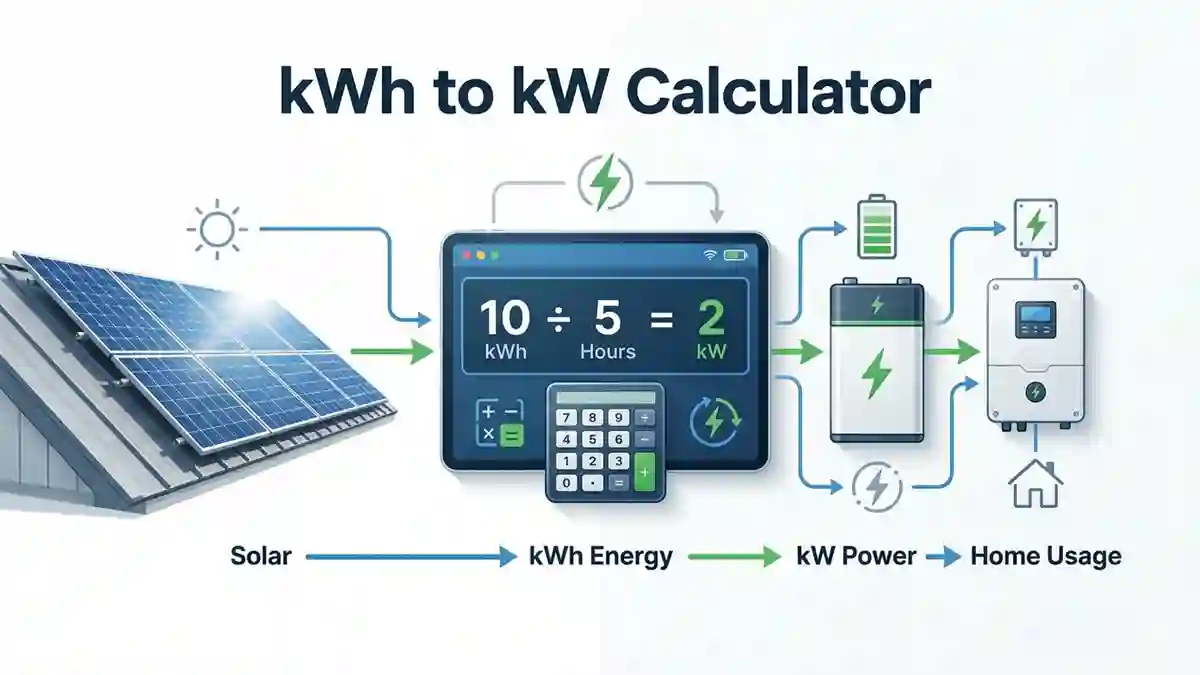
Use our free kWh to kW calculator to convert solar energy instantly. Includes battery sizing, inverter guide, global sun hours table & step-by-step solar system sizing. No sign-up needed.
kWh to kW Calculator — Complete Solar Guide
If you've ever looked at a solar quote, read an electricity bill, or tried to size a battery — you've run into kW and kWh. They look almost identical, yet they measure completely different things. Confusing the two leads to undersized solar power systems, overpaid electricity bills, and batteries that run out hours before sunrise.
This guide explains everything clearly, with a focus on solar energy applications: how panels, batteries, and inverters all depend on mastering the kWh-to-kW relationship.
1. kW vs kWh — The Core Difference
These two units describe the same electrical phenomenon from two different perspectives: how fast electricity flows (kW), and how much flows over time (kWh).
| Unit | Full Name | Type | What It Tells You | Solar Example |
| kW | Kilowatt | Power | Rate of electricity use/production right now | A 6 kW solar array's peak output capacity |
| kWh | Kilowatt-hour | Energy | Total electricity produced or consumed over time | That 6 kW array produces ~30 kWh on a sunny day |
Best analogy: Think of electricity like water flowing through a pipe. kW is the pipe's diameter — the flow rate. kWh is the total volume of water that passed through. You need both to understand the full picture.
Where Each Unit Appears
- kW — solar panel nameplate rating, inverter size, generator capacity, appliance power draw
- kWh — electricity bill (monthly consumption), battery capacity, annual solar output, tariff billing
- Both — solar quotes (kW for system size, kWh for annual yield), battery specs (kW for power, kWh for capacity)
One kilowatt equals exactly 1,000 watts. One kilowatt-hour is the energy produced or consumed by a 1 kW device running for one hour.
2. The 3 Conversion Formulas You Need
There is no single 'kWh to kW' conversion — you always need a third variable: time. These three formulas cover every scenario:
Formula A — Find Power (kW) from Energy and Time
kW = kWh ÷ Hours
Example: A home uses 12 kWh over 8 hours of night. What is the average power draw? → 12 ÷ 8 = 1.5 kW average load
Formula B — Find Energy (kWh) from Power and Time
kWh = kW × Hours
Example: An 8 kW solar system operates for 5.5 peak sun hours. How much energy does it produce? → 8 × 5.5 = 44 kWh per day (before system losses)
Formula C — Find Runtime (Hours) from Energy and Power
Hours = kWh ÷ kW
Example: A 13.5 kWh battery powering a 2 kW load. How long will it last? → 13.5 ÷ 2 = 6.75 hours
Watts and Watt-Hours
- W = Wh ÷ Hours | Wh = W × Hours
- 1 kW = 1,000 W | 1 kWh = 1,000 Wh
⚠️ Never convert kWh to kW without time. '20 kWh over 4 hours' = 5 kW. The same 20 kWh over 10 hours = 2 kW. Time is non-negotiable.
3. kWh and kW in Solar Panel Systems
Solar panels are rated in kW (or kWp — kilowatt-peak) under Standard Test Conditions (STC): 1,000 W/m² irradiance, 25°C cell temperature. The actual energy output over a day or year is measured in kWh.
How Solar Output Is Calculated
Daily Output (kWh) = System Size (kW) × Peak Sun Hours × Performance Ratio
A performance ratio (PR) of 0.80 is the global standard, accounting for:
- Temperature losses — panels lose ~0.35–0.45% efficiency per °C above 25°C
- Inverter conversion losses — approximately 2–5%
- Wiring resistance and DC losses — approximately 1–3%
- Soiling and dust — 1–5% depending on region and cleaning frequency
- Shading and mismatch losses — 0–10% depending on roof design
Real example: A 10 kW system with 5 peak sun hours and PR 0.80 produces: 10 × 5 × 0.80 = 40 kWh per day, or approximately 14,600 kWh per year.
2026 Residential Solar Panel Power Ratings
- 400–450W — mainstream PERC and half-cut monocrystalline panels
- 450–550W — premium N-type TOPCon panels (better low-light and temperature performance)
- 550–720W — large-format bifacial panels for commercial and ground-mount systems
A 10 kW system in 2026 requires just 20–22 panels at 450–500W, versus 33–40 panels a decade ago.
4. kWh and kW in Solar Battery Storage
Solar batteries have two separate ratings — understanding both is critical for correct sizing:
| Rating | Unit | What It Means | Example |
| Energy capacity | kWh | Total energy the battery can store and deliver | Tesla Powerwall 3: 13.5 kWh |
| Power output | kW | Maximum rate of charge or discharge | Tesla Powerwall 3: 11.5 kW peak |
| Usable capacity | kWh | Energy available after Depth of Discharge | LiFePO4 at 90% DoD: 12.15 kWh usable |
Battery Runtime Formula
Runtime (hrs) = Usable kWh ÷ Load (kW)
Example: 10 kWh LFP battery (90% DoD = 9 kWh usable) powering 1.5 kW → 9 ÷ 1.5 = 6 hours of backup
Battery Sizing Formula
Battery Size (kWh) = Daily Load (kWh) × Backup Days ÷ DoD
Example: 8 kWh daily load, 1.5 days backup, LFP at 90% DoD → 8 × 1.5 ÷ 0.90 = 13.3 kWh battery → choose a 15 kWh system
Battery Chemistry Comparison — 2026
| Chemistry | Usable DoD | Cycle Life | 2026 Cost | Best For |
| LiFePO4 (LFP) ✅ | 80–90% | 3,000–6,000 | $70–$120/kWh | All solar applications |
| Li-ion NMC | 70–80% | 1,500–3,000 | $100–$160/kWh | Space-limited installs |
| AGM Lead Acid | 50% | 400–700 | $50–$80/kWh | Low-budget backup only |
| Gel Lead Acid | 50–60% | 500–900 | $55–$90/kWh | Low-budget backup only |
| Flow (Vanadium) | 100% | 10,000+ | $200–$400/kWh | Commercial / grid-scale |
✅ 2026 milestone: BloombergNEF reports average LFP pack prices have reached $81/kWh — a 45% drop from 2024. Solar + battery systems now reach payback in 5–8 years in most global markets.
5. kWh and kW for Inverter Sizing
Your inverter converts DC from solar panels to AC power for your home. It is rated in kW — the maximum power it can handle at any moment.
Inverter Size (kW) ≥ Peak Load (kW) and ≥ 0.8 × Array Size (kWp)
A DC/AC ratio of 1.1–1.3 is standard for grid-tied systems. Example: A 10 kWp array generating 40 kWh/day over 5 hours needs an inverter of at least 40 ÷ 5 = 8 kW. An undersized inverter clips production at the highest-value hours of the day.
6. Global Peak Sun Hours and Daily kWh Output
Peak sun hours (PSH) directly determine how many kWh your solar system produces per kW of installed capacity. A 1 kW system produces 1 kWh per peak sun hour — before losses.
| Region / Country | Peak Sun Hrs/Day | 5 kW Output/Day | Annual Output (5 kW) |
| Australia (avg) | 4.5–6.0 hrs | 18–24 kWh | 6,570–8,760 kWh |
| USA Southwest (AZ, CA, TX) | 5.5–7.0 hrs | 22–28 kWh | 8,030–10,220 kWh |
| USA Northeast / Midwest | 3.5–4.5 hrs | 14–18 kWh | 5,110–6,570 kWh |
| United Kingdom | 2.5–3.5 hrs | 10–14 kWh | 3,650–5,110 kWh |
| Germany | 3.0–4.0 hrs | 12–16 kWh | 4,380–5,840 kWh |
| Spain / Southern Europe | 4.5–5.5 hrs | 18–22 kWh | 6,570–8,030 kWh |
| Middle East / Gulf | 5.5–6.5 hrs | 22–26 kWh | 8,030–9,490 kWh |
| India (avg) | 4.5–6.0 hrs | 18–24 kWh | 6,570–8,760 kWh |
| South Africa | 4.5–6.0 hrs | 18–24 kWh | 6,570–8,760 kWh |
| Brazil | 4.5–6.5 hrs | 18–26 kWh | 6,570–9,490 kWh |
| China (avg) | 3.5–5.5 hrs | 14–22 kWh | 5,110–8,030 kWh |
| Japan | 3.5–4.5 hrs | 14–18 kWh | 5,110–6,570 kWh |
Source: Global Solar Atlas, NREL PVWatts, 2024–2026. Output = System kW × Peak Sun Hours × 0.80 performance ratio.
Key insight: The same 5 kW solar system produces more than twice as much energy in Arizona (28 kWh/day) as in the UK (10 kWh/day). Location — not just system size — is the most important factor in solar energy yield.
7. Solar System Sizing — Step-by-Step
Using the kWh-to-kW relationship, you can size any solar system in six steps:
- Step 1 — Find your monthly electricity consumption (kWh). Check your electricity bill. Use your highest-consumption month.
- Step 2 — Calculate your daily energy need. Divide monthly kWh by 30. Example: 900 kWh ÷ 30 = 30 kWh/day
- Step 3 — Find your location's peak sun hours. Use the table above, NREL PVWatts (USA), or Global Solar Atlas (worldwide).
- Step 4 — Calculate required system size with losses. System kW = Daily kWh ÷ Peak Sun Hours ÷ 0.80. Example: 30 ÷ 5 ÷ 0.80 = 7.5 kW minimum
- Step 5 — Add 10–20% for future-proofing. EVs and heat pumps increase consumption. Example: 7.5 × 1.15 = 8.6 kW → choose a 9 kW system
- Step 6 — Convert kW to number of panels. Panels = System kW × 1,000 ÷ Panel Wattage. Example: 9,000 ÷ 450W = 20 panels
✅ 2026 sizing note: Median residential solar system size globally has grown to 7–10 kW as panel prices fell below $0.20/W. Size for your future load — expanding a system later costs 20–40% more. (Source: NREL)
8. kWh to kW Reference Table
Find your result instantly. Divide any kWh value by the time (hours) to get kW:
| Energy (kWh) | 1 Hour | 2 Hours | 4 Hours | 5 Hours | 6 Hours | 8 Hours | 24 Hours |
| 1 kWh | 1.000 kW | 0.500 kW | 0.250 kW | 0.200 kW | 0.167 kW | 0.125 kW | 0.042 kW |
| 5 kWh | 5.000 kW | 2.500 kW | 1.250 kW | 1.000 kW | 0.833 kW | 0.625 kW | 0.208 kW |
| 10 kWh | 10.00 kW | 5.000 kW | 2.500 kW | 2.000 kW | 1.667 kW | 1.250 kW | 0.417 kW |
| 15 kWh | 15.00 kW | 7.500 kW | 3.750 kW | 3.000 kW | 2.500 kW | 1.875 kW | 0.625 kW |
| 20 kWh | 20.00 kW | 10.00 kW | 5.000 kW | 4.000 kW | 3.333 kW | 2.500 kW | 0.833 kW |
| 30 kWh | 30.00 kW | 15.00 kW | 7.500 kW | 6.000 kW | 5.000 kW | 3.750 kW | 1.250 kW |
| 50 kWh | 50.00 kW | 25.00 kW | 12.50 kW | 10.00 kW | 8.333 kW | 6.250 kW | 2.083 kW |
| 100 kWh | 100.0 kW | 50.00 kW | 25.00 kW | 20.00 kW | 16.67 kW | 12.50 kW | 4.167 kW |
9. Common Appliances — Power (kW) and Daily Energy (kWh)
Use this table to calculate your total daily load before sizing a solar system or battery:
| Appliance | Power (kW) | Daily Use | Daily kWh | Solar Notes |
| Air conditioner — 1 ton | 0.9–1.2 kW | 8 hrs | 7–10 kWh | Biggest load in hot climates |
| Air conditioner — 2 ton | 1.8–2.5 kW | 8 hrs | 14–20 kWh | Consider inverter AC to reduce draw |
| Heat pump | 1.0–3.5 kW | 6–12 hrs | 6–42 kWh | Biggest load in cold climates |
| EV — Level 2 charger | 7.2–11.5 kW | 2–4 hrs | 14–46 kWh | Add 20–40 kWh/day if you have an EV |
| Refrigerator / freezer | 0.1–0.2 kW | 24 hrs | 1.2–4.8 kWh | Runs 24/7 — use efficient models |
| Electric water heater | 2.0–4.5 kW | 1–3 hrs | 2–13 kWh | Heat-pump heater cuts this by 70% |
| Washing machine | 0.5–2.0 kW | 1 hr | 0.5–2.0 kWh | Run during solar peak hours |
| Dishwasher | 1.2–1.8 kW | 1 hr | 1.2–1.8 kWh | Schedule during midday production |
| LED lighting (10 × 10W) | 0.1 kW | 6 hrs | 0.6 kWh | Minimal — already efficient |
| Desktop PC + monitor | 0.2–0.4 kW | 6 hrs | 1.2–2.4 kWh | Laptops use 5–10× less energy |
| LED TV (55 inch) | 0.08–0.15 kW | 5 hrs | 0.4–0.75 kWh | Modern TVs are very efficient |
| Pool / spa pump | 0.75–2.5 kW | 4–8 hrs | 3–20 kWh | Time to solar hours for best offset |
| Induction cooktop | 1.5–3.5 kW | 1–2 hrs | 1.5–7 kWh | Efficient vs gas in solar homes |
| WiFi router | 0.01–0.02 kW | 24 hrs | 0.24–0.48 kWh | Negligible — always on |
10. Common Mistakes — and How to Avoid Them
- Treating kW and kWh as the same. A 6 kW system does not produce 6 kWh every hour all day. It produces energy only when the sun shines — typically 4–6 hours — and with 15–20% losses.
- Using nameplate ratings without losses. Always apply a 0.80 performance ratio. Without it, you overestimate production by 20–25% and undersize your system.
- Sizing for average consumption, not peak month. Pull 12 months of bills. Size for your highest consumption month.
- Ignoring battery depth of discharge. A 10 kWh lead-acid battery only gives 5 kWh usable (50% DoD). An LFP battery gives 8–9 kWh usable. Chemistry changes your runtime dramatically.
- Undersizing the inverter. An inverter smaller than your array clips production. Aim for a DC/AC ratio of 1.1–1.3.
- Not planning for EVs and heat pumps. Size 10–20% above current needs. Adding panels later costs 20–40% more than installing the right size now.
- Ignoring panel degradation. Panels degrade ~0.5%/year. After 25 years, a 10 kW system produces ~12.5% less. Account for this in long-term calculations.
Also, check our related calculators:
Watt-Hours to Watts Calculator
Watts to Watt-Hours Calculator
11. Frequently Asked Questions
How do I convert kWh to kW?
Divide kWh by hours: kW = kWh ÷ Hours. You always need the time duration. Without time, the conversion is impossible — kWh and kW measure different physical quantities.
How much energy does a 5 kW solar system produce per day?
Formula: 5 kW × Peak Sun Hours × 0.80. In the US Southwest (6 hrs): 5 × 6 × 0.80 = 24 kWh/day. In the UK (3 hrs): 5 × 3 × 0.80 = 12 kWh/day. Annually: roughly 4,400–8,800 kWh/year depending on location.
What is the difference between kWh and kW on a solar battery?
A battery's kWh rating is its storage capacity. Its kW rating is the power output — how fast it delivers energy. A 13.5 kWh / 7 kW battery holds 13.5 kWh but delivers a maximum 7 kW at any moment. Never draw more kW than the battery is rated for.
Is kW or kWh more important for solar?
Both are essential. kW tells you the system's capacity. kWh tells you what you actually get. Start with your daily kWh consumption, then work backwards using peak sun hours and performance ratio to find the kW system size you need.
How many kW do I need to power a home with solar?
Average annual consumption: US ~10,500 kWh/year, UK ~3,600 kWh/year, Australia ~6,500 kWh/year. Formula: Annual kWh ÷ (365 × Peak Sun Hrs × 0.80) = System kW. For a US home: 10,500 ÷ (365 × 5 × 0.80) = 7.2 kW.
What is kWp and how is it different from kW?
kWp (kilowatt-peak) is rated power under Standard Test Conditions (STC): 1,000 W/m² at 25°C. Real-world output is always lower due to temperature, reduced irradiance, and system losses. A 10 kWp array typically delivers 7.5–9 kW on a real sunny day.
How long will a 10 kWh battery last?
Formula: Runtime = Usable kWh ÷ Load (kW). LFP at 90% DoD = 9 kWh usable. At 1 kW load: 9 hours. At 2 kW load: 4.5 hours. At 5 kW load: 1.8 hours.
Can I run my whole house on solar and batteries?
Yes. This is called an off-grid or self-sufficient system. You need enough solar kW to cover daytime usage and battery charging, plus enough kWh of storage for nights and cloudy days (typically 2–3 days autonomy). Most homes need 10–20 kW of solar and 30–60 kWh of battery. Hybrid (grid-tied + battery) systems are more practical and cost-effective for most households.
Related guides on SolarVisionAI.com
Solar Fence Post Lights: Cap Sizes, Types & Install Guide
Solar Charge Controller: The Complete Guide
MC4 Connectors: Solar Safety & Installation Guide
Solar Panel Types, Efficiency & Benefits
Commercial Solar Panel Installation: Engineering Guide
Commercial Solar Panel Installation — solarvisionai.com/commercial-solar-panel-installation/
Sources: NREL PVWatts, Global Solar Atlas, BloombergNEF Battery Price Survey 2025, IEA World Energy Outlook 2025