
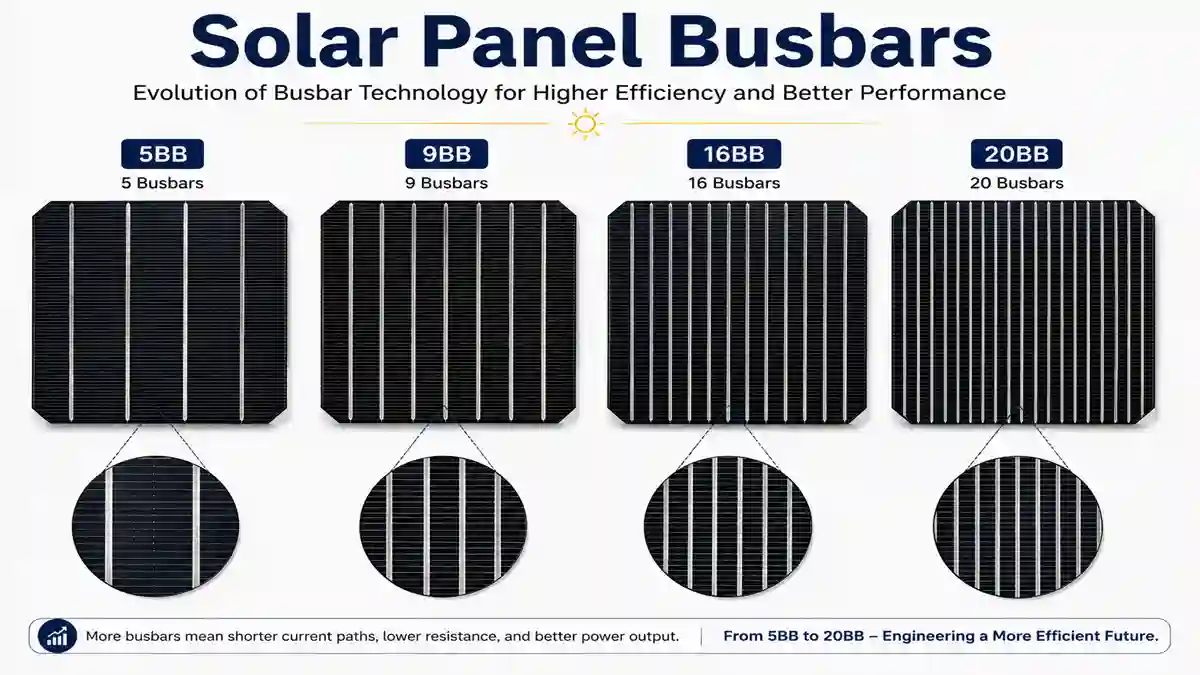
Why do Solar Panel Busbars keep increasing? learn the engineering behind 3BB, 5BB, 9BB, 16BB, and 20+ BB, and how they improve solar panel performance.
If you’ve compared solar panel datasheets recently, you’ve probably noticed a number that keeps climbing year over year — 5BB, then 9BB, now 16BB is the mainstream standard, with 20BB already appearing on newer product lines. This isn’t marketing inflation for its own sake.
Busbar count is one of the few specs where more genuinely, measurably means better, and understanding why manufacturers keep adding more explains a real, ongoing engineering trend rather than an arbitrary numbers race.
This guide is part of our Types of Solar Panels hub and our Solar Panel Technology hub, and pairs directly with our 5BB vs 9BB vs 16BB comparison — read that one for the direct buying comparison, this one for the full trajectory and the physics behind it.
What a Busbar Actually Does
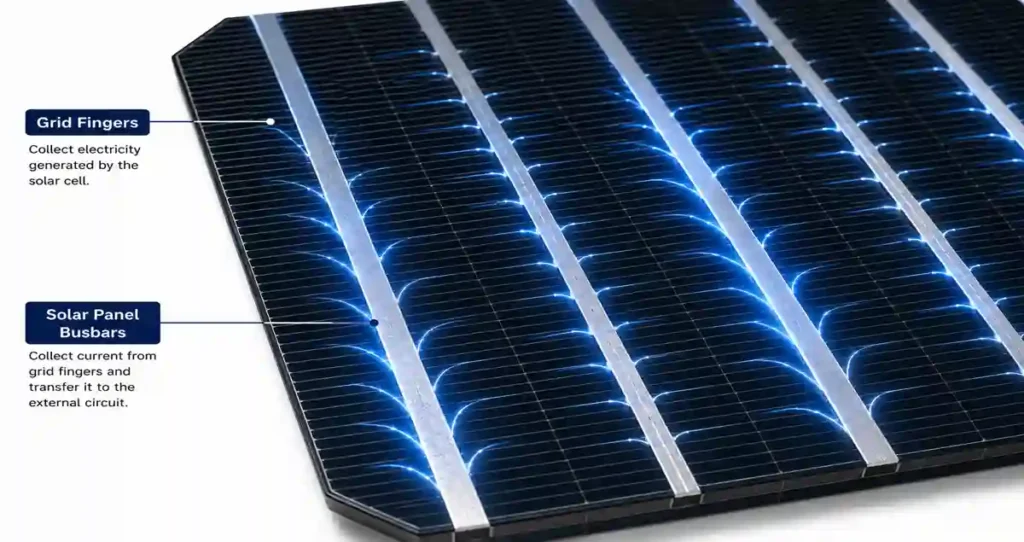
Busbars are the thin metallic strips running across the front of a solar cell, collecting the electrical current generated by the cell’s thinner grid fingers and channeling it toward the panel’s external wiring. Every cell needs some way to gather that current — the question busbar design answers is how many collection points to use, and how thick each one needs to be to do the job.
Engineer’s Note: The physics behind adding more busbars is straightforward once you see it: current traveling any distance through a conductor loses some energy to resistance, and that loss increases with distance traveled. More busbars means each grid finger has to carry current a shorter distance to reach its nearest collection point, which directly reduces resistive loss.
It’s the same underlying principle behind Half-Cut Solar Panels—shorter current paths, less resistance, and less wasted energy. Modern TOPCon Solar Panels, HJT Solar Panels, IBC (Interdigitated Back Contact) Solar Panels, and ABC (All Back Contact) Solar Panels all combine advanced cell architectures with multi-busbar technology to maximize electrical performance.
The Real Trajectory: 3BB to 16BB and Beyond
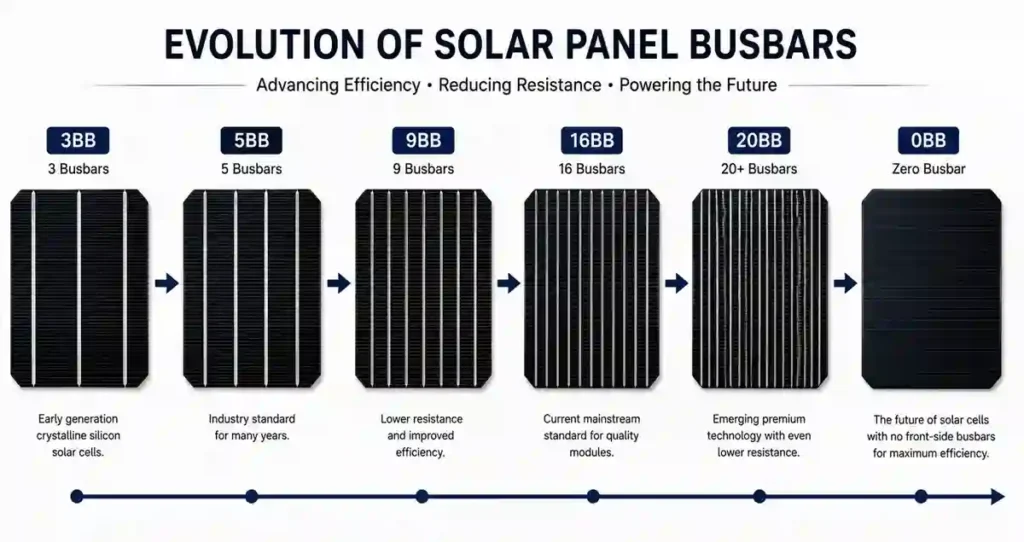
Early crystalline silicon panels used 3 busbars, then 4BB and 5BB became the standard for years. That gave way to 9BB designs roughly a decade ago, and today 16BB has become the dominant mainstream configuration across most quality manufacturers, with 20BB already appearing on newer premium product lines. Each generation delivered a real, if incremental, efficiency and reliability gain — this isn’t a case of diminishing returns being marketed as meaningful progress.
As photovoltaic technology evolved from PERC Solar Panels to TOPCon Solar Panels, HJT Solar Panels, and advanced Back Contact Solar Panels, manufacturers also increased busbar counts from 5BB to today’s 16BB and 20+ BB designs. These improvements work together rather than independently, combining better cell technology with more efficient current collection.
| Generation | Busbar Count | Era / Market Status | Industry Reference |
| Early crystalline silicon | 3BB | Legacy, largely phased out of quality manufacturing | Fraunhofer ISE |
| Second generation | 4BB – 5BB | Now confined to budget/older inventory tiers | PV Magazine |
| Third generation | 9BB – 12BB | Still common, being superseded by 16BB | NREL |
| Current mainstream (2026) | 16BB | Dominant on quality panels, expected near-universal by 2030 | PV Magazine |
| Emerging premium | 20+ BB | Appearing on newer premium product lines | PV Magazine |
| Next-generation direction | Zero Busbar (0BB) | Eliminates front-surface busbars entirely — see our dedicated guide | Industry Sources |
Busbar Technology Evolution
- 3BB – Early crystalline silicon solar panels; now obsolete in modern manufacturing.
- 5BB – Industry standard for many years and still found in older inventory.
- 9BB–12BB – Reduced electrical resistance and improved efficiency over earlier designs.
- 16BB – Current mainstream standard for most high-quality photovoltaic modules.
- 20+ BB – Emerging premium multi-busbar technology, with manufacturers introducing 20BB, 22BB, 24BB, 26BB, and even 28BB designs for further efficiency and reliability improvements.
- Zero Busbar (0BB) – The next generation of photovoltaic cell architecture, eliminating front-side busbars to maximize active cell area and reduce shading.
Advantages and Disadvantages of Higher Busbar Counts
| Advantages | Disadvantages |
| Lower resistive losses — shorter current travel distance per cell | Marginal added manufacturing complexity per additional busbar |
| Better mechanical reliability — more connection points reduce microcrack risk | Round-wire busbars require different soldering equipment than older flat-ribbon designs |
| Improved low-light and partial-shading performance | Very high busbar counts eventually hit diminishing efficiency returns |
| No longer commands a price premium — now baseline expected on quality panels | Legacy inventory with lower busbar counts can be harder to identify without checking specs |
Busbar Evolution Table
| Busbar | Technology Level | Status (2026) |
|---|---|---|
| 3BB | Obsolete | No longer used |
| 5BB | Legacy | Older inventory |
| 9BB | Transitional | Still available |
| 12BB | Modern | Some manufacturers |
| 16BB | Current Standard | Recommended |
| 20+ BB | Premium | Latest generation |
| 0BB | Future | Next-generation technology |
Why This Trend Hasn’t Stopped Yet
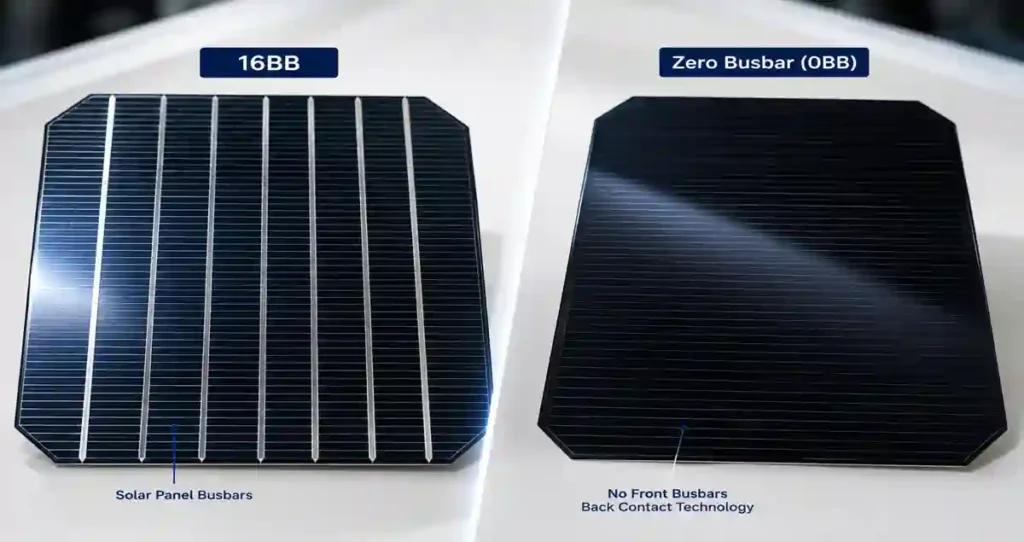
The honest engineering answer is that busbar count increases have consistently paid for themselves in efficiency and reliability terms without adding meaningful cost, which is exactly the kind of improvement that keeps getting adopted industry-wide rather than stalling out. Modern multi-busbar designs also increasingly use round wire instead of the older flat-ribbon busbars, which reduces shading from the busbars themselves and can even provide a degree of self-healing behavior when microcracks occur, since current can reroute around a damaged connection point more easily with more busbars present to begin with.
The logical endpoint of this trend, and the direction real manufacturing investment is now heading, is eliminating front-surface busbars — zero busbar (0BB) designs remove the metal grid from the front surface entirely, typically paired with back-contact or heterojunction cell architectures. That’s a genuinely different technology from simply adding more busbars, and it’s covered in detail in our dedicated Zero Busbar guide.
Today’s premium Monocrystalline Solar Panels almost universally use multi-busbar technology, regardless of whether they are based on TOPCon, HJT, or IBC cell architectures. Even emerging technologies such as Tandem Solar Panels are expected to adopt advanced current-collection methods, including multi-busbar or Zero Busbar designs.
Field Note: I check busbar count as one of the first things on any panel datasheet a client brings me, because it’s one of the clearest, least-disputed signals of how current the panel’s manufacturing actually is. A panel still specified at 5BB in 2026 is very likely older inventory, discontinued stock, or a budget import — not necessarily unusable, but worth pricing accordingly rather than paying current-generation prices for it.
Whether I’m reviewing Monocrystalline TOPCon, HJT, or Bifacial Solar Panels, busbar count is still one of the quickest indicators of how current the manufacturing technology really is.
Real-World Applications
In practice, busbar count has become less of an active decision I discuss with clients and more of a baseline quality check I perform on their behalf — nearly every quote I review today from a reputable manufacturer already specifies 16BB or higher without needing to ask. Where it does still come up as an active conversation is when a client is evaluating discounted older inventory, where confirming the busbar count is one of the fastest ways to tell whether a deal reflects genuinely older technology or just aggressive pricing on current-generation stock.
Common Misconceptions Worth Clearing Up
People sometimes assume busbar count is a marketing number similar to inflated wattage claims on portable panels — impressive-sounding but not meaningfully connected to real performance. That’s not accurate here. Unlike some marketing specs, busbar count has a direct, well-documented physical relationship to resistive loss and mechanical reliability, and the industry-wide shift toward higher counts reflects genuine, measurable engineering improvement rather than a numbers game.
The other misconception is treating busbar count as a standalone quality indicator independent of everything else on the datasheet. It’s a genuinely useful signal, but it should be read alongside PERC Solar Panels, TOPCon Solar Panels, HJT Solar Panels, IBC Solar Panels, ABC (All Back Contact) Solar Panels, and Half-Cut Solar Panels, rather than as a standalone quality indicator.
Engineering Assessment Table
| Feature | Rating |
|---|---|
| Electrical Efficiency | ★★★★★ |
| Reliability | ★★★★★ |
| Industry Adoption | ★★★★★ |
| Future Proofing | ★★★★★ |
| Overall Recommendation | ★★★★★ |
Buying Checklist
- Confirm current-generation panels specify at least 16BB — treat 9BB or lower as older inventory pricing
- Check whether busbars are round wire or flat ribbon — round wire is the more current manufacturing approach
- Don’t pay a premium purely for busbar count — it’s now a baseline expectation, not a differentiator worth a significant price gap
- Evaluate busbar count alongside cell technology and half-cut construction, not as a standalone quality signal
- Consider busbar count together with cell technology (PERC, TOPCon, HJT, IBC, or ABC) and Half-Cut Solar Panel construction for the best overall performance.
For the direct comparison across specific busbar counts, see 5BB vs 9BB vs 16BB Solar Panels. For the technology eliminating front-surface busbars entirely, see Zero Busbar Solar Panels.
My closing observation on this trend: busbar count is one of the rare specs in solar where the marketing number and the genuine engineering improvement have stayed honestly aligned for over a decade running. Unlike some inflated claims elsewhere in the industry, every step from 3BB through 16BB and toward zero busbar has represented a real, physically grounded improvement in resistive loss or manufacturing reliability. That’s worth knowing when you’re evaluating a datasheet — this is one number you can trust to mean what it claims to mean.
Future photovoltaic technologies, including Tandem Solar Panels and Perovskite Solar Panels, are also expected to move toward advanced current-collection designs that minimize front-surface shading while improving electrical efficiency.
Frequently Asked Questions
How many busbars should a good solar panel have in 2026?
16BB is currently the mainstream standard for quality panels, with 20BB appearing on newer premium product lines. Panels specified at 9BB or fewer generally reflect older inventory rather than current-generation manufacturing.
Do more busbars actually make a real difference in performance?
Yes — higher busbar counts genuinely reduce resistive losses by shortening the distance current travels to reach a collection point, and improve mechanical reliability by adding redundant connection points that reduce the impact of microcracks.
Is zero-busbar technology better than high-busbar-count designs?
Zero busbar represents a different approach entirely — removing front-surface busbars rather than adding more of them — typically paired with back-contact or heterojunction cell architecture. See our dedicated Zero Busbar guide for the full comparison.
How can I identify the busbar count on a solar panel?
In many cases, the busbars are visible as thin metallic strips on the front of each solar cell, allowing you to estimate the count. However, the most reliable method is to check the manufacturer’s datasheet, where the busbar configuration is officially specified.
Is a 5BB solar panel still worth buying?
A 5BB solar panel can still produce reliable electricity, but it represents older photovoltaic technology. If priced similarly to modern modules, a 16BB or higher panel generally offers better efficiency, improved reliability, and greater long-term value.
Is busbar count more important than solar cell technology?
No. Busbar count improves current collection and reduces electrical resistance, but overall performance also depends on the underlying cell technology. For example, an N-Type TOPCon or HJT panel typically outperforms an older PERC panel, even if both have the same busbar count.
Do more busbars increase the cost of a solar panel?
Not significantly. Multi-busbar technology has become the industry standard, so higher busbar counts no longer carry a meaningful price premium. Today, 16BB and higher designs are considered a baseline feature on quality solar panels.
Will Zero Busbar (0BB) replace multi-busbar technology?
Zero Busbar (0BB) is widely viewed as the next step in photovoltaic cell design because it eliminates front-side busbars to reduce shading and maximize active cell area. However, 16BB and 20+ BB technologies are expected to remain the mainstream commercial standard for the foreseeable future as 0BB manufacturing continues to mature.
References
Busbar count trends and market adoption data are drawn from Fraunhofer ISE’s Photovoltaics Report, ongoing coverage from PV Magazine, and NREL’s cell technology research.
Related guides on SolarVisionAI.com
- Monocrystalline Solar Panels 2026: Still Worth It or Hype
- Polycrystalline Solar Panels: Worth Buying in 2026?
- Thin-film Solar Panels: When They Beat Silicon (2026)
- BIPV Solar Panels: Building-Integrated PV Complete Guide
- Portable Solar Panels: Engineer’s Buyer’s Guide 2026
- CPV Solar Panels: Concentrated Photovoltaic Explained
- Skin Solar Panel: What “Solar Skin” Actually Means
- Solar Fence Post Lights: Cap Sizes, Types & Install Guide
- Bifacial Solar Panels in 2026: How to Boost Energy Output
- Solar Charge Controller: The Complete Guide
- MC4 Connectors: Solar Safety & Installation Guide
- Solar Panel Types, Efficiency & Benefits
- Solar Water Pump Guide
- Commercial Solar Panel Installation: Engineering Guide
- Solar Fence Post Lights: Cap Sizes, Types & Install Guide
- BESS — Battery Energy Storage System Guide
- Commercial Solar Panel Installation
- Solar Refrigerator & DC Fridge — Complete 2026 Guide
- Bifacial Solar Panel Albedo Effect Guide
- TOPCon: Why TOPCon Solar Panel is a Proven Smart Investment in 2026
- HJT: Why TOPCon Solar Panel is a Proven Smart Investment in 2026
- PERC: PERC Solar Panel: Still Relevant or Already Outdated?
- Perovskite: Perovskite Solar Panels: The 2026 Reality Check
- N-Type vs P-Type: N-Type vs P-Type Solar Panels: Honest Comparison
- ABC: ABC (all back contact) Solar Panel: Back Contact Technology Explained
- IBC: IBC Solar Panels: Interdigitated Back Contact Guide
- Tandem: Tandem Solar Panels: Are Stacked Cells Ready for Rooftops?