
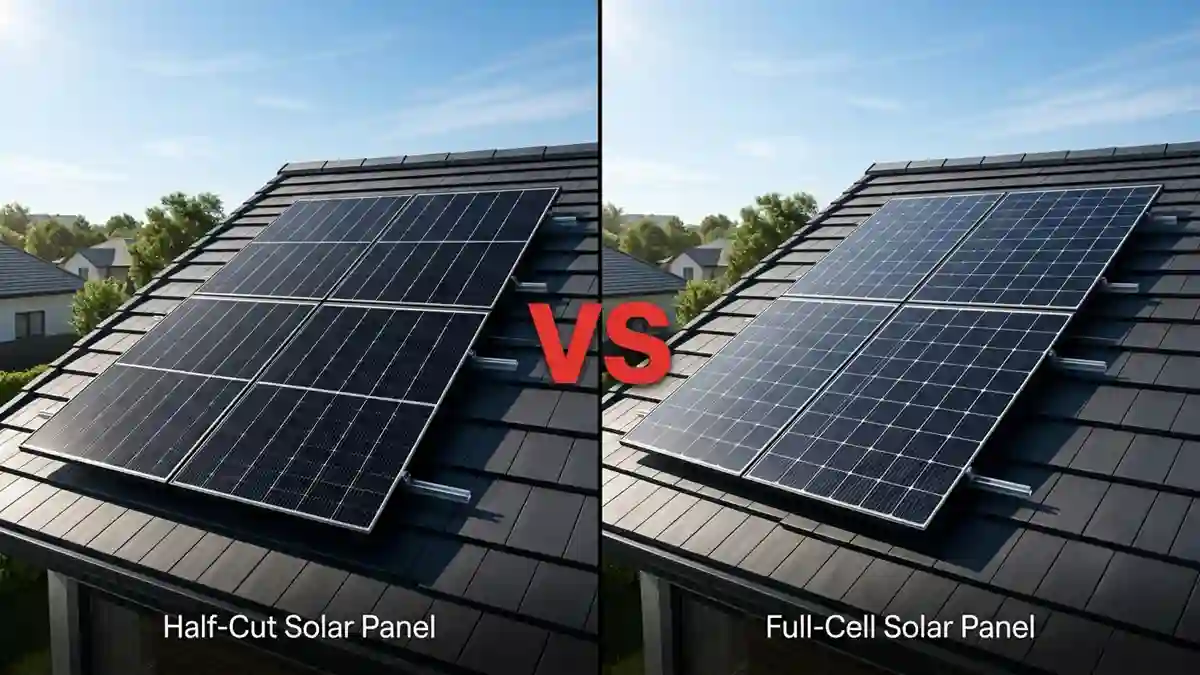
Compare half-cut vs full-cell solar panels with real engineering insights. Learn why half-cut panels are replacing full-cell technology and which is best for your system.
This is a shorter, more direct comparison than most of the buying decisions covered elsewhere on this site, mostly because one side of the comparison has largely won. Full-cell solar panels — the standard, uncut cell design that dominated the industry for decades — have been steadily replaced by half-cut construction across nearly every manufacturer’s mainstream product lines. Still, understanding exactly what you’d be giving up by choosing an older full-cell panel, and why, is worth a clear-eyed comparison rather than just taking the industry shift on faith.
This guide is part of our Types of Solar Panels hub, and is the direct companion to our Half Cut Solar Panels guide — read that one for the full technical explanation of how half-cut works, read this one for the head-to-head buying comparison.
The Core Difference in One Paragraph
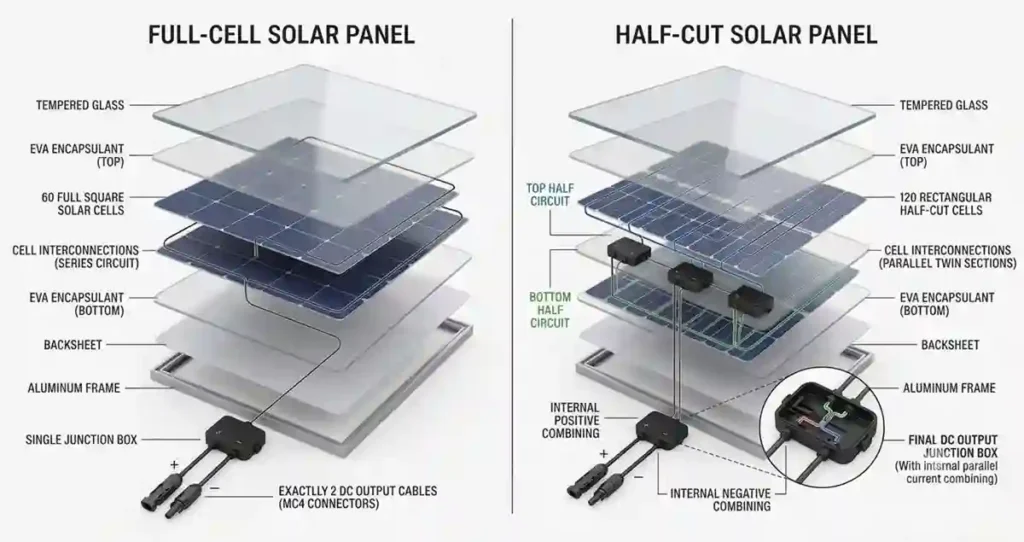
Full-cell panels use standard, uncut solar cells wired in a single series string per section of the panel. Half-cut panels use the same base cells, physically cut in half and wired as two largely independent parallel circuits. That single change in cell size and wiring topology is responsible for every performance difference covered below — nothing else about the underlying cell chemistry, glass, encapsulant, or frame construction differs between the two.
Engineer’s Note: When I review a datasheet, I check cell count as the quickest way to identify half-cut versus full-cell construction. A standard full-cell 60-cell-equivalent panel will typically be listed as 120 or 144 half-cells on a half-cut datasheet — the cell count roughly doubles because each physical cell is now counted as two half-cells, even though the panel’s overall physical dimensions are essentially unchanged.
Half-cut vs full-cell solar panels Performance Comparison
| Metric | Half-Cut | Full Cell | Industry Reference |
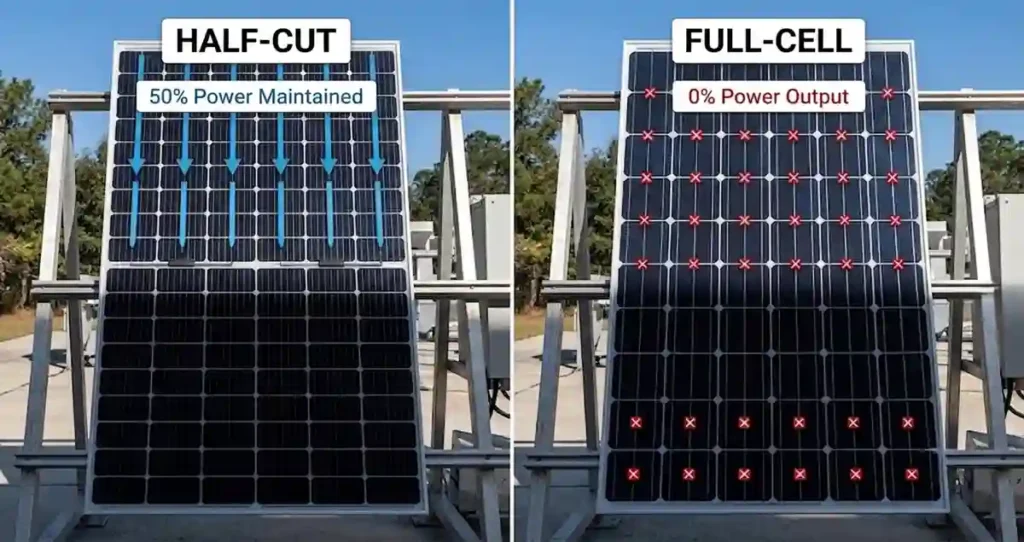
| Shading response | Better — partial shading affects only one parallel half | Worse — single shaded cell can drag down full string | Fraunhofer ISE |
| Resistive losses | Lower, from smaller individual cell size | Higher, from full-size cell current handling | NREL |
| Micro-crack resistance | Better — less mechanical stress per cell | More vulnerable under thermal cycling stress | Fraunhofer ISE |
| Current availability | Mainstream standard across nearly all manufacturers | Increasingly rare — being phased out of flagship lines | PV Magazine |
| Typical price difference | At or near parity with full-cell in 2026 | No longer meaningfully cheaper in most markets | IRENA |
Advantages and Disadvantages
| Advantages | Disadvantages |
| Half-cut: meaningfully better shading tolerance and micro-crack resistance | Half-cut: marginally more complex manufacturing, though cost gap has closed |
| Half-cut: now the mainstream, widely available default across the industry | Full-cell: increasingly hard to source from mainstream manufacturers |
| Full-cell: simpler wiring topology with fewer total interconnections | Full-cell: poor shading tolerance — one shaded cell affects the whole string |
| Full-cell: well-understood, decades-long track record in the field | Full-cell: offers no meaningful cost advantage anymore to offset its downsides |
Half-cut vs full-cell solar panels Real-World Applications
Practically speaking, this comparison rarely comes up as an active decision on new projects anymore — half-cut has become close enough to the default that most quotes I review today are half-cut without the client ever explicitly asking for it. Where the comparison does still matter is secondary markets: used or refurbished panel purchases, older inventory clearance deals, or older installations being expanded where matching existing full-cell panels might be a consideration for electrical consistency within a single array.
I’ve advised a handful of clients evaluating discounted full-cell inventory purely on cost, and my consistent guidance has been that the price gap needs to be substantial before full-cell becomes the right call, given how much shading tolerance and durability advantage half-cut now delivers at a comparable price in most markets. A modest discount on full-cell inventory rarely offsets what you’re giving up.
Field Note: I reviewed a client’s plan to expand an existing older full-cell array by adding a few full-cell panels sourced from discontinued inventory, purely to keep electrical characteristics uniform across the whole system. That’s a legitimate reason to choose full-cell today — matching an existing array — but it’s a narrow, specific justification, not a general recommendation to prefer full-cell for a new standalone project.
Applications table
| Application | Recommended Panel | Why |
|---|---|---|
| Residential Rooftops | Half-Cut | Better shading tolerance and higher efficiency. |
| Commercial Rooftops | Half-Cut | Improved reliability and reduced power loss. |
| Utility-Scale Solar Farms | Half-Cut | Industry standard for new projects. |
| Existing Full-Cell System Expansion | Full-Cell | Maintains electrical compatibility with existing arrays. |
| Budget Clearance Projects | Full-Cell | Worth considering only with significant cost savings. |
When Full-Cell Still Makes Sense
- Expanding or repairing an existing full-cell array where electrical matching across the system matters
- Genuinely steep discount pricing on clearance inventory where the savings clearly outweigh the shading and durability trade-off for that specific site
- Extremely low-shading-risk installations (open ground-mount, no nearby obstructions) where half-cut’s main practical advantage matters least
When Half-Cut Is the Clear Choice
Essentially every new residential or commercial project without a specific reason to match existing full-cell equipment. Given that pricing has converged, there’s very little remaining argument for choosing full-cell as a first purchase in 2026 outside the narrow scenarios above.
Common Misconceptions Worth Clearing Up
People sometimes assume full-cell panels are simply “older technology” in a way that implies they’re broadly inferior or unreliable. That’s not quite fair — full-cell construction has a long, well-proven track record, and plenty of full-cell panels installed over a decade ago are still performing reliably today. The issue isn’t that full-cell doesn’t work; it’s that half-cut offers a genuine, low-cost improvement that’s made choosing full-cell for a new project increasingly hard to justify, not that existing full-cell installations are somehow defective.
Why Full-Cell Solar Panels Are Disappearing
- Polycrystalline solar panels have largely disappeared from new premium installations due to their lower efficiency compared with monocrystalline technology.
- Monocrystalline solar panels have become the industry standard because they deliver higher efficiency, better aesthetics, and improved long-term performance.
- Half-cut cell architecture reduces electrical resistance and improves energy output compared with traditional full-cell designs.
- N-Type TOPCon modules have largely replaced older PERC full-cell technology due to higher efficiency, lower degradation, and better temperature performance.
- HJT (Heterojunction) technology offers even greater efficiency and long-term reliability and is almost exclusively manufactured using half-cut cells.
- Bifacial glass-glass modules are now widely combined with half-cut N-Type TOPCon and HJT technology for commercial and utility-scale solar projects.
- PERC full-cell panels are increasingly limited to older inventory, budget projects, or system expansions where module compatibility is important.
- Manufacturing costs have decreased, making half-cut panels only slightly more expensive than traditional full-cell modules.
- Leading manufacturers such as LONGi, JinkoSolar, Trina Solar, JA Solar, Canadian Solar, and Astronergy now focus primarily on half-cut N-Type products.
- Today, the global solar industry is centered on monocrystalline, half-cut, N-Type TOPCon, HJT, and bifacial technologies, making conventional full-cell and polycrystalline panels gradually disappear from new installations.
Buying Checklist
- Check the cell count on the datasheet — roughly double the expected full-cell count typically indicates half-cut construction
- For any new project without a specific matching requirement, default to half-cut given current price parity
- If considering discounted full-cell inventory, calculate whether the savings genuinely offset the shading and durability trade-off for your specific site
- Confirm warranty terms are comparable regardless of which construction you choose
For the full technical explanation of half-cut construction and its shading-tolerance advantage, see our Half Cut Solar Panels guide.
If you take one thing from this comparison, let it be this: asking “half-cut or full-cell” is no longer really the operative question for a new project in 2026 — asking “why would I choose full-cell” is the more useful framing, since the burden of justification has genuinely shifted. That’s a meaningful signal in an industry where most technology comparisons don’t resolve this cleanly, and it’s worth taking at face value rather than assuming there must be a hidden catch to half-cut’s advantages.
Engineering Assessment
| Feature | Rating |
|---|---|
| Efficiency | ★★★★★ |
| Partial Shading Performance | ★★★★★ |
| Long-Term Reliability | ★★★★★ |
| Market Availability | ★★★★★ |
| Cost Effectiveness | ★★★★★ |
| Overall Recommendation | ★★★★★ |
Frequently Asked Questions
Are full-cell solar panels still being manufactured?
Some manufacturers still produce full-cell panels, particularly for specific legacy or budget product lines, but half-cut has become the mainstream standard across most flagship residential and commercial product offerings as of 2026.
Is it worth buying full-cell panels if they’re cheaper?
Only if the discount is substantial, since half-cut typically offers meaningfully better shading tolerance and durability at little to no price premium in most current markets. A small discount on full-cell rarely offsets what you’d be giving up.
Can I mix half-cut and full-cell panels in the same solar system?
It’s technically possible but not generally recommended without careful electrical design, since the two constructions have different current and voltage characteristics that can create mismatches reducing overall system efficiency if not properly accounted for. If you’re expanding an existing full-cell array, consult with your installer about whether matching the original construction or upgrading the new section to half-cut makes more sense for your specific system.
Can half-cut and full-cell solar panels be used for net metering?
Yes. Both panel types are fully compatible with grid-tied systems and net metering where local regulations permit.
Are half-cut solar panels compatible with lithium batteries?
Yes. Half-cut and full-cell solar panels are equally compatible with lithium battery systems. Battery compatibility depends on the inverter, charge controller, and system design—not on cell construction.
References
Performance comparisons between half-cut and full-cell construction reference NREL’s panel performance research and Fraunhofer ISE’s Photovoltaics Report. Market availability and pricing context references PV Magazine and IRENA’s Power Generation Costs.
Related guides on SolarVisionAI.com
- Monocrystalline Solar Panels 2026: Still Worth It or Hype
- Polycrystalline Solar Panels: Worth Buying in 2026?
- Thin-film Solar Panels: When They Beat Silicon (2026)
- BIPV Solar Panels: Building-Integrated PV Complete Guide
- Portable Solar Panels: Engineer’s Buyer’s Guide 2026
- CPV Solar Panels: Concentrated Photovoltaic Explained
- Skin Solar Panel: What “Solar Skin” Actually Means
- Solar Fence Post Lights: Cap Sizes, Types & Install Guide
- Bifacial Solar Panels in 2026: How to Boost Energy Output
- Solar Charge Controller: The Complete Guide
- MC4 Connectors: Solar Safety & Installation Guide
- Solar Panel Types, Efficiency & Benefits
- Solar Water Pump Guide
- Commercial Solar Panel Installation: Engineering Guide
- Solar Fence Post Lights: Cap Sizes, Types & Install Guide
- BESS — Battery Energy Storage System Guide
- Commercial Solar Panel Installation
- Solar Refrigerator & DC Fridge — Complete 2026 Guide
- Bifacial Solar Panel Albedo Effect Guide
- TOPCon: Why TOPCon Solar Panel is a Proven Smart Investment in 2026
- HJT: Why TOPCon Solar Panel is a Proven Smart Investment in 2026
- PERC: PERC Solar Panel: Still Relevant or Already Outdated?
- Perovskite: Perovskite Solar Panels: The 2026 Reality Check
- N-Type vs P-Type: N-Type vs P-Type Solar Panels: Honest Comparison
- ABC: ABC (all back contact) Solar Panel: Back Contact Technology Explained
- IBC: IBC Solar Panels: Interdigitated Back Contact Guide
- Tandem: Tandem Solar Panels: Are Stacked Cells Ready for Rooftops?