
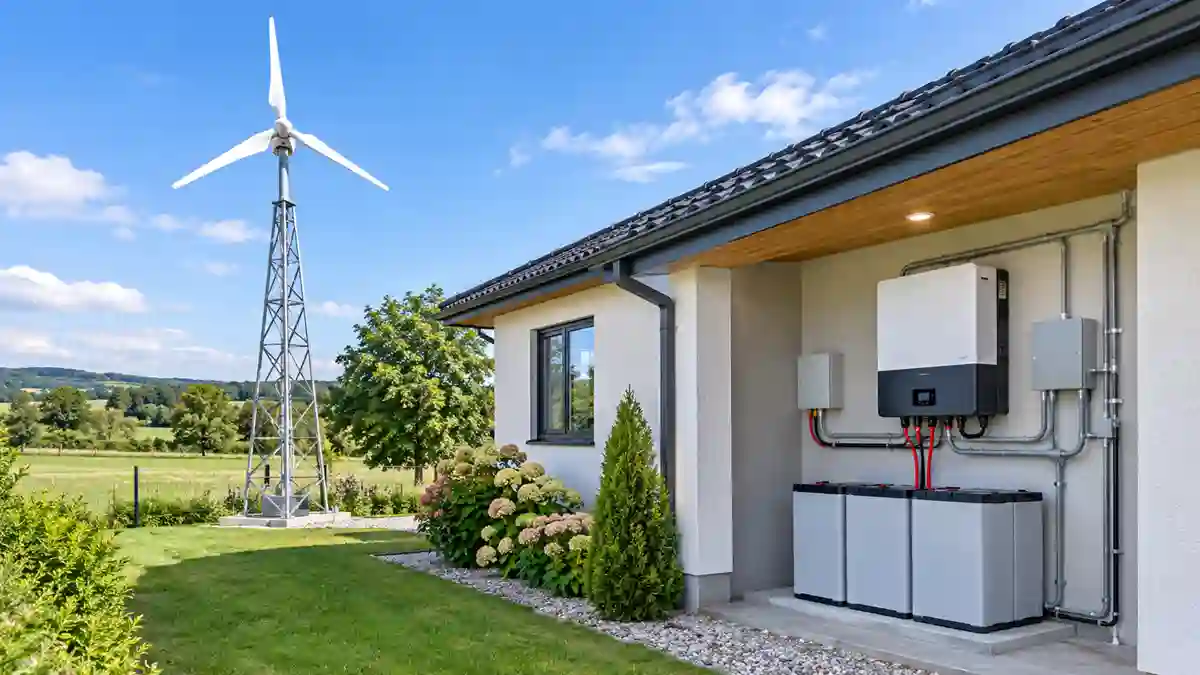
Learn how wind turbine inverter works. Compare grid-tied, off-grid, and hybrid options, understand compatibility, and discover how to choose the right inverter.
A wind turbine inverter is an important part of a wind energy system because it helps convert the electricity produced by the turbine into a form that can power household appliances, charge batteries, or supply energy to the utility grid.
Unlike solar panels, which normally provide DC electricity, many small wind turbines use generators that produce variable-voltage, variable-frequency AC electricity. This means the inverter cannot always be connected directly to the turbine. The system may need a rectifier, wind turbine controller, battery charge controller or other power-conditioning equipment.
For homeowners in the United States and other markets, choosing the correct inverter depends on the turbine specifications, electrical load, battery arrangement and grid-connection requirements.
As a solar and renewable energy engineer, I approach wind inverter selection as part of the complete system design. The turbine, controller, inverter, battery bank and protection equipment must work together. Selecting an inverter only by its kilowatt rating can lead to poor performance or equipment damage.
In this guide, I will explain how wind turbine inverters work, compare grid-tied, off-grid and hybrid options, and discuss the important points to check before selecting one.
What Is a Wind Turbine Inverter?
A wind turbine inverter is a power conversion device that helps make electricity from a wind turbine suitable for an electrical system.
Depending on the design, it may convert DC electricity from a rectifier or battery into AC electricity for household appliances or the utility grid.
A complete wind energy system may include:
- Wind turbine and generator
- Rectifier, if required by the turbine design
- Wind turbine controller
- Diversion load or braking equipment, where required
- Battery bank for storage, if included
- Wind-compatible inverter
- Electrical protection and monitoring equipment
Not every system needs all these components. The correct arrangement depends on the turbine manufacturer’s design and the selected operating mode.
How Does a Wind Turbine Inverter Work?
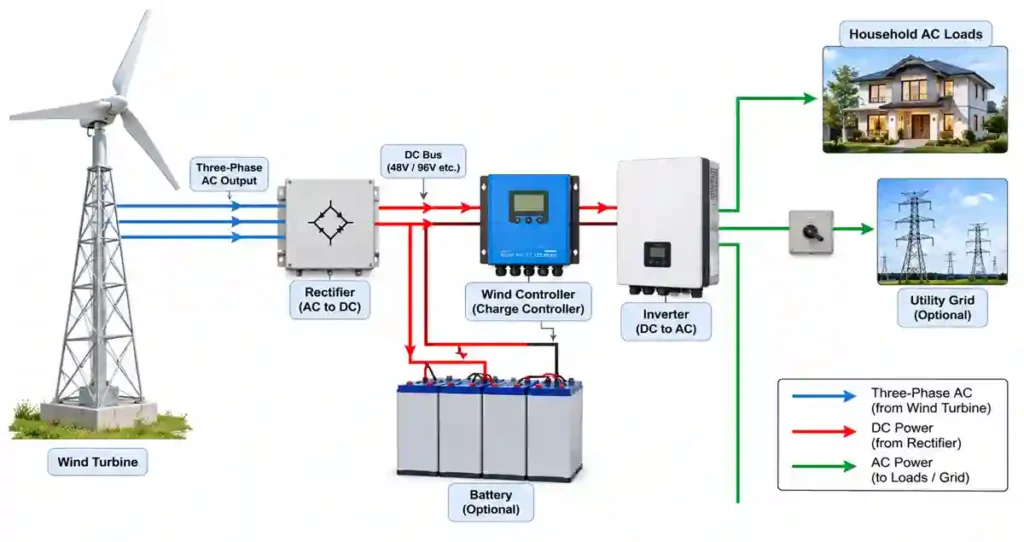
The working process depends on the type of wind turbine and inverter.
Many small wind turbines use a permanent-magnet generator that produces three-phase AC electricity. As wind speed and turbine rotation change, the generator’s voltage and frequency also change.
A typical system may work in the following steps:
- Wind turns the turbine blades.
- The rotating shaft drives the generator.
- The generator produces variable electrical output.
- A rectifier converts the generator’s AC output into DC, where required.
- A wind controller manages the electrical output and turbine protection.
- The inverter converts suitable DC power into AC electricity.
- The electricity supplies household loads, charges an appropriate storage system or is exported to the grid, depending on the system design.
The important point is that the inverter must receive the type and range of electrical input it is designed to handle.
A standard solar inverter should not be connected directly to a wind turbine simply because both systems generate renewable electricity. A compatible wind interface or an inverter specifically designed and approved for the turbine is necessary.
Main Types of Wind Turbine Inverters
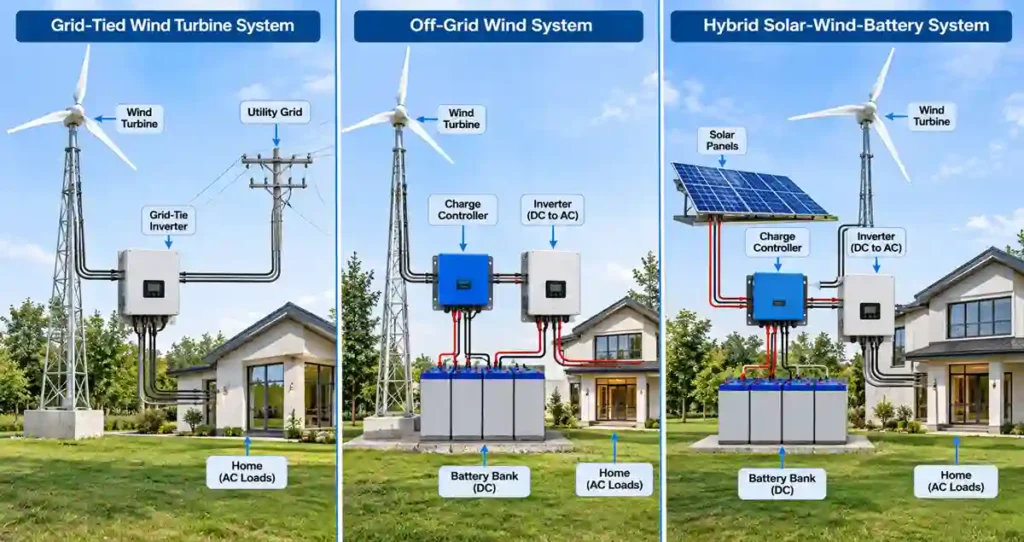
Wind turbine systems generally use three main arrangements: grid-tied, off-grid, and hybrid.
1. Grid-Tied Wind Turbine Inverter
A grid-tied wind inverter converts turbine power into AC electricity that can operate in parallel with the utility supply.
The inverter synchronizes its output with the grid’s voltage and frequency. Electricity generated by the turbine can supply local loads, while surplus energy may be exported if the utility allows it.
A typical arrangement is:
Wind Turbine → Wind Controller / Rectifier → Grid-Tied Wind Inverter → AC Distribution Board → Loads and Utility Grid
Some turbines use an integrated power-conditioning system, so a separate rectifier or controller may not be needed. Always follow the turbine manufacturer’s approved connection arrangement.
Main advantages:
- Can supply power to household loads.
- Can reduce electricity purchased from the utility.
- Batteries are not normally required.
- Can work alongside an existing solar or grid-connected system when properly designed.
Limitations:
- Utility approval and grid-interconnection compliance may be required.
- The inverter must be compatible with the turbine.
- Most grid-following inverters stop supplying power during a utility outage for anti-islanding protection.
- Wind turbine control and braking arrangements must remain effective if the grid or inverter disconnects.
A grid-tied wind turbine inverter is suitable when the property has a reliable grid connection and the local utility permits distributed wind generation.
2. Off-Grid Wind Turbine Inverter
An off-grid wind inverter is used where the property does not depend on a utility grid.
In this arrangement, the wind turbine charges a battery bank through a suitable controller and charging system. The inverter then converts the battery’s DC electricity into AC power for household appliances.
A typical arrangement is:
Wind Turbine → Rectifier / Wind Controller → Battery Bank → Off-Grid Inverter → AC Loads
The wind controller manages battery charging and turbine protection. The inverter supplies AC electricity according to the battery voltage, power rating and connected load.
Main advantages:
- Suitable for remote homes and farms.
- Can provide electricity where utility service is unavailable.
- Batteries store energy for periods with low or no wind.
- Can be combined with solar panels using compatible equipment.
Limitations:
- Battery storage adds to the project cost.
- The battery bank must be sized according to energy demand and backup time.
- Wind generation changes with weather conditions.
- A suitable diversion load or other turbine protection arrangement may be necessary.
For an off-grid installation, the inverter should be selected according to the battery voltage, continuous load, starting surge and required AC output.
Read our guide to off-grid solar systems for more information about standalone renewable energy arrangements.
3. Hybrid Wind Turbine Inverter
A hybrid wind energy system combines wind generation with another energy source, commonly solar PV and battery storage.
There are different ways to build this arrangement. One option uses a hybrid inverter for solar and battery operation, with a separate wind controller and compatible interface for the turbine. Another option uses a system specifically designed to manage both wind and solar inputs.
A typical DC-coupled arrangement may look like this:
Solar Panels → Solar MPPT Controller ─┐
Wind Turbine → Wind Controller ───────┼→ Battery Bank → Hybrid Inverter → AC Loads
The exact connections depend on the equipment. The wind turbine must not be connected to a solar MPPT input unless the manufacturer specifically approves that configuration.
Main advantages:
- Combines two renewable energy sources.
- Solar can generate during sunny daytime periods.
- Wind can contribute when suitable wind is available, including at night.
- Battery storage can support loads when generation is low.
- Can reduce dependence on a single energy source.
Limitations:
- Requires coordination between solar and wind charging equipment.
- Battery charging limits must be respected.
- Wind turbine protection must remain operational.
- More equipment and controls may increase system complexity.
A hybrid system can be useful where both solar and wind resources are suitable. However, the design should be based on actual site conditions rather than assuming that adding a wind turbine will automatically increase energy production.
Learn more in our guide to the solar and wind hybrid system.
Grid-Tied vs Off-Grid vs Hybrid Wind Inverter
The following table summarizes the main differences.
| Feature | Grid-Tied | Off-Grid | Hybrid |
|---|---|---|---|
| Utility grid | Required | Not required | Optional, depending on design |
| Battery storage | Usually not required | Normally required | Usually included |
| Main purpose | Supply loads and export permitted surplus | Supply independent loads | Combine multiple energy sources |
| Wind controller | Depends on turbine design | Required as specified by turbine | Required as specified by turbine |
| Solar integration | Possible with compatible equipment | Possible | Common |
| Backup during grid failure | Not normally available from a standard grid-following inverter | Available if designed for it | Available if designed for backup operation |
| System complexity | Moderate | Moderate | Higher |
The best option depends on the project’s energy requirements, grid availability, wind resource and budget.
Can You Use a Solar Inverter for a Wind Turbine?
This is one of the most important questions when designing a wind energy system.
In most cases, you should not connect a wind turbine directly to a standard solar inverter.
Solar panels have a different electrical output characteristic from wind generators. A PV inverter is designed to operate within its specified solar DC input and MPPT range. A wind turbine may produce variable-frequency AC, or a rectified DC output that changes with rotor speed and loading.
A wind turbine can sometimes work with a solar inverter through a specially designed wind interface. This interface may include a rectifier, turbine-specific power control, diversion load and protection functions.
Before using a solar inverter in a wind project, check:
- Whether the inverter manufacturer permits wind turbine operation.
- Whether an approved wind controller or interface is available.
- The turbine’s operating voltage and maximum voltage.
- The inverter’s permitted DC input range.
- The turbine’s power curve and control requirements.
- What happens during grid failure or inverter shutdown.
- Whether the complete arrangement meets local electrical and utility requirements.
Engineer’s Note: Never assume that a solar inverter’s MPPT function makes it suitable for wind generation. Compatibility must be confirmed for the complete turbine-controller-inverter combination.
For more background, read our guide to solar inverter selection and use.
Important Components Between a Wind Turbine and Inverter
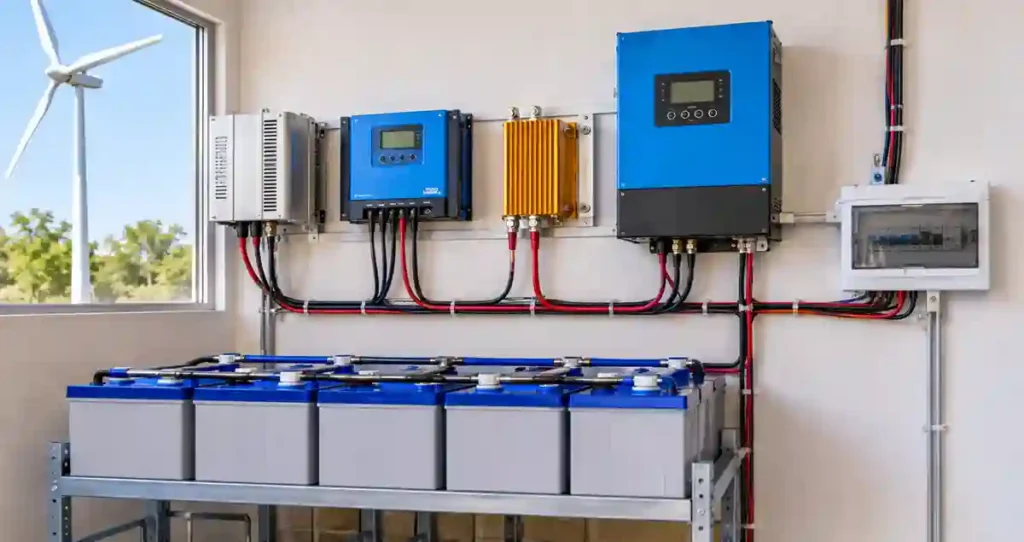
A wind inverter is only one part of the system. Other equipment may be needed to regulate and protect the electrical supply.
Wind Turbine Rectifier
Some small wind turbines produce three-phase AC electricity with changing voltage and frequency. A rectifier converts this AC output into DC electricity.
The rectifier must be rated for the turbine’s operating voltage, current and power. Its cooling and surge capability should also be checked.
Wind Turbine Controller
The controller manages the turbine’s electrical output. Depending on the design, it may regulate battery charging, control a diversion load, monitor turbine conditions and provide braking functions.
A wind controller is not necessarily the same as a solar MPPT charge controller. Their operating methods and input characteristics can be different.
Diversion Load or Dump Load
A diversion load is an electrical resistor or other suitable load that absorbs excess energy when the system needs to limit battery charging or control turbine operation.
In some battery-based wind systems, the controller diverts excess turbine power to this load when the battery reaches its charging limit.
It is important to understand that a diversion load is not a universal replacement for a turbine’s braking and safety system. Its rating, control method and operation during faults must follow the turbine manufacturer’s design.
Battery Bank
In off-grid and many hybrid systems, batteries store the energy generated by the turbine.
The battery bank must be compatible with the controller and inverter. Its voltage, charging limits, capacity and battery-management system requirements should be checked.
Read our LiFePO4 battery guide to understand lithium iron phosphate battery technology.
How to Select the Right Wind Turbine Inverter
Selecting a wind turbine inverter requires more than matching the inverter’s kilowatt rating with the turbine’s rated power.
Consider the following points before choosing equipment.
1. Check the Turbine’s Rated Power
Start with the turbine’s rated output in watts or kilowatts.
For example, a 5 kW wind turbine has a rated power of 5,000 watts under the manufacturer’s specified operating conditions.
However, this does not mean that the turbine produces 5 kW continuously. Actual generation changes with wind speed.
The inverter and controller must be selected using the turbine manufacturer’s electrical specifications, including its operating and maximum output.
2. Check the Input Voltage Range
The inverter must accept the voltage supplied by the approved controller or rectifier.
For example, if a wind controller provides a DC output, confirm that its normal and maximum voltage remain within the inverter’s permitted input range.
Never select an inverter based only on its nominal voltage. Maximum voltage under high wind or low-load conditions also matters.
3. Confirm AC Output Voltage and Frequency
Check the AC output required by the property.
Common configurations include:
- 120 V, 60 Hz in many North American residential applications.
- 230 V, 50 Hz in many countries.
- Three-phase 400 V, 50 Hz for certain commercial and industrial installations.
The inverter must match the local electrical supply and the utility’s interconnection requirements.
4. Check Continuous and Surge Power
The inverter must support the continuous load and the starting current of appliances such as pumps, refrigerators, and motors.
For example:
A home has a continuous load of 2,000 watts.
Its largest motor requires an additional starting surge of 2,000 watts.
The inverter must be capable of supplying the operating load and the required starting surge at the same time, subject to the manufacturer’s surge-duration rating.
Do not select an inverter based only on the sum of appliance running watts.
For additional guidance, use our inverter size calculator.
5. Check Battery Compatibility
For off-grid and battery-based hybrid systems, confirm:
- Battery nominal voltage.
- Supported battery chemistry.
- Maximum charging and discharging current.
- Battery management system communication, if required.
- Low-voltage and high-voltage protection settings.
The battery, charge controller and inverter must all operate within the battery manufacturer’s permitted limits.
6. Check Turbine Protection and Fault Handling
A wind turbine can continue rotating during strong wind even when the inverter stops accepting power.
The system must have an approved method to manage excess energy and protect the turbine during events such as:
- Battery fully charged.
- Inverter shutdown.
- Utility grid failure.
- Controller fault.
- Excessive wind speed.
- Electrical overvoltage.
The protection arrangement must be designed for the actual turbine. Do not assume that switching off the inverter is a safe way to stop wind generation.
Simple Wind Turbine Inverter Sizing Example
Consider a small wind energy system with the following specifications:
- Wind turbine rated power: 5 kW.
- Battery system: 48 V nominal.
- Required inverter output: 230 V AC.
- Maximum expected household running load: 3 kW.
The inverter should be selected to supply the required 3 kW running load, with additional capacity for motor starting and future load requirements where appropriate.
However, the inverter’s battery voltage compatibility and its approved input arrangement are just as important as its output rating.
A 5 kW turbine does not automatically require a 5 kW battery inverter. The turbine’s energy may be used to charge batteries, while the inverter is sized according to the AC loads and backup requirements.
Important: This is an illustrative example, not a final equipment selection. A real design requires the turbine power curve, controller specifications, battery charging limits, load profile and inverter datasheet.
Wind Turbine Inverter Installation and Protection
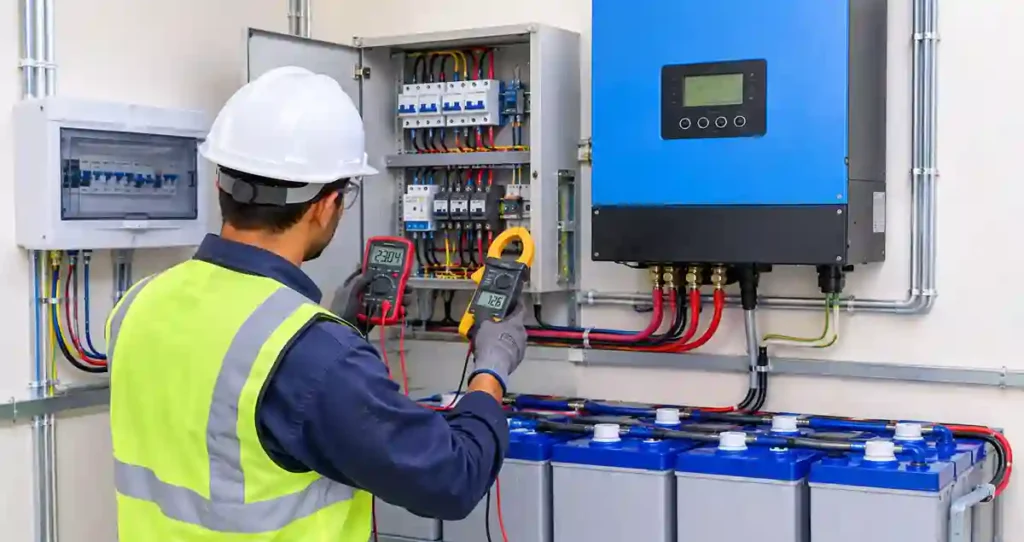
Correct installation is essential for safe operation and long equipment life.
Important design and installation checks include:
- Install the inverter according to the manufacturer’s clearance, ventilation and environmental requirements.
- Use cables rated for the expected current, voltage, temperature and installation conditions.
- Provide suitable overcurrent protection and isolation.
- Confirm grounding and bonding arrangements.
- Protect equipment against lightning and surge events where required by the site design.
- Keep battery equipment in a suitable location with appropriate safety provisions.
- Follow the turbine manufacturer’s shutdown and braking procedure.
- Label electrical circuits and provide clear operating instructions.
- Verify the grid-interconnection protection where the system operates in parallel with the utility.
Wind turbine wiring and protection should be designed by a qualified professional. Turbine circuits may remain energized while the rotor is turning, so maintenance procedures must account for the turbine’s mechanical and electrical hazards.
Wind Turbine Engineering Standards and Electrical Codes: IEC, IEEE, NFPA, NEC and UL
A wind turbine inverter installation must follow applicable equipment safety, electrical installation and grid-interconnection requirements. The exact standards depend on the project location, turbine type, inverter certification and local authority.
The following standards and codes are particularly relevant:
- IEEE 1547 – Distributed Energy Resource Interconnection: Covers technical requirements for connecting distributed energy resources, including inverter-based systems, to the utility grid. It addresses interconnection performance, abnormal grid conditions, power quality and islanding.
- IEEE 1547.1 – Interconnection Testing: Provides conformance test procedures for equipment designed to meet IEEE 1547 requirements.
- NFPA 70 (NEC) – National Electrical Code: Covers electrical installation safety. Article 694 addresses small wind electric systems, while other applicable articles may cover inverters, energy storage and interconnections.
- UL 1741 – Inverters, Converters and Interconnection Equipment: Covers relevant safety and performance requirements for equipment used with distributed energy resources.
- UL 6142 – Small Wind Turbine Systems: Addresses safety requirements for small wind turbine generating systems, including relevant electrical control and protection aspects.
- IEC 61400-2 – Small Wind Turbines: Covers design and safety requirements for small wind turbines. It is relevant to the turbine system rather than being an inverter-only standard.
Important Engineering Note: IEEE 1547 addresses grid interconnection, UL 1741 covers applicable inverter and interconnection equipment, and NFPA 70 addresses electrical installation. IEC 61400-2 and UL 6142 relate to small wind turbine safety. These standards are not interchangeable, and their legal applicability depends on local adoption, utility rules and project requirements.
For projects outside the United States, including installations in Pakistan, the applicable national electrical regulations, utility interconnection requirements and authority approvals must also be checked.
Official references:
- IEEE 1547 – Standard for Distributed Energy Resource Interconnection
- IEEE 1547 Series
- NFPA 70 – National Electrical Code
- IEC 61400-2 – Small Wind Turbines
- U.S. Department of Energy – Small Wind Guidebook
Common Wind Turbine Inverter Selection Mistakes
Some mistakes can reduce system performance or create serious equipment risks.
Using an ordinary solar inverter without checking compatibility: A PV inverter is not automatically suitable for wind generation. Confirm the complete approved wind interface and operating arrangement.
Ignoring maximum input voltage: Wind turbine voltage can change with rotor speed and loading. Check the maximum permitted voltage, not only the nominal voltage.
Removing the diversion load without an approved alternative: Some wind systems depend on a diversion load or another control method to manage excess power. Removing it can compromise turbine protection.
Selecting the inverter only by turbine rated power: Inverter selection must also consider load demand, battery voltage, surge capacity and system architecture.
Ignoring grid failure: A grid-connected inverter may stop operating when the utility supply fails. The turbine still needs a safe and manufacturer-approved control arrangement.
Mixing incompatible batteries and controllers: Battery chemistry, voltage and charging limits must match the equipment specifications.
Can a Wind Turbine Inverter Work with Solar Panels?
Yes. A wind turbine can be integrated with solar panels in a hybrid renewable energy system.
A common arrangement uses a separate solar MPPT controller for PV panels and a dedicated wind controller for the turbine. Both charging systems can supply a shared battery bank when their voltage settings, current limits and battery compatibility are properly coordinated.
The hybrid inverter then supplies AC power to the connected loads.
Some systems use AC coupling or specialized wind interfaces instead. The correct design depends on the equipment and the manufacturer’s approved configuration.
Solar and wind generation can complement each other, but the expected benefit must be assessed using local solar and wind data.
Can AI Improve Wind Turbine Inverter Monitoring?
AI-based monitoring can help analyze operating data such as turbine output, inverter performance, battery voltage, wind speed and fault history.
For example, monitoring software may identify unusual output patterns, highlight repeated inverter trips or help estimate when maintenance is needed.
However, AI monitoring does not replace turbine protection, electrical safety devices or the inverter’s certified control functions. It should support the engineering system rather than control safety-critical functions without proper validation.
Engineer’s Note
When I design a wind energy system, I do not select the inverter first and then try to make the turbine fit it. I start with the turbine’s generator characteristics, rated and maximum voltage, power curve, control method and operating requirements.
After that, I check the controller, rectifier, battery arrangement, and inverter as one complete system.
This approach is important because wind generation behaves differently from solar PV. The inverter must be compatible with the turbine and its protection equipment, not simply match its rated kilowatt capacity.
Engineer’s Field Notes
Before approving a wind turbine inverter for a project, I would verify the following:
- Turbine rated power and manufacturer power curve.
- Generator output type: AC or DC.
- Normal and maximum operating voltage.
- Rectifier and controller specifications.
- Inverter DC input voltage and current limits.
- Battery voltage and charging limits, if applicable.
- Continuous and surge AC output requirements.
- Diversion load and braking arrangement.
- Grid-failure and inverter-failure response.
- Grounding, overcurrent protection and surge protection.
- Local utility approval and applicable electrical codes.
These checks help avoid equipment mismatch and improve the reliability of the complete wind energy system.
Frequently Asked Questions
What type of inverter is used for a wind turbine?
A wind turbine can use a grid-tied wind inverter, an off-grid battery inverter or a hybrid arrangement. The correct option depends on the turbine output, controller and system design.
Can I connect a wind turbine directly to a solar inverter?
Not normally. A standard solar inverter is designed for PV input characteristics. A wind turbine generally needs a compatible controller or interface, unless the inverter manufacturer specifically approves direct connection.
Does a wind turbine need a charge controller?
Battery-based wind systems normally require a suitable wind controller to regulate charging and manage turbine protection. The exact equipment depends on the turbine design.
Can a wind turbine charge a lithium battery?
Yes, if the wind controller and battery charging system are compatible with the lithium battery’s voltage, current limits and battery management system requirements.
Does a grid-tied wind inverter work during a power outage?
Most standard grid-following inverters disconnect during a utility outage because of anti-islanding protection. Backup power requires a properly designed system with suitable grid-forming or backup equipment.
What is a diversion load in a wind energy system?
A diversion load absorbs excess electrical energy when the controller needs to regulate battery charging or manage turbine operation. It must be correctly rated and configured for the turbine.
Can I combine a wind turbine with a hybrid solar inverter?
Yes, through a compatible system design. A separate wind controller or approved interface is commonly used. Do not connect the turbine directly to the solar MPPT input unless the manufacturer permits it.
How do I size a wind turbine inverter?
Consider the turbine’s electrical specifications, inverter input range, battery voltage, household running load, motor starting surge and protection requirements. The turbine’s rated power alone is not enough.
Final Thoughts
A wind turbine inverter is an important part of a reliable wind energy system, but choosing the right model requires more than checking its rated power.
Grid-tied systems need compatible interconnection equipment, off-grid systems need suitable battery and charging arrangements, and hybrid systems need coordinated wind and solar controls.
The most important design principle is to match the turbine, controller, inverter, battery and protection equipment as one complete system. A correctly designed arrangement can improve energy use, equipment reliability and long-term system performance.
Related guides
- Solar and Wind Hybrid System: Design, Sizing, Cost, and Working
- Wind and Solar Hybrid Controller: Wiring, Inputs and Protection
- Home Wind Turbine: Cost, Output, Sizing and Is It Worth It?
Related guides on SolarVisionAI.com
- Monocrystalline Solar Panels 2026: Still Worth It or Hype
- Polycrystalline Solar Panels: Worth Buying in 2026?
- Thin-film Solar Panels: When They Beat Silicon (2026)
- BIPV Solar Panels: Building-Integrated PV Complete Guide
- Portable Solar Panels: Engineer’s Buyer’s Guide 2026
- CPV Solar Panels: Concentrated Photovoltaic Explained
- Skin Solar Panel: What “Solar Skin” Actually Means
- Solar Fence Post Lights: Cap Sizes, Types & Install Guide
- Bifacial Solar Panels in 2026: How to Boost Energy Output
- Solar Charge Controller: The Complete Guide
- MC4 Connectors: Solar Safety & Installation Guide
- Solar Panel Types, Efficiency & Benefits
- Solar Water Pump Guide
- Commercial Solar Panel Installation: Engineering Guide
- Solar Fence Post Lights: Cap Sizes, Types & Install Guide
- BESS — Battery Energy Storage System Guide
- Commercial Solar Panel Installation
- Solar Refrigerator & DC Fridge — Complete 2026 Guide
- Bifacial Solar Panel Albedo Effect Guide
- TOPCon: Why TOPCon Solar Panel is a Proven Smart Investment in 2026
- HJT: Why TOPCon Solar Panel is a Proven Smart Investment in 2026
- PERC: PERC Solar Panel: Still Relevant or Already Outdated?
- Perovskite: Perovskite Solar Panels: The 2026 Reality Check
- N-Type vs P-Type: N-Type vs P-Type Solar Panels: Honest Comparison
- ABC: ABC (all back contact) Solar Panel: Back Contact Technology Explained
- IBC: IBC Solar Panels: Interdigitated Back Contact Guide
- Tandem: Tandem Solar Panels: Are Stacked Cells Ready for Rooftops?