
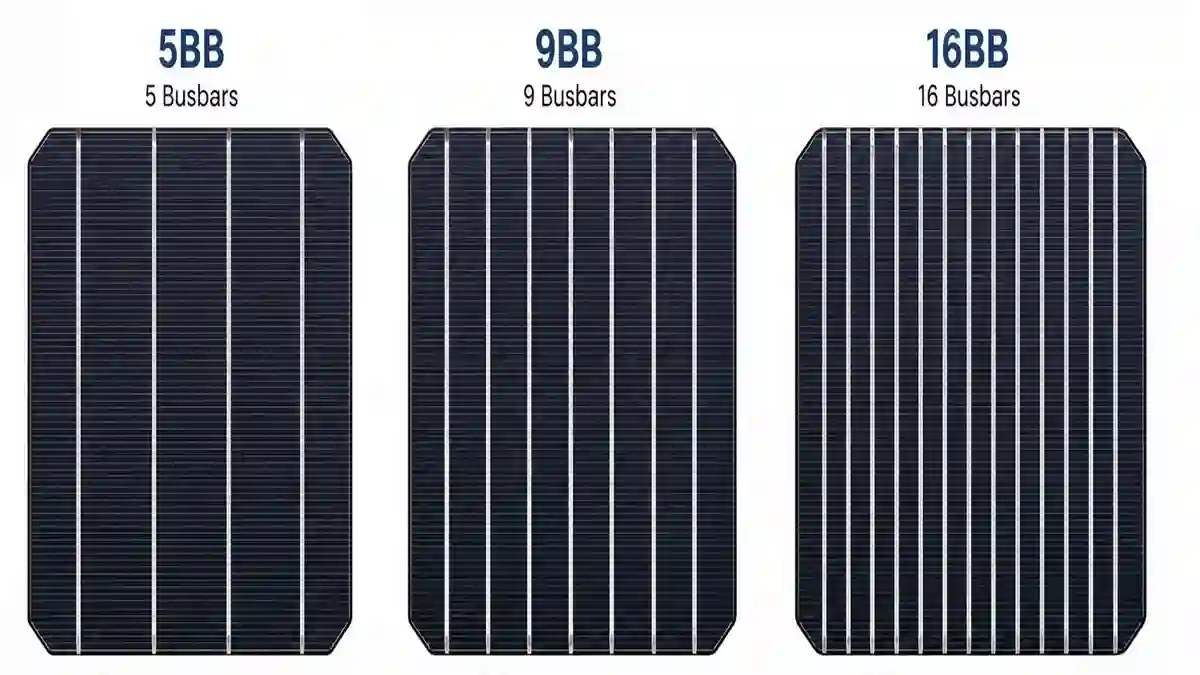
5BB vs 9BB vs 16BB solar panels compared by a registered engineer — real efficiency and reliability data across every mainstream busbar count.
This is a comparison that used to be a genuinely open question a few years ago and has since largely resolved itself — 16BB has become the dominant mainstream configuration, and 5BB is now mostly a marker of older inventory rather than a live budget alternative. Still, since you’ll encounter all three counts in real quotes and marketplace listings, it’s worth understanding exactly what separates them rather than just defaulting to whichever number sounds biggest.
This guide is part of our Types of Solar Panels hub, and is the direct companion to our Solar Panel Busbars guide — read that one for the full trajectory and physics, read this one for the specific three-way comparison.
What Separates These Three Configurations
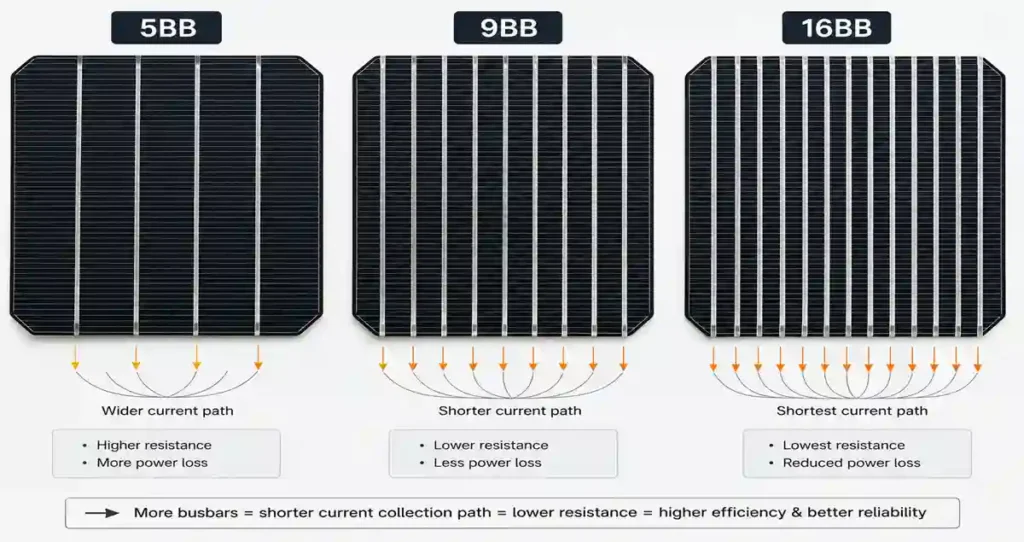
5BB, 9BB, and 16BB all describe the same underlying cell technology with a different number of current-collection busbars running across the front surface. The cell chemistry, glass, encapsulant, and frame construction don’t change based on busbar count — this is purely a wiring density question, similar in spirit to how half-cut construction is a wiring topology question independent of cell chemistry.
Engineer’s Note: MBB — multi-busbar — is a term you’ll see used somewhat loosely in marketing, generally referring to any configuration with 9 or more busbars. Don’t treat “MBB” as a specific count; always check the actual number on the datasheet, since a 9BB panel and a 16BB panel are both technically “multi-busbar” but represent meaningfully different points on the efficiency and reliability curve.
Performance Comparison
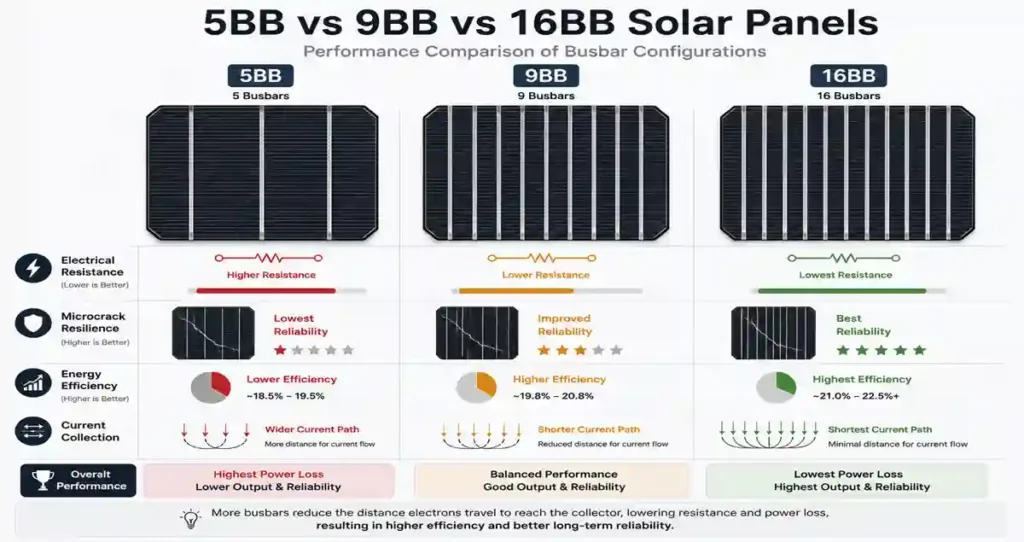
| Metric | 5BB | 9BB | 16BB | Industry Reference |
| Market status (2026) | Legacy — largely phased out | Common, being superseded | Current mainstream standard | PV Magazine |
| Relative resistive loss | Highest of the three | Moderate | Lowest of the three | NREL |
| Microcrack resilience | Lowest — fewer redundant connections | Improved over 5BB | Best — most redundant current paths | Fraunhofer ISE |
| Typical price positioning | Discount/clearance inventory only | Mid-tier, still widely available | Standard for quality current manufacturing | IRENA |
Busbar count should never be evaluated in isolation. Modern 5BB vs 9BB vs 16BB Solar Panels should also be compared based on their underlying cell technology. For example, a 16BB TOPCon Solar Panel or 16BB HJT Solar Panel typically delivers better overall performance than an older 16BB PERC Solar Panel, while Half-Cut Solar Panels further improve current flow by shortening electrical pathways within each photovoltaic cell.
Advantages and Disadvantages
| Advantages | Disadvantages |
| 16BB: lowest resistive loss and best mechanical reliability of the three | 16BB: no longer meaningfully more expensive, but still marginally so on some lines |
| 9BB: solid mid-tier performance, still widely available and well-proven | 9BB: measurably behind 16BB on both efficiency and reliability metrics |
| 5BB: can represent genuine clearance-pricing savings on older inventory | 5BB: highest resistive loss and weakest microcrack resilience of the three |
| All three: same underlying cell chemistry options available across configurations | Comparing purely on busbar count ignores cell technology, which matters just as much |
Recommended Applications
| Busbar Count | Recommended Use |
|---|---|
| 5BB | Older systems, replacement modules, clearance inventory |
| 9BB | Budget-conscious residential and commercial projects |
| 16BB | Residential, commercial, industrial, and utility-scale installations |
| 20+ BB | Premium high-efficiency photovoltaic modules |
Real-World Applications
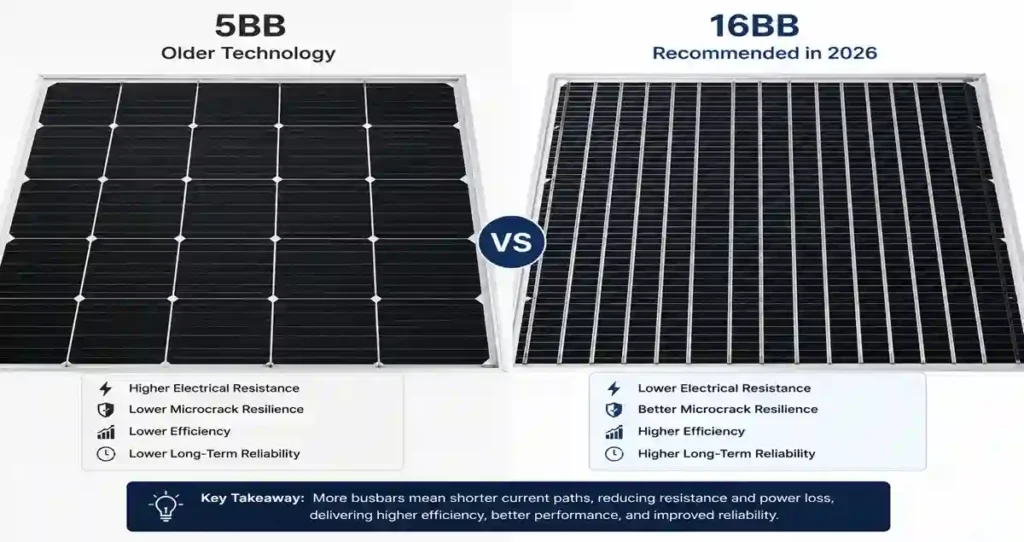
For any new project in 2026, I default to specifying 16BB without much deliberation, given that it’s now the mainstream standard at little to no price premium over 9BB. The scenario where this comparison still matters practically is evaluating clearance or discounted inventory — a genuinely steep discount on 9BB or even 5BB stock can occasionally make sense for a secondary structure or budget-constrained project, provided the buyer understands exactly what they’re trading away in resistive loss and reliability terms.
I’ve advised clients comparing a heavily discounted 5BB panel against standard-priced 16BB stock to run the numbers on total system output over 25 years rather than just comparing sticker price, since the resistive loss difference, while modest per panel, compounds across a full system’s lifetime energy yield in a way that’s easy to underestimate from the busbar count difference alone.
Field Note: A client once found what looked like an excellent deal on 5BB panels, unaware the low busbar count reflected genuinely older manufacturing rather than just a different price tier of current technology. Once we compared the total lifetime output difference against 16BB stock at a modest additional cost, the 16BB panels won clearly on cost per kilowatt-hour delivered over the system’s life, despite the higher upfront sticker price.
How to Verify Busbar Count When Comparing Quotes
The most reliable way to confirm busbar count across competing quotes is requesting the actual manufacturer datasheet for the specific panel model being proposed, rather than relying on a sales sheet or verbal description. Datasheets consistently list cell configuration details including busbar count in their technical specifications section, usually alongside cell dimensions and wafer type. If an installer can’t readily produce this documentation, that’s worth treating as a flag to ask more questions before proceeding.
I also recommend cross-checking the busbar count against the panel’s stated efficiency and temperature coefficient figures, since these specs tend to move together predictably — a panel claiming 16BB construction should generally show efficiency and degradation figures consistent with current-generation manufacturing, not older-generation numbers paired with a newer busbar count claim. A mismatch between these figures is worth flagging directly with the supplier before purchasing.
Common Misconceptions Worth Clearing Up
People sometimes assume any panel marketed as “multi-busbar” or “MBB” is equivalent to the current 16BB standard. As covered above, MBB is a loose marketing term that can technically describe anything from 9BB upward — always check the actual specified count on the datasheet rather than trusting the MBB label alone to tell you which generation of technology you’re actually buying.
Buying Checklist
- Always check the specific busbar number on the datasheet, not just whether it’s labeled “MBB”
- Default to 16BB for any new project given current price parity with older configurations
- If considering discounted 5BB or 9BB inventory, calculate total lifetime output difference, not just upfront cost
- Confirm whether busbars are round wire or flat ribbon, since this also correlates with manufacturing generation
For the full trajectory and physics behind why busbar counts keep climbing, see our Solar Panel Busbars guide. For the technology eliminating busbars entirely, see Zero Busbar Solar Panels
One practical note worth adding: busbar count comparisons matter most when everything else on the datasheet is held equal. A 16BB panel with an older, less efficient cell chemistry underneath won’t necessarily outperform a 9BB panel using a newer cell architecture — busbar count improves whatever cell technology it’s paired with, but it doesn’t override the underlying efficiency ceiling that cell chemistry itself sets. Always read busbar count as one input alongside cell technology, not the single deciding factor.
Frequently Asked Questions
Is 16BB significantly better than 9BB?
Yes, measurably so in both resistive loss reduction and microcrack resilience, though the price gap between the two has narrowed enough that 16BB is now the more sensible default choice for most new purchases.
Should I avoid 5BB panels entirely?
Not necessarily, but treat them as older technology appropriate only for steep clearance pricing, not standard current-market rates. Calculate the total lifetime output difference against 16BB before assuming a 5BB discount is genuinely a good deal.
Does MBB mean the same thing as 16BB?
No — MBB (multi-busbar) is a general term that can describe anything from 9 busbars upward. Always check the specific number on the datasheet rather than assuming an MBB label means current-generation 16BB technology. Treat MBB as a category, not a guarantee of any particular generation within that category.
How can I verify whether a solar panel is 5BB, 9BB, or 16BB?
The most reliable method is to review the manufacturer’s datasheet, where the busbar count is listed in the technical specifications. While the busbars are often visible on the front of the solar cell, official documentation provides the most accurate confirmation.
Is 9BB still a good choice in 2026?
Yes. A quality 9BB panel remains a dependable option, particularly when offered at a significant discount. However, for most new installations, 16BB has become the preferred standard because it offers improved efficiency and mechanical reliability at a similar price.
Does busbar count matter more than TOPCon or HJT technology?
No. Busbar count reduces electrical resistance, but overall solar panel performance is influenced more by the underlying cell technology. The best results come from combining advanced cell architectures such as TOPCon or HJT with modern multi-busbar designs.
References
Performance comparisons across busbar configurations reference NREL’s cell technology research, Fraunhofer ISE’s Photovoltaics Report, and market pricing context from IRENA’s Power Generation Costs and PV Magazine.
Related guides on SolarVisionAI.com
- Monocrystalline Solar Panels 2026: Still Worth It or Hype
- Polycrystalline Solar Panels: Worth Buying in 2026?
- Thin-film Solar Panels: When They Beat Silicon (2026)
- BIPV Solar Panels: Building-Integrated PV Complete Guide
- Portable Solar Panels: Engineer’s Buyer’s Guide 2026
- CPV Solar Panels: Concentrated Photovoltaic Explained
- Skin Solar Panel: What “Solar Skin” Actually Means
- Solar Fence Post Lights: Cap Sizes, Types & Install Guide
- Bifacial Solar Panels in 2026: How to Boost Energy Output
- Solar Charge Controller: The Complete Guide
- MC4 Connectors: Solar Safety & Installation Guide
- Solar Panel Types, Efficiency & Benefits
- Solar Water Pump Guide
- Commercial Solar Panel Installation: Engineering Guide
- Solar Fence Post Lights: Cap Sizes, Types & Install Guide
- BESS — Battery Energy Storage System Guide
- Commercial Solar Panel Installation
- Solar Refrigerator & DC Fridge — Complete 2026 Guide
- Bifacial Solar Panel Albedo Effect Guide
- TOPCon: Why TOPCon Solar Panel is a Proven Smart Investment in 2026
- HJT: Why TOPCon Solar Panel is a Proven Smart Investment in 2026
- PERC: PERC Solar Panel: Still Relevant or Already Outdated?
- Perovskite: Perovskite Solar Panels: The 2026 Reality Check
- N-Type vs P-Type: N-Type vs P-Type Solar Panels: Honest Comparison
- ABC: ABC (all back contact) Solar Panel: Back Contact Technology Explained
- IBC: IBC Solar Panels: Interdigitated Back Contact Guide
- Tandem: Tandem Solar Panels: Are Stacked Cells Ready for Rooftops?