
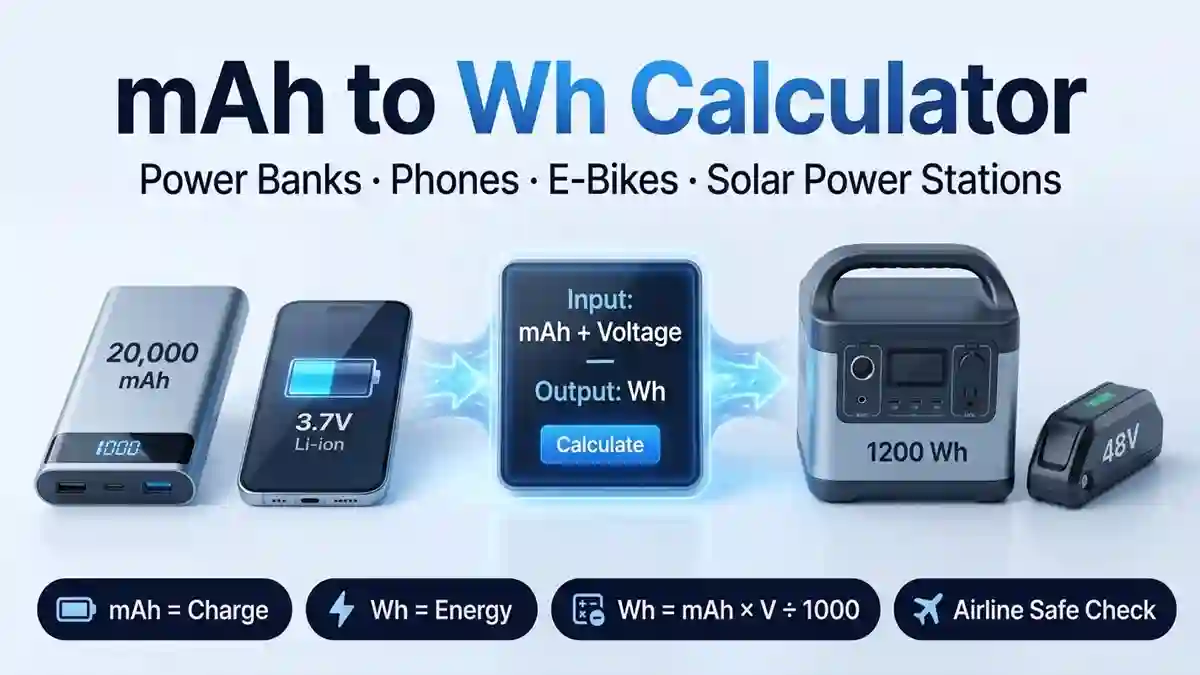
Free mAh to Wh Calculator — Convert battery capacity instantly both ways. Perfect for power banks, phone batteries, laptops, EVs, and solar battery packs.
Please enter valid values greater than zero.
Formula: Wh = (mAh × V) ÷ 1000
Use our free mAh to Wh Calculator to instantly convert battery capacity between milliamp-hours (mAh) and watt-hours (Wh) in both directions. Whether you are comparing power bank capacities, checking a phone or laptop battery, sizing a portable solar power station, or evaluating an EV battery pack, this tool gives you an accurate, engineering-grade result in seconds.
1. Why You Need a mAh to Wh Calculator for Battery Capacity
Milliamp-hours (mAh) is the most commonly printed battery capacity rating on power banks, phone batteries, and portable electronics. However, mAh alone does not tell you how much actual energy a battery stores — because mAh measures charge, not energy. Watt-hours (Wh) is the true measure of stored energy and the only rating that allows fair comparison between batteries of different voltages.
This is why a 20,000 mAh power bank rated at 3.7V and a 10,000 mAh power bank rated at 7.4V actually store the exact same amount of energy — 74 Wh. Without converting to Wh, most buyers assume the 20,000 mAh unit is twice as powerful, which is incorrect.
Engineer’s Note: Airlines restrict carry-on power banks by Wh, not mAh — typically a 100 Wh limit without airline approval and a 160 Wh absolute maximum. A power bank printed only in mAh must be converted to Wh before travel. Most airlines and the ICAO safety guidelines calculate this as: Wh = (mAh × V) ÷ 1000. Always check your power bank’s printed Wh rating or calculate it before flying with any lithium battery pack.
2. mAh to Wh Calculator Formula
mAh to Wh: Wh = (mAh × Voltage) ÷ 1000
Wh to mAh: mAh = (Wh ÷ Voltage) × 1000
Example 1: A 10,000 mAh power bank at 3.7V: (10,000 × 3.7) ÷ 1000 = 37 Wh
Example 2: A 74 Wh laptop battery at 11.1V converts to: (74 ÷ 11.1) × 1000 = 6,667 mAh
Engineer’s Note: Always use the actual cell voltage printed on the battery, not an assumed standard value. Single-cell lithium-ion and LiFePO4 packs are commonly 3.6V to 3.7V nominal. Two-cell (2S) packs are 7.2V to 7.4V. Three-cell (3S) packs used in many laptops and power tools are 10.8V to 11.1V. Using the wrong voltage in this formula produces a Wh result that is off by the exact multiple of the voltage error — a very common mistake when comparing battery specifications online.
3. mAh vs Wh: Understanding Battery Capacity Ratings
Milliamp-hours (mAh) measures electric charge — the total current a battery can deliver over one hour. Watt-hours (Wh) measures energy — the total work that charge can perform, which depends on both the current (mAh) and the voltage (V) at which it is delivered.
- mAh (Milliamp-hours): Charge capacity. Only meaningful when compared at the same voltage. Commonly printed on phone batteries, power banks, and small lithium cells.
- Wh (Watt-hours): Energy capacity. The universal unit for comparing batteries of any voltage or chemistry. Required by airlines, shipping regulations, and solar battery datasheets.
- mWh (Milliwatt-hours): A smaller energy unit sometimes used for very low-capacity cells like hearing aid batteries and small IoT sensors. 1 Wh = 1,000 mWh.
Engineer’s Note: Never compare two batteries by mAh rating alone unless you have confirmed they operate at the exact same voltage. A 5,000 mAh battery at 3.7V (18.5 Wh) stores less than half the energy of a 5,000 mAh battery at 11.1V (55.5 Wh) — despite having an identical mAh rating. Always convert to Wh before making a purchasing or engineering decision.
4. mAh to Wh Calculator: Practical Applications
Power Banks and Portable Chargers
Power bank manufacturers print mAh prominently for marketing purposes since larger numbers appear more impressive. Converting to Wh reveals the true energy capacity and allows accurate comparison across brands and voltage configurations. This conversion is also required to determine airline carry-on eligibility.
Phone and Laptop Batteries
Smartphone batteries are typically rated in mAh at 3.7V to 3.85V nominal. Laptop batteries use multi-cell configurations rated in Wh directly on the label, but internal cell mAh values are sometimes needed when comparing replacement battery packs or third-party cells.
Portable Solar Power Stations
Portable power stations and solar generators list capacity in Wh (500Wh, 1000Wh, 2000Wh models are common). When comparing against a power bank’s mAh rating, or when sizing solar panel input to match the battery’s charge requirements, converting between mAh and Wh ensures accurate system planning.
Electric Vehicle (EV) and E-Bike Batteries
EV and e-bike battery packs are typically rated in both Ah (amp-hours, 1000x larger than mAh) and Wh. A 48V, 20Ah e-bike battery equals 20,000 mAh at 48V, converting to 960 Wh of total energy — essential information for determining range and charging time.
Solar Battery Banks and Off-Grid Systems
Solar battery specifications are always given in Wh or Ah at system voltage (12V, 24V, or 48V), never in mAh, since mAh is a low-voltage consumer electronics unit. However, converting small mAh-rated cells to Wh is useful when building custom battery packs from individual 18650 or LiFePO4 cells for DIY solar storage projects.
Engineer’s Note: When building a custom solar battery pack from individual 18650 lithium cells (typically 2,500-3,500 mAh at 3.7V each), calculate total pack Wh by first converting one cell to Wh, then multiplying by the number of cells in the pack (accounting for series and parallel configuration). A 4S4P pack (4 cells in series, 4 strings in parallel) using 3,500 mAh cells at 3.7V provides: 3,500 × 3.7 ÷ 1000 = 12.95 Wh per cell × 16 cells = 207 Wh total pack capacity.
5. mAh to Wh Calculator: Quick Reference Table
| Capacity (mAh) | Voltage (V) | Energy (Wh) | Common Device |
| 3,000 mAh | 3.7 V | 11.1 Wh | Smartphone Battery |
| 5,000 mAh | 3.7 V | 18.5 Wh | Small Power Bank |
| 10,000 mAh | 3.7 V | 37 Wh | Standard Power Bank |
| 20,000 mAh | 3.7 V | 74 Wh | Large Power Bank |
| 27,000 mAh | 3.7 V | 99.9 Wh | Max Airline-Approved Power Bank |
| 6,700 mAh | 11.1 V | 74.4 Wh | Laptop Battery |
| 20,000 mAh | 48 V | 960 Wh | E-Bike Battery |
| 100,000 mAh | 12 V | 1,200 Wh | Portable Solar Power Station |
6. Common Mistakes When Using a mAh to Wh Calculator
- Assuming a Fixed Voltage: Not every lithium cell is 3.7V. Confirm the actual nominal voltage from the datasheet or product label before converting.
- Comparing mAh Across Different Voltages: A higher mAh rating at a lower voltage can store less total energy than a lower mAh rating at a higher voltage. Always convert to Wh for fair comparison.
- Ignoring Airline Wh Limits: Power banks are regulated by Wh, not mAh, for air travel. A power bank printed only in mAh must be converted before checking airline compliance.
- Confusing mAh with Ah: 1 Ah = 1,000 mAh. E-bike and EV batteries are typically rated in Ah, not mAh — forgetting this conversion factor causes a 1000x calculation error.
- Ignoring Battery Efficiency Losses: The Wh value calculated from mAh and voltage represents the battery’s rated capacity, not the usable output after charge/discharge efficiency losses, which typically reduce real-world usable energy by 5-10%.
Engineer’s Note: When shopping for a replacement battery or comparing competing products, always request the Wh rating directly from the manufacturer’s datasheet rather than calculating it yourself from an advertised mAh figure, since marketing materials sometimes round the mAh number up while using the actual, unrounded voltage — producing a calculated Wh figure that differs from the certified, tested rating on the safety datasheet.
7. Frequently Asked Questions
How do I convert mAh to Wh for a power bank?
Multiply the mAh rating by the battery voltage, then divide by 1000. For a standard 10,000 mAh power bank at 3.7V: (10,000 × 3.7) ÷ 1000 = 37 Wh. Most consumer power banks use a nominal 3.7V single lithium-ion cell configuration.
What is the maximum mAh power bank allowed on a flight?
Airlines regulate power banks by Wh, not mAh. The typical limit is 100 Wh without special airline approval, and 160 Wh as an absolute maximum with approval. At 3.7V, 100 Wh corresponds to approximately 27,027 mAh — which is why most travel-friendly power banks are marketed at 26,800 mAh or 27,000 mAh to stay under this important safety threshold.
Why do two power banks with the same mAh have different Wh?
Because they use different cell voltages. A single-cell (3.7V) power bank and a dual-cell (7.4V) power bank with identical mAh ratings will store very different amounts of energy — the 7.4V unit stores exactly double the Wh of the 3.7V unit at the same mAh rating.
How many mAh is a 100 Wh battery?
It depends on voltage. At 3.7V: (100 ÷ 3.7) × 1000 = 27,027 mAh. At 11.1V: (100 ÷ 11.1) × 1000 = 9,009 mAh. At 48V (typical e-bike voltage): (100 ÷ 48) × 1000 = 2,083 mAh. Always specify the voltage when converting Wh back to mAh.
Can I use this calculator for solar battery packs and 18650 lithium cells?
Yes. This calculator works for any battery chemistry and voltage, including 18650 lithium-ion cells, LiFePO4 cells, e-bike batteries, and portable solar power stations. Simply enter the actual mAh (or Ah, converted to mAh by multiplying by 1000) and the correct nominal voltage for your specific cell or pack configuration.
Also Check Our Related Calculators
- Watt-Hours to Watts Calculator
- Watts to Watt-Hours Calculator
- kWh to kW Calculator
- kW to HP Calculator
- Amps to Watts Calculator
- Solar Battery Size Calculator
- Solar Panel Size Calculator
- Solar ROI Calculator
- Inverter Size Calculator
- Watts to Amps Calculator
- Volts to Watts Calculator
Related guides on SolarVisionAI.com
- Solar Fence Post Lights: Cap Sizes, Types & Install Guide
- Solar Charge Controller: The Complete Guide
- MC4 Connectors: Solar Safety & Installation Guide
- Solar Panel Types, Efficiency & Benefits
- Solar Water Pump Guide
- Commercial Solar Panel Installation: Engineering Guide
- Solar Fence Post Lights: Cap Sizes, Types & Install Guide — solarvisionai.com/solar-fence-post-lights/
- BESS — Battery Energy Storage System Guide — solarvisionai.com/bess-battery-energy-storage-system-guide/
- Commercial Solar Panel Installation — solarvisionai.com/commercial-solar-panel-installation/