
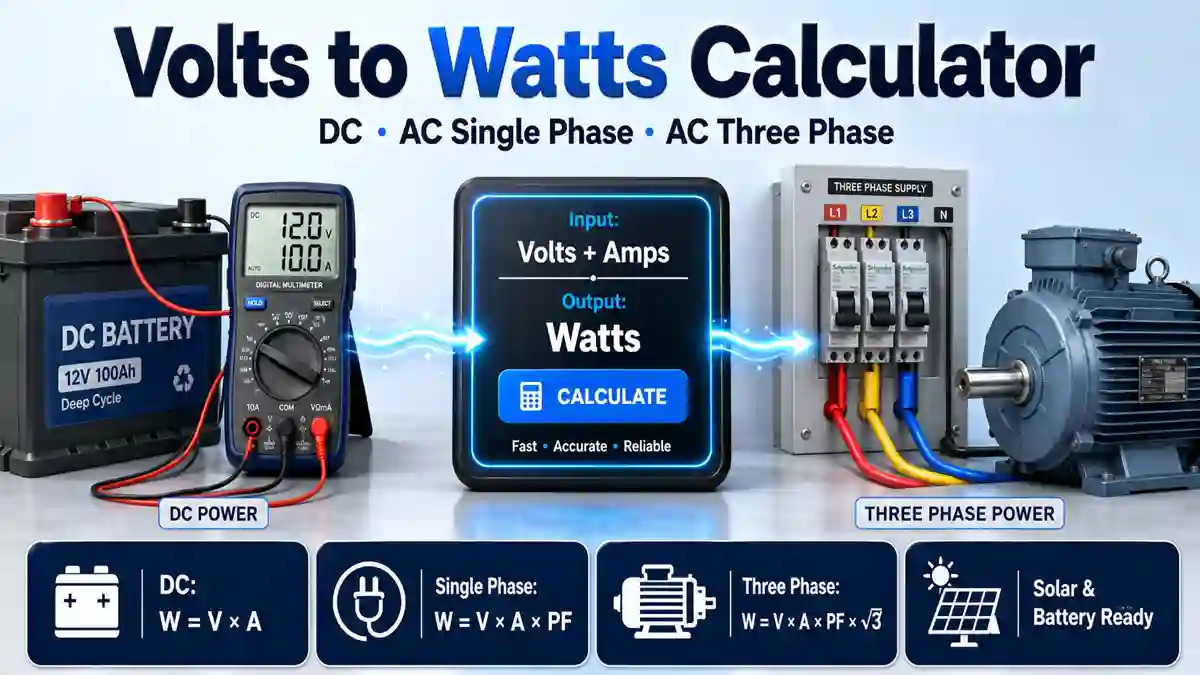
Free Volts to Watts Calculator — Convert volts and amps to watts instantly for DC, AC single-phase, and three-phase systems. Built for solar and batteries.
Please enter valid values greater than zero.
Formula: W = V × A
Use our free Volts to Watts Calculator to instantly convert voltage and current into power for DC circuits, AC Single Phase, and AC Three Phase systems. Whether you are checking a solar panel’s power output, sizing a battery bank, or verifying an appliance’s power draw from its voltage and amperage rating, this tool delivers fast, accurate results.
1. Why a Volts to Watts Calculator Is Essential for Solar and Electrical Work
Voltage and current are the two values most commonly measured directly with a multimeter or clamp meter, but power in Watts is what actually determines an appliance’s energy consumption, a solar panel’s output capacity, or a battery’s discharge rate. A Volts to Watts Calculator converts your field measurements into the power figure needed for load calculations, system sizing, and energy planning.
This calculation is especially critical in solar work, where panel Voc and Vmp (open-circuit and maximum power point voltages) combined with Isc and Imp (short-circuit and maximum power point currents) determine the actual watt output you can expect from an array under real operating conditions — numbers that often differ meaningfully from the panel’s simple STC nameplate rating.
Engineer’s Note: When measuring a live circuit with a multimeter to estimate power, always measure voltage and current under actual load, not open-circuit voltage. Open-circuit voltage (no current flowing) does not represent real operating conditions and will give a misleadingly high power estimate if multiplied directly by a separately measured current under load.
2. The Volts to Watts Calculator Formula
DC Circuit
Formula: Watts (W) = Volts (V) × Amps (A)
Example: A 12V battery supplying 10A: 12 × 10 = 120 Watts
AC Single Phase
Formula: Watts (W) = Volts (V) × Amps (A) × Power Factor
Example: A 230V circuit drawing 8A with PF 0.85: 230 × 8 × 0.85 = 1,564 Watts
AC Three Phase
Formula: Watts (W) = Volts (V) × Amps (A) × Power Factor × √3
Example: A 400V three-phase circuit drawing 15A with PF 0.8: 400 × 15 × 0.8 × 1.732 = 8,314 Watts (8.31 kW)
Engineer’s Note: The DC formula (W = V × A) applies directly to solar panel power calculations at any single operating point, but a panel’s actual voltage and current both vary continuously with sunlight intensity and temperature. For accurate energy yield estimates over a full day, use the panel’s Vmp and Imp values specifically — not Voc and Isc, which represent unloaded conditions that never occur while the panel is actually delivering power.
3. Volts to Watts Calculator: Practical Applications
Solar Panel Power Output Verification
Using a multimeter to measure a solar panel’s actual operating voltage and current under a connected load allows you to calculate real-world power output and compare it against the panel’s rated wattage. A significant shortfall often indicates shading, soiling, a wiring fault, or panel degradation.
Battery Bank Power Calculations
Battery voltage combined with discharge current in Amps gives the instantaneous power being delivered to a load. This calculation is used to verify that a battery bank is not being discharged beyond its safe continuous power rating, especially for high-draw appliances like water pumps and power tools.
Appliance Power Verification
When an appliance’s wattage rating is missing or illegible but its voltage and current draw are known or measurable, this calculator reconstructs the power rating needed for load planning, generator sizing, and inverter capacity calculations.
Generator and Alternator Output Checks
Measuring a generator or vehicle alternator’s output voltage and current under a known load verifies its actual power delivery against the rated nameplate capacity, helping identify underperforming or failing charging systems.
Engineer’s Note: For three-phase power measurements, always confirm whether your voltage reading is line-to-line or line-to-neutral, as these differ by a factor of √3. Using a line-to-neutral voltage reading in the standard three-phase line-to-line formula will produce a significantly understated power result — a common measurement error in industrial and commercial electrical fieldwork.
4. Quick Reference Volts to Watts Conversion Table
| Voltage (V) | Current (A) | Power Factor | Circuit Type | Power (W) |
| 12 V | 10 A | 1.0 (DC) | DC | 120 W |
| 24 V | 20 A | 1.0 (DC) | DC | 480 W |
| 48 V | 30 A | 1.0 (DC) | DC | 1,440 W |
| 230 V | 8 A | 0.85 | AC Single Phase | 1,564 W |
| 230 V | 15 A | 0.90 | AC Single Phase | 3,105 W |
| 400 V | 10 A | 0.80 | AC Three Phase | 5,542 W |
| 400 V | 20 A | 0.85 | AC Three Phase | 11,778 W |
| 415 V | 30 A | 0.90 | AC Three Phase | 19,399 W |
5. Common Mistakes When Converting Volts to Watts
- Using Open-Circuit Voltage: Measuring a solar panel or battery’s voltage with no load connected gives a higher reading than actual operating voltage, inflating the calculated power figure.
- Ignoring Power Factor: Multiplying voltage and current directly for AC loads without applying power factor gives apparent power (VA), not real power (Watts) — these differ significantly for motors and inductive loads.
- Confusing Line-to-Line and Line-to-Neutral Voltage: In three-phase systems, using the wrong voltage reference in the formula produces results that are off by a factor of √3 (approximately 1.732).
- Using Vmp/Imp and Voc/Isc Interchangeably: Solar panel datasheets list both operating point values (Vmp, Imp) and unloaded/shorted values (Voc, Isc). Only Vmp × Imp gives the panel’s actual rated power output.
- Ignoring Voltage Sag Under Load: Battery and generator voltage drops slightly under heavy load compared to no-load or lightly-loaded conditions. Always measure voltage under the actual load being calculated for an accurate power figure.
Engineer’s Note: When troubleshooting an underperforming solar array, compare the measured Vmp × Imp power output against the panel’s STC-rated wattage, then account for real-world derating factors such as temperature (typically 10-15% loss in hot climates), soiling (5-15% loss depending on cleaning frequency), and wiring losses (2-3% in a well-designed system) before concluding there is a fault. A panel producing 85% of its STC rating under these combined factors may be functioning entirely normally.
6. Frequently Asked Questions About Volts to Watts Conversion
How do I calculate watts from volts and amps for a solar panel?
Multiply the panel’s Vmp (voltage at maximum power point) by its Imp (current at maximum power point), both found on the panel’s datasheet or nameplate. For a panel with Vmp 40V and Imp 10A: 40 × 10 = 400 Watts, matching the panel’s rated STC power output.
What is the difference between watts and VA when converting from volts and amps?
For DC circuits and purely resistive AC loads, Watts and VA are equal. For AC circuits with motors, inductive loads, or electronic power supplies, VA (Volts × Amps) is always equal to or greater than real Watts, with the difference determined by the power factor. Watts = VA × Power Factor.
How many watts is 12 volts at 20 amps?
For a DC circuit: 12V × 20A = 240 Watts. This calculation applies directly to any DC system including solar panels, batteries, and 12V appliances, since power factor does not apply to DC circuits.
Why does my calculated wattage not match the appliance nameplate rating?
This usually indicates either an incorrect power factor assumption for an AC load, a voltage measurement taken under no-load or light-load conditions rather than full operating load, or normal manufacturing tolerance (typically ±5-10%) between the nameplate rating and actual measured performance.
Can I use this calculator for three-phase industrial equipment?
Yes. Select the AC Three Phase mode and enter the line-to-line voltage, the per-phase current, and the equipment’s power factor from its nameplate or datasheet. The calculator applies the standard three-phase power formula, including the √3 (1.732) multiplier required for accurate three-phase power calculations.
Also Check Our Related Calculators
- Watt-Hours to Watts Calculator
- Watts to Watt-Hours Calculator
- kWh to kW Calculator
- kW to HP Calculator
- Amps to Watts Calculator
- Solar Battery Size Calculator
- Solar Panel Size Calculator
- Inverter Size Calculator
- Watts to Amps Calculator
Related guides on SolarVisionAI.com
- Monocrystalline Solar Panels 2026: Still Worth It or Hype
- Polycrystalline Solar Panels: Worth Buying in 2026?
- Thin-film Solar Panels: When They Beat Silicon (2026)
- BIPV Solar Panels: Building-Integrated PV Complete Guide
- Portable Solar Panels: Engineer’s Buyer’s Guide 2026
- CPV Solar Panels: Concentrated Photovoltaic Explained
- Skin Solar Panel: What “Solar Skin” Actually Means
- Solar Fence Post Lights: Cap Sizes, Types & Install Guide
- Bifacial Solar Panels in 2026: How to Boost Energy Output
- Solar Charge Controller: The Complete Guide
- MC4 Connectors: Solar Safety & Installation Guide
- Solar Panel Types, Efficiency & Benefits
- Solar Water Pump Guide
- Commercial Solar Panel Installation: Engineering Guide
- Solar Fence Post Lights: Cap Sizes, Types & Install Guide
- BESS — Battery Energy Storage System Guide
- Commercial Solar Panel Installation
- Solar Refrigerator & DC Fridge — Complete 2026 Guide
- Bifacial Solar Panel Albedo Effect Guide
- TOPCon: Why TOPCon Solar Panel is a Proven Smart Investment in 2026
- HJT: Why TOPCon Solar Panel is a Proven Smart Investment in 2026
- PERC: PERC Solar Panel: Still Relevant or Already Outdated?
- Perovskite: Perovskite Solar Panels: The 2026 Reality Check
- N-Type vs P-Type: N-Type vs P-Type Solar Panels: Honest Comparison
- ABC: ABC (all back contact) Solar Panel: Back Contact Technology Explained
- IBC: IBC Solar Panels: Interdigitated Back Contact Guide
- Tandem: Tandem Solar Panels: Are Stacked Cells Ready for Rooftops?