
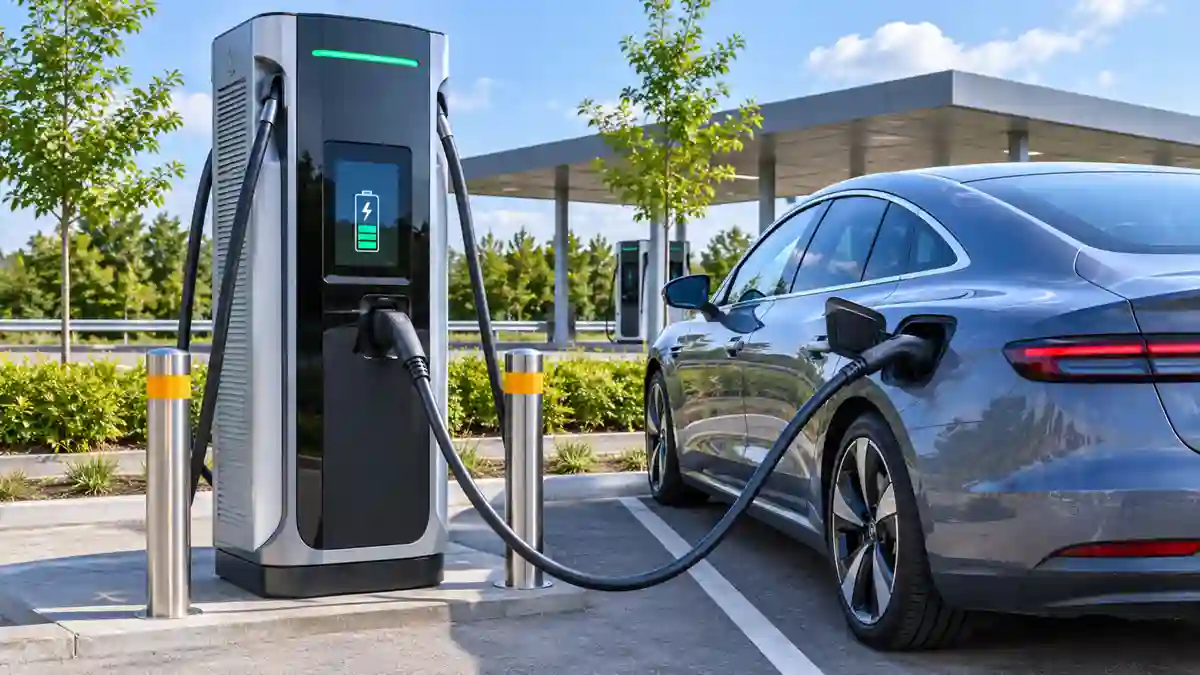
Electric vehicle charging technology has developed beyond conventional home charging. While Level 1 and Level 2 chargers are commonly used for residential and workplace charging, Level 3 chargers are designed to deliver much higher power and reduce charging time.
A Level 3 EV charger is commonly known as a DC fast charger (DCFC). Unlike Level 1 and Level 2 chargers, which supply AC electricity to the vehicle, a DC fast charger converts incoming AC electricity into DC power inside the charging station and delivers it directly to the vehicle’s battery.
From my experience in solar engineering and electrical system planning, I increasingly consider future EV charging requirements when discussing installations with customers. However, DC fast charging requires a different level of electrical infrastructure from ordinary residential EV charging. It involves high-power conversion equipment, suitable utility supply, specialized cables, thermal management and vehicle compatibility.
In this guide, I explain how Level 3 EV chargers work, their power ratings, charging speeds, cooling methods, applications, installation requirements and important electrical standards.
What Is a Level 3 EV Charger?
A Level 3 EV charger is a high-power DC charging station that supplies direct current to an electric vehicle’s battery. It is commonly installed at public charging stations, highway charging hubs, commercial locations and fleet charging facilities.
The main difference between Level 2 and Level 3 charging is where AC-to-DC conversion takes place.
- Level 1: Supplies AC power through a standard household outlet.
- Level 2: Supplies AC power through dedicated charging equipment. The vehicle’s onboard charger converts it into DC.
- Level 3: Converts AC electricity into DC inside the charging station and supplies DC power directly to the vehicle battery.
Because the conversion equipment is located in the charging station, DC fast chargers can deliver much higher power than conventional residential AC chargers.
In North America, Level 3 is a commonly used name for DC fast charging. However, DCFC is the more technically precise term when discussing international charging systems.
How Does a Level 3 DC Fast Charger Work?
A DC fast charging station receives electricity from the utility grid, usually through a three-phase AC supply. Power electronics inside the station convert the incoming AC electricity into controlled DC output.
The charging process generally follows these steps:
- AC electricity enters the charging station from the utility or site distribution system.
- Power conversion modules rectify the AC supply into DC.
- The charging station communicates with the vehicle to establish charging parameters.
- The station supplies controlled DC power to the vehicle battery.
- The charger and vehicle continuously monitor voltage, current, temperature and other operating conditions.
The vehicle’s battery management system (BMS) plays an important role in this process. It communicates the charging limits and helps protect the battery from excessive voltage, current and temperature.
Important: A 350 kW charging station does not mean every vehicle will charge at 350 kW. The actual charging power depends on the vehicle’s maximum DC charging capability, battery temperature, state of charge, voltage and the station’s available output.
Why Are Fast EV Chargers DC Instead of AC?
Fast EV chargers use DC (direct current) because an electric vehicle’s battery stores and uses energy in DC form. When an EV charges through an AC charger, the vehicle’s onboard charger must convert incoming AC electricity into DC before it reaches the battery. This onboard converter has limited power capacity, which restricts AC charging speed.
A DC fast charger performs this AC-to-DC conversion inside the charging station using high-power power electronics. It then supplies regulated DC power directly to the vehicle’s battery through the charging system, communicating with the Battery Management System (BMS) to control voltage, current, temperature and charging limits.
By bypassing the vehicle’s onboard AC charger, DC fast charging can deliver much higher power levels, making it suitable for highway stops, public charging hubs and commercial fleets.
In simple terms: AC charging relies on the vehicle’s onboard charger for AC-to-DC conversion, while a DC fast charger performs this conversion externally and supplies DC power to the vehicle’s battery.
Level 3 EV Charger Power Ratings and Voltage
DC fast chargers are available in different power ratings depending on the intended application and charging infrastructure.
In the United States, common public DC fast charging equipment includes 50 kW, 100 kW, 150 kW, 250 kW and 350 kW systems. Some newer equipment supports outputs up to 500 kW.
| DC charger rating | Typical application |
|---|---|
| 50 kW | Public and commercial charging |
| 60–100 kW | Urban and destination charging |
| 120–150 kW | Public fast-charging stations |
| 180–200 kW | Highway and commercial charging hubs |
| 250 kW | High-power public charging |
| 300–350 kW | High-power highway charging |
| 400–500 kW | Selected high-power charging applications |
These are representative equipment ratings, not guaranteed charging rates for every vehicle.
The US Department of Energy’s Alternative Fuels Data Center describes DC fast charging equipment with output ratings up to 500 kW. Its guidance also explains that charging power and range gained depend on the vehicle and battery state of charge.
DC Output Voltage
DC fast charging equipment supports different voltage ranges depending on the station design and vehicle platform. Many systems support approximately 400–1,000 V DC, while some standards and equipment designs support wider ranges.
Many electric vehicles use 400 V battery architectures, while newer high-voltage vehicle platforms use approximately 800 V systems.
A compatible charger must operate within the vehicle’s supported voltage and current limits. The charging station adjusts its output according to the vehicle’s communication and control requirements.
Why Does Voltage Matter?
For a given power level, higher voltage can reduce the current required.
Using the simplified electrical relationship:
Power (kW) = Voltage (V) × Current (A) ÷ 1,000
For example, a 150 kW DC output would require approximately:
- 375 A at 400 V
- 187.5 A at 800 V
These are illustrative calculations. Actual output depends on operating voltage, current limits, conversion efficiency and the vehicle’s charging curve.
Higher-voltage systems can help reduce current-related losses and support high-power charging, but vehicle and charger compatibility remains essential.
Level 3 EV Charging Speed
DC fast charging can add substantial driving range in a relatively short time. However, charging speed is not constant throughout the charging session.
A vehicle generally accepts higher charging power when its battery has a lower state of charge. As the battery approaches a higher state of charge, the charging system reduces power to protect battery performance and manage temperature.
The US Department of Energy’s Alternative Fuels Data Center indicates that DC fast charging can provide approximately 100–200 or more miles of driving range in 30 minutes, depending on the vehicle and charging conditions.
Factors That Affect DC Fast Charging Speed
Several factors influence actual charging time:
- Battery capacity: Larger batteries generally require more energy to reach the same state of charge.
- Vehicle charging capability: Each EV has a maximum DC charging power.
- Battery voltage: The charging system must support the vehicle’s voltage architecture.
- Battery temperature: Cold or excessively hot batteries may accept less power.
- State of charge: Charging power usually decreases as the battery approaches a higher state of charge.
- Charger capacity: The charging station must be capable of supplying the required power.
- Power sharing: Some charging stations distribute their available power between multiple vehicles.
For this reason, comparing charging stations only by their maximum kW rating does not provide a complete picture of charging performance.
Liquid-Cooled DC Fast Charging Cables and Connectors
One important engineering consideration in high-power DC charging is heat management in the output cable and vehicle connector.
As charging current increases, electrical resistance generates heat in the conductors and contact points. A conventional air-cooled cable may require larger conductors to manage the temperature rise, making it heavier, thicker and more difficult for drivers to handle.
To address this challenge, many high-power charging systems use liquid-cooled charging cables and connectors.
How Does Liquid Cooling Work in an EV Charging Cable?
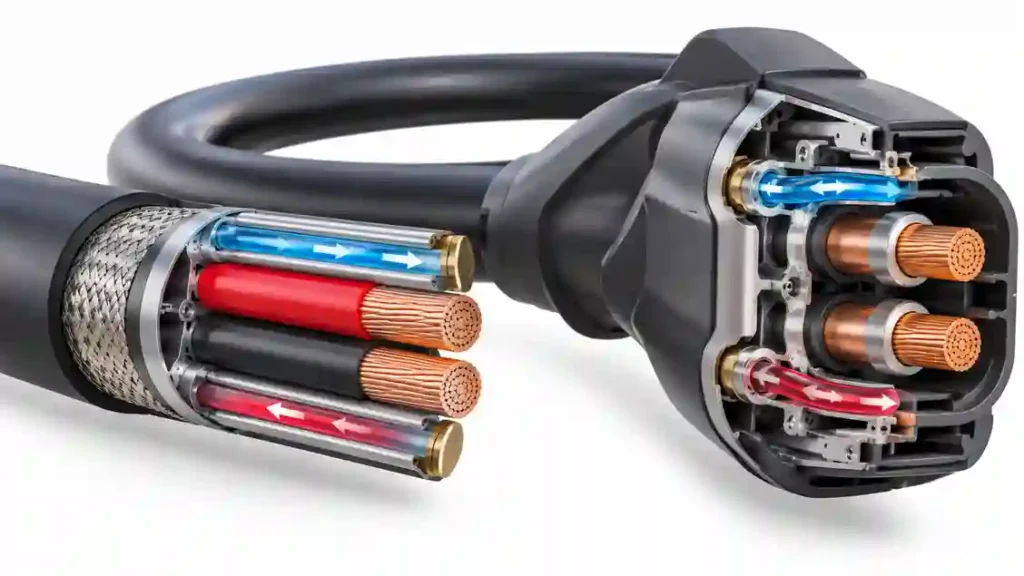
A liquid-cooled DC charging cable contains electrical power conductors and separate coolant passages within the cable assembly. A cooling unit circulates coolant through these passages to remove heat from the cable and connector.
A typical arrangement includes:
- Cooling unit: A pump circulates coolant through the cooling circuit.
- Coolant supply passage: Carries cooled fluid toward the charging cable and connector.
- Cable cooling passages: Transfer heat away from the high-current cable assembly.
- Connector cooling: Helps control temperature around the DC power contacts.
- Return passage: Carries warmed coolant back to the cooling unit.
- Heat exchanger: Transfers heat from the coolant to the surrounding environment.
- Monitoring system: Uses temperature sensors and, where provided, leak detection to monitor the cooling system.
The coolant does not flow through the copper electrical conductors. It travels through dedicated cooling passages designed into the cable and connector assembly.
What Coolant Is Used?
Some liquid-cooled EV charging cables use a water-glycol mixture. The exact coolant composition depends on the cable manufacturer’s design and specifications.
For example, Phoenix Contact’s technical data for one high-power CCS charging cable specifies a 50% water and 50% glycol coolant mixture, integrated temperature sensors and cooling within both the cable and vehicle connector.
The coolant must be compatible with the system’s seals, hoses, connectors and operating temperatures. It should never be replaced with an arbitrary fluid.
Why Is Liquid Cooling Important?
Liquid cooling offers several practical advantages for high-power DC charging:
- Helps remove heat from high-current cable conductors and connector contacts.
- Allows some cable designs to use smaller conductors than comparable air-cooled designs.
- Can reduce cable weight and improve handling.
- Helps maintain connector temperatures within specified operating limits.
- Supports high-current charging applications where passive cooling may be insufficient.
For example, some commercially available high-power cable assemblies are designed for 500 A operation and include integrated liquid cooling and temperature monitoring. This is a manufacturer-specific example, not a rating that applies to every DC fast charger.
Temperature Sensors and Leakage Protection
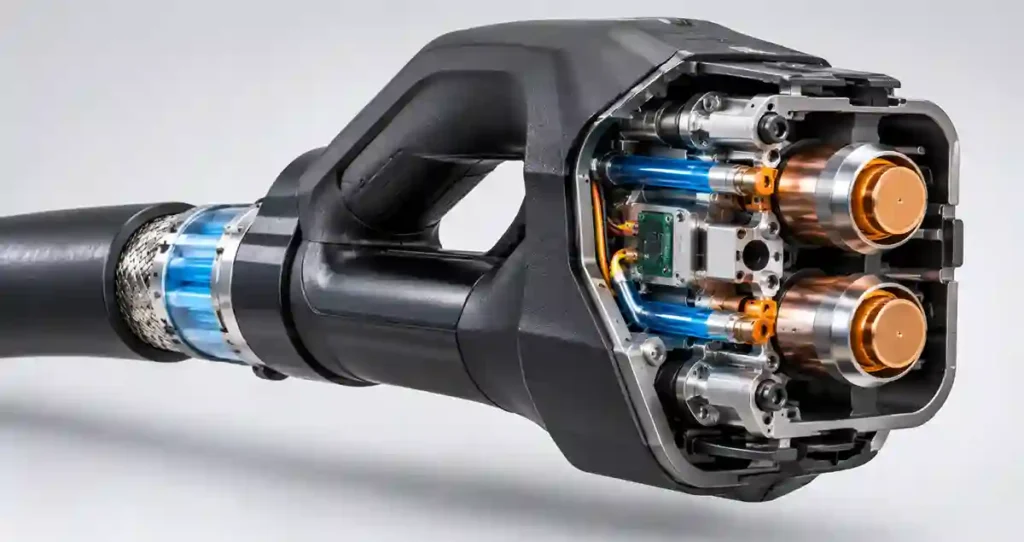
Cooling alone is not enough. A high-power charging cable also needs suitable monitoring and protection.
Depending on the design, temperature sensors can be installed near the DC contacts and within the cable power conductors. The charging system uses these readings to monitor thermal conditions.
If the temperature exceeds the manufacturer’s permitted limit, the charger may reduce the output current or stop charging.
Liquid-cooled systems may also include coolant leakage detection and cooling-system status monitoring. A leak, loss of coolant flow or cooling-system fault must be handled according to the equipment’s safety design.
Air-Cooled vs. Liquid-Cooled DC Charging Cables
Not every DC fast charger uses liquid-cooled cables. The cooling arrangement depends on the charger’s rated current, cable design and operating conditions.
| Feature | Air-cooled cable | Liquid-cooled cable |
|---|---|---|
| Cooling method | Heat dissipates through cable surfaces and surrounding air | Circulating coolant removes heat |
| Cable size | May require larger conductors at high current | Can allow more compact cable designs |
| Cable handling | Can become heavier and less flexible at high current | May improve handling for equivalent high-power applications |
| Cooling equipment | No dedicated cable coolant circuit | Requires pump, coolant circuit and heat exchanger |
| Monitoring | Temperature monitoring may be provided | Temperature and coolant monitoring may be provided |
| Application | Suitable for many lower-current DC charging systems | Often used in high-power charging systems |
Engineering note: Liquid cooling is not automatically better for every charging installation. The correct cable and cooling arrangement must be selected according to the charger’s rated current, duty cycle, ambient conditions and manufacturer’s specifications.
Level 3 EV Charger Applications and Uses
Level 3 chargers are particularly useful where vehicles need to recharge quickly and return to operation without long charging periods.
1. Highway Charging Stations
DC fast chargers are commonly installed along highways and major transportation routes. They allow EV drivers to recharge during travel stops rather than waiting several hours.
2. Public Charging Hubs
Commercial charging hubs can install multiple DC fast chargers to serve several vehicles. These facilities may use power management systems to distribute available electrical capacity.
3. Commercial Buildings and Shopping Centers
Shopping centers, hotels and commercial facilities can offer DC fast charging as an additional service for customers and visitors. The required charger rating depends on vehicle turnover and available site power.
4. Electric Vehicle Fleets
Delivery companies, ride-hailing services and commercial fleet operators may use DC fast charging to reduce vehicle downtime.
5. Bus and Transport Depots
Electric buses and other commercial vehicles may require high-power charging infrastructure to meet demanding operating schedules. Charging requirements depend on vehicle size, battery capacity and available depot charging time.
6. Fuel Stations and Service Areas
Traditional fuel stations can add DC fast charging facilities to serve electric vehicles. These installations require substantial electrical infrastructure and suitable site planning.
Level 3 EV Charger Connectors and Standards
Connector compatibility is one of the most important considerations when selecting a DC fast charger.
Different markets use different connector standards, and not every EV supports every connector.
CCS1 – North America
The Combined Charging System Type 1 (CCS1) is used for DC fast charging in North America.
It combines the familiar J1772 AC charging connection with two additional large DC power contacts.
NACS / SAE J3400 – North America
The North American Charging Standard, now standardized as SAE J3400, is based on the connector design originally developed by Tesla.
It supports both AC and DC charging through the same connector format. Adoption across the North American vehicle market has expanded, making it an important connector to consider when planning new charging infrastructure.
CHAdeMO – Japan and Other Markets
CHAdeMO is a DC charging standard developed in Japan. It has been used by several Japanese EV manufacturers and remains relevant for compatible vehicles and existing charging infrastructure.
CCS2 – Europe and Other Markets
CCS2 is widely used for DC fast charging in Europe and many other international markets. It combines the Type 2 AC connector with additional DC contacts.
GB/T – China
China uses its own GB/T charging standards for AC and DC charging. Equipment and vehicle compatibility must be checked against the relevant Chinese standard.
| Connector | Main market or application | Charging type |
|---|---|---|
| CCS1 | North America | DC fast charging |
| SAE J3400 / NACS | North America | AC and DC |
| CHAdeMO | Japan and selected international markets | DC fast charging |
| CCS2 | Europe and many international markets | DC fast charging |
| GB/T | China | AC and DC under separate standards |
Before installing or selecting a charger, confirm the vehicle’s inlet, charging protocol and supported power level. An adapter should only be used where it is approved and compatible with the vehicle, charger and charging network.
Level 3 EV Charger Compatibility: Which Electric Vehicles Can Use DC Fast Charging?
Not every electric vehicle can use a Level 3 DC fast charger. Compatibility depends on the vehicle’s DC charging capability, connector type, charging communication protocol, voltage range and maximum charging current.
Unlike Level 2 AC charging, where many vehicles can use a compatible AC charging connection, DC fast charging requires the vehicle and charging station to support compatible DC charging technology.
Which EVs Support DC Fast Charging?
Many modern electric vehicles support DC fast charging, including models from major manufacturers.
Examples of vehicles with DC fast-charging capability include:
| Manufacturer | Example EV models | Common DC charging connector in the US |
|---|---|---|
| Tesla | Model 3, Model Y, Model S, Model X | NACS / SAE J3400 |
| Ford | Mustang Mach-E, F-150 Lightning | CCS1 or NACS, depending on model and configuration |
| Hyundai | IONIQ 5, IONIQ 6 | CCS1 or NACS, depending on model and market |
| Kia | EV6, EV9 | CCS1 or NACS, depending on model and market |
| Chevrolet | Equinox EV, Blazer EV, Silverado EV | CCS1 or NACS, depending on model and configuration |
| BMW | i4, i5, iX | CCS1 or NACS, depending on model and configuration |
| Volkswagen | ID.4 | CCS1 or NACS, depending on model and configuration |
These are examples, not a guarantee that every model year, trim or regional version supports the same connector. Always check the vehicle’s charging inlet and manufacturer’s specifications.
Important Factors That Determine Compatibility
1. DC Fast Charging Support
The vehicle must have a DC charging system. Some plug-in hybrid vehicles and lower-cost EV configurations support AC charging only and cannot use a DC fast charger.
2. Connector Compatibility
The charging connector must match the vehicle’s charging inlet, or an approved compatible adapter must be available.
For example:
- CCS1 vehicles require a compatible CCS1 charging connection or an approved adapter where supported.
- NACS vehicles use the SAE J3400 connector.
- CCS2 vehicles are commonly found in Europe and many international markets.
- CHAdeMO vehicles require a compatible CHAdeMO charging station.
3. Battery Voltage Compatibility
The charging station must support the vehicle’s battery voltage range. A 400V or 800V vehicle architecture can affect the charging power available from a particular station.
4. Maximum DC Charging Power
The vehicle has a maximum DC charging rate. A 150 kW vehicle cannot necessarily use the full output of a 350 kW charging station.
5. Charging Communication Protocol
The vehicle and charging station must communicate using compatible charging protocols. This communication controls voltage, current, charging limits and safety functions.
Can a 400V EV Use an 800V DC Fast Charger?
It depends on the charging station’s design.
Some high-power DC chargers support a wide output voltage range and can charge both 400V and 800V vehicles. Other systems have narrower operating ranges or specific power-conversion arrangements.
Therefore, an 800V-rated charger should not automatically be assumed to support every 400V EV at its full rated power. Always verify the charger’s output voltage range and vehicle compatibility.
What Happens If You Connect an Incompatible EV?
If a vehicle does not support DC fast charging or cannot communicate correctly with the charging station, the charging session will generally not start.
Other possible limitations include:
- The connector does not fit the vehicle inlet.
- The vehicle does not support the charger’s charging protocol.
- The charger cannot provide the required voltage range.
- The vehicle accepts less power than the charger’s rated output.
- An adapter is not approved for that vehicle or charging network.
Engineering recommendation: Before specifying a DC fast charger for a commercial site, identify the expected vehicle models and verify their connector type, DC charging capability, voltage range and maximum charging power. This helps avoid investing in charging equipment that cannot serve the intended vehicles.
Level 3 EV Charging in Countries Using 220–240V AC Supply
Many countries, including Pakistan, the UK, Australia and several Asian and European markets, use approximately 220–240V AC for ordinary single-phase residential electricity.
However, a DC fast charger does not operate like a typical 220–240V home AC charger.
A commercial DC fast charging station normally requires a suitable commercial or industrial electrical supply. Depending on the country and equipment design, this may be a three-phase supply such as 400V AC or another supported distribution voltage.
For example, a commercial DC fast charger installed on a 400V three-phase electrical system converts the incoming AC supply into controlled DC output for the vehicle.
The following distinction is important:
- 220–240V single-phase: Common for residential AC charging, including many Level 2 installations.
- 400V three-phase: Common in many international commercial and industrial electrical systems and used by suitable DC fast charging equipment.
- 480V three-phase: Commonly encountered in North American commercial and industrial installations.
- DC output: Delivered by the charging station to the EV battery at the voltage and current supported by the vehicle.
The exact input voltage, phase configuration and power requirements must always be checked against the charger’s manufacturer specifications and the local electrical supply.
Level 3 EV Charger Installation Requirements
Installing a DC fast charging station is more complex than installing a residential Level 2 charger. It requires electrical, civil, utility and operational planning.
1. Electrical Supply Capacity
The first step is to assess the available electrical supply and the charger’s input requirements.
A 150 kW or 350 kW charging station can place a substantial demand on the site’s electrical infrastructure. The engineer must evaluate the existing service capacity, transformer rating, distribution equipment and other connected loads.
2. Transformer and Distribution System
Depending on the available utility supply, a dedicated transformer or service upgrade may be necessary.
The distribution system must be designed for the charger’s input voltage, current, fault level and operating conditions.
3. Protection and Earthing
Appropriate overcurrent protection, grounding, protective bonding, isolation and other safety measures must be provided according to applicable electrical codes and equipment requirements.
4. Cable Sizing and Voltage Drop
The input cables and associated electrical equipment must be sized for the charger’s rated demand, installation conditions, conductor material, ambient temperature, voltage drop and applicable derating requirements.
5. Civil and Site Requirements
A DC fast charging installation may require:
- Concrete foundations and equipment mounting.
- Underground cable trenches or cable ducts.
- Vehicle access and parking arrangements.
- Protective bollards and impact protection.
- Adequate ventilation and equipment clearances.
- Drainage and weather protection.
- Accessible charging spaces and suitable signage.
6. Network Connectivity and Monitoring
Commercial DC charging stations often use network connectivity and charging management software to monitor energy consumption, charging sessions, equipment status and payment processing.
For multi-charger sites, a charging management system can help distribute available power and manage peak demand.
Can You Install a Level 3 EV Charger at Home?
Technically, some smaller DC charging systems can be installed in private facilities, but conventional Level 3 charging is generally not practical for ordinary homes.
A residential property may not have sufficient electrical service capacity to support a 50 kW, 150 kW or higher-power charging station.
A home installation could require major electrical upgrades, a suitable transformer, dedicated distribution equipment and approval from the utility.
For most homeowners, Level 2 charging is the more practical solution. It can provide overnight charging without the substantial infrastructure requirements associated with DC fast charging.
Can Solar Power Be Used with a Level 3 EV Charger?
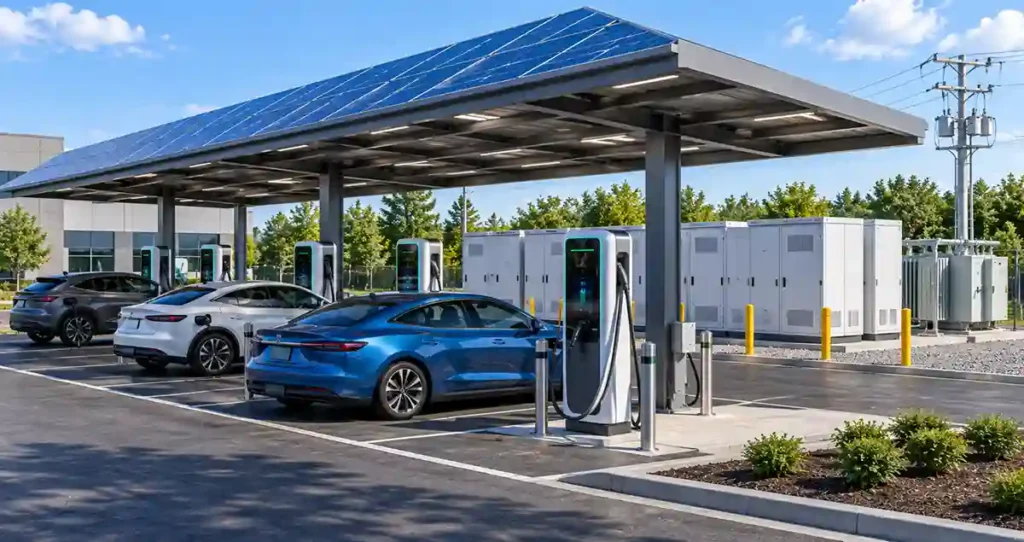
Yes. Solar energy can contribute to the electricity supply of a DC fast charging facility, but system design becomes more demanding as charging power increases.
A commercial solar installation can supply part of the site’s energy demand. Battery storage can also help manage peak demand, store surplus solar generation and support charging during periods of lower solar output.
For example, a commercial charging hub could combine:
- A grid connection.
- A rooftop or ground-mounted solar PV system.
- A battery energy storage system.
- DC fast charging stations.
- An energy management system.
The system must be designed around the charging demand, solar generation profile, battery power and energy capacity, utility limits and operating schedule.
A solar PV system rated at 100 kW does not automatically support a 150 kW DC charger at full output. The available power must be evaluated alongside other site loads and the grid connection.
Smart energy management can coordinate solar generation, battery charging and discharging, grid demand and EV charging schedules. AI-based forecasting may further improve energy planning, but electrical protection and charging controls must remain compliant with applicable standards.
For a broader explanation of solar integration, see our guide to how solar EV charging works.
Level 3 EV Charger Advantages and Disadvantages
Advantages
- Much faster charging than conventional AC charging.
- Suitable for highway and public charging networks.
- Supports commercial and fleet vehicle operations.
- Reduces charging downtime where vehicles need to return to service quickly.
- Can be integrated with solar PV and battery storage systems.
- Supports high-energy-demand transportation facilities.
Disadvantages
- Higher equipment and installation costs.
- Requires substantial electrical supply capacity.
- May require transformer or utility service upgrades.
- More complex electrical and civil installation.
- Not every EV can accept the charger’s maximum rated power.
- Battery charging speed generally decreases at higher states of charge.
- Commercial stations require ongoing maintenance and operational management.
NEC Codes and International Safety Standards for DC Fast Chargers
For installations in the United States, engineers and electrical contractors should consider the applicable edition of the National Electrical Code (NEC), local amendments and the requirements of the Authority Having Jurisdiction (AHJ).
The NFPA identifies the 2026 NEC as its current edition, but the edition legally applicable to a particular project depends on local adoption.
Important NEC references include:
- NEC Article 625: Electric Vehicle Power Transfer System. The primary NEC article covering EV charging equipment and related power-transfer installations.
- NEC Article 110: General requirements for electrical installations and equipment.
- NEC Article 220: Load calculations and demand considerations.
- NEC Article 240: Overcurrent protection.
- NEC Article 250: Grounding and bonding.
- NEC Article 300: Wiring methods and installation requirements.
- NEC Article 310: Conductors and their ampacity.
- NEC Article 705: Interconnected electric power production sources, where applicable to solar integration.
- NEC Article 706: Energy storage systems, where applicable to battery integration.
Relevant equipment and international standards include:
- UL 2202: Electric Vehicle Charging System Equipment.
- UL 2231: Personnel Protection Systems for Electric Vehicle Supply Circuits.
- UL 2251: Plugs, Receptacles and Couplers for Electric Vehicles.
- SAE J1772: AC and DC charging interface requirements associated with the Combined Charging System.
- SAE J3400: North American charging connector standard.
- IEC 61851-23: DC electric vehicle supply equipment.
- IEC 62196-3: Plugs, socket-outlets, vehicle connectors and vehicle inlets for DC charging.
IEC 61851-23 is particularly relevant to DC charging equipment. Its requirements address DC power transfer, electrical safety, control functions and thermal management.
The exact listing and certification requirements depend on the equipment, installation and jurisdiction. Always verify the adopted code edition, manufacturer instructions and local AHJ requirements.
Frequently Asked Questions
What is the power range of a Level 3 EV charger?
DC fast chargers commonly range from approximately 50 kW to 350 kW. Some equipment supports outputs up to 500 kW, depending on the technology and application.
Is Level 3 charging AC or DC?
Level 3 charging refers to DC fast charging. The station converts incoming AC electricity into DC and supplies it directly to the vehicle battery.
How long does a Level 3 EV charger take to charge a car?
Charging time varies by vehicle, battery size, charger output, temperature and state of charge. Some vehicles can gain substantial driving range in approximately 20–30 minutes, but actual results differ.
What is a liquid-cooled EV charging cable?
A liquid-cooled EV charging cable uses a circulating coolant to remove heat from the cable assembly and connector during high-current charging. It can help manage temperature while allowing a more manageable cable size and weight.
Do all DC fast chargers use liquid-cooled cables?
No. Some DC fast chargers use air-cooled or other thermally managed cable designs. Liquid cooling is particularly useful in high-current applications where cable and connector temperatures need more active control.
Can liquid-cooled EV charging cables leak?
Yes, a liquid-cooled cable contains a coolant circuit, so leakage is a design and maintenance consideration. Suitable equipment may include leakage detection, temperature monitoring and protective shutdown functions. Inspection and maintenance should follow the manufacturer’s instructions.
Can a 350 kW charger charge every electric vehicle at 350 kW?
No. The vehicle must support that charging power. The battery management system, battery temperature, state of charge and charger conditions determine the actual charging rate.
Can a Level 3 charger be installed at home?
It is technically possible in some circumstances, but it is generally impractical for ordinary homes because of high electrical demand and infrastructure requirements. Level 2 charging is usually more suitable for residential use.
What is the difference between Level 3 and DC fast charging?
In North America, Level 3 is a commonly used name for DC fast charging. DCFC is the more precise technical description, particularly when comparing international charging systems.
Conclusion
Level 3 EV chargers play an important role in public charging networks, highway infrastructure and commercial vehicle operations. Their high power output can significantly reduce charging time, but successful installation requires more than selecting a charger with a high kW rating.
Electrical supply capacity, transformer requirements, connector compatibility, vehicle charging limits, cable cooling, protection systems and site planning all need to be evaluated before installation.
For homeowners, Level 2 charging is generally the more practical choice. For commercial sites, fleets and public charging networks, DC fast charging can provide the speed and operational flexibility required for higher vehicle usage.
Engineering perspective: The right charging solution is not necessarily the one with the highest power rating. It is the one that matches the vehicle, electrical infrastructure, charging demand, thermal management requirements and long-term operating conditions.
Related guides
- How Solar EV Charging Works: From Solar Panels to Your EV
- Grid-Connected vs. Off-Grid EV Charging: Key Differences
- Solar Inverter for EV Charging: Capacity, Types and Compatibility
- Direct Solar EV Charging vs. Solar Plus Battery Storage: Which Is Better?
- EV Charger Levels Explained: Level 1 vs. Level 2 vs. Level 3
- Level 1 EV Charger: Speed, Power & Cost
- Level 2 EV Charger: Speed, Installation & Cost