
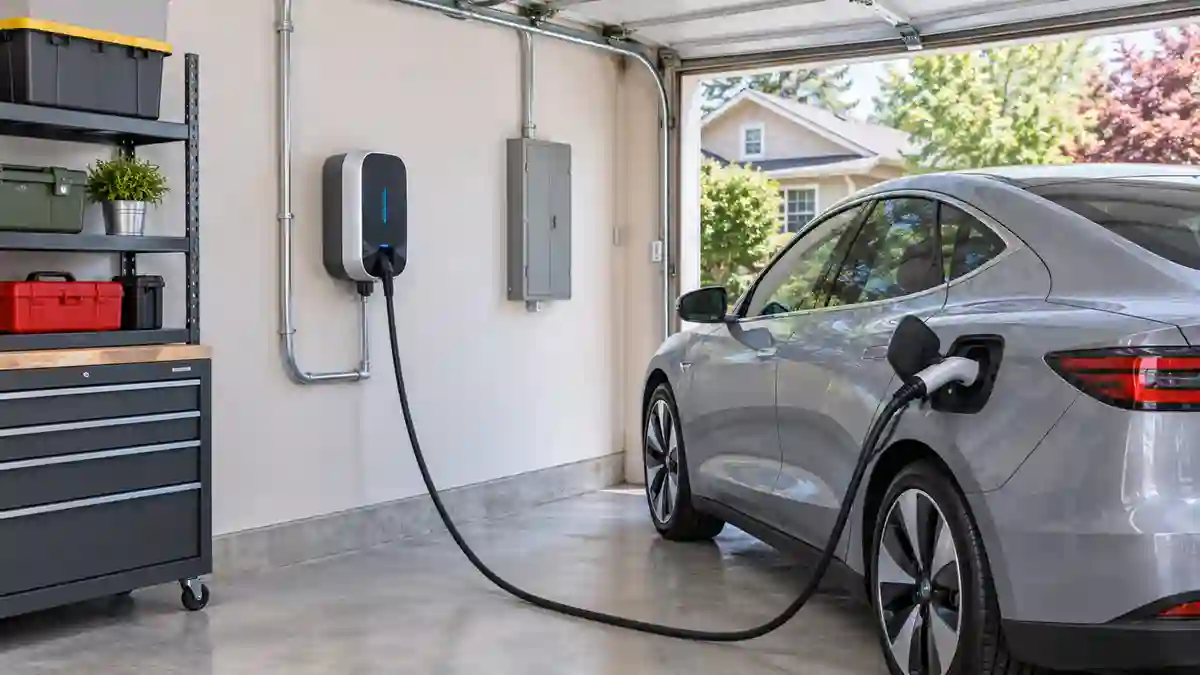
Learn how a Level 2 EV charger works, its charging speed, 240V power requirements, installation costs, and electrical requirements for home charging.
A Level 2 EV charger is one of the most practical options for charging an electric vehicle at home. Unlike Level 1 charging, which uses a standard 120V household outlet, Level 2 charging operates on a 208V or 240V electrical supply and can deliver considerably more power.
For homeowners who drive regularly, a Level 2 charger can provide enough energy to replenish a vehicle’s battery overnight. It is also commonly used in workplaces, commercial buildings, and public parking facilities.
From my experience as a solar and EV charging engineer, I am increasingly seeing returning solar customers ask about extending their existing electrical and solar systems to accommodate EV charging. Some initially consider Level 1 charging, while others want a dedicated Level 2 charger for faster home charging.
When discussing these requirements, I consider not only the charger’s power rating but also the existing electrical panel, inverter capacity, solar generation, battery storage, and future household demand. Planning these requirements early can help avoid unnecessary modifications later.
What Is a Level 2 EV Charger?
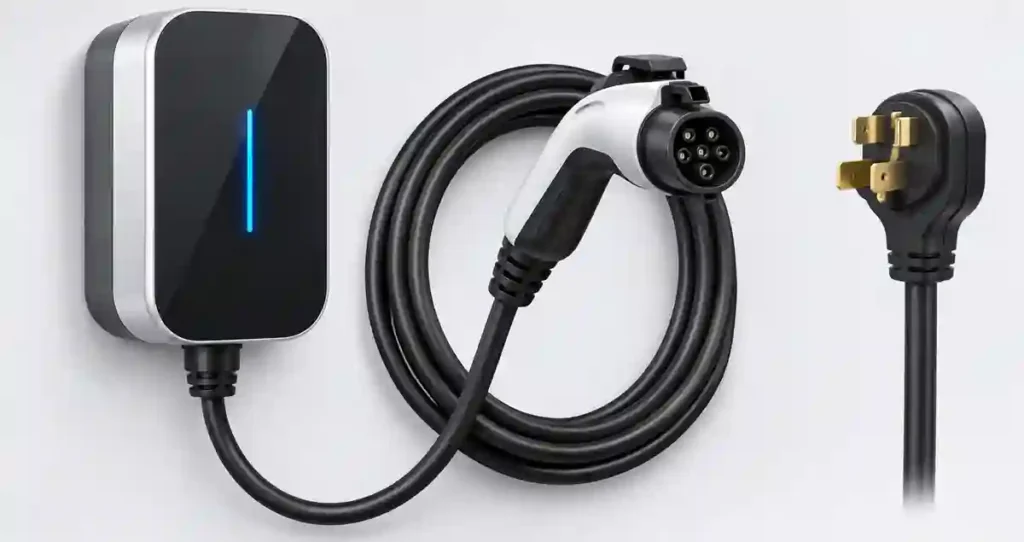
A Level 2 EV charger is an AC charging system that uses a 208V or 240V electrical supply.
It is commonly installed in residential garages and commercial parking areas. Compared with Level 1 charging, it delivers higher power and significantly reduces charging time.
A typical Level 2 setup includes:
- A dedicated electrical circuit.
- A Level 2 EVSE (Electric Vehicle Supply Equipment).
- A charging cable and compatible vehicle connector.
- Appropriate circuit protection and grounding.
- An electrical panel with sufficient capacity.
The EVSE supplies AC electricity to the vehicle. The vehicle’s onboard charger converts that AC electricity into DC power to charge the battery.
Level 2 EV Charger Voltage and Power Requirements
In US residential installations, Level 2 chargers commonly use 240V split-phase electrical service. Commercial installations may use 208V three-phase electrical systems.
The charger’s power output depends on its current rating and the vehicle’s onboard charger capacity.
| Electrical specification | Typical value |
|---|---|
| Supply voltage | 208–240V AC |
| Common charging current | 16A–48A |
| Typical residential power | 7.2–11.5 kW |
| Higher-power residential option | Up to 19.2 kW |
| Common receptacle | NEMA 14-50 |
| Installation | Hardwired or plug-in |
| Charging type | AC charging |
Common Level 2 Charger Ratings
| EVSE current | Approximate power at 240V | Typical circuit rating |
|---|---|---|
| 16A | 3.84 kW | 20A |
| 24A | 5.76 kW | 30A |
| 32A | 7.68 kW | 40A |
| 40A | 9.60 kW | 50A |
| 48A | 11.52 kW | 60A |
| 80A | 19.20 kW | 100A |
Circuit ratings are illustrative examples based on a continuous charging load and the 125% sizing principle. Actual installations must follow the applicable code, equipment instructions, and local requirements.
Important: A 48A EVSE does not guarantee that the vehicle will charge at 11.52 kW. The vehicle’s onboard charger may have a lower maximum AC charging capacity.
How Fast Does a Level 2 EV Charger Charge?
Level 2 charging typically adds approximately 10–30 miles of driving range per hour, depending on the charger’s power output and vehicle efficiency.
| Charging duration | Approximate added range |
|---|---|
| 1 hour | 10–30 miles |
| 2 hours | 20–60 miles |
| 4 hours | 40–120 miles |
| 6 hours | 60–180 miles |
| 8 hours | 80–240 miles |
These are estimates, not guaranteed charging results. Actual performance depends on the vehicle’s onboard charger, battery condition, temperature, charging power, and energy losses.
Example: Level 2 Charging Calculation
Assume a home EV charger delivers 7.2 kW for four hours.
Energy delivered:
7.2 kW × 4 hours = 28.8 kWh
If the electric vehicle consumes approximately 0.30 kWh per mile:
28.8 kWh ÷ 0.30 kWh/mile = 96 miles
Therefore, the vehicle could receive approximately 96 miles of driving range from four hours of charging under these assumptions.
How Much Does a Level 2 EV Charger Cost?
The cost of installing a Level 2 EV charger in the United States depends on the equipment, electrical panel capacity, wiring distance, labor, and installation arrangement.
The following estimates provide a general residential cost reference.
| Cost component | Estimated US cost |
|---|---|
| Level 2 charger equipment | $400–$1,200 |
| Installation | $500–$1,700 |
| Estimated combined cost | $900–$2,900 |
These are broad planning estimates, not guaranteed contractor quotations. Electrical panel upgrades, long cable runs, trenching, permits, and utility service modifications may increase the total cost.
What Affects Installation Costs?
- Existing electrical panel capacity.
- Distance between the panel and EV charger.
- Wiring, conduit, and breaker requirements.
- Plug-in versus hardwired installation.
- Indoor or outdoor installation location.
- Permits and inspection charges.
- Electrical service or panel upgrades.
For a straightforward installation near an electrical panel, costs may be relatively modest. A charger installed in a detached garage or far from the main panel can require additional wiring and construction work.
Level 2 EV Charging Electricity Cost
The electricity cost depends on the energy consumed and the utility’s electricity rate.
For example, assume:
- Charger power: 7.2 kW
- Charging duration: 4 hours
- Electricity rate: $0.16 per kWh
Energy consumed:
7.2 × 4 = 28.8 kWh
Charging cost:
28.8 × $0.16 = $4.61
This is an illustrative calculation before accounting for charging losses or additional utility charges.
Homeowners with time-of-use electricity plans may reduce charging expenses by scheduling charging during lower-rate periods.
Applications and Uses of Level 2 EV Chargers
Level 2 EV chargers are suitable for locations where vehicles remain parked long enough to receive a meaningful charge. Common applications include:
- Residential Homes: Homeowners use Level 2 chargers for convenient overnight charging, particularly when daily driving distances exceed what Level 1 charging can comfortably support.
- Workplaces and Offices: Employees can charge their vehicles during working hours, making Level 2 charging useful for workplace parking facilities.
- Commercial Buildings: Shopping centers, hotels, restaurants, and business facilities can offer EV charging as an additional customer service.
- Apartment Complexes: Property owners can install shared or dedicated chargers for residents, subject to electrical capacity and parking arrangements.
- Fleet and Business Vehicles: Companies can charge electric cars, service vehicles, and light-duty fleets during scheduled parking periods.
- Solar-Integrated Homes: Level 2 chargers can work alongside residential solar systems and compatible energy management equipment to make better use of available solar generation.
Engineering Consideration: Charger selection should depend on vehicle parking duration, daily energy requirements, available electrical capacity, and the number of vehicles being served.
NEC Codes and Safety Standards for Level 2 EV Charging
Level 2 EV charger installations in the United States must comply with the applicable National Electrical Code (NEC), equipment standards, and local electrical requirements.
Key references include:
- NEC Article 625: Covers EV charging equipment and installation requirements.
- NEC Article 210: Addresses branch circuits and receptacle requirements.
- NEC Article 220: Covers electrical load calculations.
- NEC Article 250: Addresses grounding and bonding.
- NEC Article 110: Covers general electrical installation requirements.
- UL 2594: Safety standard for AC EV supply equipment.
- SAE J1772 and SAE J3400: Relevant North American EV charging connector standards.
Dedicated Circuit and Breaker Sizing
EV charging is considered a continuous load. Under applicable NEC requirements, the branch circuit and overcurrent protection must generally be sized at 125% of the maximum continuous charging current.
For example:
- 32A EVSE → 40A circuit.
- 40A EVSE → 50A circuit.
- 48A EVSE → 60A circuit.
A 48A Level 2 charger therefore commonly requires a 60A branch circuit, with appropriately sized conductors, protection, and installation methods.
Always verify the locally adopted NEC edition, manufacturer instructions, and requirements of the local Authority Having Jurisdiction (AHJ).
Engineer’s Note: A 240V outlet alone does not guarantee that an installation is suitable for EV charging. Check circuit capacity, grounding, wiring, receptacle rating, and the charger’s continuous load requirements.
Can You Use a Level 2 EV Charger With Solar Panels?
Yes. A Level 2 EV charger can operate alongside a residential solar PV system.
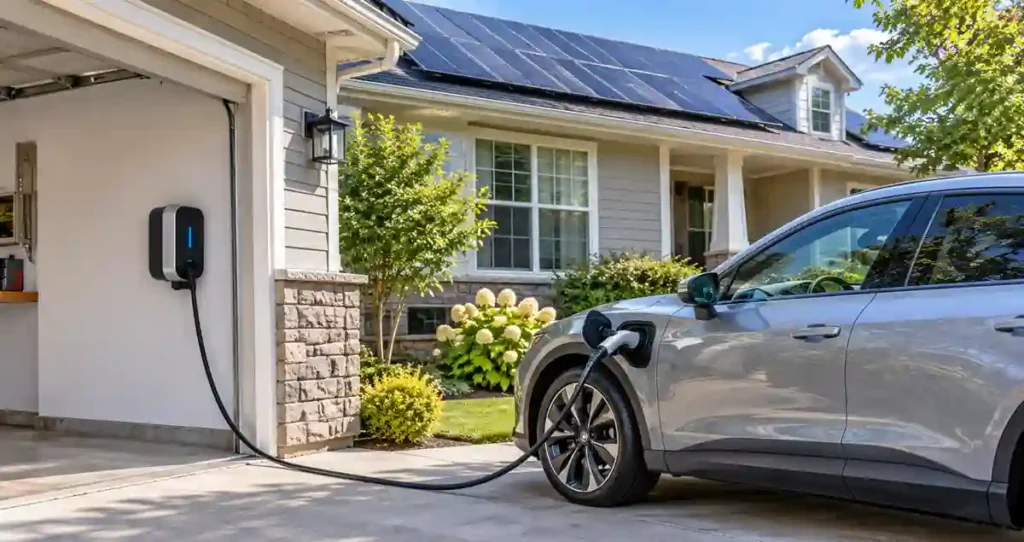
However, the arrangement depends on available solar generation, household demand, inverter capacity, and whether the system includes battery storage.
For example, consider a home with:
- 10 kW solar PV capacity.
- A compatible 10 kW hybrid inverter.
- A Level 2 EV charger with a 7.2 kW maximum charging rate.
The charger may receive electricity from solar generation when sufficient power is available. If household demand increases or solar production falls, the remaining charging energy may come from the grid or a compatible battery system.
A smart EV charging system can adjust charging power according to available solar generation, household consumption, electricity tariffs, and vehicle charging requirements.
For homeowners planning a new solar installation, I recommend considering EV charging provision even if they do not currently own an electric vehicle.
Relevant guides:
- How Solar EV Charging Works
- Direct Solar EV Charging vs. Battery Storage
- Solar Inverter for EV Charging
Smart Level 2 EV Charging and Energy Management
Modern Level 2 chargers may include Wi-Fi connectivity, mobile applications, scheduling, and energy monitoring.
When integrated with a compatible home energy management system, charging can be coordinated with:
- Real-time solar generation.
- Household electricity consumption.
- Battery state of charge.
- Utility time-of-use rates.
- Vehicle departure and charging schedules.
AI-based energy management can help optimize charging decisions using these inputs. However, the system must operate within the electrical limits of the EVSE, inverter, battery, and electrical service.
Smart charging is especially useful in homes where solar panels, battery storage, household loads, and EV charging share the same electrical infrastructure.
Advantages and Disadvantages of Level 2 EV Charging
| Advantages | Disadvantages |
|---|---|
| Faster than Level 1 charging | Higher installation cost |
| Suitable for overnight home charging | Usually requires a dedicated circuit |
| Supports larger EV batteries | May require electrical panel upgrades |
| Available in residential and commercial versions | Installation requires proper electrical assessment |
| Can integrate with solar and smart energy systems | Actual speed is limited by vehicle onboard charger capacity |
Is a Level 2 EV Charger Right for Your Home?
For many homeowners, Level 2 charging is a practical balance between charging speed, installation cost, and everyday convenience.
It is particularly suitable for:
- Drivers with regular daily commuting.
- Homes with battery electric vehicles.
- Households that need faster overnight charging.
- Homeowners with solar PV systems.
- Households planning to own more than one electric vehicle.
Before selecting a charger, assess the vehicle’s maximum AC charging capacity, daily driving requirements, electrical panel capacity, and available installation space.
From a solar engineering perspective, I also recommend checking whether the existing inverter and electrical system can accommodate future EV charging demand. A properly planned system can make it easier to integrate solar generation, battery storage, and EV charging without unnecessary upgrades.
Level 2 EV Charging in 220–240V Regions
The 120V supply used for Level 1 charging in the United States is not standard in every country. In many regions, including Pakistan, the UK, Europe, Australia and parts of Asia, residential electricity commonly operates at approximately 220–240V AC. This higher voltage allows homeowners to use Level 2-style AC charging at higher power than a typical US 120V household outlet.
However, the available charging power depends on whether the property has a single-phase or three-phase electrical supply, the circuit’s current rating, the EV charger’s capacity and the vehicle’s onboard AC charger.
Typical AC charging configurations in 220–240V regions
| Electrical supply | Typical current | Approx. charging power |
|---|---|---|
| 230V single-phase | 16A | 3.7 kW |
| 230V single-phase | 32A | 7.4 kW |
| 400V three-phase | 16A | 11 kW |
| 400V three-phase | 32A | 22 kW |
These are common configurations, not guaranteed outputs for every property or vehicle.
Why can some regions support 22 kW AC charging?
In countries with a 230V single-phase supply, a dedicated 32A EV charger can typically deliver around 7.4 kW. Where a 400V three-phase supply is available, a compatible 16A or 32A charger can deliver approximately 11 kW or 22 kW, respectively.
This is why 22 kW AC charging is common in some European and other international markets. It is not the same electrical configuration as the conventional North American 240V single-phase Level 2 system, which generally reaches a maximum of 19.2 kW at 80A.
Important consideration: The charger’s rated output does not guarantee that the vehicle will accept the same power. The vehicle’s onboard AC charger, available supply capacity, wiring, protective devices and installation requirements all affect the actual charging rate.
In international markets, AC charging is also commonly described using IEC 61851 charging modes, particularly Mode 3 for dedicated AC charging stations, rather than relying only on the North American Level 1 and Level 2 terminology.
Engineering note: Before specifying a 7.4 kW, 11 kW or 22 kW charger, check the property’s phase availability and maximum electrical demand. A three-phase charger cannot deliver its full rated output from a single-phase supply.
Frequently Asked Questions
Does a Level 2 EV charger require 240V?
Most residential Level 2 chargers use 240V AC, while some commercial systems use 208V AC.
How many miles does a Level 2 charger add per hour?
A typical Level 2 charger adds approximately 10–30 miles per hour, depending on charging power and vehicle efficiency.
Does a Level 2 EV charger need a dedicated circuit?
Yes, Level 2 installations generally require an appropriately rated dedicated branch circuit under applicable NEC requirements.
Can I install a Level 2 charger myself?
Some plug-in equipment is designed for consumer use, but the electrical circuit and receptacle must be properly rated and installed. Hardwired installations and any required electrical modifications should be handled by a qualified electrician in accordance with local requirements.
Can a Level 2 charger work with solar panels?
Yes. It can use electricity from a solar PV system when sufficient generation is available. Smart charging controls can help coordinate EV charging with household demand.
Is Level 2 charging better than Level 1?
Level 2 is generally better for drivers who need faster charging or have larger EV batteries. Level 1 may be sufficient for short daily commutes and lower charging requirements.
Can a 10 kW solar inverter support a Level 2 EV charger?
Potentially, yes. It depends on the inverter’s AC output, household load, EVSE power, grid connection, and energy management arrangements. A 10 kW inverter does not automatically provide 10 kW of spare capacity for EV charging.
Final Thoughts
Level 2 EV charging offers a practical home charging solution for drivers who need more speed than a standard 120V outlet can provide.
However, selecting the correct charger requires more than checking its power rating. Electrical panel capacity, circuit sizing, vehicle compatibility, installation cost, and future energy requirements all matter.
For homeowners with solar panels, planning EV charging alongside solar and battery storage can provide additional flexibility and better use of available energy.
Continue reading: EV Charger Levels Explained: Level 1 vs. Level 2 vs. Level 3
Related guides
- How Solar EV Charging Works: From Solar Panels to Your EV
- Grid-Connected vs. Off-Grid EV Charging: Key Differences
- Solar Inverter for EV Charging: Capacity, Types and Compatibility
- Direct Solar EV Charging vs. Solar Plus Battery Storage: Which Is Better?
- EV Charger Levels Explained: Level 1 vs. Level 2 vs. Level 3
- Level 1 EV Charger: Speed, Power & Cost
- Level 3 EV Charger: How DC Fast Charging Works