
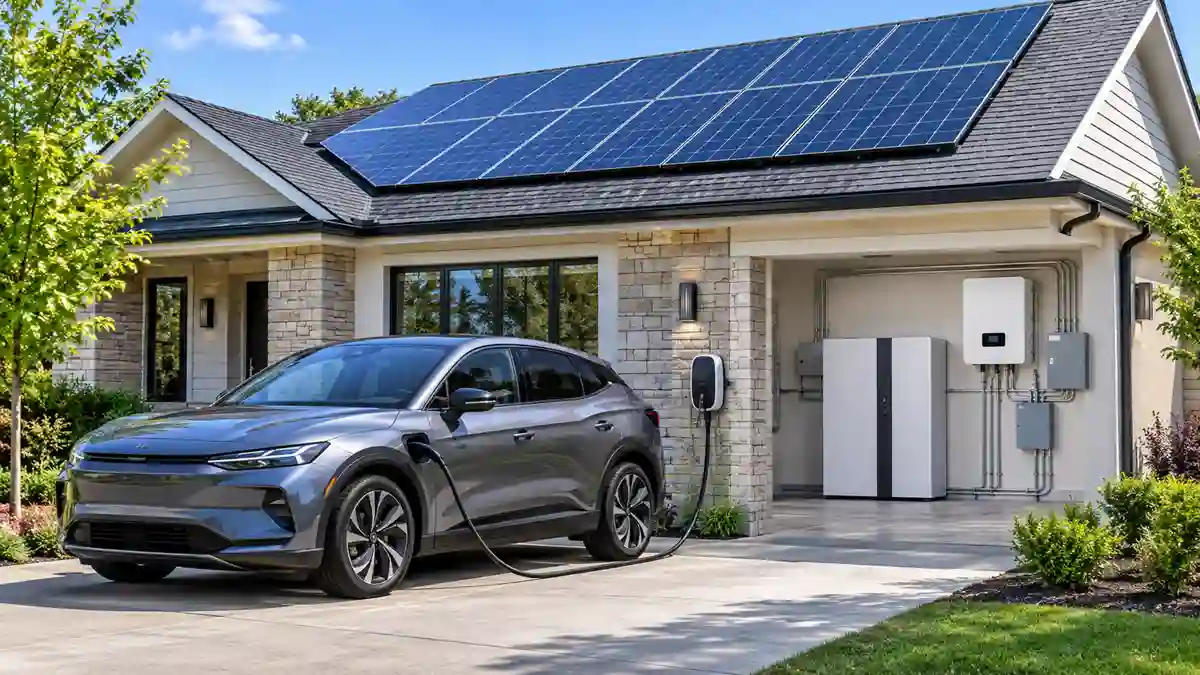
Compare direct solar EV charging with solar battery storage. Explore costs, efficiency, charging times, system requirements and the best option for your home.
Charging an electric vehicle (EV) with rooftop solar can reduce the amount of electricity a household purchases from the utility. However, homeowners need to decide how they want to use the electricity their solar panels generate.
One option is to charge the EV directly while solar generation is available. The other is to install a stationary home battery, store surplus solar electricity during the day, and use that energy to charge the vehicle later.
Both approaches can reduce grid electricity consumption, but they have different equipment requirements, costs, efficiencies, and operating benefits.
In this guide, we compare direct solar EV charging with solar plus battery storage, explain how each system works, and examine practical examples to help homeowners choose the right arrangement.
If you are new to the subject, start with our guide on How Solar EV Charging Works. It explains the complete energy flow from solar panels and inverters to EV chargers and vehicle batteries.
1. What Is Direct Solar EV Charging?
Direct solar EV charging uses electricity generated by rooftop solar panels to charge an electric vehicle while the panels are producing power.
In a typical residential installation, the solar inverter converts the panels’ DC electricity into AC electricity. This electricity supplies household appliances and, when available, an EV charger.
When solar generation exceeds household consumption, the remaining electricity can be used for EV charging. A compatible smart EV charger or energy management system can adjust charging power according to available solar surplus.
For example, if a solar inverter is producing 6 kW AC and household appliances are consuming 1.5 kW, approximately 4.5 kW may be available for EV charging, subject to system losses and equipment limitations.
How direct solar EV charging works
The typical energy flow is:
- Rooftop solar panels generate DC electricity.
- The solar inverter converts DC electricity into AC electricity.
- Household appliances receive the electricity they need.
- Available solar surplus supplies the EV charger.
- The EV’s onboard charger converts AC electricity into DC electricity to charge the vehicle battery.
If solar production decreases because of clouds, shading, or changing sunlight, the charging system may reduce its charging power, pause charging, or draw electricity from the grid. Its behavior depends on the charger settings and system configuration.
Important: Direct solar EV charging does not normally mean connecting rooftop panels directly to an electric vehicle. A conventional residential AC charging arrangement uses an inverter, electrical distribution equipment, and EV supply equipment (EVSE).
Equipment required
A typical direct solar EV charging system includes:
- Solar PV panels
- Solar inverter
- Compatible Level 1 or Level 2 EV charger
- Electrical distribution and protection equipment
- Energy meter or current sensors
- Smart charging controls, where required
A stationary home battery is not essential.
For a deeper understanding of the inverter’s role, see our Solar Inverter Guide.
2. What Is Solar EV Charging with Battery Storage?
Solar EV charging with battery storage adds a stationary battery to the solar installation.
Instead of using all available solar electricity immediately, the system can store some surplus generation for later use. During daylight hours, solar panels supply household loads and charge the battery when sufficient surplus electricity is available.
When solar generation decreases or stops, stored energy can be discharged to supply household appliances or charge an EV, depending on the system’s design and available battery capacity.
This arrangement is particularly useful for households where the vehicle is usually parked at home in the evening rather than during peak solar generation hours.
How solar plus battery EV charging works
The typical energy flow is:
- Solar panels generate DC electricity.
- A compatible inverter or hybrid inverter manages solar generation.
- Household loads receive the electricity they require.
- Surplus solar electricity charges the stationary battery.
- Stored energy is discharged when solar production is insufficient.
- The EV charger supplies electricity to the vehicle.
The exact energy path depends on the system architecture. An AC-coupled installation uses separate solar and battery conversion equipment on the AC side, while a DC-coupled hybrid system can connect PV and battery equipment through a shared DC arrangement.
Equipment required
A solar EV charging system with battery storage may include:
- Solar PV panels
- Compatible solar or hybrid inverter
- Stationary battery storage system
- Battery management system (BMS)
- EV charger
- Energy meter and monitoring equipment
- Energy management controls
- Electrical protection and isolation equipment
The inverter, battery, and EV charger must be compatible in terms of power ratings, operating limits, and control functions.
For more information, read our guides to Solar Battery Types, Efficiency and Storage and Lithium-Ion Batteries for Solar Systems.
3. Direct Solar EV Charging vs. Solar Plus Battery Storage
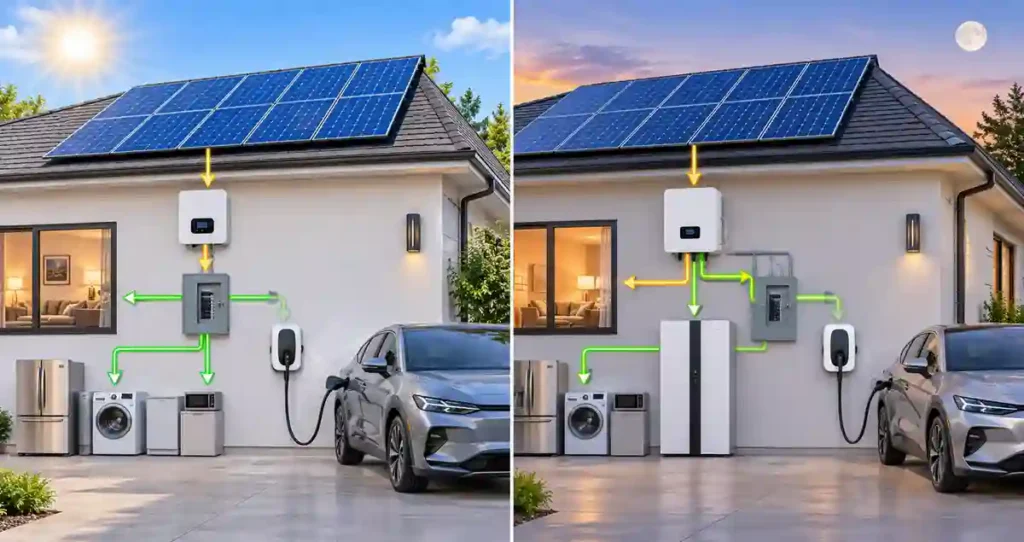
Both arrangements use solar electricity to charge an EV, but their energy management capabilities are different.
| Feature | Direct Solar EV Charging | Solar Plus Battery Storage |
|---|---|---|
| Solar energy use | Real-time solar generation | Real-time generation and stored energy |
| Stationary battery | Not required | Required |
| Daytime charging | Yes | Yes |
| Evening charging | Usually requires grid electricity | Can use stored solar energy |
| Initial investment | Generally lower | Generally higher |
| Energy conversion stages | Typically fewer | Additional battery charge/discharge stages |
| Solar self-consumption | Depends on daytime EV availability | Can increase through stored energy |
| Backup capability | Not provided by PV alone | Possible with suitable backup configuration |
| System complexity | Relatively simple | More complex |
| Best suited for | Daytime home charging | Evening charging and greater flexibility |
The best arrangement depends on when the vehicle is parked at home, how much solar surplus is available, household consumption, utility rates, and whether backup power is important.
For another system-level comparison, see Grid-Connected vs. Off-Grid EV Charging. That guide focuses on grid dependence and system architecture, while this article focuses on whether to use solar electricity immediately or store it for later.
4. How Much Solar Electricity Can Go Directly to an EV?
The amount of solar electricity available for EV charging changes throughout the day. It depends on PV output, household consumption, weather, shading, inverter capacity, and the charging equipment’s operating limits.
Consider this illustrative residential installation:
- Solar inverter output: 6 kW AC
- Household demand: 1.5 kW
- Available solar surplus: 4.5 kW
- EV charger demand: 7.2 kW
The solar system can supply approximately 4.5 kW to the EV. The remaining 2.7 kW may come from the grid if grid supplementation is enabled and the electrical installation supports it.
If the charger is configured for solar-surplus-only operation, it may instead reduce charging power or pause charging when sufficient solar generation is unavailable.
Example: Solar energy available during the day
| Time | Solar output | Home demand | Potential solar surplus |
|---|---|---|---|
| 9:00 AM | 2.0 kW | 1.0 kW | 1.0 kW |
| 11:00 AM | 4.5 kW | 1.2 kW | 3.3 kW |
| 1:00 PM | 6.0 kW | 1.5 kW | 4.5 kW |
| 3:00 PM | 4.0 kW | 1.4 kW | 2.6 kW |
| 5:00 PM | 1.5 kW | 1.0 kW | 0.5 kW |
These figures are illustrative rather than a guaranteed production profile. Actual output varies with location, season, weather, orientation, and system design.
The example shows why daytime charging can make good use of solar generation without requiring a stationary battery.
5. How Battery Storage Changes EV Charging
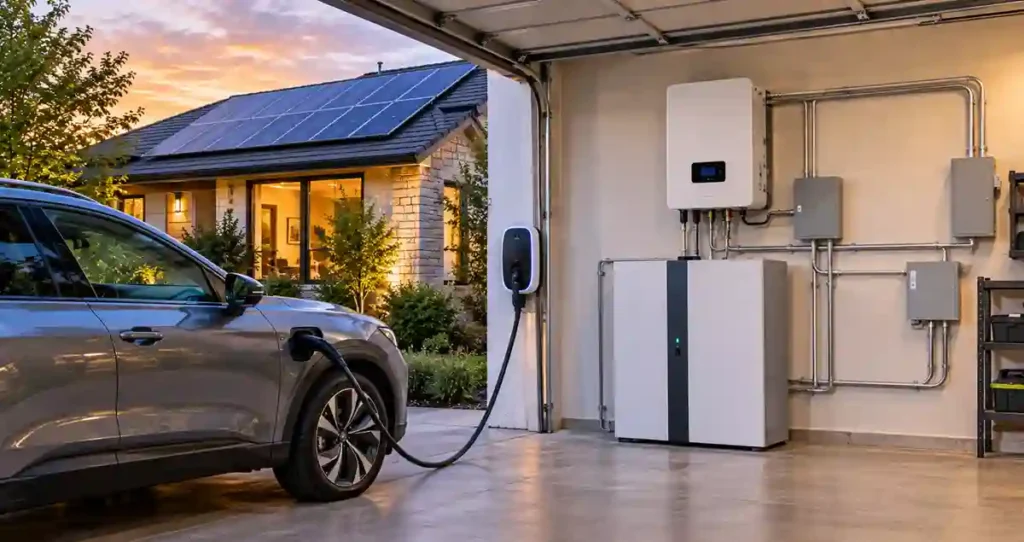
A home battery allows solar electricity generated during the day to be used later. This is particularly useful when an EV returns home in the evening, after the solar system has stopped producing meaningful electricity.
For example, a household may generate surplus solar energy between 10 AM and 3 PM, but the vehicle may not arrive home until 6 PM.
Without storage, the earlier surplus may have been exported to the grid or used by other household loads. With battery storage, some of that energy can be saved and used for EV charging later.
However, a home battery does not create additional solar energy. It shifts some energy from one time to another, and some electricity is lost during charging and discharging.
This is why battery storage should be evaluated according to the household’s actual energy-use pattern rather than simply adding a battery to every solar EV charging system.
6. Practical Example: Charging an EV With and Without a Home Battery
Consider a household with:
- A 6 kW solar PV system
- A 7.2 kW Level 2 EV charger
- An EV requiring 30 kWh of charging energy
- Daytime solar surplus available
- Evening vehicle charging in the battery-storage scenario
Option A: Direct solar EV charging
Assume the EV is charging during the day and receives an average of 4 kW of surplus solar power over six hours.
The total energy supplied by solar is:
4 kW × 6 hours = 24 kWh
If the EV needs 30 kWh, solar will provide 24 kWh. The remaining 6 kWh must come from the grid or another available power source.
Option B: Solar plus battery storage
Now assume the household stores solar energy during the day and uses it later to deliver 30 kWh to the EV.
If we assume a battery-to-EV energy delivery efficiency of 90%, the battery must supply:
30 kWh ÷ 0.90 = 33.3 kWh
Therefore, approximately 33.3 kWh must be drawn from the battery to deliver 30 kWh to the vehicle.
Note: These are simplified examples. Actual energy requirements depend on charging losses, battery usable capacity, system efficiency, and operating conditions.
The battery’s required nominal capacity would be higher still if only a portion of its rated capacity is available for routine operation.
This example does not include every conversion loss, battery reserve, inverter limitation, or household load. Actual system sizing requires a complete energy and power assessment.
For homeowners who want to estimate the broader financial impact of solar generation, our Solar ROI Calculator can provide a useful starting point. EV charging and battery assumptions should still be evaluated separately.
7. Which System Is More Efficient?
Direct solar charging generally involves fewer energy conversion stages when solar electricity is used immediately.
In a conventional AC-coupled residential system, solar electricity passes through the PV inverter and EVSE, while the EV’s onboard charger converts AC electricity into DC for the vehicle battery.
When stationary battery storage is added, energy must also pass through the battery charging and discharging process. This introduces additional conversion losses.
However, efficiency is not the only factor that matters. A battery may make more solar energy useful to a household by shifting it to a time when the EV is actually available for charging.
Practical takeaway: Direct charging can be more energy-efficient for immediate daytime use, while battery storage can improve the timing and availability of solar electricity.
8. Cost Comparison: Is a Home Battery Worth Adding for EV Charging?
A direct solar EV charging system generally has a lower initial cost because it does not require a stationary battery and its associated controls.
A solar-plus-battery system requires additional investment in:
- Battery modules
- Battery management system
- Compatible inverter or power conversion equipment
- Installation and protection equipment
- Monitoring and energy management controls
The financial benefit depends on local electricity tariffs, export compensation, charging schedules, battery costs, and how frequently the battery is used.
When direct solar charging may be more economical
Direct solar charging can be attractive when:
- The EV is usually parked at home during daylight hours.
- The solar system regularly produces surplus electricity.
- The utility offers reasonable compensation for exported electricity.
- The homeowner wants to minimize initial investment.
- Backup power is not a major requirement.
When battery storage may provide additional value
Battery storage may be more useful when:
- The EV is usually parked at home in the evening.
- Export compensation is low compared with the retail electricity rate.
- The household has high evening electricity demand.
- The homeowner wants backup power during outages.
- The system can use time-of-use electricity rates effectively.
A battery should not be purchased solely on the assumption that it will always reduce EV charging costs. Its economic value should be evaluated against installed cost, usable capacity, round-trip efficiency, warranty, expected cycling, and electricity tariff structure.
For homeowners comparing battery technologies, see LiFePO4 Batteries for Solar Systems.
9. Can a Home Battery Charge an EV During a Power Outage?
Yes, but only when the solar, battery, inverter, and EV charging system are designed to operate during an outage.
A standard grid-connected solar installation usually shuts down during a utility outage for electrical safety. Having rooftop panels does not automatically mean that a home can continue charging an EV when the grid fails.
For backup operation, the system may require:
- A compatible hybrid or grid-forming inverter
- Battery storage with sufficient usable capacity
- Automatic or manual transfer equipment
- A properly configured backup electrical panel
- Suitable grounding and protection
- An EV charger connected to the supported backup supply
The inverter must also have sufficient continuous power capacity to operate the EV charger alongside other backed-up loads.
For example, a battery may have enough stored energy in kWh to support a charging session, but the inverter may not have enough output power in kW to operate a 7.2 kW charger. Both energy capacity and power capacity matter.
For more information, see our guide to Home Battery Backup.
10. Engineer’s Note: What Should Be Checked Before Adding Battery Storage?
From my work in solar engineering and system design, I would not recommend selecting a home battery based only on the EV charger’s power rating. The more important starting point is understanding the household’s energy profile and when the vehicle is actually available for charging.
A 7.2 kW EV charger does not mean the home needs a 7.2 kWh battery, and a large battery does not automatically mean the system can operate a high-power charger.
I would assess the following before recommending either arrangement:
1. Solar generation profile
Check the expected hourly and seasonal PV generation. A system that produces a large amount of energy at midday may still have limited output in the early morning or late afternoon.
2. Household load profile
Identify how much solar generation is already consumed by air conditioning, refrigeration, cooking, water heating, and other appliances. Only the remaining surplus should be considered available for EV charging or battery charging.
3. EV charging schedule
Find out whether the vehicle is parked at home during peak solar hours. If it is usually away during the day, battery storage or scheduled grid charging may be more practical.
4. Inverter output and headroom
Check the inverter’s continuous output rating, existing household demand, and permitted operating limits. The system must be capable of handling the required loads simultaneously.
5. Battery usable capacity and power
Evaluate usable kWh, continuous discharge power, charging power, reserve settings, and conversion efficiency. Capacity and power are separate design considerations.
6. Control and equipment compatibility
Confirm that the inverter, battery, energy meter, and EV charger can communicate or operate together as required. A solar-surplus charging feature should be verified rather than assumed.
My engineering preference is to establish the actual load profile first, calculate the available solar surplus, and then determine whether battery storage provides enough additional value to justify its cost.
11. How to Choose the Right Solar EV Charging Setup
Before choosing between direct solar charging and solar-plus-battery storage, evaluate the household’s actual energy-use pattern.
Choose direct solar charging if:
- Your EV is available for charging during the day.
- You have consistent solar surplus.
- You want a simpler installation.
- You do not need a battery for backup or evening use.
- Your priority is minimizing initial system cost.
Consider solar plus battery storage if:
- Your EV is usually parked at home after sunset.
- You want to use daytime solar generation in the evening.
- Your household has substantial evening electricity demand.
- You want backup capability from a properly designed system.
- Your utility tariff makes stored electricity financially useful.
Regardless of the selected approach, the system should be assessed for solar PV capacity, household consumption, EV charging demand, inverter capacity, battery capacity where applicable, electrical protection, and energy management.
If you are still deciding between a grid-connected and independent installation, revisit Grid-Connected vs. Off-Grid EV Charging. The two decisions are related, but they are not the same: a grid-connected system can also use battery storage, and an off-grid system normally needs storage or another reliable source of power.
U.S. Electrical Codes and IEEE Standards
Solar EV charging and battery storage installations in the United States must follow applicable electrical codes, equipment certification requirements, and local utility rules.
Key references include:
- NEC Article 625: EV charging equipment and electrical connections.
- NEC Article 690: Solar PV system installations.
- NEC Article 705: Interconnected power production systems.
- NEC Article 706: Energy storage systems.
- IEEE 1547-2018: Grid interconnection requirements for distributed energy resources.
- IEEE 1547.9-2022: Energy storage interconnection guidance.
Equipment safety standards may also include UL 2594 for EV chargers, UL 1741 for inverters, and UL 9540 for energy storage systems.
For official technical references, consult the NFPA National Electrical Code, IEEE 1547 standards, and the U.S. Department of Energy’s solar permitting and inspection guidance.
Engineering note: The applicable NEC edition, equipment listings, utility interconnection requirements, and permits depend on the state and local Authority Having Jurisdiction (AHJ). Always verify local requirements before installation.
12. Frequently Asked Questions
Can I charge my EV directly from solar panels without a battery?
Yes. A residential solar system can charge an EV during daylight hours without stationary battery storage. The solar inverter and compatible EV charging equipment manage the electricity supply. If solar generation is insufficient, the grid may provide the remaining electricity unless the charger is configured for solar-only operation.
Is a home battery necessary for solar EV charging?
No. A battery is optional for many grid-connected residential solar EV charging systems. It becomes useful when the homeowner wants to use solar electricity after sunset, increase energy flexibility, or provide backup power through a compatible system.
Is direct solar EV charging cheaper than using a battery?
It generally has a lower initial installation cost because it avoids additional battery equipment. However, the overall financial result depends on the household’s charging schedule, utility rates, export compensation, and battery economics.
Can I charge my EV at night using solar energy?
Yes, if solar electricity was stored in a stationary battery during the day. Without storage, nighttime EV charging normally requires electricity from the grid or another available power source.
Does a solar battery make EV charging completely independent of the grid?
Not necessarily. Grid independence depends on solar generation, battery capacity, inverter output, EV charging demand, and seasonal conditions. A system designed for backup or off-grid operation must be sized for the required loads and operating conditions.
Can I use my EV battery instead of a home battery?
Some EVs and charging systems support bidirectional charging, such as vehicle-to-home (V2H). This requires a compatible vehicle, bidirectional charging equipment, and suitable electrical controls. It is not supported by every EV or charger.
Conclusion
Direct solar EV charging and solar-plus-battery storage both help households use more of their own solar electricity, but they serve different needs.
Direct charging is often the simpler and lower-cost approach when an EV is parked at home during the day. Solar-plus-battery storage offers greater flexibility for evening charging, household energy management, and backup applications, but it increases system cost and introduces additional energy losses.
The right choice depends on when the vehicle is available, how much solar surplus the home generates, local electricity prices, and whether battery backup is an important requirement.
For many homeowners, the best starting point is to evaluate daytime solar surplus and EV charging schedules before deciding whether stationary battery storage is worth the additional investment.