
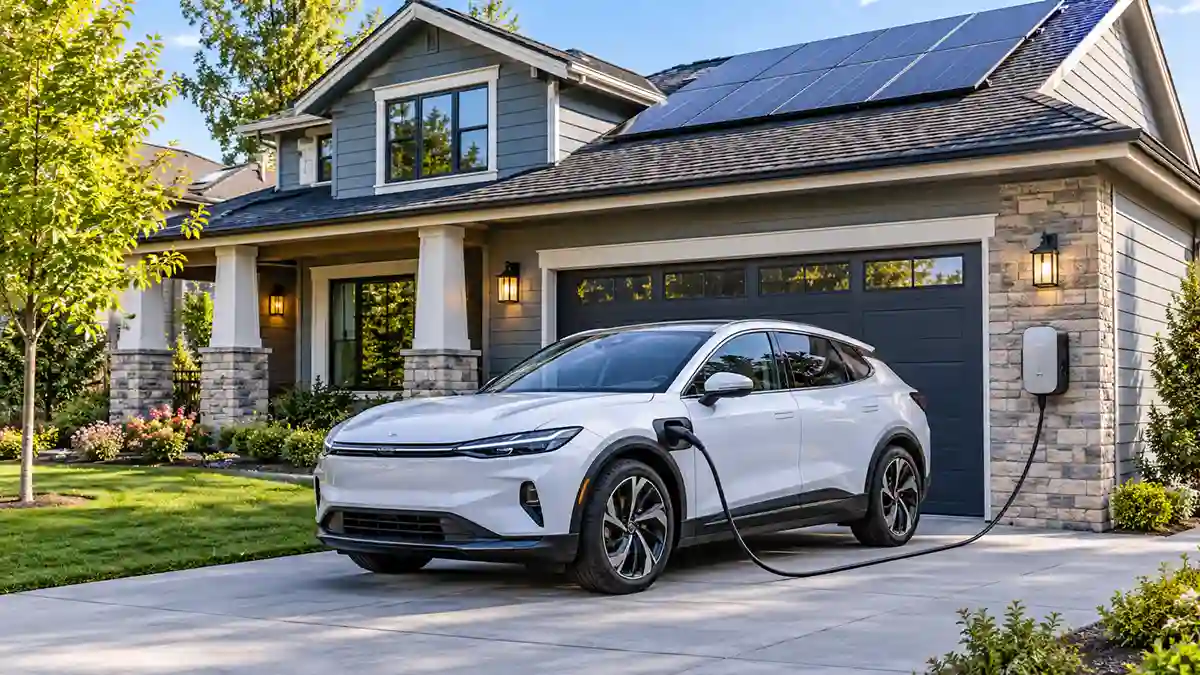
Understand EV charger levels, including Level 1, Level 2 and Level 3 charging. Compare voltage, charging speed, power requirements and costs.
From my experience in solar engineering and system design, I increasingly consider future EV charging requirements when discussing solar installations with clients. I now recommend making provision for an EV charger even if the homeowner does not currently own an electric vehicle.
Planning ahead means considering inverter capacity, electrical panel space, wiring routes, and future charging requirements. This can help homeowners avoid unnecessary electrical modifications when they eventually purchase an EV.
Electric vehicles can be charged using different types of charging equipment, but not every EV charger delivers electricity at the same speed. Some use a standard household outlet, while others require a dedicated electrical circuit or high-power charging equipment installed at public charging stations.
In the United States, EV charging is commonly discussed in three categories: Level 1, Level 2, and Level 3. Each offers a different charging speed, power requirement, installation arrangement, and typical application.
Understanding EV charger levels helps homeowners choose the right charging equipment, estimate how long charging will take, and decide whether a standard household outlet or a dedicated charging station is more suitable.
This guide compares Level 1, Level 2, and Level 3 charging, including their voltage, power output, charging speeds, costs, and practical uses.
EV Charger Levels Explained: Differences, Charging Speed and Costs
What Are EV Charger Levels?
EV charger levels describe the different charging power categories used to recharge electric vehicle batteries.
The three commonly discussed categories are:
- Level 1: Basic AC charging through a standard 120-volt household outlet in the United States.
- Level 2: Faster AC charging through a 208-volt or 240-volt electrical supply.
- Level 3: A commonly used consumer term for DC fast charging, which supplies direct current to the vehicle’s battery.
The main difference is how much electrical power the charging equipment can deliver and how quickly the vehicle can accept that power.
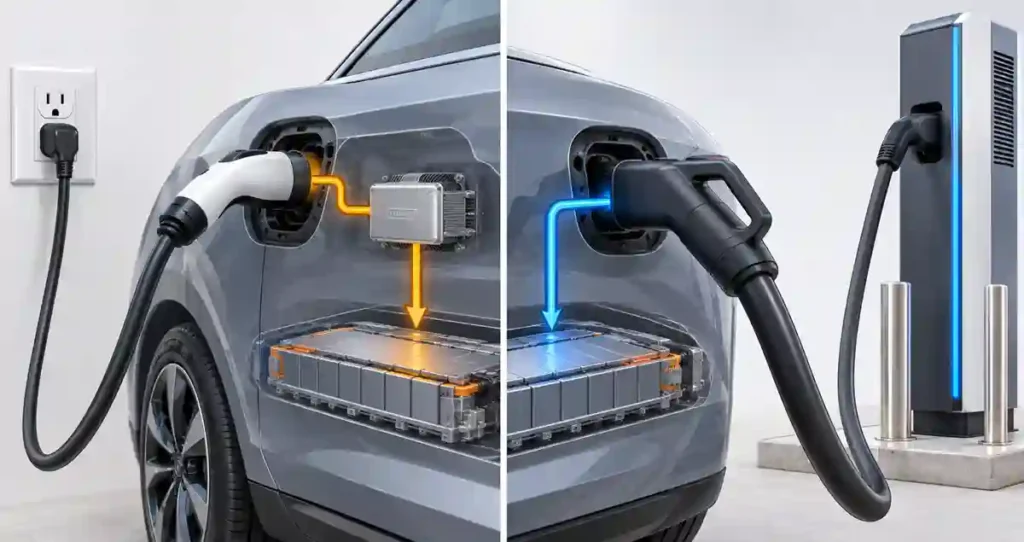
Level 1 and Level 2 use AC electricity. The vehicle’s onboard charger converts that AC electricity into DC electricity for battery storage. DC fast charging works differently: the conversion equipment is located in the charging station, which supplies DC power directly to the vehicle’s battery system.
It is worth understanding that Level 3 is widely used in everyday EV discussions, but US technical references generally use the term DC fast charging (DCFC) rather than treating Level 3 as a consistently defined formal category.
Level 1 vs. Level 2 vs. Level 3: Quick Comparison
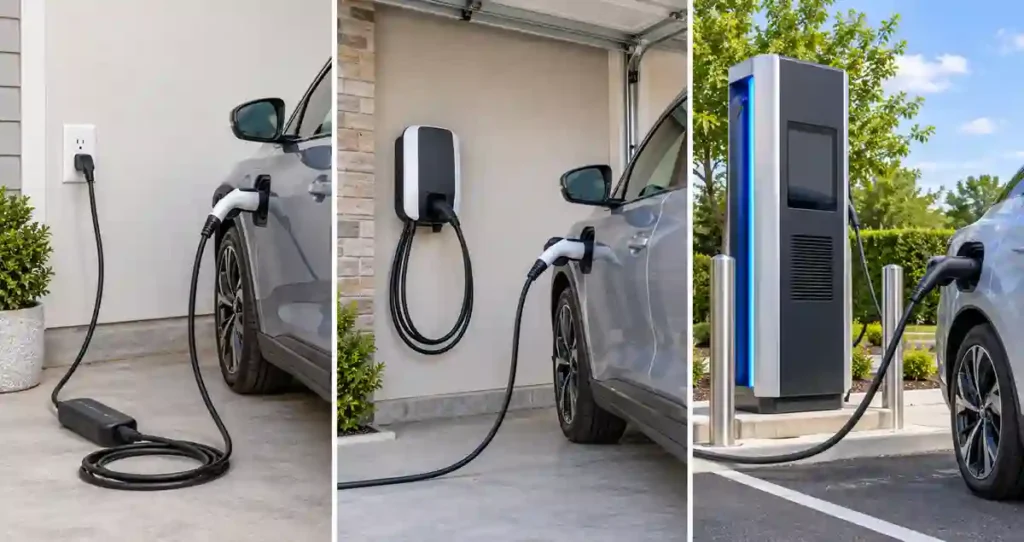
The following table summarizes the main differences between the three charging categories.
| Feature | Level 1 | Level 2 | Level 3 / DCFC |
|---|---|---|---|
| Charging type | AC | AC | DC |
| Typical US voltage | 120 V | 208–240 V | High-voltage DC output |
| Typical power | Around 1.4–1.9 kW | Around 7–19 kW | Around 50–350 kW |
| Charging speed | Slow | Moderate to fast | Very fast |
| Common location | Home | Home, workplace, public | Public fast-charging stations |
| Installation | Standard suitable outlet | Dedicated circuit or hardwired unit | Specialized high-power installation |
| Best application | Overnight or low daily mileage | Everyday home charging | Long-distance travel and quick charging |
Actual charging performance depends on the vehicle, charger rating, battery condition, temperature, and available electrical supply. These figures are representative US charging configurations rather than guaranteed performance for every EV.
1. Level 1 EV Charger: Basic Household Charging
Level 1 is the simplest EV charging option. It uses a standard 120-volt AC household outlet, making it accessible to many homeowners without installing a dedicated Level 2 charging station.
Most electric vehicles have historically been supplied with a portable charging cable or cordset that supports Level 1 charging, although included equipment varies by manufacturer and model.
How does Level 1 charging work?
The charging cable connects to a suitable household outlet on one end and the vehicle’s charging port on the other.
Electricity travels through the cable and the vehicle’s onboard charger, which converts AC electricity into DC electricity for the battery.
A typical Level 1 charging arrangement operates at approximately 120 V and 12 A, delivering around 1.44 kW. Some equipment can support up to 16 A, or approximately 1.92 kW, when connected to an appropriately rated circuit.
How fast is Level 1 charging?
Level 1 is the slowest commonly used EV charging option.
Depending on the vehicle and operating conditions, it can typically add around 2–5 miles of driving range per hour.
For example, an EV receiving eight hours of Level 1 charging may gain approximately 16–40 miles of range. Actual results vary with charging power, vehicle efficiency, and temperature.
Advantages of Level 1 charging
- Uses a standard suitable household outlet.
- Requires relatively little additional charging equipment.
- Convenient for plug-in hybrid vehicles.
- Can work for drivers with low daily mileage.
- Useful as a backup charging option.
Limitations of Level 1 charging
- Slow charging speed.
- Less practical for larger EV batteries.
- May not replace enough energy during a short overnight charging period.
- Requires a suitable, properly maintained electrical outlet and circuit.
Best for: Plug-in hybrid owners, drivers with short daily commutes, and EV owners who do not need to replenish large amounts of battery energy every day.
For a more detailed explanation, see our upcoming guide: Level 1 EV Charger: Charging Speed, Power Requirements and Cost.
2. Level 2 EV Charger: The Most Practical Home Charging Option
Level 2 charging is a popular option for residential EV charging in the United States. It offers significantly more power than Level 1 and is suitable for homeowners who regularly charge an electric vehicle overnight.
Unlike Level 1, which uses a standard 120 V outlet, Level 2 equipment operates through a 208 V or 240 V AC electrical supply.
Residential installations commonly use 240 V, while 208 V is often found in commercial buildings.
How does Level 2 charging work?
A Level 2 charging station connects to a dedicated electrical circuit or is installed as a hardwired unit.
The charger communicates with the vehicle, manages the charging current, and provides AC electricity to the vehicle’s onboard charger.
Common residential charging power examples include:
- 7.2 kW at 240 V and 30 A.
- 9.6 kW at 240 V and 40 A.
- 11.5 kW at 240 V and approximately 48 A.
- 19.2 kW at 240 V and 80 A, where the equipment, vehicle, and electrical installation support it.
The actual current and power depend on the EVSE rating, circuit capacity, vehicle onboard charger, and installation requirements.
How fast is Level 2 charging?
Level 2 charging can typically add approximately 10–30 miles of driving range per hour, depending on the vehicle and charging power.
For example, an EV receiving 7.2 kW of charging power for five hours would receive approximately 36 kWh of energy before accounting for charging losses.
This makes Level 2 a practical solution for overnight charging, workplace charging, and destination charging.
Advantages of Level 2 charging
- Much faster than Level 1.
- Suitable for regular residential EV charging.
- Supports a wide range of charging power levels.
- Can work with smart charging schedules.
- Can be integrated with solar energy systems.
- Available in portable and permanently installed configurations.
Limitations of Level 2 charging
- Requires a suitable 208 V or 240 V electrical supply.
- May require a new dedicated circuit.
- Installation costs can increase if the electrical panel or service needs upgrading.
- Maximum charging speed depends on the vehicle’s onboard charger.
Best for: Homeowners who drive regularly, have larger EV batteries, or want convenient overnight charging.
For more details, read our upcoming dedicated guide: Level 2 EV Charger: Charging Speed, Installation and Cost.
3. Level 3 EV Charger: DC Fast Charging
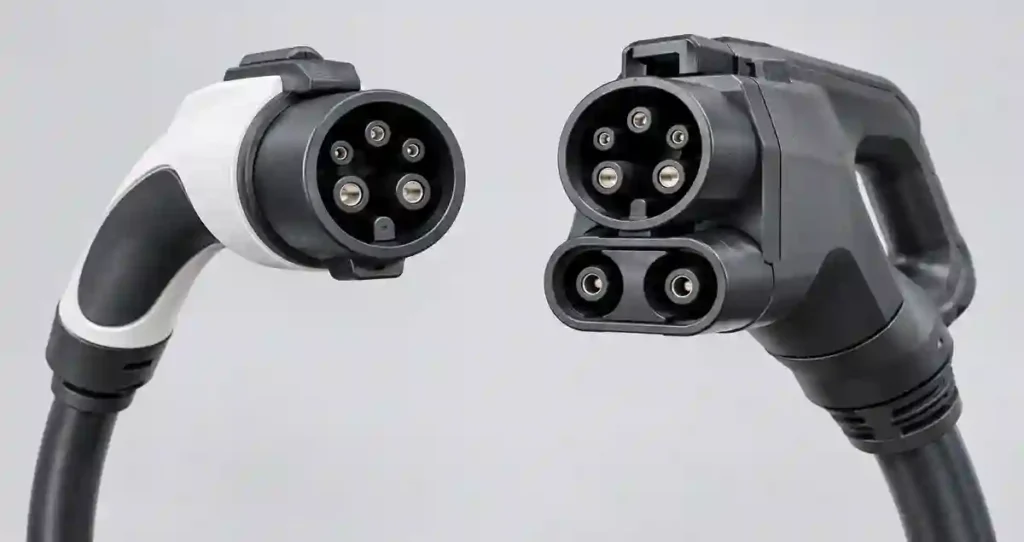
Level 3 is the term commonly used by EV owners to describe DC fast charging. Unlike Level 1 and Level 2, DC fast charging supplies direct current to the vehicle rather than relying on the vehicle’s onboard AC charger for the main conversion process.
The power conversion equipment is installed inside the charging station.
This allows DC fast chargers to deliver much higher power than typical residential AC chargers.
How does DC fast charging work?
A DC fast charging station receives high-power AC electricity from the electrical supply and converts it into DC electricity within the charging equipment.
The DC output is then delivered to the vehicle’s battery through a compatible charging connector and controlled charging communication system.
Because the power conversion takes place outside the vehicle, DC fast charging can bypass the power limitation of the vehicle’s onboard AC charger.
However, the vehicle’s battery management system still controls how much power the battery can safely accept.
How powerful are DC fast chargers?
DC fast charging equipment commonly starts around 50 kW, while modern public charging stations can offer 150 kW, 250 kW, 350 kW, or higher-rated equipment.
Some charging equipment supports outputs up to 500 kW, but the vehicle must be designed to accept such power.
A 350 kW charging station does not mean every connected vehicle will charge at 350 kW. The actual charging rate depends on the vehicle’s maximum DC charging capability, battery temperature, state of charge, and station power availability.
How fast is DC fast charging?
DC fast charging can add a substantial amount of driving range in a relatively short period.
Depending on the vehicle and charging station, a charging session may take approximately 20–60 minutes to reach around 80% battery charge from a low state of charge.
However, this is not a universal charging time. Some vehicles charge faster, while others require longer.
Charging power also usually decreases as the battery approaches a higher state of charge. This is why charging from 10% to 80% can be much faster than charging from 80% to 100%.
Advantages of DC fast charging
- Much faster than residential AC charging.
- Useful for long-distance travel.
- Reduces charging stops on major highways.
- Supports commercial and public charging networks.
- Suitable for vehicles designed for high-power DC charging.
Limitations of DC fast charging
- More expensive charging infrastructure.
- Requires specialized electrical equipment.
- Not generally suitable for ordinary residential installations.
- Charging speed depends heavily on vehicle battery capability.
- Frequent high-power charging may affect battery aging depending on vehicle design, thermal management, and operating conditions.
Best for: Highway travel, public charging stations, commercial fleets, and drivers who need to replenish a substantial amount of battery energy quickly.
For a deeper explanation, see our upcoming guide: Level 3 EV Charger: DC Fast Charging, Power and Cost.
AC Charging vs. DC Charging: What Is the Difference?
One of the most important differences between EV charger levels is whether the vehicle receives AC or DC electricity.
Level 1 and Level 2 charging deliver AC electricity to the vehicle. The vehicle’s onboard charger converts it into DC for the battery.
DC fast charging performs the conversion inside the charging station and supplies DC electricity directly to the vehicle’s battery system.
| Feature | AC Charging | DC Fast Charging |
|---|---|---|
| Charging categories | Level 1 and Level 2 | DC fast charging |
| Conversion equipment | Vehicle onboard charger | Charging station |
| Charging speed | Generally lower | Generally higher |
| Equipment cost | Lower to moderate | Much higher |
| Common use | Homes and workplaces | Public charging stations |
| Solar integration | Can use compatible AC solar systems | Requires specialized DC charging infrastructure |
This difference also explains why a standard residential solar inverter can support Level 1 or Level 2 EV charging through a suitable electrical installation, but cannot directly replace a DC fast charging station.
For a related explanation, read our guide on how solar EV charging works.
Which EV Charger Level Is Best for Home Use?
For most US homeowners, Level 2 charging is the most practical long-term residential option.
However, the right choice depends on daily driving distance, battery capacity, available electrical service, charging habits, and installation budget.
Consider these general situations:
Choose Level 1 if:
- Your daily driving distance is relatively short.
- You own a plug-in hybrid.
- You can leave your vehicle connected for extended periods.
- You do not need a faster charging arrangement.
Choose Level 2 if:
- You drive your EV regularly.
- You want convenient overnight charging.
- You have a larger battery.
- You want to integrate smart charging or solar energy.
Use DC fast charging if:
- You travel long distances.
- You need to recharge during a journey.
- You do not have access to convenient home charging.
- Your vehicle supports the charging station’s connector and power output.
For a typical homeowner, installing a Level 2 charger is often a more practical investment than attempting to install DC fast charging equipment at home.
Can You Charge an EV Using Solar Panels?
Yes. A residential solar system can supply electricity for EV charging, particularly when combined with a compatible Level 2 AC charger.
A typical arrangement includes:
- Rooftop solar panels generate DC electricity.
- The solar inverter converts it into AC electricity.
- The electrical panel distributes electricity to household loads and the EV charger.
- The EV’s onboard charger converts AC electricity into DC for battery storage.
A grid-connected system can use available grid electricity when solar production is insufficient. A compatible smart EV charger can also adjust charging power according to available solar surplus.
Battery storage provides another option by storing excess solar energy for later use, although battery capacity and discharge power must be considered when designing the system.
Explore our related guides:
- Grid-Connected vs. Off-Grid EV Charging
- Direct Solar EV Charging vs. Battery Storage
- Solar Inverter for EV Charging
EV Charging Connectors: Another Important Difference
Charging level and charging connector are not the same thing.
A charging level describes the charging method and power category, while the connector determines the physical and electrical interface between the charging equipment and the vehicle.
In the United States, common connector types include:
- SAE J1772: Commonly used for Level 1 and Level 2 AC charging.
- NACS / SAE J3400: Used for AC charging and DC fast charging.
- CCS1: Used for DC fast charging.
- CHAdeMO: A DC fast charging connector used by some vehicle models, particularly older Japanese EVs.
Connector compatibility depends on the vehicle model, charging station, and available adapters. Always check the vehicle manufacturer’s specifications before using a charging station.
Electrical Codes and Standards for EV Charging
EV charger installations in the United States must comply with applicable electrical codes, equipment standards, and local authority requirements.
Key references include:
- NEC Article 625: Main electrical installation requirements for EV charging equipment.
- NEC Article 210: Branch-circuit requirements.
- NEC Article 220: Electrical load calculations.
- NEC Article 250: Grounding and bonding.
- UL 2594: Safety standard for AC EV charging equipment.
- UL 2202: Safety standard for DC charging equipment.
- IEEE 1547-2018: Grid interconnection requirements relevant to connected solar and battery systems.
Engineer’s Note: Level 2 chargers commonly require a dedicated circuit, while DC fast chargers need significantly greater electrical capacity. Always verify the locally adopted NEC edition, equipment specifications, permits, and inspection requirements before installation.
What Affects EV Charging Speed?
Charging level is only one factor affecting how quickly an EV battery charges.
Several other factors influence the actual charging rate.
1. Battery capacity
A larger battery generally requires more energy to recharge from the same state of charge.
2. Vehicle charging capability
An EV has maximum AC and DC charging limits. A higher-rated charging station cannot force the vehicle to accept more power than its design allows.
3. Battery state of charge
Charging power often decreases as the battery approaches a high state of charge, particularly during DC fast charging.
4. Battery temperature
Very hot or cold battery conditions can reduce charging power. Battery thermal management helps maintain suitable operating temperatures.
5. Available electrical supply
The charging station may be limited by circuit capacity, electrical service, power sharing, or the available grid connection.
6. Charging losses
Not all electricity supplied by the charging equipment reaches the battery. Conversion losses and vehicle auxiliary loads affect the final stored energy.
EV Charger Installation Costs in the United States
The cost of an EV charger depends on its charging level, equipment price, electrical installation, and available power supply. The following estimates provide a general US market comparison.
| Charger type | Equipment cost | Installation cost |
|---|---|---|
| Level 1 (residential) | $0–$900 | $100–$1,000 |
| Level 2 (residential) | $400–$1,200 | $500–$1,700 |
| Level 2 (commercial) | $2,200–$4,600 | $2,200–$6,000 |
| DC fast (50 kW) | ~$23,000 | ~$12,000 |
| DC fast (150 kW) | ~$69,000 | ~$36,000 |
| DC fast (350 kW) | ~$82,000 | ~$84,000 |
All figures are approximate costs in US dollars per charging port, based on published US Department of Transportation estimates drawing on NREL research. They exclude potential grid upgrades.
What Affects EV Charger Installation Costs?
- Electrical panel capacity and required upgrades.
- Distance between the electrical panel and charger.
- Wiring, conduit, trenching, and labor.
- Permits and inspections.
- Utility service upgrades and transformer requirements.
- Charger power rating and networking features.
Engineer’s Note: Level 1 charging is usually the least expensive option because many EVs include a portable charging cable. Level 2 is generally the practical choice for home charging, while DC fast charging requires substantial electrical infrastructure and is primarily intended for commercial and public locations.
Frequently Asked Questions
Is Level 2 charging faster than Level 1?
Yes. Level 2 uses a higher-voltage electrical supply and typically delivers substantially more power than Level 1, making it a better option for regular residential EV charging.
Is Level 3 the same as DC fast charging?
Level 3 is a commonly used consumer term for DC fast charging. In US technical discussions, DC fast charging or DCFC is the clearer terminology because the formal use of Level 3 is less consistent than Level 1 and Level 2.
Can I install a Level 2 EV charger at home?
Yes. Many homeowners install Level 2 chargers using a dedicated 208 V or 240 V circuit. An electrician should assess the electrical panel, service capacity, wiring, circuit protection, and applicable local requirements before installation.
Can a Level 1 charger fully charge an EV overnight?
It depends on battery capacity, starting state of charge, charging power, and how many hours the vehicle remains connected. Level 1 may be sufficient for some plug-in hybrids and low-mileage drivers, but larger battery EVs may need more time.
Is DC fast charging bad for EV batteries?
DC fast charging is supported by vehicles designed for it. Battery degradation depends on several factors, including battery chemistry, temperature, charging frequency, and charging management. It is not accurate to say that every DC fast charging session damages a battery.
Can solar panels support Level 2 EV charging?
Yes. A properly designed solar system can supply a Level 2 charger through a compatible inverter and electrical installation. Smart energy management can also coordinate EV charging with available solar generation and household electricity demand.
Which EV charger level is best for everyday use?
Level 2 is generally the most practical option for homeowners who drive regularly and want convenient overnight charging. Level 1 can work for lower daily mileage, while DC fast charging is more suitable for public and highway charging.
Final Thoughts
Understanding EV charger levels is an important first step when selecting charging equipment for an electric vehicle.
Level 1 offers basic household charging, Level 2 provides a practical solution for everyday residential and workplace use, and DC fast charging enables much faster charging at public stations.
For most homeowners, Level 2 offers a useful balance between charging speed, installation requirements, and convenience. Drivers who travel long distances can benefit from public DC fast charging, while Level 1 may remain sufficient for some lower-mileage applications.
As residential solar and battery storage become more integrated with electric vehicle charging, understanding these charging categories also helps homeowners plan a more efficient home energy system.