
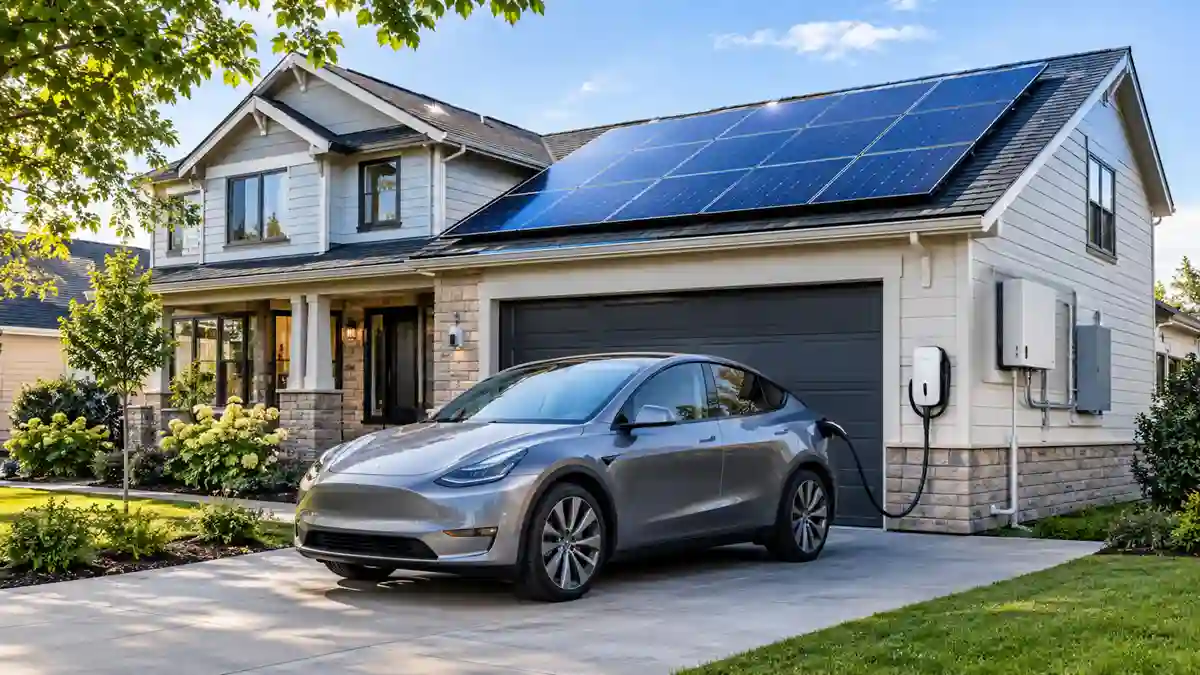
Learn how to choose a solar inverter for EV charging, calculate inverter capacity, manage solar power, and integrate battery storage for home EV charging.
Choosing the right solar inverter for EV charging is an important part of designing a residential solar energy system. Although many existing solar installations can support electric vehicle charging, the inverter, electrical panel, EV charger, and household loads must work together.
A solar inverter converts the DC electricity generated by solar panels into AC electricity that can supply household appliances and compatible EV charging equipment. However, the amount of solar power available for charging depends on inverter capacity, solar generation, and the electricity already being consumed by the property.
Homeowners may also want to combine solar generation with grid electricity or battery storage, particularly when the vehicle is not available during peak sunlight hours.
This guide explains how a solar inverter works with an EV charger, how much inverter capacity may be required, which inverter types are suitable, and what to check before installing a solar EV charging system.
1. How Does a Solar Inverter Work for EV Charging?
Solar panels generate direct current (DC) electricity. A solar inverter converts this electricity into alternating current (AC), which can be used by household appliances and compatible AC EV chargers.
In a typical residential installation, the energy flow is:
Solar panels → Solar inverter → Main electrical panel → EV charger → Electric vehicle
The EV charger, technically called electric vehicle supply equipment (EVSE), controls the electricity supplied to the vehicle.
During conventional AC charging, the EVSE supplies AC electricity to the vehicle, and the vehicle’s onboard charger converts it into DC electricity to charge the battery.
This means a standard residential AC EV charger does not normally connect directly to the solar inverter. Instead, it receives electricity through the property’s electrical distribution system.
When solar generation exceeds household consumption, the available surplus can be used for EV charging. If solar production is insufficient, the utility grid can supply the remaining power in a grid-connected installation.
For a complete explanation of this process, read our guide to How Solar EV Charging Works.
2. Can You Use an Existing Solar Inverter for EV Charging?
In many cases, yes. An existing grid-connected solar inverter can support a home EV charger without requiring a complete replacement of the solar system.
However, its suitability depends on several factors.
Inverter AC output capacity
The inverter’s rated AC output determines how much power it can deliver at a given time.
For example, a 5 kW solar inverter cannot supply 7.2 kW to an EV charger using solar generation alone. If the property remains connected to the utility grid, the grid may provide the difference.
Available solar generation
An inverter’s rated capacity does not mean it will continuously produce its maximum output.
Actual solar generation changes with sunlight intensity, temperature, shading, panel orientation, and system operating conditions.
A solar array may produce sufficient electricity for EV charging around midday but considerably less during early morning or late afternoon.
Existing household consumption
Household appliances also consume part of the available solar generation.
Air conditioners, water heaters, cooking appliances, and other electrical loads can reduce the surplus available for EV charging.
Therefore, the usable solar power depends on the difference between solar generation and the property’s other electrical consumption.
Electrical panel and service capacity
Even when the solar inverter has sufficient output, the electrical panel, service conductors, circuit protection, and utility service must safely accommodate the EV charging load.
A qualified electrical contractor should assess the property’s electrical capacity before installing a new charger.
3. Which Solar Inverter Is Suitable for EV Charging?
Different inverter types offer different levels of flexibility. The best choice depends on whether the property uses grid electricity, battery storage, or an independent off-grid system.
Grid-connected solar inverter
A conventional grid-connected inverter supplies AC electricity to the property’s electrical panel.
An EV charger connected to that panel can use available solar electricity. When solar generation is insufficient, the utility grid can supply additional power.
This is a common arrangement for homeowners who already have rooftop solar and want to add EV charging.
One limitation is that a conventional grid-tied inverter normally shuts down during a utility outage to prevent energizing the grid. It should not be assumed to provide backup charging unless the installation includes suitable backup equipment and an approved operating mode.
Hybrid solar inverter
A hybrid inverter can coordinate solar generation, household consumption, and battery storage.
Depending on the model and system configuration, it may support:
- Solar generation and household consumption monitoring.
- Battery charging and discharging.
- Backup power operation.
- EV charger integration.
- Solar surplus management.
This arrangement can be useful when homeowners want to charge their EV using daytime solar generation and stored energy at other times.
However, not every hybrid inverter includes direct EV charger integration. Compatibility must be confirmed using the manufacturer’s equipment documentation.
Read our Hybrid Inverter Guide for more information.
Off-grid solar inverter
An off-grid inverter operates independently of the utility grid. It must supply connected loads using available solar generation, battery storage, or another supported power source.
EV charging can add a substantial load to an off-grid installation. The inverter must support the charger’s operating power, while the solar array and battery must provide enough energy for the required charging period.
A system designed only for ordinary household appliances may not have sufficient inverter capacity or battery storage for EV charging.
For more information, see our guide to Off-Grid Solar Systems.
4. AC EV Charging vs. DC Fast Charging
The type of EV charger is another important consideration when selecting a solar inverter for EV charging.
AC home charging
Most residential EV charging uses AC charging equipment.
The EVSE supplies controlled AC electricity to the vehicle, and the vehicle’s onboard charger converts it into DC for battery storage.
Common residential arrangements in the United States include:
- Level 1 charging using a 120 V AC supply.
- Level 2 charging using a 208–240 V AC supply, commonly 240 V in residential applications.
Level 2 charging is a common choice for homeowners who want faster charging than a standard household outlet can provide.
For solar system design, the important consideration is that the inverter and electrical installation must support the charging load, either through available solar power, grid supply, or a combination of both.
DC fast charging
DC fast charging equipment supplies DC electricity to the vehicle’s battery system, bypassing the vehicle’s onboard AC charger for the main conversion process.
These chargers generally require much higher electrical power and more substantial electrical infrastructure than residential AC charging equipment.
A conventional residential solar inverter should not be assumed to connect directly to a DC fast charger. Such installations require equipment and electrical infrastructure specifically designed for high-power DC charging.
For most residential solar installations, AC charging is the practical starting point. We will cover the different EV charging levels in separate guides.
Integrated Solar Inverters and EV Chargers
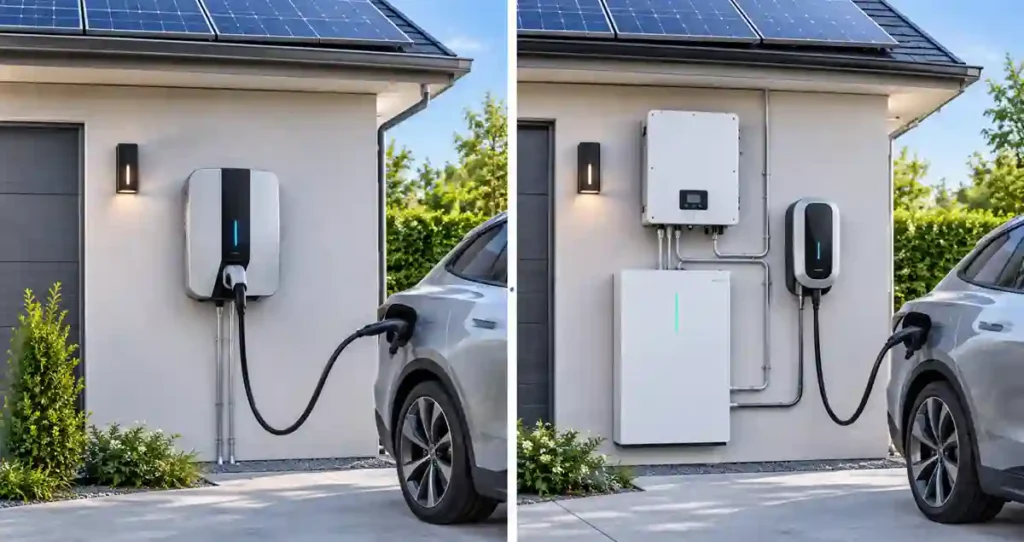
Some manufacturers offer solar inverters with built-in EV charging, while others provide separate smart EV chargers that communicate with hybrid inverters and battery storage systems.
One notable example is the SolarEdge HD-Wave EV Charging Inverter, which combines solar conversion and Level 2 AC EV charging in one device. Other manufacturers, including Fronius and Huawei, offer coordinated solar inverter and EV charger ecosystems.
Some relevant product examples include:
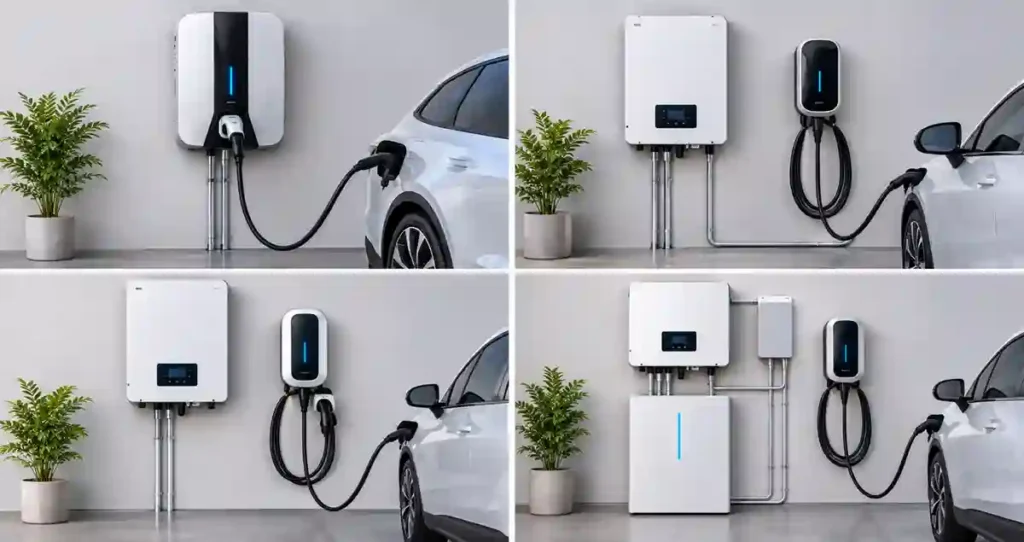
- SolarEdge HD-Wave EV Charging Inverter: An integrated solar inverter and EV charger.
- Fronius GEN24 Plus + Wattpilot Flex: A hybrid inverter paired with a smart EV charger.
- Huawei SUN2000 + SCharger: A coordinated solar inverter and EV charging solution.
- SolarEdge Home Hub + Home EV Charger: A modular solar, battery and EV charging ecosystem.
The key difference is that an integrated inverter contains the EV charging function within the same device, whereas a coordinated system uses separate products that communicate with one another.
For homeowners considering battery storage, a modular hybrid inverter and compatible smart EV charger can offer greater flexibility. Always check inverter capacity, battery compatibility, charging output and regional approvals before selecting equipment.
5. How Much Solar Inverter Capacity Do You Need for EV Charging?
The required inverter capacity depends on the EV charger’s power rating, household demand, available solar generation, and whether the grid or battery can supplement the solar supply.
Consider this simplified residential example.
System assumptions:
- Solar inverter: 8 kW AC
- Household demand: 1.5 kW
- EV charger demand: 7.2 kW
- Available inverter output: 8 kW
Assume the inverter is producing its full rated output.
First, calculate the solar power remaining after household consumption:
8 kW − 1.5 kW = 6.5 kW
The EV charger requires 7.2 kW. Therefore:
- Solar supplies approximately 6.5 kW.
- The grid supplies approximately 0.7 kW.
- Total power supplied to the EV charger is 7.2 kW.
This example assumes the system allows grid supplementation and the inverter can deliver its full rated output at that time.
It demonstrates an important point: an 8 kW solar inverter can support a 7.2 kW EV charger in a grid-connected installation without supplying the entire charging load from solar energy.
Actual performance will vary with solar production and household consumption.
Engineering consideration: Inverter sizing should not be based on the EV charger’s rating alone. The designer must also consider the property’s existing loads, solar generation profile, electrical service capacity, and the intended charging schedule.
6. Can a Solar Inverter Automatically Adjust EV Charging?
A solar inverter by itself does not necessarily control an EV charger’s charging rate. However, some solar energy systems can work with compatible EV chargers and energy management equipment to adjust charging according to available solar surplus.
This feature is commonly called solar surplus charging or solar-aware charging.
A compatible energy management system measures the property’s electricity generation and consumption. It then adjusts the EV charger’s power demand according to the available surplus.
Consider this example:
- Solar inverter output: 6 kW
- Household consumption: 1.5 kW
- Available solar surplus: 4.5 kW
If the EV charger supports dynamic power adjustment, it may reduce its charging demand to use approximately 4.5 kW of available solar power.
If cloud cover reduces solar production or household consumption increases, the charging system can reduce the charging rate accordingly.
Some systems can also combine solar and grid electricity to maintain a selected charging rate.
However, a standard solar inverter and EV charger do not automatically provide this functionality simply because they are installed at the same property. Compatible monitoring equipment, communication, and control features are required.
7. Can You Combine a Solar Inverter, EV Charger, and Battery Storage?
Yes. A solar inverter, battery storage system, and EV charger can work together when the equipment and system configuration support the intended operation.
A typical hybrid solar installation may follow this energy arrangement:
Solar panels → Hybrid inverter → Household loads and battery storage → EV charger
During the day, solar generation can supply household consumption, charge the battery, and provide available surplus for EV charging.
Later, stored energy can be used for household loads or EV charging, depending on the system’s power limits and energy management settings.
However, two battery specifications are particularly important:
Usable battery energy: Determines how much stored electricity is available for charging the EV.
Continuous discharge power: Determines how much power the battery can deliver at one time.
A battery may contain sufficient stored energy but still be unable to supply the EV charger’s full instantaneous power requirement.
For a deeper understanding of storage options, see our guides to Home Battery Backup and Solar Battery Types and Efficiency.
8. What Should You Check Before Buying a Solar Inverter for EV Charging?
Before purchasing an inverter or EV charger, review the following factors.
1. Inverter output rating
Check the inverter’s continuous AC output rating and determine how much power is already being used by household loads.
2. EV charger power requirements
Confirm the charger’s voltage, current, and rated charging power. Also check the vehicle’s maximum AC charging capability.
3. Electrical panel and service capacity
A qualified electrician should assess the electrical service rating, existing loads, panel capacity, circuit requirements, and protective devices.
4. Solar monitoring compatibility
If you want automatic solar surplus charging, confirm whether the EV charger can communicate with the inverter or an external energy management system.
5. Battery integration
If battery storage is included, check whether the inverter can coordinate battery charging, discharging, and EV charging according to the intended operating strategy.
6. Manufacturer compatibility
Check the inverter and EV charger manufacturers’ documentation for supported equipment, communication protocols, monitoring devices, firmware requirements, and installation limitations.
Do not assume that products from different manufacturers will automatically communicate or support advanced solar charging features.
9. Smart Energy Management for Solar EV Charging
Smart energy management can improve how a home solar system uses available electricity.
Depending on the equipment, an energy management system may:
- Prioritize household electricity consumption.
- Direct available solar surplus toward EV charging.
- Reduce charging power when household demand increases.
- Coordinate EV charging with battery storage.
- Schedule charging during selected hours.
- Limit the property’s total electrical demand.
Some manufacturers provide integrated inverter and EV charger systems. Others use compatible third-party energy meters or energy management controllers.
For example, SolarEdge offers EV charging integration with selected solar inverter systems. Its documentation describes features such as excess PV charging, charging schedules, and load management.
These functions depend on supported equipment and system configuration. Homeowners should confirm the exact compatible models and operating limitations before purchasing equipment.
11. Practical Engineering Recommendation: 10 kW Solar System with Battery Storage and AI Energy Management
For a homeowner planning to combine solar energy, battery storage, and electric vehicle charging, a 10 kW solar system can be a useful starting point for evaluating the overall system design. However, the final capacity should depend on household electricity consumption, local solar conditions, EV charging habits, utility rates, and backup requirements.
As an illustrative residential configuration, consider the following setup:
- Solar PV system: 10 kW
- Hybrid solar inverter: 10 kW
- Battery storage: Approximately 16 kWh of lithium battery capacity
- EV charging: A compatible Level 2 AC EV charger
- Energy management: A smart energy management system, potentially supported by AI-based optimization
This configuration brings solar generation, battery storage, household loads, and EV charging together through a coordinated energy system.
How the system can manage energy
During sunny hours, solar electricity can first supply household loads. The energy management system can then direct available surplus electricity toward battery charging or the EV, depending on the homeowner’s priorities and charging schedule.
For example:
- During the day: Solar generation supplies the home and uses surplus energy to charge the EV or battery.
- When solar generation falls: The battery can support selected household loads or EV charging, provided its available discharge power is sufficient.
- During cloudy weather: The system can reduce EV charging power, use available battery energy, or import electricity from the grid.
- During peak-rate periods: Smart controls can prioritize stored energy or schedule EV charging when electricity costs are lower.
An AI-assisted energy management system can improve these decisions by considering real-time electricity consumption, solar production, weather forecasts, electricity tariffs, battery state of charge, and the vehicle’s expected departure time. However, AI is not essential for every installation. A conventional energy management system can also coordinate these functions using predefined operating rules.
An important battery and inverter consideration
A 16 kWh battery describes its energy capacity, not the amount of power it can continuously deliver. The battery’s continuous discharge rating, BMS limits, inverter compatibility, and protection equipment must all be checked before pairing it with a 10 kW inverter.
This is particularly important with lower-voltage battery systems, where a high-power inverter can require substantial DC current. Battery modules connected in parallel must also be approved by the manufacturer and correctly matched for voltage, chemistry, BMS communication, and current sharing.
The system should therefore be sized as a complete installation rather than by matching the inverter’s kW rating with the battery’s kWh capacity alone.
For readers evaluating the solar generation side, our guide to a 10 kW solar system provides further information about system capacity and expected performance.
Engineering takeaway: A 10 kW solar array, 10 kW hybrid inverter, approximately 16 kWh of lithium storage, and a compatible EV charger can form a useful example for understanding integrated home energy management. It is not a one-size-fits-all design. Actual equipment ratings and capacities should be selected after assessing the home’s energy profile, EV charging requirements, local conditions, and applicable electrical codes.
10. U.S. Electrical Codes and Installation Requirements
In the United States, solar PV and EV charging installations must comply with applicable electrical codes, equipment requirements, and local permitting rules.
Important references include:
- NEC Article 625: Electric vehicle power transfer systems.
- NEC Article 690: Solar photovoltaic systems.
- NEC Article 705: Interconnected electric power production sources.
- NEC Article 706: Energy storage systems, where applicable.
- IEEE 1547-2018: Interconnection and interoperability requirements for distributed energy resources connected to electric power systems.
For residential EV charging, the electrical contractor should verify the charger’s rated load, branch-circuit requirements, overcurrent protection, grounding, and manufacturer’s installation instructions.
For example, a 40 A continuous EV charging load generally requires a 50 A branch circuit under the 125% continuous-load sizing approach, subject to the applicable code edition and installation requirements.
The 2026 National Electrical Code has been published, but local jurisdictions may still enforce earlier editions or adopt amendments. The applicable NEC edition, utility requirements, permits, and inspection procedures depend on the local Authority Having Jurisdiction (AHJ).
Always confirm local requirements with a qualified electrical contractor and the relevant authority.
A larger inverter does not automatically guarantee better solar EV charging. The system must be designed around when the vehicle is available, how much energy it needs, and how much solar power is actually available during those hours.
This approach helps avoid unnecessary equipment costs and makes better use of available solar electricity.
11. Final Checklist Before Installing Solar EV Charging
Before finalizing the installation, make sure you have checked:
- Solar inverter type, model, and AC output rating.
- EV charger’s voltage, current, and rated charging power.
- Household electrical demand and service capacity.
- Solar generation during the planned charging period.
- Battery power and usable capacity, if applicable.
- Solar surplus monitoring and charging control compatibility.
- Manufacturer-approved equipment combinations.
- Local electrical codes, permits, and inspections.
Frequently Asked Questions
Can I use my existing solar inverter for EV charging?
In many cases, yes. An existing grid-connected solar inverter can supply electricity to a home EV charger through the property’s electrical distribution system. However, available inverter output, household demand, electrical service capacity, and charger requirements must be checked.
What size solar inverter do I need for EV charging?
The required inverter capacity depends on the EV charger’s power rating, household electricity consumption, solar generation, and whether grid or battery power can supplement the system. A proper assessment should consider the property’s total electrical load rather than the EV charger alone.
Can a 5 kW solar inverter support a 7 kW EV charger?
It may support the charger in a grid-connected installation if the grid supplies the difference and the electrical system is designed for the combined load. However, the inverter alone cannot supply 7 kW when its available AC output is limited to 5 kW.
Do I need a hybrid inverter for solar EV charging?
No. A conventional grid-connected solar inverter can support residential EV charging. A hybrid inverter may offer additional flexibility by coordinating solar generation, battery storage, and household consumption.
Can I charge my EV using solar power without a battery?
Yes. A battery is not essential for daytime solar EV charging. A grid-connected system can use available solar generation and draw additional electricity from the grid when needed. Charging after sunset generally requires grid electricity or stored energy.
Can a solar inverter directly charge an electric vehicle?
A standard residential solar inverter does not normally connect directly to a conventional AC EV charger. The inverter supplies AC power through the property’s electrical distribution system, and the EVSE controls electricity supplied to the vehicle.
Can I use battery storage with a solar EV charger?
Yes, if the inverter, battery, and EV charging equipment support the intended arrangement. The battery must have sufficient usable energy and continuous discharge power for the planned charging demand.
Conclusion
Choosing the right solar inverter for EV charging requires more than matching the inverter’s rated output with the EV charger’s power rating.
The inverter must supply suitable AC power, the property’s electrical system must support the additional load, and the charging equipment must operate safely within the available capacity.
For homeowners who want to maximize solar energy use, compatible energy management equipment can adjust EV charging according to available solar generation. Battery storage can provide additional flexibility when the vehicle needs charging outside daylight hours.
The best solution is one designed around the home’s energy profile, vehicle charging requirements, and future electricity needs.