
Learn how a Level 1 EV charger works, its charging speed, 120V power requirements, installation costs, and whether it is suitable for home EV charging
From my experience as a solar and EV charging engineer, I am increasingly seeing returning solar customers ask about adding EV charging to their existing electrical and solar systems. Some are interested in starting with a Level 1 charger because it can use a suitable existing 120V household outlet without requiring a dedicated 240V charging installation.
These customer discussions have made me look more closely at practical EV charging requirements, especially how homeowners can use their existing electrical infrastructure. In this guide, I share my engineering perspective on Level 1 charging, its practical limitations, power requirements, and when upgrading to Level 2 makes more sense.
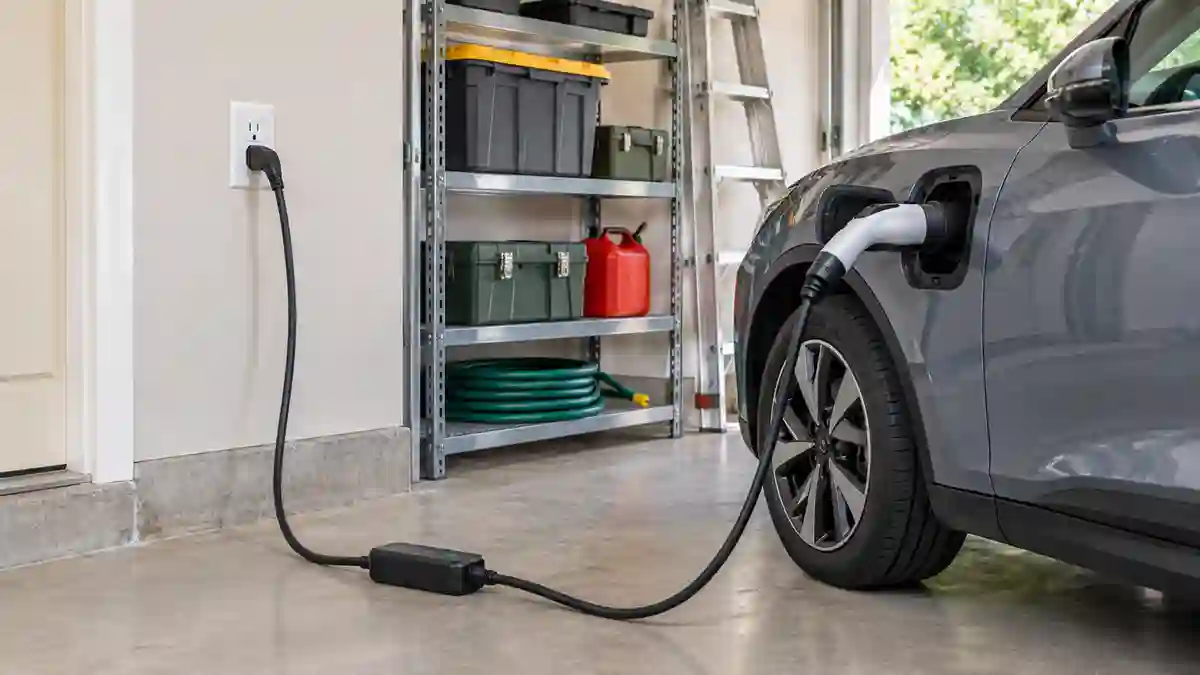
A Level 1 EV charger is the simplest way to charge an electric vehicle at home. It uses a standard 120-volt household outlet in the United States, making it convenient for drivers who do not want to install a dedicated 240V charging circuit.
Although Level 1 charging is slower than Level 2 charging, it can be sufficient for drivers with short daily commutes, plug-in hybrid vehicles, or vehicles that remain parked for extended periods.
Understanding its charging speed, electrical requirements, and limitations can help you decide whether a standard household outlet is enough for your EV.
What Is a Level 1 EV Charger?
A Level 1 EV charger uses a 120V AC household outlet to supply electricity to an electric vehicle.
Most electric vehicles include a portable charging cable, commonly called an EVSE (Electric Vehicle Supply Equipment). One end connects to the household outlet, while the vehicle-side connector plugs into the charging port.
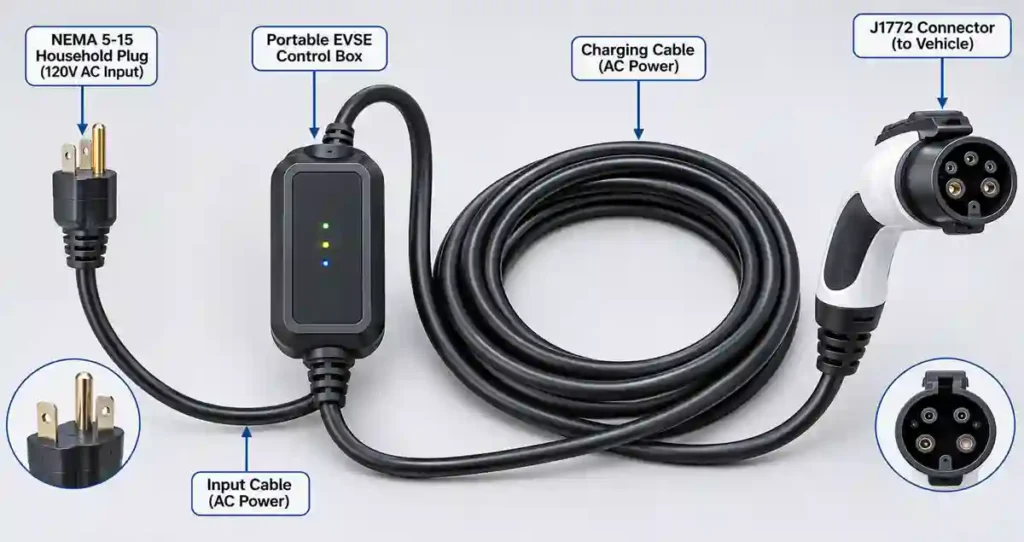
The vehicle’s onboard charger converts the incoming AC electricity into DC power to charge its battery.
Unlike a Level 2 charger, Level 1 charging generally does not require a dedicated 240V circuit or a separate wall-mounted charging station, provided a suitable existing outlet is available.
Level 1 EV Charger Voltage and Power Requirements
In the United States, Level 1 charging typically operates at 120V AC.
Its actual power output depends on the charging current supported by the EVSE and the electrical circuit.
| Electrical specification | Typical value |
|---|---|
| Supply voltage | 120V AC |
| Common current settings | 8A–12A |
| Higher-current option | Up to 16A on a suitable 20A circuit |
| Typical power at 12A | 1.44 kW |
| Power at 16A | 1.92 kW |
| Common outlet | NEMA 5-15 |
| Charging type | AC charging |
Important: A 12A continuous charging load is generally suitable for a 15A circuit. A 16A continuous load requires a suitable 20A circuit. Always follow the EVSE manufacturer’s instructions and applicable electrical codes.
How Fast Does a Level 1 EV Charger Charge?
Level 1 charging typically adds approximately 2–5 miles of driving range per hour, depending on vehicle efficiency, charging power, battery condition, and environmental conditions.
The following table provides a general comparison.
| Charging duration | Approximate added range |
|---|---|
| 1 hour | 2–5 miles |
| 4 hours | 8–20 miles |
| 8 hours | 16–40 miles |
| 12 hours | 24–60 miles |
| 24 hours | 48–120 miles |
These are estimated ranges, not guaranteed results. Actual charging performance varies between EV models.
Example: Overnight Level 1 Charging
Assume an EV receives an average of 1.2 kW of charging power for 10 hours.
Energy delivered:
1.2 kW × 10 hours = 12 kWh
If the vehicle consumes approximately 0.30 kWh per mile:
12 kWh ÷ 0.30 kWh/mile = 40 miles
This means overnight Level 1 charging could replenish approximately 40 miles of driving range under these assumptions.
Actual battery energy received may be lower because of charging losses and vehicle operating conditions.
How Much Does a Level 1 EV Charger Cost?
Level 1 charging is generally the least expensive home charging option because many EV manufacturers include a portable charging cable with the vehicle.
The following US estimates illustrate potential costs.
| Cost item | Approximate cost |
|---|---|
| Included portable charging cable | Often $0 additional |
| Replacement or optional portable EVSE | Varies by model |
| Installation using a suitable existing outlet | Often $0 |
| Electrical outlet work or dedicated outlet installation | $100–$1,000 |
The installation estimate is a broad infrastructure benchmark, not a standard price for replacing a household outlet. Actual costs depend on wiring condition, circuit capacity, distance, permits, and local labor rates.
Level 1 Charging Electricity Cost
The cost of charging also depends on your electricity rate.
For example, assume:
- Charging power: 1.2 kW
- Charging duration: 10 hours
- Electricity rate: $0.16 per kWh
Energy consumed:
1.2 × 10 = 12 kWh
Charging cost:
12 × $0.16 = $1.92
This is an illustrative energy-cost calculation. Your actual bill will depend on utility rates, charging losses, and any applicable time-of-use pricing.
Electrical Safety and NEC Requirements
Level 1 charging uses ordinary household voltage, but it still requires a suitable electrical circuit.
In the United States, NEC Article 625 covers electric vehicle power transfer equipment. Other relevant provisions include:
- NEC Article 210: Branch circuits and receptacle requirements.
- NEC Article 250: Grounding and bonding.
- NEC Article 110: General electrical installation requirements.
Before regular EV charging, check that the outlet, wiring, grounding, circuit protection, and EVSE are suitable for continuous operation. Avoid damaged outlets, unsuitable extension cords, and overloaded circuits.
Always confirm the locally adopted NEC edition and consult a qualified electrician when the outlet or circuit condition is uncertain.
Can You Use a Level 1 EV Charger With Solar Panels?
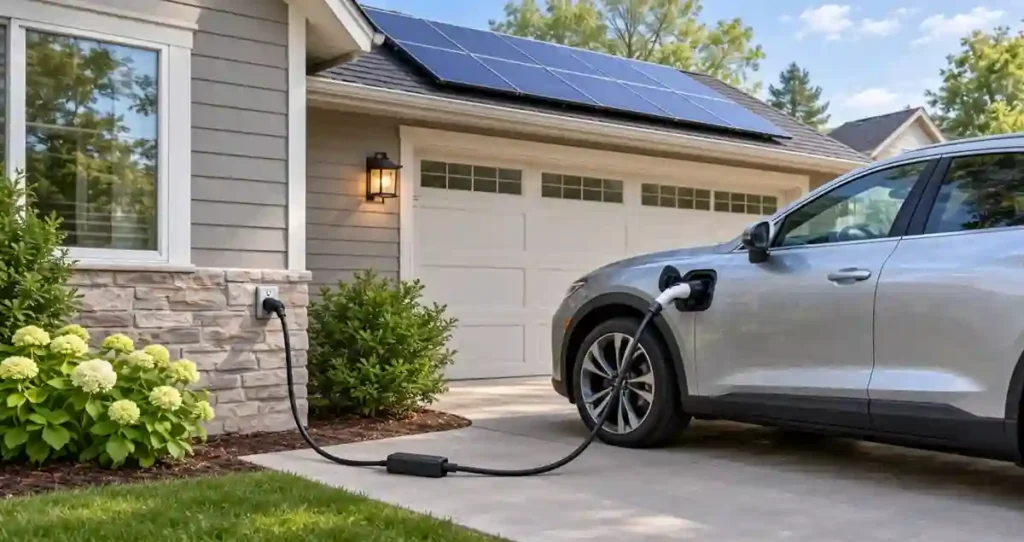
Yes. A Level 1 EV charger can use electricity supplied by a solar PV system, but the charging arrangement depends on the inverter, household demand, available solar generation, and grid connection.
For example, a home with a 10 kW solar system may have enough daytime generation to support Level 1 EV charging while also supplying household loads.
However, solar production changes throughout the day. If generation falls below household and EV demand, the remaining electricity may come from the grid or a compatible battery system.
For homeowners considering solar EV charging, planning for future charging requirements during the original solar installation can help avoid unnecessary electrical modifications.
Read more:
- How Solar EV Charging Works
- Direct Solar EV Charging vs. Battery Storage
- Solar Inverter for EV Charging
Advantages and Disadvantages of Level 1 Charging
| Advantages | Disadvantages |
|---|---|
| Uses a standard 120V outlet | Slow charging speed |
| Often requires no separate charger purchase | Not ideal for high daily mileage |
| Lower installation cost | Long battery recharge times |
| Convenient for overnight charging | Limited power for larger EV batteries |
| Useful for plug-in hybrid vehicles | May not meet the needs of multiple EVs |
Is a Level 1 EV Charger Right for You?
A Level 1 EV charger can be a practical option if you drive relatively short distances, have a plug-in hybrid, or can leave your vehicle connected for long periods.
However, drivers with longer daily commutes, larger battery electric vehicles, or multiple EVs may benefit more from a Level 2 charging installation.
From a solar system design perspective, I also recommend considering future EV charging requirements when planning a residential solar installation. Even if a homeowner does not currently own an electric vehicle, checking inverter capacity, electrical panel space, and wiring routes can make a future upgrade easier.
For most households that need faster overnight charging, Level 2 is worth considering.
Important Electrical Considerations
A Level 1 EV charger commonly operates at 12A on a 15A circuit or up to 16A on a suitable 20A circuit. EV charging is treated as a continuous load, so circuit sizing must account for the applicable 125% requirement.
For example:
- 12A charging load → typically a 15A circuit.
- 16A charging load → typically a 20A circuit.
Always verify the EVSE manufacturer’s instructions, receptacle rating, circuit condition, locally adopted NEC edition, and local inspection requirements before installation.
Engineer’s Note: A standard household outlet does not automatically mean the circuit is suitable for continuous EV charging. Check wiring condition, grounding, outlet quality, and circuit loading before recommending it.
Frequently Asked Questions
Does a Level 1 EV charger use a regular household outlet?
Yes. In the United States, Level 1 charging typically uses a standard 120V household outlet, provided the outlet and circuit are suitable for EV charging.
How many miles does Level 1 charging add per hour?
It typically adds around 2–5 miles of driving range per hour, depending on the EV and charging conditions.
Can Level 1 charging fully charge an electric car overnight?
It depends on the battery size and how much energy needs to be replenished. A plug-in hybrid may recharge overnight, but a larger battery electric vehicle can require considerably longer.
Is Level 1 charging bad for an EV battery?
No. Level 1 charging is a normal AC charging method and is not inherently harmful to an EV battery when used with compatible, properly installed equipment.
Can I charge my EV using a Level 1 charger and solar panels?
Yes. A solar system can supply some or all of the charging energy when sufficient solar generation is available. Grid or battery support may be needed when solar production is insufficient.
Is Level 1 charging cheaper than Level 2 charging?
Level 1 generally has lower equipment and installation costs. However, electricity costs depend mainly on the energy consumed and the utility rate, not simply the charging level.
Final Thoughts
Level 1 charging provides a simple entry point for home EV charging in the United States. Its use of a standard 120V outlet makes it accessible, but its limited power output means it is not suitable for every driving pattern.
Before choosing a charging level, consider your daily mileage, vehicle battery capacity, available electrical supply, and future charging requirements.
For faster home charging, the next option is Level 2.
Continue reading: EV Charger Levels Explained: Level 1 vs. Level 2 vs. Level 3