
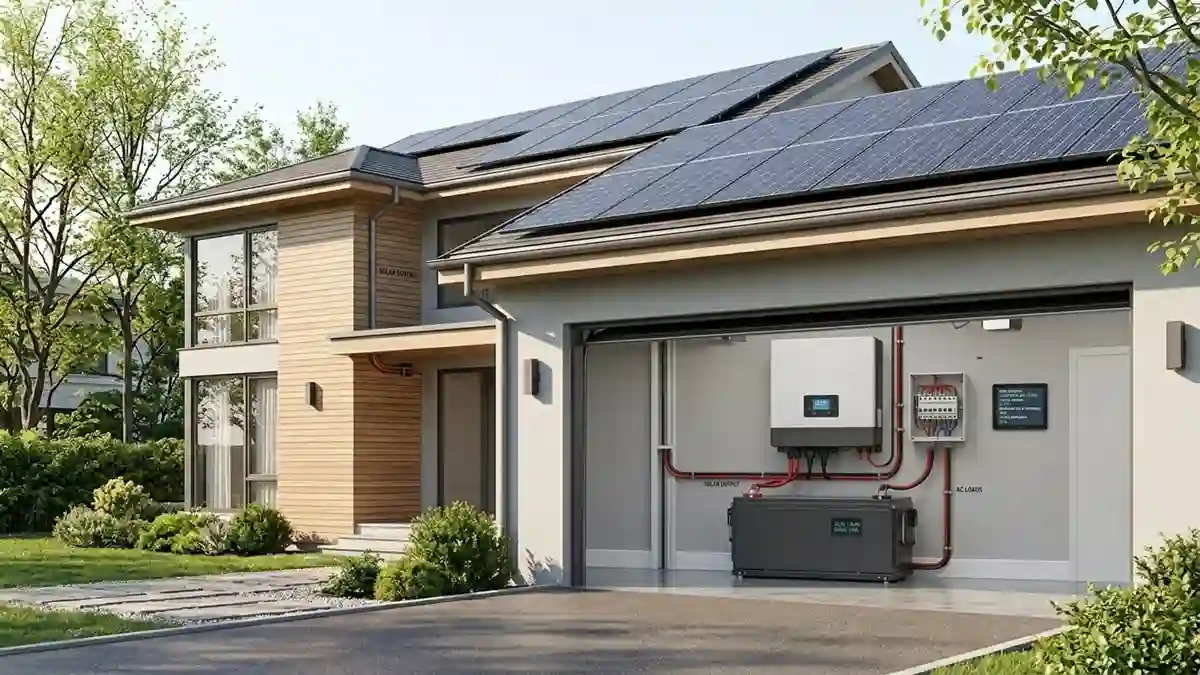
LiFePO4 batteries for solar energy storage are widely used because they offer long cycle life, high usable capacity, good efficiency, and strong thermal stability. But choosing the right battery is only part of the job. The battery bank, inverter, solar array, charging settings, and battery management system all need to work together.
I’ve worked with a lot of homeowners who are excited about solar power systems but get stuck on the same question: which battery and how many do I actually need? It’s an easy thing to get wrong. Early on, I saw a lot of people choose a battery that sounded impressive on paper, then find out it couldn’t get them through a single evening once the fridge, a few lights, and a router were running.
LiFePO4 has changed that. It’s not just a longer-lasting battery — it is well suited to being charged and discharged every day, year after year, when operated within the manufacturer’s specified conditions.
Quick answer: LiFePO4 is one of the most widely used lithium chemistries for solar storage because it handles daily cycling, offers high usable capacity, and is generally more thermally stable than NMC lithium-ion chemistry. To design a system, start with your daily energy need, multiply by the days of backup you want, divide by the usable depth of discharge and system efficiency, then size the solar array to recharge the battery under your expected solar conditions.
Solar storage puts unusual demands on a battery. It charges and discharges every day, often for a decade or more, and it may sit in garages, utility rooms or outdoor enclosures where temperatures vary. That is the environment where LiFePO4 can perform well when properly installed and operated.
This guide focuses on how to design a solar system around LiFePO4 batteries: how they connect, how to choose a compatible inverter, how to size the battery bank and solar array, and what to check for charging and safety.
For a broader comparison of battery chemistries, see our lithium-ion battery for solar guide, and for the wider energy storage picture, see our solar battery types guide.
1. Why LiFePO4 Batteries for Solar are a good choice
LiFePO4, or lithium iron phosphate, has several characteristics that make it well suited to solar energy storage:
- Long cycle life. Manufacturers commonly rate LiFePO4 batteries for thousands of cycles. The actual service life depends on temperature, depth of discharge, charging conditions, operating current and the manufacturer’s specifications.
- Deep usable capacity. Many LiFePO4 batteries can be operated at a high depth of discharge, often around 90% or more, although the manufacturer’s recommended limit should always be followed.
- High efficiency. Battery-level round-trip efficiency can be around 95% or better under suitable operating conditions. Whole-system efficiency is lower once inverter and other system losses are included.
- Thermal stability. LiFePO4 is generally more thermally stable than NMC lithium-ion chemistry, which is an important consideration for residential and commercial energy storage.
- Low routine maintenance. Unlike flooded lead-acid batteries, LiFePO4 batteries do not require regular watering or equalization.
Its main limitation in cold climates is charging temperature. LiFePO4 batteries should not be charged outside the temperature range specified by the manufacturer. Some batteries include low-temperature charging protection or self-heating, while others require a heated or insulated installation environment.
2. How LiFePO4 Connects to a Solar System
There are several common ways to integrate a LiFePO4 battery with solar:
| Configuration | How it works | Best for |
|---|---|---|
| DC-coupled | Panels feed a charge controller or hybrid inverter that charges the battery on the DC side | New systems and off-grid systems |
| AC-coupled | An existing grid-tied solar inverter remains in place while a separate battery inverter manages storage | Adding storage to an existing solar system |
| Off-grid hybrid | A hybrid inverter manages solar, battery, generator and loads | Cabins, remote homes and backup systems |
Our hybrid inverter guide explains how these inverters coordinate solar, battery and grid, while our off-grid solar system guide shows the complete off-grid layout.
3. How to Choose an Inverter for Your LiFePO4 Battery
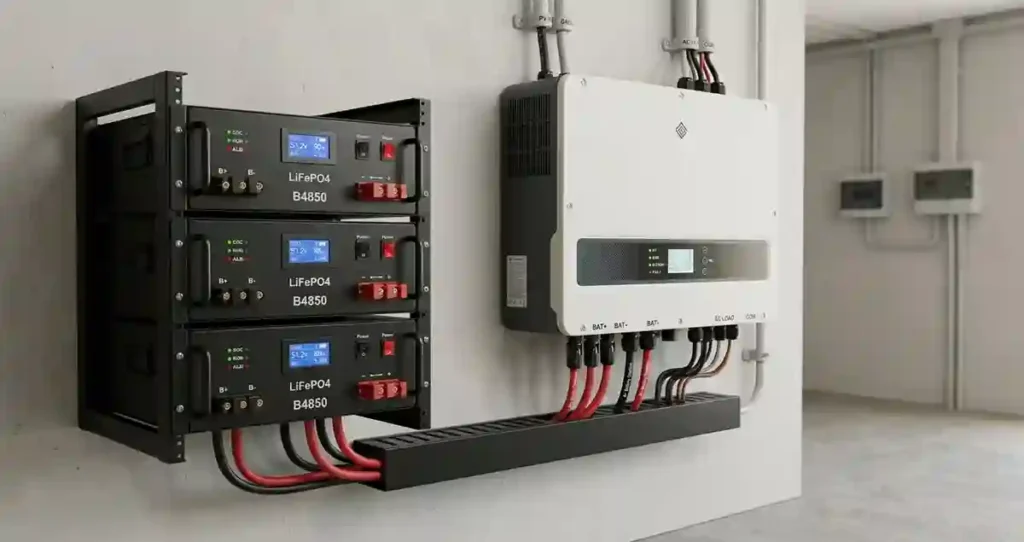
The battery stores energy, but the inverter is what converts that stored DC energy into usable AC power for your home. Picking the wrong inverter — or one that does not properly match the battery — is one of the most common reasons a solar-plus-battery system underperforms.
Match the inverter’s power rating to your loads
Add up the wattage of everything you expect to run at the same time. If your fridge, some lights, a laptop and a router together pull around 800 W, you’ll want an inverter rated comfortably above that because some appliances, especially refrigerators, pumps and motors, can draw significantly more power when starting.
| Typical household load | Suggested inverter size |
|---|---|
| Lights, phone/laptop charging, router, small fridge | 1,000–2,000 W |
| Add a TV, microwave or larger fridge | 2,000–3,000 W |
| Whole-home backup, including equipment such as a well pump or AC | 5,000 W or more |
These are general examples rather than final design values. Actual inverter sizing should account for continuous load, starting current, power factor and the inverter manufacturer’s specifications.
Match the inverter’s voltage to your battery
Batteries and inverters are commonly designed around specific DC voltage classes such as 12 V, 24 V or 48 V/51.2 V.
The battery voltage must be compatible with the inverter’s required DC input range. You cannot simply connect a 12 V battery to an inverter designed for a 48 V battery bank.
As a general rule, smaller systems often use 12 V or 24 V configurations, while higher-power residential systems commonly use 48 V-class batteries because higher DC voltage reduces current for the same power level.
Check that the battery can supply the current the inverter needs
This is where a lot of people miss something important.
Every battery has a limit on how much current it can safely provide at once, often listed as a continuous discharge current or a C rating. The C rating describes the discharge rate relative to the battery’s capacity.
For example:
- A battery rated at 0.5C can continuously discharge at a current equal to roughly half its rated Ah capacity.
- A battery rated at 1C can continuously discharge at a current approximately equal to its rated Ah capacity.
If your inverter is large and your appliances draw a lot of power at once, make sure the battery’s continuous discharge capability is high enough.
For example, a 5,000 W inverter operating from a 51.2 V battery may require roughly:
5,000 ÷ 51.2 ≈ 98 A
Actual DC current will be higher when inverter losses are included.
If the battery cannot supply the required current, its BMS may limit or disconnect the battery to protect the cells. The result can be an unexpected shutdown even though the battery still has plenty of stored energy.
Check for communication compatibility
Many modern LiFePO4 batteries can communicate with compatible hybrid inverters through protocols such as CAN bus or RS485. The battery can share information such as state of charge, charging limits and discharge limits.
Communication is not always mandatory, but when the inverter and battery are designed to work together, it can make system operation and commissioning more reliable.
Before purchasing, check whether the battery is listed as compatible with your specific inverter model.
Engineer’s Note: The single most common issue I run into isn’t necessarily a bad battery or bad panels — it’s a battery and inverter that are both good products but simply weren’t designed to work together, or a battery that cannot supply enough current for the inverter attached to it. Before buying, check the inverter manufacturer’s approved battery list and confirm the battery’s continuous discharge rating.
General Compatibility Checklist
Before purchasing a LiFePO4 battery and inverter, check:
- Battery voltage matches the inverter’s required voltage range.
- Battery’s continuous discharge capability covers the inverter’s expected maximum power demand.
- Inverter and battery are confirmed compatible by the manufacturer, where communication is required.
- Battery has enough usable capacity for the required backup duration.
- Charge controller or inverter supports a lithium-compatible charging profile.
- Battery BMS communication requirements are understood before installation.
4. Sizing the LiFePO4 Battery Bank
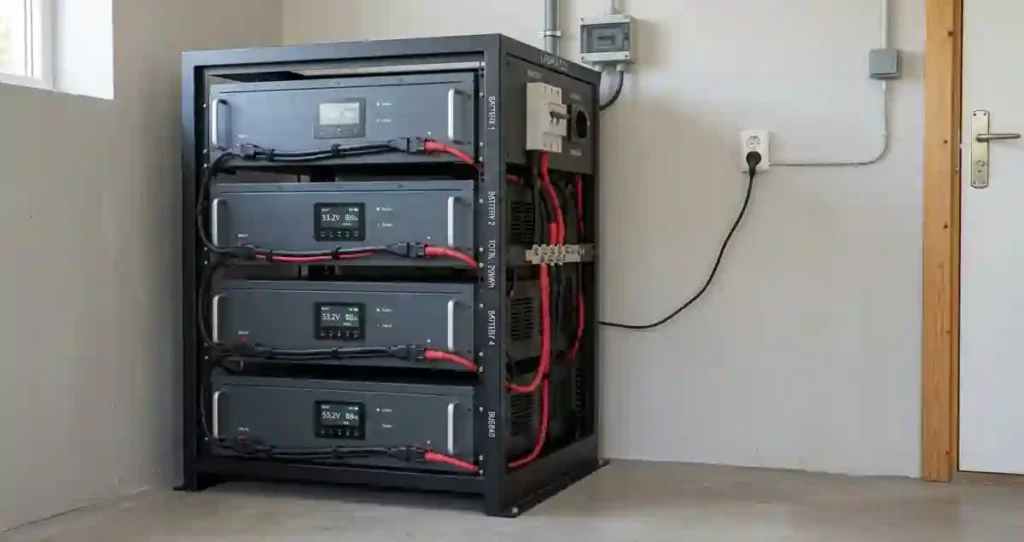
Battery sizing starts with energy consumption, not the size of the solar panel array.
Step 1: Determine daily energy
Add up the energy consumed by the loads the battery needs to support. For backup systems, focus on essential loads rather than automatically including the entire house.
Step 2: Determine backup duration
Decide how long you want the battery to operate without solar.
One day of autonomy may be suitable for some grid-connected backup systems, while off-grid systems may require more depending on the location, solar resource, and generator availability.
Step 3: Account for usable depth of discharge
Divide the required energy by the usable fraction of the battery.
For example, using 90% usable capacity:
Required capacity ÷ 0.90
Step 4: Account for system efficiency
Battery-to-load energy is affected by inverter and other system losses.
Using 92% overall efficiency as an illustrative design assumption:
Required nominal battery capacity = Daily energy × backup days ÷ 0.90 ÷ 0.92
Worked Example
Essential loads use 8 kWh per day and you want 1.5 days of backup.
| Step | Result |
|---|---|
| Energy needed: 8 kWh × 1.5 days | 12 kWh |
| Divide by usable depth of discharge (0.90) | 13.3 kWh |
| Divide by system efficiency (0.92) | 14.5 kWh |
| Round up to available modules | 20.5 kWh nominal |
Two 51.2 V 200 Ah batteries provide approximately:
51.2 V × 200 Ah = 10.24 kWh each
Two batteries therefore provide approximately 20.48 kWh nominal capacity.
Actual usable energy depends on the battery manufacturer’s specified operating limits and system efficiency.
You can run your own numbers with the solar battery size calculator. For the module itself, see our guide to the 51.2V 200Ah LiFePO4 battery.
LiFePO4 Battery Sizing Quick Reference
The following table is an illustrative reference using approximately 90% usable capacity and 92% system efficiency:
| Daily Energy | Backup Duration | Approx. Nominal Battery Capacity |
|---|---|---|
| 5 kWh | 1 day | 6 kWh |
| 8 kWh | 1 day | 10 kWh |
| 10 kWh | 1 day | 12 kWh |
| 15 kWh | 1 day | 18 kWh |
| 20 kWh | 1 day | 24 kWh |
These figures are starting points, not final engineering designs. Actual battery sizing should consider load profile, peak demand, battery specifications, temperature, inverter efficiency and the required reserve capacity.
5. Sizing the Solar Array to Recharge the Battery
The solar array must be large enough to supply the daily loads while also replacing the energy removed from the battery.
For a basic estimate:
Solar array size = Daily energy ÷ peak sun hours ÷ system derating factor
A derating factor of approximately 0.75 can be used as an illustrative planning assumption to account for losses from temperature, wiring, inverter conversion and other system factors. Actual system performance varies by location and design.
For example, if the battery needs to support 8 kWh/day:
| Season | Peak sun hours | Approx. array needed for 8 kWh/day |
|---|---|---|
| Summer | 5 | About 2.1 kW |
| Winter | 3 | About 3.6 kW |
Off-grid systems should generally be designed around the poorer solar resource period rather than the best summer conditions, or they should include another energy source such as a generator.
Grid-connected systems have more flexibility because the grid can cover periods when solar production is insufficient.
Our solar panel size calculator can help estimate the required solar panel count.
6. Charge Settings and Battery Communication
Solar equipment must be configured according to the battery manufacturer’s specified charging profile and voltage limits.
For LiFePO4 systems:
- Use a lithium-compatible charging profile or manufacturer-specified settings.
- Follow the battery manufacturer’s charge voltage limits.
- Do not apply lead-acid equalization settings unless explicitly permitted by the battery manufacturer.
- Follow the manufacturer’s temperature limits and compensation requirements.
- Configure low-temperature charging protection where applicable.
The full settings for 12 V, 24 V and 48 V systems are covered in our LiFePO4 battery charger guide.
In a hybrid system, the battery BMS may communicate with the inverter through CAN bus or RS485. This allows the inverter to receive information about state of charge, charge limits and discharge limits.
That communication can be particularly useful because LiFePO4 battery voltage remains relatively flat across much of its discharge range, making voltage alone less reliable for estimating state of charge.
Engineer’s Note: Buy the battery and inverter as a compatible pair where possible. A battery on the inverter manufacturer’s approved list can reduce commissioning problems related to communication protocols, charge limits and protection settings.
7. Safety, Codes and Siting
Battery storage must be installed according to the applicable electrical, fire and building requirements for the installation location.
For U.S. installations, relevant requirements may include NEC Article 706 and NFPA 855, along with applicable local permitting requirements. Battery and energy-storage equipment may also be required to meet applicable product and system safety standards.
For example, depending on the equipment and installation:
- UL 1973 may apply to stationary batteries.
- UL 9540 addresses energy storage systems.
- UL 9540A is used for thermal-runaway fire propagation testing.
Always confirm the requirements that apply to the specific battery, inverter and installation.
Basic installation considerations include:
- Keep the battery within the temperature range specified by the manufacturer.
- Provide clear working space and access to disconnects.
- Protect battery circuits with appropriately sized overcurrent protection.
- Fuse or protect parallel battery strings as required by the system design and manufacturer.
- Install equipment in an approved location with suitable ventilation, clearances and environmental protection.
- Check local permitting requirements before purchase and installation.
For commercial installations, see our commercial solar battery installation guide.
8. When LiFePO4 Is Not the Best Choice
LiFePO4 is a strong option for many solar-storage applications, but it is not automatically the right choice for every installation.
Unheated spaces in freezing climates
If the battery may experience temperatures below its permitted charging range, choose equipment with appropriate low-temperature protection or self-heating, or provide a suitable controlled environment.
Space-limited installations
Where physical space and weight are major constraints, another lithium chemistry may offer higher energy density. Compare the specific requirements of the application rather than choosing based on chemistry alone.
Rarely used standby backup
For a battery that will rarely cycle and where the initial purchase price is the dominant consideration, lead-acid may still be considered. However, the shorter cycle life and lower usable capacity should be included when comparing total system cost.
9. Frequently Asked Questions
Is LiFePO4 good for solar storage?
Yes. Its long cycle life, high usable capacity, efficiency and thermal stability make LiFePO4 a widely used chemistry for residential and off-grid solar storage. Actual suitability depends on the application, installation environment and battery specifications.
How long does a LiFePO4 solar battery last?
Manufacturers commonly publish cycle-life ratings in the thousands of cycles. At one cycle per day, several thousand cycles can represent many years of operation, but actual service life depends on temperature, depth of discharge, charging conditions, discharge current and battery quality.
How many LiFePO4 batteries do I need for solar?
Start by calculating your daily energy requirement and multiplying it by the required backup duration. Then account for usable depth of discharge and system efficiency before dividing by the usable or nominal capacity of the selected battery module.
The worked example in Section 4 shows the method.
Can I mix LiFePO4 with lead-acid batteries?
Generally, no. LiFePO4 and lead-acid batteries have different charging characteristics, voltage behaviour and battery-management requirements. They should not simply be connected together as one battery bank.
A properly designed system should use compatible batteries with the correct charging and protection equipment.
Do I need a special charge controller for LiFePO4?
You need a charge controller or inverter/charger that supports the battery’s required charging profile and voltage limits. Many modern MPPT controllers support lithium batteries, but always verify compatibility with the specific battery manufacturer’s requirements.
Related Guides
- 24V 200Ah LiFePO4 Battery: Specs, Uses & Buying Guide
- 48V 200Ah LiFePO4 Battery: Specs, Sizing & Home Storage Guide
- LiFePO4 Battery Charger: Voltage, Amps & Settings
- Solar Panel Repair Guide: Diagnose Problems, Costs & Fixes
- IRS Form 5695 for 2025: Solar Tax Credit Guide
Related guides on SolarVisionAI.com
- Monocrystalline Solar Panels 2026: Still Worth It or Hype
- Polycrystalline Solar Panels: Worth Buying in 2026?
- Thin-film Solar Panels: When They Beat Silicon (2026)
- BIPV Solar Panels: Building-Integrated PV Complete Guide
- Portable Solar Panels: Engineer’s Buyer’s Guide 2026
- CPV Solar Panels: Concentrated Photovoltaic Explained
- Skin Solar Panel: What “Solar Skin” Actually Means
- Solar Fence Post Lights: Cap Sizes, Types & Install Guide
- Bifacial Solar Panels in 2026: How to Boost Energy Output
- Solar Charge Controller: The Complete Guide
- MC4 Connectors: Solar Safety & Installation Guide
- Solar Panel Types, Efficiency & Benefits
- Solar Water Pump Guide
- BESS — Battery Energy Storage System Guide
- Commercial Solar Panel Installation
- Solar Refrigerator & DC Fridge — Complete 2026 Guide
- Bifacial Solar Panel Albedo Effect Guide
- TOPCon: Why TOPCon Solar Panel is a Proven Smart Investment in 2026
- HJT: Why Heterojunction Is the Hot Climate Champion
- PERC: PERC Solar Panel: Still Relevant or Already Outdated?
- Perovskite: Perovskite Solar Panels: The 2026 Reality Check
- N-Type vs P-Type: N-Type vs P-Type Solar Panels: Honest Comparison
- ABC: ABC (all back contact) Solar Panel: Back Contact Technology Explained
- IBC: IBC Solar Panels: Interdigitated Back Contact Guide
- Tandem: Tandem Solar Panels: Are Stacked Cells Ready for Rooftops?