
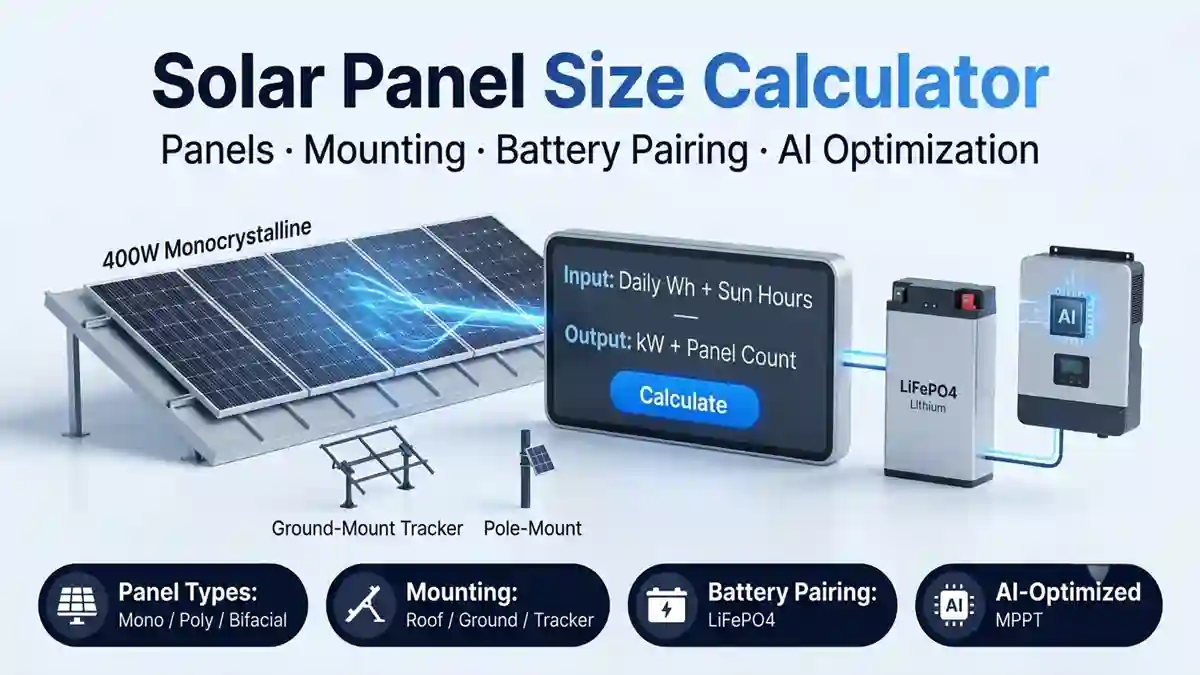
Free Solar Panel Size Calculator — Find exact array size in kW and number of panels needed. Covers all climates, panel sizes, and system efficiencies for home and commercial solar.
Please enter a valid daily energy value greater than zero.
Use our free Solar Panel Size Calculator to find exactly how many solar panels you need and the total array size in kW for your home, off-grid cabin, or commercial solar system. Enter your daily energy consumption, local peak sun hours, and panel wattage to get an instant, engineering-grade recommendation — including the right battery bank pairing, panel type, and mounting configuration for your climate.
1. Why Solar Panel Size Calculation Requires More Than One Number
Solar panel sizing is not a single calculation — it is a chain of four dependent factors: your daily energy demand, your local peak sun hours, your system’s real-world efficiency losses, and the specific panel wattage you choose. Skipping any one of these factors leads to an undersized array that cannot recharge your batteries fully, or an oversized array that wastes capital on panels the roof or ground mount cannot even fit.
This calculator also feeds directly into your battery sizing decision. An oversized panel array charging an undersized lithium battery bank wastes potential energy every clear day. An undersized array paired with a large lithium iron phosphate (LiFePO4) bank leaves the batteries chronically undercharged, which shortens lithium battery lifespan even though lithium chemistry tolerates partial cycling far better than lead acid.
Engineer’s Note: Always size the solar array and the battery bank together, never in isolation. A common mistake is sizing panels for average daily sun and batteries for worst-case backup days without checking that the array can actually recharge the battery bank within a single sunny day after a cloudy stretch. Use our Solar Battery Size Calculator alongside this tool to confirm both numbers are compatible.
2. The Solar Panel Sizing Formula
Array Size (W) = Daily Energy (Wh) ÷ Peak Sun Hours ÷ System Efficiency ÷ Panel Derating
Number of Panels = Array Size (W) ÷ Individual Panel Wattage
Example: Daily energy: 3,000 Wh | Peak sun hours: 5 | Efficiency: 90% | Derating: 90% | Panel: 400W
Calculation: 3000 ÷ 5 ÷ 0.90 ÷ 0.90 = 740 W required array → 740 ÷ 400 = 2 panels minimum → with 25% overhead: 3 panels recommended
Engineer’s Note: Panel derating accounts for temperature losses, dust and soiling, wiring resistance, and connector losses — all of which reduce real-world output below the panel’s STC (Standard Test Conditions) nameplate rating. In hot climates above 35°C ambient, crystalline silicon panels lose 10-15% of rated output. Always use a derating factor of 85% or lower for installations in the Middle East, Pakistan, and similar hot, dusty regions.
3. Choosing the Right Solar Panel Type
Panel technology significantly affects both cost per watt and real-world performance, especially in hot climates and space-constrained installations. Choosing the correct panel type is just as important as calculating the correct array size.
Monocrystalline Panels
Monocrystalline silicon panels offer the highest efficiency, typically 20-22%, and the best performance in high-temperature conditions and low-light situations. They are the standard choice for residential rooftop installations where roof space is limited and every watt per square meter matters. Monocrystalline panels also have the best long-term degradation rate, typically under 0.5% per year.
Polycrystalline Panels
Polycrystalline panels are less expensive per watt but have lower efficiency, typically 15-17%, and require more roof or ground area for the same power output. They remain a cost-effective choice for ground-mounted systems and off-grid installations where space is not a constraint and upfront budget is the priority.
Bifacial Panels
Bifacial panels capture sunlight on both the front and rear surfaces, generating an additional 5-20% energy yield when mounted on reflective surfaces such as white gravel, sand, or metal roofing. Bifacial technology is increasingly used in commercial ground-mount and solar carport installations where the mounting structure allows light to reach the rear surface.
Thin-Film Panels
Thin-film panels (CdTe or amorphous silicon) are lightweight, flexible, and perform better than crystalline panels in partial shading and high-temperature conditions, but at a lower efficiency of 10-13%. They are used in specialized applications such as curved surfaces, portable solar kits, and building-integrated photovoltaics (BIPV) rather than standard rooftop installations.
Engineer’s Note: For most residential and commercial installations in 2026, high-efficiency monocrystalline PERC or TOPCon panels rated 400W to 600W offer the best balance of cost, efficiency, and long-term reliability. Reserve polycrystalline panels for budget ground-mount systems only, and consider bifacial panels for any ground-mounted or carport installation where the extra 5-15% yield justifies the modest cost premium.
4. Solar Panel Mounting Options
The mounting method affects not only installation cost but also the actual energy yield of your array, since mounting angle and orientation directly influence how much sunlight each panel captures throughout the year.
- Roof Mount (Fixed Tilt): Most common residential option. Panels are mounted parallel to or at a fixed angle above the roof surface using rail-and-clamp systems. Lowest cost, no moving parts, but fixed tilt means suboptimal angle for part of the year.
- Ground Mount (Fixed Tilt): Used when roof space is insufficient or roof orientation is poor. Allows optimal tilt angle for your latitude and easier maintenance access, but requires more land area and additional structural framing cost.
- Pole Mount: Common for solar water pump systems and remote off-grid installations. Elevates panels above ground level to avoid shading from vegetation and allows manual seasonal tilt adjustment in some designs.
- Solar Tracker (Single-Axis): Automatically rotates panels to follow the sun’s daily path, increasing energy yield by 15-25% compared to fixed tilt. Higher upfront cost and additional maintenance due to moving parts, best justified in utility-scale and large commercial installations.
- Solar Tracker (Dual-Axis): Follows both the daily and seasonal sun path for maximum yield increase of 25-35%, but the highest cost and complexity. Reserved for large commercial and utility installations where the yield gain outweighs the mechanical maintenance burden.
Engineer’s Note: For rooftop residential systems, fixed tilt roof mounting is almost always the correct engineering and economic choice — the added yield from tracking rarely justifies the mechanical complexity and maintenance burden at residential scale. Reserve single-axis and dual-axis trackers for ground-mounted commercial and utility-scale installations above 50kW, where the percentage yield gain translates into meaningful absolute energy and revenue.
5. Battery Pairing: Lithium vs Lead Acid for Your Solar Array
Your panel array must be paired with the correct battery chemistry and capacity to store the energy it generates. The battery type you choose affects how much overhead you should build into your panel sizing.
Lithium Iron Phosphate (LiFePO4) Batteries
LiFePO4 is the recommended lithium battery chemistry for solar storage in 2026, offering 3,000 to 5,000 cycles at 80% depth of discharge, no maintenance requirements, and stable performance in hot climates. Because LiFePO4 accepts a higher charge current safely, it can absorb your panel array’s peak output more efficiently than lead acid, meaning less energy is wasted during peak sun hours.
Lead Acid and AGM Batteries
Lead acid and AGM batteries remain a lower-cost entry point for battery storage but limit charge acceptance rate and depth of discharge to 50%. This means a lead acid battery bank requires a larger panel array oversizing factor to fully recharge within a single day, especially after a cloudy period, compared to an equivalent lithium setup.
Engineer’s Note: If pairing your panel array with a LiFePO4 lithium battery bank, use the standard 25% panel overhead calculated by this tool. If pairing with lead acid or AGM batteries, increase your panel overhead to 35-40% to compensate for the lower charge acceptance rate and ensure the battery bank reaches full charge regularly — chronic partial charging is the leading cause of premature lead acid battery failure in solar systems.
6. How AI and Smart Monitoring Improve Solar Panel Performance
Modern solar installations increasingly use AI-powered monitoring and optimization to close the gap between theoretical panel output and actual real-world energy harvest. AI-driven systems continuously analyze weather forecasts, historical generation data, and battery state of charge to make real-time decisions that a fixed, static system cannot.
- AI Weather-Adaptive Charging: Machine learning models predict cloudy periods 24-48 hours in advance and adjust battery charge and discharge cycles to preserve reserve capacity before low-generation days.
- AI-Based Soiling Detection: Smart monitoring systems compare expected versus actual panel output in real time to detect dust accumulation or panel degradation, triggering cleaning alerts before losses become significant.
- AI Load Shifting: Intelligent energy management systems automatically shift flexible loads such as water pumps and battery charging to align with peak solar generation windows, reducing reliance on stored battery capacity.
- AI-Optimized MPPT Tracking: Modern Maximum Power Point Tracking (MPPT) charge controllers use adaptive algorithms to extract 2-5% more energy from a solar array compared to older fixed-step tracking methods, particularly under partial shading or rapidly changing cloud cover.
Engineer’s Note: When budgeting for a solar system in 2026, allocate for a modern AI-capable hybrid inverter with adaptive MPPT and app-based monitoring rather than a basic PWM charge controller. The efficiency gain from smart MPPT tracking alone, typically 20-30% more harvested energy compared to older PWM controllers, often reduces the total number of panels needed by one or two units — offsetting most or all of the additional inverter cost.
7. Quick Reference Solar Array Sizing Table
| Daily Energy | Peak Sun Hours | Panel Type | Array Size | Panels (400W) |
| 500 Wh | 5 hrs | Monocrystalline | 0.15 kW | 1 panel |
| 1,000 Wh | 5 hrs | Monocrystalline | 0.31 kW | 1 panel |
| 2,000 Wh | 5 hrs | Monocrystalline | 0.62 kW | 2 panels |
| 3,000 Wh | 5 hrs | Monocrystalline | 0.93 kW | 3 panels |
| 5,000 Wh | 6 hrs | Monocrystalline | 1.29 kW | 4 panels |
| 8,000 Wh | 6 hrs | Bifacial | 2.06 kW | 6 panels |
| 10,000 Wh | 6 hrs | Bifacial | 2.57 kW | 7 panels |
| 15,000 Wh | 7 hrs | Bifacial | 3.31 kW | 9 panels |
8. Common Solar Panel Sizing Mistakes
- Using STC Nameplate Ratings Directly: Real-world output is always 10-25% below the panel’s rated STC wattage due to temperature, dust, and wiring losses. Always apply a derating factor.
- Ignoring Seasonal Sun Hour Variation: Peak sun hours vary significantly between summer and winter. Size for your worst realistic season, not the annual average, if year-round reliability is required.
- Wrong Panel Type for the Application: Using low-efficiency polycrystalline panels on a space-constrained roof, or high-cost bifacial panels on a roof mount that cannot benefit from rear-side light capture, wastes either space or budget.
- Undersizing for Battery Chemistry: Pairing a tightly-sized panel array with lead acid batteries that need a higher charge overhead leaves the battery bank chronically undercharged.
- Ignoring Mounting Angle Losses: A flat roof mount at the wrong tilt angle for your latitude can lose 10-20% annual yield compared to an optimally tilted ground mount or adjustable rack.
Engineer’s Note: Always request the actual PTC (PVUSA Test Conditions) or PVsyst-modeled output for your specific panel model and location rather than relying solely on the STC nameplate rating. PTC ratings are typically 10-15% lower than STC and better reflect real installed performance, giving you a much more accurate basis for panel count and battery pairing decisions.
9. Frequently Asked Questions
How many solar panels do I need for a typical home?
A typical home consuming 10,000 Wh (10 kWh) per day in a region with 5-6 peak sun hours needs approximately a 2.5-3 kW solar array, which equals 6-8 panels of 400W each, after accounting for system efficiency and panel derating.
What is the difference between monocrystalline and polycrystalline panels?
Monocrystalline panels are made from a single silicon crystal, offering higher efficiency (20-22%) and better performance in heat and low light. Polycrystalline panels use multiple silicon fragments melted together, offering lower efficiency (15-17%) at a lower cost per watt. Monocrystalline is preferred for space-constrained rooftops; polycrystalline suits budget ground-mount systems with ample space.
Should I choose lithium or lead acid batteries for my solar panel system?
LiFePO4 lithium batteries are the recommended choice in 2026 for most solar installations due to their higher depth of discharge (80% vs 50%), longer cycle life (3,000-5,000 cycles vs 300-500 cycles), and better charge acceptance from your solar array. Lead acid remains a valid lower-cost option for budget-constrained off-grid systems with less frequent cycling.
Does the mounting type affect how many panels I need?
Yes. A fixed roof mount at a suboptimal tilt angle can reduce annual yield by 10-20% compared to an optimally tilted ground mount, meaning you may need additional panels to compensate. Solar trackers increase yield by 15-35% but are rarely cost-justified for residential-scale systems.
How does AI-based monitoring improve solar panel output?
AI-powered MPPT charge controllers and monitoring systems extract 2-5% more energy per panel by adapting to rapidly changing light conditions, while AI-based soiling and fault detection prevents gradual, unnoticed output losses from dust buildup or panel degradation. Over a system’s 20-25 year lifespan, these gains can offset the cost of one or two additional panels.
Also Check Our Related Calculators
- Watt-Hours to Watts Calculator
- Watts to Watt-Hours Calculator
- kWh to kW Calculator
- kW to HP Calculator
- Amps to Watts Calculator
- Solar Battery Size Calculator
- mAh to Wh Calculator
- Solar ROI Calculator
- Inverter Size Calculator
- Watts to Amps Calculator
- Volts to Watts Calculator
Related guides on SolarVisionAI.com
Solar Fence Post Lights: Cap Sizes, Types & Install Guide
Solar Charge Controller: The Complete Guide
MC4 Connectors: Solar Safety & Installation Guide
Solar Panel Types, Efficiency & Benefits
Commercial Solar Panel Installation: Engineering Guide
Commercial Solar Panel Installation — solarvisionai.com/commercial-solar-panel-installation/