
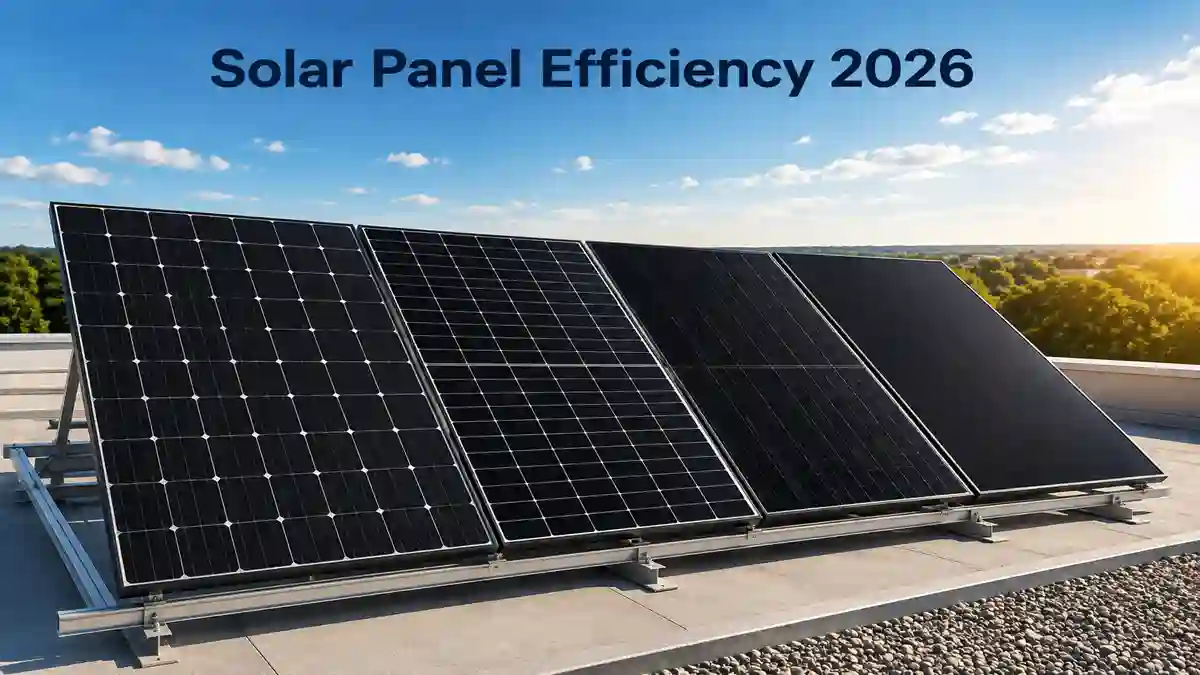
Solar Panel Efficiency explained by an engineer: compare TOPCon, HJT, PERC and back-contact panels, plus the real-world factors that reduce energy output.
Efficiency is the number every buyer fixates on, and the number I spend the most time explaining isn’t the whole story. It matters — genuinely, measurably — but it’s a single lab-measured figure standing in for a system that behaves differently depending on temperature, shading, angle, age, and a half-dozen other variables most spec sheets never mention. This guide is the anchor for our entire Efficiency cluster, covering what the number means, what erodes it in the real world, and where to look for the details that actually predict how your system performs.
This guide is part of our Types of Solar Panels hub and our Solar Panel Technology hub.
Engineer’s Note: The efficiency percentage on a datasheet is measured under Standard Test Conditions (STC) — a controlled lab environment at 25°C cell temperature, fixed light intensity, and a specific light spectrum. Your roof will almost never match those conditions. Treat the STC efficiency number as a standardized way to compare panels against each other, not as a literal prediction of your system’s real-world output.
What Efficiency Actually Measures
Solar panel efficiency is the percentage of sunlight hitting the panel’s surface that gets converted into usable electricity. Mainstream monocrystalline panels today typically run 18-22%, meaning roughly one-fifth of the sun’s energy hitting the panel becomes electricity, with the rest lost to reflection, heat, and conversion losses inherent to how photovoltaic cells work. That might sound low, but it’s worth remembering this number has climbed steadily for decades, and even a modest annual gain compounds into meaningful real-world improvement across an industry installing panels by the millions.
Efficiency by Panel Type and Cell Technology
| Cell Technology / Category | Typical Module Efficiency | Main Engineering Advantage | Technical Reference |
| Monocrystalline (PERC) | 20% – 22% | Mature and cost-effective | NREL, Fraunhofer ISE |
| Monocrystalline (TOPCon) | 22% – 23.5% | Strong mainstream N-Type performance | NREL, Fraunhofer ISE |
| Monocrystalline (HJT) | 22% – 24% | Excellent temperature performance | NREL, Fraunhofer ISE |
| Back-Contact (ABC / IBC) | 22% – 25%+ | Very high efficiency & premium aesthetics | NREL |
| Polycrystalline | 15% – 18% | Lower upfront cost applications | NREL |
| Thin-Film (CdTe / CIGS) | 10% – 12% | Specialty and large-area applications | NREL |
| CPV (Utility-Scale) | 30%+ | High efficiency under concentrated sunlight | NREL, Fraunhofer ISE |
For the full breakdown of what drives these differences by panel category, see our Monocrystalline vs Polycrystalline vs Thin-Film comparison. For cell-technology-specific detail, see our Solar Panel Technology hub.
Advantages and Disadvantages of Prioritizing High Efficiency
| Advantages | Disadvantages |
| Higher efficiency extracts more output from limited roof space | Premium efficiency panels command a real cost-per-watt premium |
| Fewer panels needed for a given system size — simpler racking and wiring | Efficiency gains above the mainstream range often show diminishing returns per dollar |
| Better performance in marginal conditions (partial shade, low light) | Highest-efficiency options aren’t always the best-proven for long-term reliability |
| Future-proofs a space-constrained roof against later expansion needs | On a space-abundant site, the premium may not be worth the marginal gain |
What Actually Erodes Efficiency in the Real World
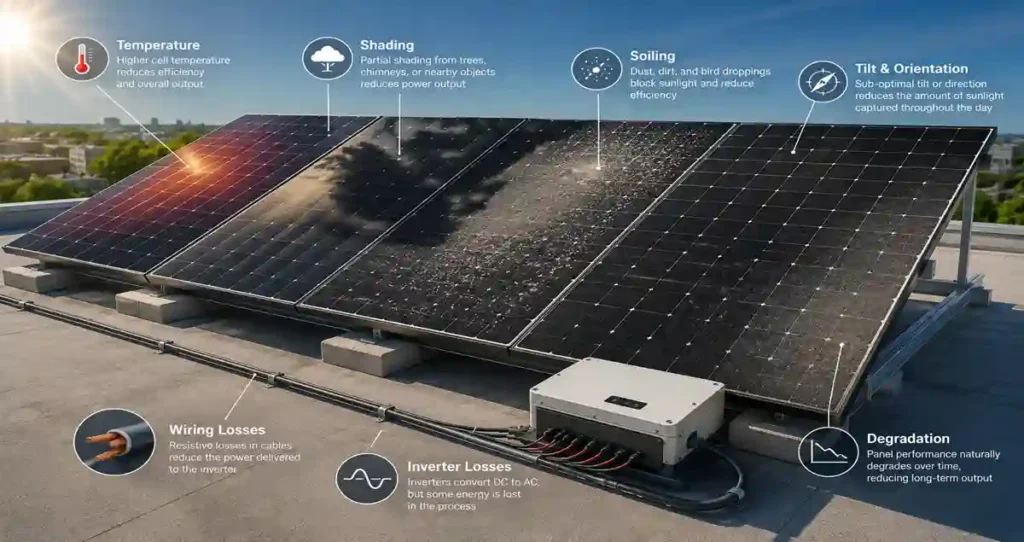
Temperature is the single largest real-world efficiency factor most buyers underestimate — every panel loses output as cell temperature rises above the 25°C lab standard. Shading, dust and soiling, panel angle mismatch, wiring losses, inverter conversion losses, and long-term degradation each chip away at the gap between the datasheet number and what actually reaches your meter.
Field Note: I’ve reviewed system performance data where the client was convinced their panels were underperforming or defective, when the actual culprit was a combination of ordinary factors — mild afternoon shading from a nearby structure, a few degrees of non-optimal tilt, and normal seasonal dust accumulation. None of that indicates a faulty panel. It’s simply the difference between a lab-rated number and the real, messy conditions every rooftop system operates under.
How Solar Panel Efficiency Changes Across Cell Technologies
- PERC Solar Panels — mature technology with lower efficiency than newer N-Type architectures.
- TOPCon Solar Panels — current mainstream high-efficiency technology.
- HJT Solar Panels — strong temperature performance and high efficiency.
- IBC Solar Panels — back-contact architecture designed to maximize active front surface.
- ABC Solar Panels — advanced all-back-contact design focused on high efficiency and aesthetics.
- Half-Cut Solar Panels — reduce current-path losses and can improve module-level performance.
- Monofacial Solar Panels — convert front-side sunlight and remain highly practical for many rooftops.
- Bifacial Solar Panels — can generate additional rear-side energy when installation conditions allow it.
- Zero Busbar Solar Panels — an emerging current-collection approach designed to reduce front-side metalization and shading.
The Full Efficiency Cluster — What Each Guide Covers
- 7 Factors That Kill Solar Panel Efficiency — the complete roundup of real-world efficiency losses
- Solar Panel Temperature Coefficient — including hot-climate performance specifically
- Solar Panel Degradation Rate — how output declines year over year across a 25-year system life
- LID vs LeTID in Solar Panels — two specific early-life degradation mechanisms explained
- STC vs NOCT Solar Panel Ratings — the two standardized test conditions behind every datasheet number
How I Actually Use Efficiency Data in System Design
When I’m sizing a system for a client, efficiency is the starting input, not the final answer. I use it to calculate how many panels fit a given roof area and hit the target system size, then immediately layer in temperature coefficient, expected shading, and degradation projections to arrive at a realistic annual energy yield estimate — a number that’s almost always meaningfully different from what a naive STC-based calculation alone would suggest.
This layered approach is exactly why I built this cluster the way I did, with the main efficiency guide anchoring five deeper technical guides rather than trying to cram every real-world factor into one page. Each factor genuinely deserves its own explanation, and a buyer who reads through the full cluster comes away understanding not just what their panel’s efficiency rating is, but what will actually happen to that number once it’s installed on their specific roof.
Common Misconceptions Worth Clearing Up
People frequently assume the highest-efficiency panel available is automatically the best choice for their project. Efficiency is one input into a system design, not the entire decision — a slightly lower-efficiency panel at meaningfully lower cost can deliver better value on a space-abundant site, and factors like degradation rate, temperature coefficient, and manufacturer reliability often matter more to 25-year total output than the headline STC percentage.
Buying Checklist
- Compare efficiency figures only between panels tested under the same standard (STC is universal, but confirm it’s what’s being quoted)
- Weigh efficiency against cost per watt for your specific roof size, not efficiency in isolation
- Request temperature coefficient and degradation rate figures alongside the headline efficiency number
- Remember efficiency measures the cell’s conversion rate, not your system’s total real-world energy yield
Frequently Asked Questions
What is a good solar panel efficiency rating in 2026?
18-22% is solid mainstream efficiency for monocrystalline panels. Premium TOPCon, HJT, and back-contact panels reach 22-25%+. Below 18% is generally polycrystalline or thin-film territory, appropriate for specific space-abundant or specialty applications rather than space-constrained residential roofs.
Does higher efficiency always mean more total power?
Only per unit of panel area. A higher-efficiency panel produces more watts from the same physical size, but total system output depends on the number of panels installed, not efficiency percentage alone — a larger array of lower-efficiency panels can produce more total power than a smaller array of higher-efficiency ones.
Why does my system underperform its rated efficiency?
Rated efficiency is measured under lab-standard STC conditions that real rooftops rarely match exactly. Temperature above 25°C, shading, dust, non-optimal tilt angle, and wiring/inverter losses all reduce real-world output below the datasheet figure — this is normal and expected, not necessarily a sign of a defective system. If output seems unusually low even accounting for these factors, that’s when a professional inspection becomes worthwhile.
Does a higher-efficiency solar panel perform better in hot weather?
Not necessarily. Temperature coefficient is a separate specification that determines how strongly a panel’s power output changes as cell temperature rises above the STC reference temperature.
Is 25% solar panel efficiency possible?
Yes. Premium back-contact technologies and other advanced photovoltaic architectures can reach or exceed the mid-20% efficiency range, although availability and pricing vary by manufacturer and market.
Does solar panel efficiency decrease over time?
Yes. All photovoltaic modules experience gradual degradation, although the rate varies by cell technology, module construction and manufacturer. The degradation rate should therefore be considered alongside the initial efficiency rating.
Does efficiency matter more on a small roof?
Usually, yes. When roof space is limited, higher-efficiency panels can produce more installed capacity within the available area. On a large roof or ground-mounted site, the cost per watt and overall system economics may matter more.
Which is more important: solar panel efficiency or wattage?
Neither should be considered independently. Wattage tells you the panel’s rated power output, while efficiency tells you how much power it produces relative to its physical area. For a fixed roof area, efficiency becomes particularly important.
References
Efficiency figures across panel categories are drawn from NREL’s Best Research-Cell Efficiency Chart and Fraunhofer ISE’s Photovoltaics Report.
The Full Efficiency Cluster — What Each Guide Covers
- 7 Factors That Kill Solar Panel Efficiency — the complete roundup of real-world efficiency losses
- Solar Panel Temperature Coefficient — including hot-climate performance specifically
- Solar Panel Degradation Rate — how output declines year over year across a 25-year system life
- LID vs LeTID in Solar Panels — two specific early-life degradation mechanisms explained
- STC vs NOCT Solar Panel Ratings — the two standardized test conditions behind every datasheet number
- Solar Panel Efficiency in 2026: What Actually Matters?
Related guides on SolarVisionAI.com
- Monocrystalline Solar Panels 2026: Still Worth It or Hype
- Polycrystalline Solar Panels: Worth Buying in 2026?
- Thin-film Solar Panels: When They Beat Silicon (2026)
- BIPV Solar Panels: Building-Integrated PV Complete Guide
- Portable Solar Panels: Engineer’s Buyer’s Guide 2026
- CPV Solar Panels: Concentrated Photovoltaic Explained
- Skin Solar Panel: What “Solar Skin” Actually Means
- Solar Fence Post Lights: Cap Sizes, Types & Install Guide
- Bifacial Solar Panels in 2026: How to Boost Energy Output
- Solar Charge Controller: The Complete Guide
- MC4 Connectors: Solar Safety & Installation Guide
- Solar Panel Types, Efficiency & Benefits
- Solar Water Pump Guide
- Commercial Solar Panel Installation: Engineering Guide
- Solar Fence Post Lights: Cap Sizes, Types & Install Guide
- BESS — Battery Energy Storage System Guide
- Commercial Solar Panel Installation
- Solar Refrigerator & DC Fridge — Complete 2026 Guide
- Bifacial Solar Panel Albedo Effect Guide
- TOPCon: Why TOPCon Solar Panel is a Proven Smart Investment in 2026
- HJT: Why TOPCon Solar Panel is a Proven Smart Investment in 2026
- PERC: PERC Solar Panel: Still Relevant or Already Outdated?
- Perovskite: Perovskite Solar Panels: The 2026 Reality Check
- N-Type vs P-Type: N-Type vs P-Type Solar Panels: Honest Comparison
- ABC: ABC (all back contact) Solar Panel: Back Contact Technology Explained
- IBC: IBC Solar Panels: Interdigitated Back Contact Guide
- Tandem: Tandem Solar Panels: Are Stacked Cells Ready for Rooftops?